Thank you for visiting SNEWPapers!
Sign up free
Story
May 3, 1850
The Liberator
Boston, Suffolk County, Massachusetts
What is this article about?
The Baltimore Clipper reports on Boston disunionists denouncing Daniel Webster as a traitor at Faneuil Hall for his pro-Union speech, contrasting his patriotism with their fanaticism and hypocrisy on slavery.
Clipping
OCR Quality
98%
Excellent
Full Text
From the Baltimore Clipper.
DENUNCIATION OF DANIEL WEBSTER.
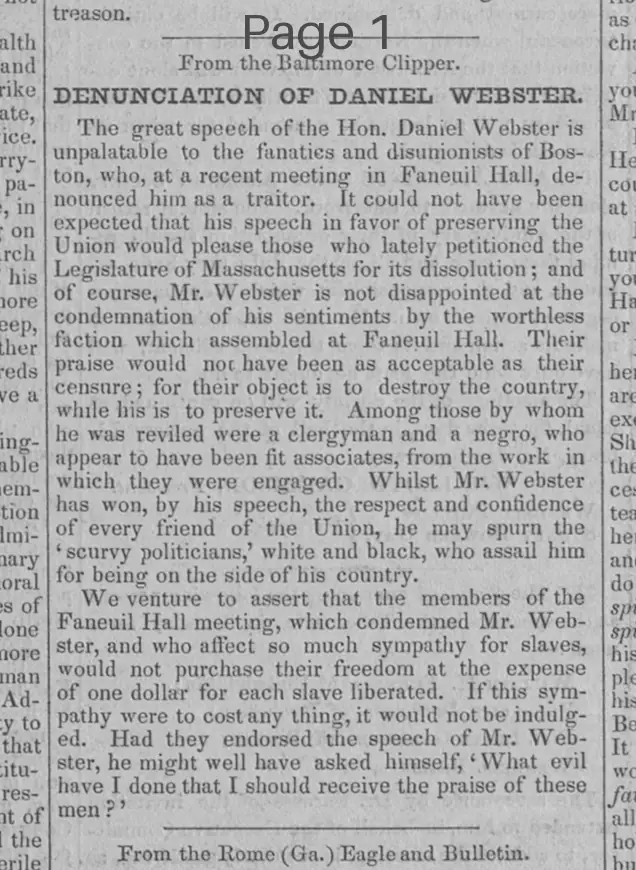
The great speech of the Hon. Daniel Webster is unpalatable to the fanatics and disunionists of Boston, who, at a recent meeting in Faneuil Hall, denounced him as a traitor. It could not have been expected that his speech in favor of preserving the Union would please those who lately petitioned the Legislature of Massachusetts for its dissolution; and of course, Mr. Webster is not disappointed at the condemnation of his sentiments by the worthless faction which assembled at Faneuil Hall. Their praise would not have been as acceptable as their censure; for their object is to destroy the country, while his is to preserve it. Among those by whom he was reviled were a clergyman and a negro, who appear to have been fit associates, from the work in which they were engaged. Whilst Mr. Webster has won, by his speech, the respect and confidence of every friend of the Union, he may spurn the 'scurvy politicians,' white and black, who assail him for being on the side of his country.
We venture to assert that the members of the Faneuil Hall meeting, which condemned Mr. Webster, and who affect so much sympathy for slaves, would not purchase their freedom at the expense of one dollar for each slave liberated. If this sympathy were to cost any thing, it would not be indulged. Had they endorsed the speech of Mr. Webster, he might well have asked himself, 'What evil have I done that I should receive the praise of these men?'
DENUNCIATION OF DANIEL WEBSTER.
The great speech of the Hon. Daniel Webster is unpalatable to the fanatics and disunionists of Boston, who, at a recent meeting in Faneuil Hall, denounced him as a traitor. It could not have been expected that his speech in favor of preserving the Union would please those who lately petitioned the Legislature of Massachusetts for its dissolution; and of course, Mr. Webster is not disappointed at the condemnation of his sentiments by the worthless faction which assembled at Faneuil Hall. Their praise would not have been as acceptable as their censure; for their object is to destroy the country, while his is to preserve it. Among those by whom he was reviled were a clergyman and a negro, who appear to have been fit associates, from the work in which they were engaged. Whilst Mr. Webster has won, by his speech, the respect and confidence of every friend of the Union, he may spurn the 'scurvy politicians,' white and black, who assail him for being on the side of his country.
We venture to assert that the members of the Faneuil Hall meeting, which condemned Mr. Webster, and who affect so much sympathy for slaves, would not purchase their freedom at the expense of one dollar for each slave liberated. If this sympathy were to cost any thing, it would not be indulged. Had they endorsed the speech of Mr. Webster, he might well have asked himself, 'What evil have I done that I should receive the praise of these men?'
What sub-type of article is it?
Historical Event
What themes does it cover?
Moral Virtue
Justice
What keywords are associated?
Daniel Webster
Faneuil Hall
Union Preservation
Disunionists
Boston Meeting
Political Denunciation
What entities or persons were involved?
Daniel Webster
Where did it happen?
Faneuil Hall, Boston
Story Details
Key Persons
Daniel Webster
Location
Faneuil Hall, Boston
Story Details
Boston disunionists at Faneuil Hall denounce Daniel Webster as a traitor for his speech favoring Union preservation, contrasting his patriotism with their destructive aims and hypocritical sympathy for slaves.