Thank you for visiting SNEWPapers!
Sign up free
The Virginia Gazette
Richmond, Williamsburg, Richmond County, Virginia
What is this article about?
A defense of Rev. Samuel Davies' religious poems against published criticisms in the newspaper, emphasizing their moral and poetic value, and refuting specific critiques by citing poets like Milton, Pope, and Addison.
Merged-components note: This is a single continuous letter to the editor defending the poems of Mr. Samuel Davies against criticism; the second part was mislabeled as literary but is a direct continuation indicated by '[To be continued.]'.
Clippings
1 of 2
OCR Quality
Full Text
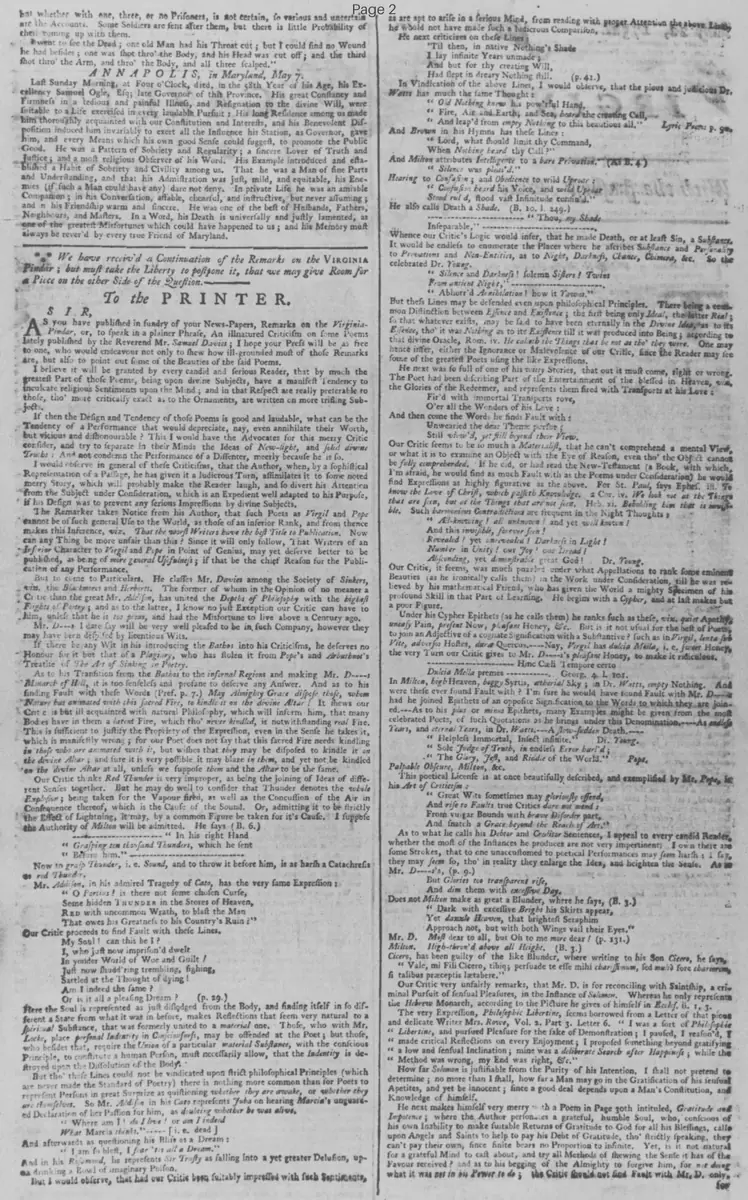
SIR,
As you have published in Sundry of your News-Papers, Remarks on the Virginia-Pindar, or, to speak in a plainer Phrase, An ill-natured Criticism on some Poems lately published by the Reverend Mr. Samuel Davies; I hope your Press will be as free to one, who would endeavour not only to shew how ill-grounded most of those Remarks are, but also to point out some of the Beauties of the said Poems.
I believe it will be granted by every candid and serious Reader, that by much the greatest Part of those Poems, being upon divine Subjects, have a manifest Tendency to inculcate religious Sentiments upon the Mind; and in that Respect are really preferable to those, tho' more critically exact as to the Ornaments, are written on more trifling Subjects.
If then the Design and Tendency of those Poems is good and laudable, what can be the Tendency of a Performance that would depreciate, nay, even annihilate their Worth, but vicious and dishonourable? This I would have the Advocates for this merry Critic consider, and try to separate in their Minds the Ideas of New-light, and wicked divine Truths: And not condemn the Performance of a Dissenter, meerly because he is so.
I would observe in general of these Criticisms, that the Author, when, by a sophistical Representation of a Passage, he has given it a ludicrous Turn, assimilates it to some noted merry Story, which will probably make the Reader laugh, and so divert his Attention from the Subject under Consideration, which is an Expedient well adapted to his Purpose, if his Design was to prevent any serious Impressions by divine Subjects.
The Remarker takes Notice from his Author, that such Poets as Virgil and Pope cannot be of such general Use to the World, as those of an inferior Rank, and from thence makes this Inference, viz. That the worse Writers have the best Title to Publication. Now can any Thing be more unfair than thus? Since it will only follow, That Writers of an Inferior Character to Virgil and Pope in Point of Genius, may yet deserve better to be published, as being of more general Usefulness; if that be the chief Reason for the Publication of any Performance.
But to come to Particulars. He classes Mr. Davies among the Society of Sinkers, viz. the Blackmores and Herberts. The former of whom in the Opinion of no meaner a Critic than the great Mr. Addison, has united the Depths of Philosophy with the highest Flights of Poetry; and as to the latter, I know no just Exception our Critic can have to him, unless that he is too pious, and had the Misfortune to live above a Century ago.
Mr. D---s I dare say will be very well pleased to be in such Company, however they may have been def cried by licentious Wits.
If there be any Wit in his introducing the Bathos into his Criticisms, he deserves no Honour for it but that of a Plagiary, who has stolen it from Pope's and Arbuthnot's Treatise of The Art of Sinking in Poetry.
As to his Transition from the Bathos to the infernal Regions and making Mr. D---s Monarch of Hell, it is too senseless and profane to deserve any Answer. And as to his finding Fault with these Words (Pref. p. 7.) May Almighty Grace disperse those, whom Nature has animated with this sacred Fire, to kindle it on the divine Altar! It shews our Critic is but ill acquainted with natural Philosophy, which will inform him, that many Bodies have in them a latent Fire, which tho' never kindled, is notwithstanding real Fire.
This is sufficient to justify the Propriety of the Expression, even in the Sense he takes it, which is manifestly wrong; for our Poet does not say that this sacred Fire needs kindling in those who are animated with it, but wishes that they may be disposed to kindle it on the divine Altar; and sure it is very possible it may blaze in them, and yet not be kindled on the divine Altar at all, unless we suppose them and the Altar to be the same.
Our Critic thinks Red Thunder is very improper, as being the joining of Ideas of different Senses together. But he may do well to consider that Thunder denotes the noble Explosion; being taken for the Vapour fired, as well as the Concussion of the Air in Consequence thereof, which is the Cause of the Sound. Or, admitting it to be strictly the Effect of Lightning, it may, by a common Figure be taken for it's Cause. I suppose the Authority of Milton will be admitted. He says (B. 6.)
"In his right Hand
Grasping ten thousand Thunders, which he sent
Before him."
Now to grasp Thunder, i. e. Sound, and to throw it before him, is as harsh a Catachresis on red Thunder.
Mr. Addison, in his admired Tragedy of Cato, has the very same Expression;
"O Portius! is there not some chosen Curse,
Some hidden Thunder in the Stores of Heaven,
Rip with uncommon Wrath, to blast the Man
That owes his Greatness to his Country's Ruin?"
Our Critic proceeds to find Fault with these Lines.
My Soul! can this be I?
I, who just now imprison'd dwelt
In yonder World of Woe and Guilt!
Just now shudd'ring trembling, sighing,
Startled at the Thought of dying!
Am I indeed the same?
Or is it all a pleasing Dream?
(p. 29.)
Here the Soul is represented as just dislodged from the Body, and finding itself in so different a State from what it was in before, makes Reflections that seem very natural to a spiritual Substance, that was formerly united to a material one. Those, who with Mr. Locke, place personal Identity in Consciousness, may be offended at the Poet; but those, who besides that, require the Union of a particular material Substance, with the conscious Principle, to constitute a human Person, must necessarily allow, that the Identity is destroyed at the Dissolution of the Body.
But tho' these Lines could not be vindicated upon strict philosophical Principles (which are never made the Standard of Poetry) there is nothing more common than for Poets to represent Persons in great Surprize as questioning whether they are awake, or whether they are themselves. So Mr. Addison in his Cato represents Juba on hearing Marcia's unguarded Declaration of her Passion for him, as doubting whether he was alive.
"Where am I? do I sleep! or am I indeed
What Marcia thinks."...-[i. e. dead]
And afterwards as questioning his Bliss as a Dream:
"I am so blest, I fear 'tis all a Dream."
And in his Remnant, he represents Sir Trusty as falling into a yet greater Delusion, upon drinking a Bowl of imaginary Poison.
But I would observe, that had our Critic been suitably impressed with such Sentiments as are apt to arise in a serious Mind, from reading with proper Attention the above Lines he would not have made such a ludicrous Comparison.
He next criticizes on these Lines
Til then, in native Nothing's Shade
I lay infinite Years unmade;
And but for thy creating Will,
Had slept in dreary Nothing still.
(p.41.)
In Vindication of the above Lines, I would observe, that the pious and judicious Dr. Watts has much the same Thought:
"Of Nothing know'n pow'rful Hand,
Fire, Air and Earth, and Sea, heard the creating Call,
And leap'd from empty Nothing to this beauteous all.…"
Lyric Psalms p. 90
And Brown in his Hymns has these Lines:
"Lord, what should limit thy Command,
When Nothing heard thy Call?"
And Milton attributes Intelligence to a bare Privation. (B.4)
"Silence was pleas'd."
Hearing to Confusion; and Obedience to wild Uproar:
"Confusion heard his Voice, and wild Uproar
Stood rul'd, stood vast Infinitude confin'd."
He also calls Death a Shade. (B. 10. l. 249.)
"Thou, my Shade
Inseparable,"
Whence our Critic's Logic would infer, that he made Death, or at least Sin, a Substance.
It would be endless to enumerate the Places where he ascribes Substance and Personality to Privation and Non-Entities, as to Night, Darkness, Chance, Chimera, &c. So the celebrated Dr. Young.
"Silence and Darkness! Solemn Sisters! Twins
From antient Night,
Abhorr'd Annihilation! how it yawns."
But these Lines may be defended even upon philosophical Principles. There being a common Distinction between Essence and Existence; the first being only Ideal, the latter Real; so that whatever exists, may be said to have been eternally in the Divine Idea, as to its Essence, tho'it was Nothing as to its Existence till it was produced into Being; according to that divine Oracle, Rom. iv. He calleth the Things that be not as tho' they were. One may hence infer, either the Ignorance or Malevolence of our Critic, since the Reader may see some of the greatest Poets using the like Expressions.
He next was so full of one of his merry Stories, that out it must come, right or wrong.
The Poet had been describing Part of the Entertainment of the Blessed in Heaven, viz. the Glories of the Redeemer, and represents them fired with Transports at his Love:
Fir'd with immortal Transports rove,
O'er all the Wonders of his Love:
And then come the Words he finds Fault with:
Unwearied the dear Theme pursue;
Still glow'd, yet still beyond their View.
Our Critic seems to be so much a Materialist, that he can't comprehend a mental View or what it is to examine an Object with the Eye of Reason, even tho'the Object cannot be fully comprehended. If he did, or had read the New-Testament (a Book, with which, I'm afraid, he would find as much Fault with as the Poems under Consideration) he would find Expressions as highly figurative as the above. For St. Paul, says Ephes. iii. To know the Love of Christ, which passeth Knowledge. 2 Cor. iv. We look not at the Things that are seen, but at the Things that are not seen. Heb. xi. Beholding him that is invisible. Such harmonicus Contradictions are frequent in the Night Thoughts:
"All-knowing! all unknown! and yet well known!
And this invisible, forever seen!
Revealed! yet unrevealed! Darkness in Light!
Number in Unity! our Foe! our Friend!
According, yet ademonstrable great God! Dr. Young."
Our Critic, it seems, was much puzzled under what Appellations to rank some eminent Beauties (as he ironically calls them) in the Work under Consideration, till he was relieved by his mathematical Friend, who has given the World a mighty Specimen of his profound Skill in that Part of Learning. He begins with a Cipher, and at last makes but a poor Figure.
Under his Cypher Epithets (as he calls them) he ranks such as these, viz. greater Apathy, uneasy Pain, present Now, saar Honey, &c.. But is it not usual for the best of Poets, to join an Adjective of a cognate Signification with a Substantive? Such as in Virgil, lenta Vite, adversos Hotes, dura Quercus. ----Nay, Virgil has dulcia Mella, i. e. sweet Honey. the very Turn our Critic gives to Mr. D---s's pleasant Honey, to make it ridiculous.
..Hinc Cali Tempore certo
Dulcia Mella premes
Georg. 4. l. 101.
In Milton, high Heaven, boggy Syrtis, thereial Sky; in Dr. Watts, empty Nothing. And were these ever found Fault with? I'm sure he would have found Fault with Mr. D-- had he joined Epithets of an opposite Signification to the Words to which they are joined.-o-As to his plus or minus Epithets, many Examples might be given from the most celebrated Poets, of such Quotations as he brings under this Denomination,-er-As endless Years, and eternal Years, in Dr. Watts.---A now-sudden Death. --o-
"Helpless Immortal, Inectinfinite."
Di. Young.
"Sole Judge of Truth, in endless Error hurl'd;
The Glory, Fear and Riddle of the World."
Pope.
Palpable Obscure, Milton, &c.
This poetical License is at once beautifully described, and exemplified by Mr. Pope, in his Art of Criticism:
"Great Wits Sometimes may gloriously offend,
And rise to Faults true Critics dare not mend:
From vulgar Bounds with brave Disorder part,
And snatch a Grace beyond the Reach of Art."
As to what he calls his Debtor and Creditor Sentences, I appeal to every candid Reader whether the most of the Instances he produces are not very impertinent, I own there are some Strokes, that to one unaccustomed to poetical Performances may seem harsh: I say they may seem so, tho' in reality they enlarge the Idea, and heighten the Sense. As Mr. D----s's, (p. 9.)
But Glories too transparent rise,
And dim them with excessive Day.
Does not Milton make as great a Blunder, where he says, (B. 3.)
"Dark with excessive Bright his Skirts appear,
Yet dazzle Heaven, that brightest Seraphim
Approach not, but with both Wings veil their Eyes."
Mr. D. Most dear to all, but Oh to me more dear! (p. 131.)
Milton. High-thron'd above all Height. (B. 3.)
Cicero, has been guilty of the like Blunder, where writing to his Son Cicero, he says
"Vale, mi Fili Cicero, tibiq; persuade te esse mihi chariimum, et multo fore chariorem italibus praeceptis latabere."
Our Critic very unfairly remarks, that Mr. D. is for reconciling with Saintship, a criminal Pursuit of Sensual Pleasures, in the Instance of Solomon. Whereas he only represents the Hebrew Monarch, according to the Picture he gives of himself in Eccl. i. 1, 3.
The very Expression, Philosophic Libertine, seems borrowed from a Letter of that pious and delicate Writer Mrs. Rowe, Vol. 2. Part 3. Letter 6. "I was a sort of Philosophic
Libertine, and pursued Pleasure for the sake of Demonstration; I paused, I reasoned, I
made critical Reflections on every Enjoyment; I proposed something beyond gratifying
a low and sensual Inclination; mine was a deliberate Search after Happiness; while the
Method was wrong, my End was right, &c."
How far Solomon is justifiable from the Purity of his Intention, I shall not pretend to determine; no more than I shall, how far a Man may go in the Gratification of his sensual Appetites, and yet be innocent; since a good deal depends upon a Man's Constitution, and Knowledge of himself.
He next makes himself very merry with a Poem in Page 20th intituled, Gratitude and Impotence; where the Author personates a grateful, humble Soul, who, 'conscious of his own Inability to make suitable Returns of Gratitude to God for all his Blessings, calls upon Angels and Saints to help to pay his Debt of Gratitude, tho' strictly speaking, they can't pay their own, since finite bears no Proportion to infinite. Yet, is it not natural for a grateful Mind to cast about, and try all Methods of shewing the Sense it has of the Favour received? and as to his begging of the Almighty to forgive him, for not doing what it was not in his Power to do; tho' Critic's honour'd act find Fault with a Mr. D. only.
Sir, this as it is a Doctrine universally held by the Calvinists, viz. That Mankind are justly punishable for not doing what is not in their Power to do; since they lost in Adam the Power of performing the divine Will, and God was not obliged either to abrogate his Law, or to confer new Powers upon them, who thus sinned in their first Parent. He calls them, as there is perhaps some Ground for his Reflections, so I would observe, As to the Remainder of his Criticism upon the Pindaric Strains, and smooth Lines, as that, if one was to examine merely the Consonance of their final Syllables, no Poet that ever wrote would escape Censure. Let the following Instances out of Some of our best Poets suffice.
"I leave the Art of Poetry and Verse
To those that Practice them with more Success."
Addison.
"As th' eternal Art educing good from ill,
Grafts on his Passion's our best Principle."
Pope's Essay on Man.
"Their full-fed Heroes, their pacific Mayors,
Their annual Trophies, and their monthly Wars."
Pope's Dunciad.
"Our Life contains a thousand Springs,
And dies if one be gone;
Strange that a Harp of thousand Strings
Should keep in Tune so long."
Dr. Watts.
I therefore look upon this Part of the Criticism to be so mean, and to shew so much of a cavilling Temper, that I believe few candid Readers will thank him for so poor an Entertaintment.
[To be continued.]
What sub-type of article is it?
What themes does it cover?
What keywords are associated?
What entities or persons were involved?
Letter to Editor Details
Recipient
The Printer
Main Argument
the criticisms of rev. samuel davies' poems are ill-grounded and unfair; the poems promote valuable religious sentiments and employ legitimate poetic techniques, as evidenced by parallels in works by milton, pope, addison, and others.
Notable Details