Thank you for visiting SNEWPapers!
Sign up free
Editorial
September 29, 1961
Newport Navalog
Newport, Newport County, Rhode Island
What is this article about?
A photo caption describes U.S. artillery practice in West Berlin amid the 1961 crisis. The editorial praises the calm, resolute American response to Communist threats in Berlin, contrasting it with the Age of Anxiety and highlighting military confidence.
Merged-components note: Image and caption on Berlin artillery practice illustrate the 'A Cool View Is Best In Anxiety Age' editorial on the Berlin crisis; merge into single editorial component.
Clipping
OCR Quality
92%
Excellent
Full Text
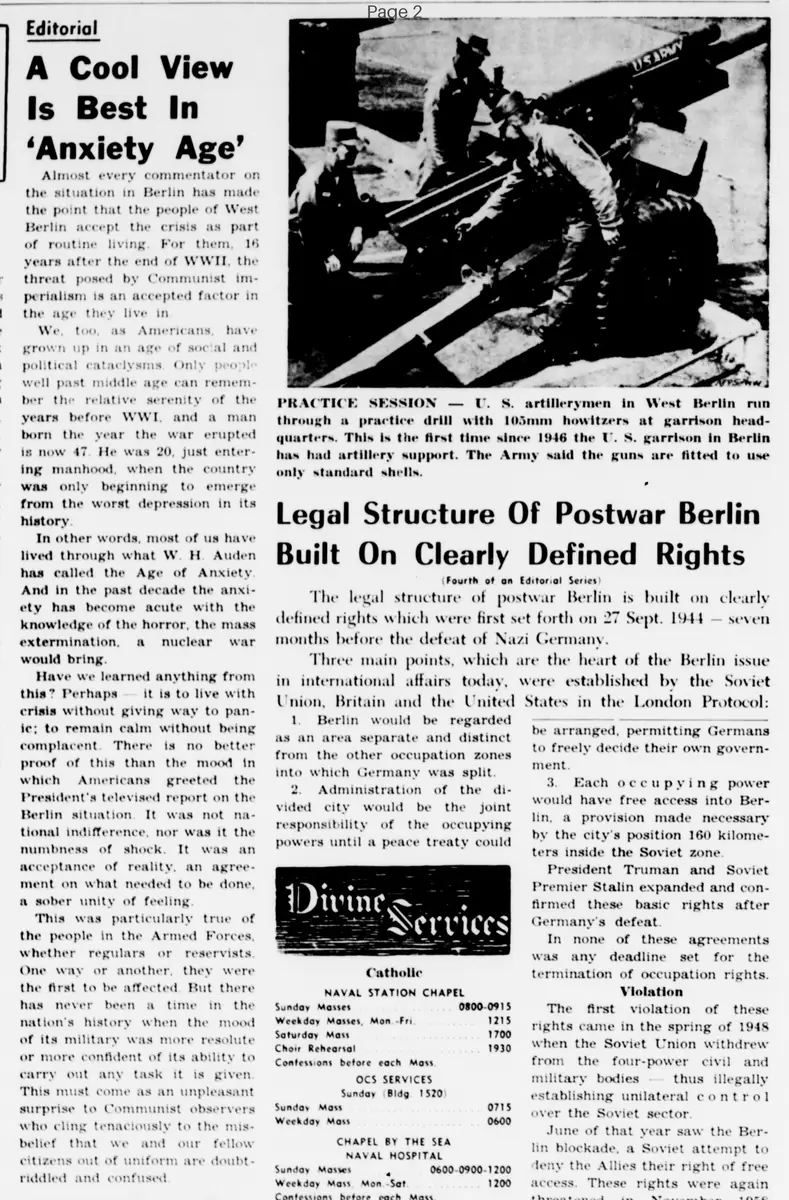
PRACTICE SESSION
U. S. artillerymen in West Berlin run through a practice drill with 105mm howitzers at garrison headquarters. This is the first time since 1946 the U. S. garrison in Berlin has had artillery support. The Army said the guns are fitted to use only standard shells.
A Cool View Is Best In Anxiety Age
Almost every commentator on the situation in Berlin has made the point that the people of West Berlin accept the crisis as part of routine living. For them, 16 years after the end of WWII, the threat posed by Communist imperialism is an accepted factor in the age they live in.
We, too, as Americans, have grown up in an age of social and political cataclysms. Only people well past middle age can remember the relative serenity of the years before WWI, and a man born the year the war erupted is now 47. He was 20, just entering manhood, when the country was only beginning to emerge from the worst depression in its history.
In other words, most of us have lived through what W. H. Auden has called the Age of Anxiety. And in the past decade the anxiety has become acute with the knowledge of the horror, the mass extermination, a nuclear war would bring.
Have we learned anything from this? Perhaps it is to live with crisis without giving way to panic; to remain calm without being complacent. There is no better proof of this than the mood in which Americans greeted the President's televised report on the Berlin situation. It was not national indifference, nor was it the numbness of shock. It was an acceptance of reality, an agreement on what needed to be done, a sober unity of feeling.
This was particularly true of the people in the Armed Forces, whether regulars or reservists. One way or another, they were the first to be affected. But there has never been a time in the nation's history when the mood of its military was more resolute or more confident of its ability to carry out any task it is given.
This must come as an unpleasant surprise to Communist observers who cling tenaciously to the misbelief that we and our fellow citizens out of uniform are doubt-riddled and confused.
U. S. artillerymen in West Berlin run through a practice drill with 105mm howitzers at garrison headquarters. This is the first time since 1946 the U. S. garrison in Berlin has had artillery support. The Army said the guns are fitted to use only standard shells.
A Cool View Is Best In Anxiety Age
Almost every commentator on the situation in Berlin has made the point that the people of West Berlin accept the crisis as part of routine living. For them, 16 years after the end of WWII, the threat posed by Communist imperialism is an accepted factor in the age they live in.
We, too, as Americans, have grown up in an age of social and political cataclysms. Only people well past middle age can remember the relative serenity of the years before WWI, and a man born the year the war erupted is now 47. He was 20, just entering manhood, when the country was only beginning to emerge from the worst depression in its history.
In other words, most of us have lived through what W. H. Auden has called the Age of Anxiety. And in the past decade the anxiety has become acute with the knowledge of the horror, the mass extermination, a nuclear war would bring.
Have we learned anything from this? Perhaps it is to live with crisis without giving way to panic; to remain calm without being complacent. There is no better proof of this than the mood in which Americans greeted the President's televised report on the Berlin situation. It was not national indifference, nor was it the numbness of shock. It was an acceptance of reality, an agreement on what needed to be done, a sober unity of feeling.
This was particularly true of the people in the Armed Forces, whether regulars or reservists. One way or another, they were the first to be affected. But there has never been a time in the nation's history when the mood of its military was more resolute or more confident of its ability to carry out any task it is given.
This must come as an unpleasant surprise to Communist observers who cling tenaciously to the misbelief that we and our fellow citizens out of uniform are doubt-riddled and confused.
What sub-type of article is it?
Foreign Affairs
Military Affairs
War Or Peace
What keywords are associated?
Berlin Crisis
Communist Imperialism
Age Of Anxiety
American Resolve
Military Confidence
What entities or persons were involved?
West Berlin
Communists
President
Armed Forces
W. H. Auden
Editorial Details
Primary Topic
American Calm And Resolve In Berlin Crisis
Stance / Tone
Supportive Of Resolute, Non Panicked Response To Communist Threat
Key Figures
West Berlin
Communists
President
Armed Forces
W. H. Auden
Key Arguments
West Berliners Accept Crisis Routinely
Americans Live In Age Of Anxiety But Respond Calmly
Military Mood Is Resolute And Confident
Communists Misjudge American Unity