Thank you for visiting SNEWPapers!
Sign up free
The New Hampshire Gazette
Portsmouth, Rockingham County, New Hampshire
What is this article about?
A reader submits an essay to the printer defining courage as clear-headed duty in danger and cowardice as its opposite. It urges Britain to reward military bravery with merit-based honors and promotions, abolish strict seniority, and punish cowardice to strengthen defenses amid European wars in 1756. References Greek, Roman, and recent examples.
Merged-components note: The second component continues directly from the first, forming a single essay submitted as a letter to the editor; relabel editorial to letter_to_editor for coherence.
Clippings
1 of 2
OCR Quality
Full Text
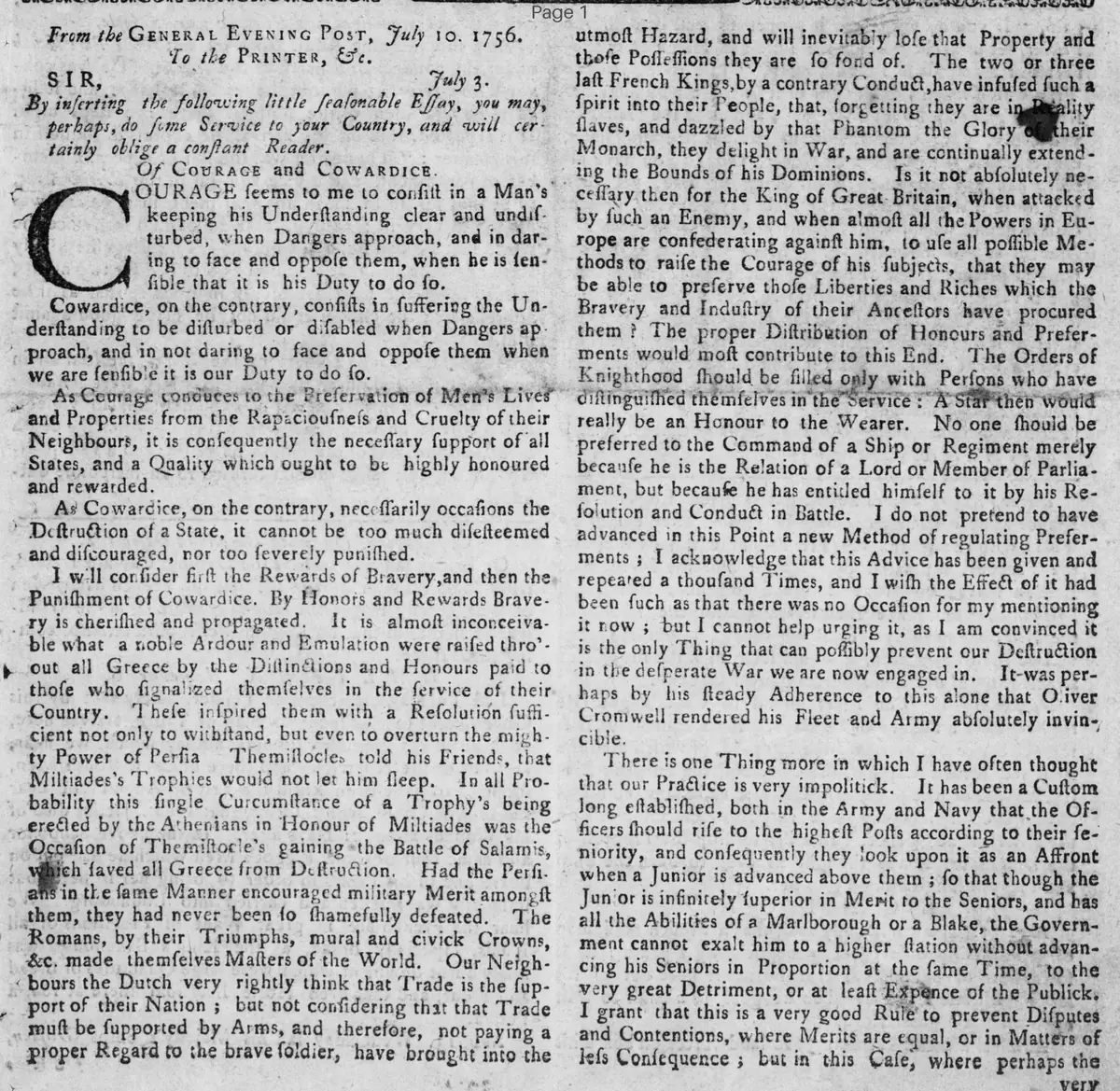
To the Printer, &c.
SIR,
July 3.
By inserting the following little seasonable Essay, you may, perhaps, do some Service to your Country, and will certainly oblige a constant Reader.
Of Courage and Cowardice.
COURAGE seems to me to consist in a Man's keeping his Understanding clear and undisturbed, when Dangers approach, and in daring to face and oppose them, when he is sensible that it is his Duty to do so.
Cowardice, on the contrary, consists in suffering the Understanding to be disturbed or disabled when Dangers approach, and in not daring to face and oppose them when we are sensible it is our Duty to do so.
As Courage conduces to the Preservation of Men's Lives and Properties from the Rapaciousness and Cruelty of their Neighbours, it is consequently the necessary support of all States, and a Quality which ought to be highly honoured and rewarded.
As Cowardice, on the contrary, necessarily occasions the Destruction of a State, it cannot be too much disesteemed and discouraged, nor too severely punished.
I will consider first the Rewards of Bravery, and then the Punishment of Cowardice. By Honors and Rewards Bravery is cherished and propagated.
It is almost inconceivable what a noble Ardour and Emulation were raised thro'-out all Greece by the Distinctions and Honours paid to those who signalized themselves in the service of their Country.
These inspired them with a Resolution sufficient not only to withstand, but even to overturn the mighty Power of Persia. Themistocles told his Friends, that Miltiades's Trophies would not let him sleep. In all Probability this single Circumstance of a Trophy's being erected by the Athenians in Honour of Miltiades was the Occasion of Themistocles's gaining the Battle of Salamis, which saved all Greece from Destruction.
Had the Persians in the same Manner encouraged military Merit amongst them, they had never been so shamefully defeated. The Romans, by their Triumphs, mural and civic Crowns, &c. made themselves Masters of the World. Our Neighbours the Dutch very rightly think that Trade is the support of their Nation; but not considering that that Trade must be supported by Arms, and therefore, not paying a proper Regard to the brave Soldier, have brought into the utmost Hazard, and will inevitably lose that Property and those Possessions they are so fond of. The two or three last French Kings, by a contrary Conduct, have infused such a Spirit into their People, that, forgetting they are in Reality slaves, and dazzled by that Phantom the Glory of their Monarch, they delight in War, and are continually extending the Bounds of his Dominions. Is it not absolutely necessary then for the King of Great Britain, when attacked by such an Enemy, and when almost all the Powers in Europe are confederating against him, to use all possible Methods to raise the Courage of his Subjects, that they may be able to preserve those Liberties and Riches which the Bravery and Industry of their Ancestors have procured them? The proper Distribution of Honours and Preferments would most contribute to this End.
The Orders of Knighthood should be filled only with Persons who have distinguished themselves in the Service: A Star then would really be an Honour to the Wearer. No one should be preferred to the Command of a Ship or Regiment merely because he is the Relation of a Lord or Member of Parliament, but because he has entitled himself to it by his Resolution and Conduct in Battle. I do not pretend to have advanced in this Point a new Method of regulating Preferments; I acknowledge that this Advice has been given and repeated a thousand Times, and I wish the Effect of it had been such as that there was no Occasion for my mentioning it now; but I cannot help urging it, as I am convinced it is the only Thing that can possibly prevent our Destruction in the desperate War we are now engaged in. It was perhaps by his steady Adherence to this alone that Oliver Cromwell rendered his Fleet and Army absolutely invincible.
There is one Thing more in which I have often thought that our Practice is very impolitic. It has been a Custom long established, both in the Army and Navy that the Officers should rise to the highest Posts according to their Seniority, and consequently they look upon it as an Affront when a Junior is advanced above them; so that though the Junior is infinitely superior in Merit to the Seniors, and has all the Abilities of a Marlborough or a Blake, the Government cannot exalt him to a higher Station without advancing his Seniors in Proportion at the Same Time, to the very great Detriment, or at least Expence of the Publick.
I grant that this is a very good Rule to prevent Disputes and Contentions, where Merits are equal, or in Matters of less Consequence; but in this Case, where perhaps the
Every Being of a State is concerned, which often depends upon the Conduct of a General or Admiral, I cannot help thinking that this Custom ought to be abolished. If the Advancement of these seniors does not prove the absolute Ruin of a State, it may however be extremely prejudicial to it. We send our Fleets and Armies under each of these seniors successively: They are destroyed by their Want of skill or Courage, or, at best, the necessary service is not performed, till the Junior succeeding to the Command in his Turn, rescues us from the Jaws of Destruction. So that should some of these old Captains say, "We have not had Opportunities of signalizing ourselves in our present Stations; advance us, and then make Trial of our Abilities;" If it depended upon me I should answer, "The Publick would run too great a Risk." Should they say again, "If you do not think it proper to trust us with the Power, let us at least enjoy the Title and Half pay of Generals or Admirals;" I should reply, "The giving you the Title would lessen the Honour of it to those who have deservedly gained it by their Actions; and as to the Half Pay you desire, your Country, in its present Circumstances, cannot afford it you; but however, though you have already had pay long enough for doing nothing, yet when you retire it will give you the Half Pay of your present Commissions, which will support you in as handsome a Manner as you ought to live." Many Officers, as Things stand at present, think of nothing but enjoying their Pay, and never care to enter upon service, knowing that if they live long enough they will be superior Officers of course; whereas if there was an Alteration in this Respect, it is incredible what an Emulation it would excite, what an Eagerness to go upon Action, and how many noble Actions would be performed.
[The Remainder concerning the Punishment of Cowardice must be deferred to the next Paper]
What sub-type of article is it?
What themes does it cover?
What keywords are associated?
What entities or persons were involved?
Letter to Editor Details
Author
A Constant Reader
Recipient
The Printer
Main Argument
courage is essential for preserving states and should be rewarded with merit-based honors and promotions in the military, while cowardice must be punished; britain must reform its army and navy practices, including abolishing strict seniority, to succeed in the current war against european powers.
Notable Details