Thank you for visiting SNEWPapers!
Sign up free
The National Intelligencer And Washington Advertiser
Washington, District Of Columbia
What is this article about?
Congressional committee report on Captain Alexander Murray's claim for relief from damages awarded against him for recapturing the American schooner Charming Betty (formerly Jane) from French privateers near Guadaloupe in July 1800, involving naval actions, court proceedings up to the Supreme Court, and executive instructions during the Quasi-War with France.
Clipping
OCR Quality
Full Text
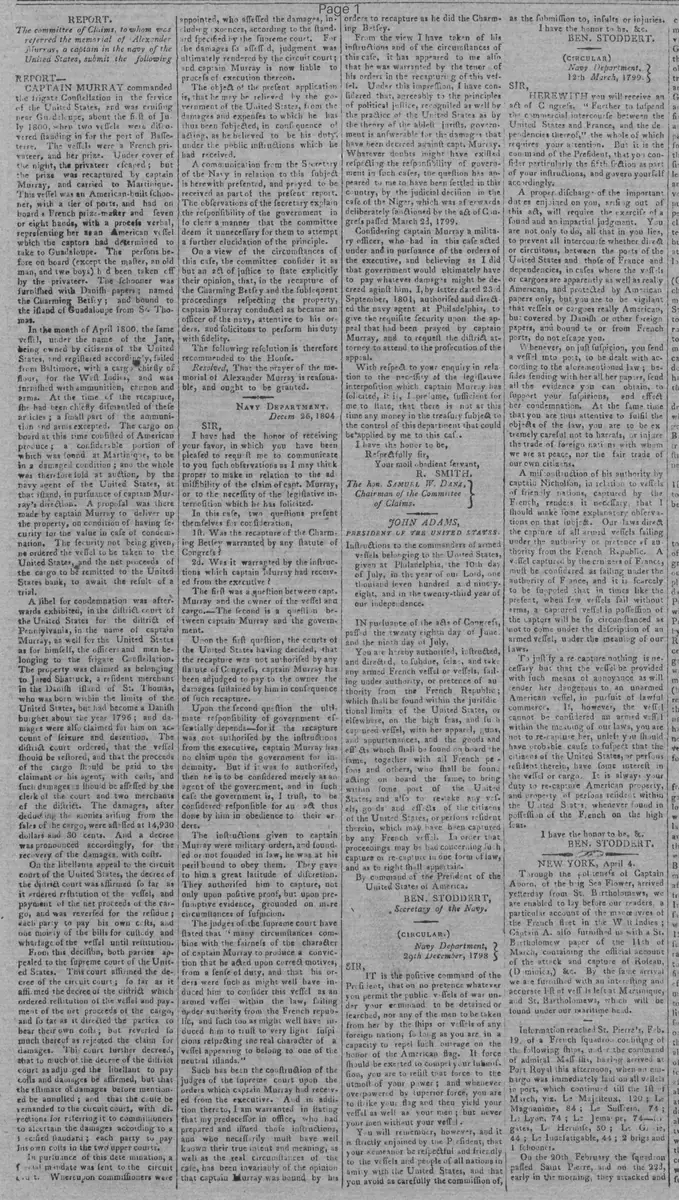
The committee of Claims, to whom was referred the memorial of Alexander Murray, a captain in the navy of the United States, submit the following REPORT.
CAPTAIN MURRAY commanded the frigate Constellation in the service of the United States, and was cruising near Guadaloupe, about the 1st of July 1800, when two vessels were discovered standing in for the port of Basseterre. The vessels were a French privateer, and her prize. Under cover of the night, the privateer escaped; but the prize was recaptured by captain Murray, and carried to Martinique.
This vessel was an American-built schooner, with a tier of ports, and had on board a French prize-master and seven or eight hands, with a proces verbal, representing her as an American vessel which the captors had determined to take to Guadaloupe. The persons before on board (except the master, an old man, and two boys) had been taken off by the privateer. The schooner was furnished with Danish papers; named the Charming Betty; and bound to the island of Guadaloupe from St. Thomas.
In the month of April 1800, the same vessel, under the name of the Jane, being owned by citizens of the United States, and registered accordingly, sailed from Baltimore, with a cargo chiefly of flour, for the West Indies, and was furnished with ammunition, cannon and arms. At the time of the recapture, she had been chiefly dismantled of these articles; a small part of the ammunition and arms excepted. The cargo on board at this time consisted of American produce; a considerable portion of which was found, at Martinique, to be in a damaged condition; and the whole was therefore sold at auction, by the navy agent of the United States, at that island, in pursuance of captain Murray's direction. A proposal was there made by captain Murray to deliver up the property, on condition of having security for the value in case of condemnation. The security not being given, he ordered the vessel to be taken to the United States, and the net proceeds of the cargo to be remitted to the United States bank, to await the result of a trial.
A libel for condemnation was afterwards exhibited, in the district court of the United States for the district of Pennsylvania, in the name of captain Murray, as well for the United States as for himself, the officers and men belonging to the frigate Constellation. The property was claimed as belonging to Jared Shattuck, a resident merchant in the Danish island of St. Thomas, who was born within the limits of the United States, but had become a Danish burgher about the year 1796; and damages were also claimed for him on account of seizure and detention. The district court ordered, that the vessel should be restored, and that the proceeds of the cargo should be paid to the claimant or his agent, with costs, and such damages as should be assessed by the clerk of the court and two merchants of the district. The damages, after deducting the monies arising from the sales of the cargo, were assessed at 14,930 dollars and 30 cents. And a decree was pronounced accordingly, for the recovery of the damages, with costs.
On the libellants appeal to the circuit court of the United States, the decree of the district court was affirmed so far as it ordered restitution of the vessel, and payment of the net proceeds of the cargo, and was reversed for the residue; each party to pay his own costs, and one moiety of the bills for custody and wharfage of the vessel until restitution. From this decision, both parties appealed to the supreme court of the United States. This court affirmed the decree of the circuit court: so far as it affirmed the decree of the district which ordered restitution of the vessel and payment of the net proceeds of the cargo, and so far as it directed the parties to bear their own costs; but reversed so much thereof as rejected the claim for damages. This Court further decreed, that so much of the decree of the district court as adjudged the libellant to pay costs and damages be affirmed, but that the estimate of damages before mentioned be annulled; and that the cause be remanded to the circuit court, with directions for referring it to commissioners to ascertain the damages according to a revised standard; each party to pay his own costs in the two upper courts.
In pursuance of this determination, a peremptory mandate was sent to the circuit court. Whereupon commissioners were appointed, who assessed the damages, including expenses, according to the standard specified by the supreme court. For the damages assessed, judgment was ultimately rendered by the circuit court; and captain Murray is now liable to process of execution thereon.
The object of the present application is, that he may be relieved by the government of the United States, from the damages and expenses to which he has thus been subjected, in consequence of acting, as he believed to be his duty, under the public instructions which he had received.
A communication from the Secretary of the Navy in relation to this subject is herewith presented, and prayed to be received as part of the present report.
The observations of the Secretary explain the responsibility of the government in so clear a manner that the committee deem it unnecessary for them to attempt a further elucidation of the principle.
On a view of the circumstances of this case, the committee consider it as but an act of justice to state explicitly their opinion, that, in the recapture of the Charming Betty and the subsequent proceedings respecting the property, captain Murray conducted as became an officer of the navy, attentive to his orders, and solicitous to perform his duty with fidelity.
The following resolution is therefore recommended to the House.
Resolved, That the prayer of the memorial of Alexander Murray is reasonable, and ought to be granted.
NAVY DEPARTMENT.
December 26, 1804.
SIR,
I have had the honor of receiving your favor, in which you have been pleased to request me to communicate to you such observations as I may think proper to make in relation to the admissibility of the claim of Capt. Murray, or to the necessity of the legislative interposition which he has solicited.
In this case, two questions present themselves for consideration.
1st. Was the recapture of the Charming Betty warranted by any statute of Congress?
2d. Was it warranted by the instructions which captain Murray had received from the executive?
The first was a question between Capt. Murray and the owner of the vessel and cargo. The second is a question between captain Murray and the government.
Upon the first question, the courts of the United States having decided, that the recapture was not authorized by any statute of Congress, Captain Murray has been adjudged to pay to the owner the damages sustained by him in consequence of such recapture.
Upon the second question the ultimate responsibility of government essentially depends—for if the recapture was not authorized by the instructions from the executive, captain Murray has no claim upon the government for indemnity. But if it was so authorized, then he is to be considered merely as an agent of the government, and in such case the government is, I trust, to be considered responsible for an act thus done by him in obedience to their orders.
The instructions given to captain Murray were military orders, and founded or not founded in law, he was at his peril bound to obey them. They gave to him a great latitude of discretion. They authorized him to capture, not only upon positive proof, but upon presumptive evidence, grounded on mere circumstances of suspicion.
The judges of the supreme court have stated that 'many circumstances combine with the fairness of the character of captain Murray to produce a conviction that he acted upon correct motives, from a sense of duty, and that his orders were such as might well have induced him to consider this vessel as an armed vessel within the law, sailing under authority from the French republic, and such too as might well have induced him to trust to very light suspicions respecting the real character of a vessel appearing to belong to one of the neutral islands.'
Such has been the construction of the judges of the supreme court upon the orders which captain Murray had received from the executive. And in addition thereto, I am warranted in stating that my predecessor in office, who had prepared and issued those instructions, and who necessarily must have well known their true intent and meaning, as well as the real circumstances of the case, has been invariably of the opinion that captain Murray was bound by his orders to recapture as he did the Charming Betty.
From the view I have taken of his instructions and of the circumstances of this case, it has appeared to me also that he was warranted by the tenor of his orders in the recapturing of this vessel. Under this impression, I have considered that, agreeably to the principles of political justice, recognized as well by the practice of the United States as by the theory of the ablest jurists, government is answerable for the damages that have been decreed against Capt. Murray.
Whatever doubts might have existed respecting the responsibility of government in such cases, the question has appeared to me to have been settled in this country, by the judicial decision in the case of the Niger, which was afterwards deliberately sanctioned by the act of Congress passed March 2d, 1799.
Considering captain Murray a military officer, who had in this case acted under and in pursuance of the orders of the executive, and believing as I did that government would ultimately have to pay whatever damages might be decreed against him, I, by letter dated 23d September, 1801, authorized and directed the navy agent at Philadelphia, to give the requisite security upon the appeal that had been prayed by captain Murray, and to request the district attorney to attend to the prosecution of the appeal.
With respect to your enquiry in relation to the necessity of the legislative interposition which captain Murray has solicited, it is, I presume, sufficient for me to state, that there is not at this time any money in the treasury subject to the control of this department that could be applied by me to this case.
I have the honor to be,
Respectfully, sir,
Your most obedient servant,
R. SMITH.
The hon. SAMUEL W. DANA,
Chairman of the Committee of Claims.
JOHN ADAMS, PRESIDENT OF THE UNITED STATES.
Instructions to the commanders of armed vessels belonging to the United States, given at Philadelphia, the 10th day of July, in the year of our Lord, one thousand seven hundred and ninety-eight, and in the twenty-third year of our independence.
IN pursuance of the acts of Congress, passed the twenty-eighth day of June, and the ninth day of July.
You are hereby authorized, instructed, and directed, to subdue, seize, and take any armed French vessel or vessels, sailing under authority, or pretence of authority from the French Republic; which shall be found within the jurisdictional limits of the United States, or elsewhere, on the high seas, and such captured vessel, with her apparel, guns, and appurtenances, and the goods and effects which shall be found on board the same, together with all French persons and others, who shall be found acting on board the same, to bring within some port of the United States, and also to re-take any vessels, goods and effects of the citizens of the United States, or persons resident therein, which may have been captured by any French vessel. In order that proceedings may be had concerning such captures or re-capture in due form of law, and as to right shall appertain.
By command of the President of the United States of America.
BEN. STODDERT,
Secretary of the Navy.
(CIRCULAR.)
Navy Department,
29th December, 1798.
SIR,
IT is the positive command of the President, that on no pretence whatever you permit the public vessels of war under your command to be detained or searched, nor any of the men to be taken from her by the ships or vessels of any foreign nation, so long as you are in a capacity to repel such outrage on the honor of the American flag. If force should be exerted to compel your submission, you are to resist that force to the utmost of your power; and whenever overpowered by superior force, you are to strike your flag and then yield your vessel as well as your men; but never your men without your vessel.
You will remember, however, and it is strictly enjoined by the President, that your demeanor be respectful and friendly to the vessels and people of all nations in amity with the United States, and that you avoid as carefully the commission of, as the submission to, insults or injuries.
I have the honor to be, &c.
BEN. STODDERT.
(CIRCULAR)
Navy Department,
12th March, 1799.
SIR,
HEREWITH you will receive an act of Congress, "Further to suspend the commercial intercourse between the United States and France, and the dependencies thereof" the whole of which requires your attention. But it is the command of the President, that you consider particularly the fifth section as part of your instructions, and govern yourself accordingly.
A proper discharge of the important duties enjoined on you, arising out of this act, will require the exercise of a sound and an impartial judgment. You are not only to do, all that in you lies, to prevent all intercourse whether direct or circuitous, between the ports of the United States and those of France and dependencies, in cases where the vessels or cargoes are apparently as well as really American, and protected by American papers only, but you are to be vigilant that vessels or cargoes really American, but covered by Danish or other foreign papers, and bound to or from French ports, do not escape you.
Whenever, on just suspicion, you send a vessel into port, to be dealt with according to the a forementioned law: besides sending with her all her papers, send all the evidence you can obtain, to support your suspicions, and effect her condemnation. At the same time that you are thus attentive to fulfil the objects of the law, you are to be extremely careful not to harass, or injure the trade of foreign nations with whom we are at peace, nor the fair trade of our own citizens.
A misconstruction of his authority by captain Nicholson, in relation to vessels of friendly nations, captured by the French, renders it necessary, that I should make some explanatory observations on that subject. Our laws direct the capture of all armed vessels sailing under the authority or pretence of authority from the French Republic. A vessel captured by the cruizers of France, must be considered as sailing under the authority of France, and it is scarcely to be supposed that in times like the present, when few vessels sail without arms, a captured vessel in possession of the captors will be so circumstanced as not to come under the description of an armed vessel, under the meaning of our laws.
To justify a re-capture nothing is necessary but that the vessel be provided with such means of annoyance as will render her dangerous to an unarmed American vessel, in pursuit of lawful commerce. If, however, the vessel cannot be considered an armed vessel within the meaning of our laws, you are not to re-capture her, unless you should have probable cause to suspect that the citizens of the United States, or persons resident therein, have some interest in the vessel or cargo. It is always your duty to re-capture American property, and property of persons resident within the United States, whenever found in possession of the French on the high seas.
I have the honor to be, &c.
BEN. STODDERT.
What sub-type of article is it?
What keywords are associated?
What entities or persons were involved?
Where did it happen?
Domestic News Details
Primary Location
Near Guadaloupe
Event Date
About The 1st Of July 1800
Key Persons
Outcome
vessel and cargo restored to claimant; captain murray held liable for damages assessed by commissioners, including expenses; committee recommends granting relief to murray from government.
Event Details
Captain Murray, commanding USS Constellation, recaptured the schooner Charming Betty (formerly Jane) from a French privateer near Guadaloupe. The vessel, originally American-owned but with Danish papers, was taken to Martinique then the US. Legal proceedings in Pennsylvania courts, affirmed by Supreme Court, ruled the recapture unauthorized by statute but per executive orders; damages awarded against Murray, who seeks congressional relief.