Thank you for visiting SNEWPapers!
Sign up free
The Enquirer
Richmond, Henrico County, Virginia
What is this article about?
Legal opinion by A. J. Dallas on the U.S. non-intercourse act with St. Domingo's rebellious districts, including details of the sloop Penelope's trial in Philadelphia District Court, where claimants won due to interpretation of 'resident.' Opinion answers eight questions on trade violations, bonds, and penalties.
Merged-components note: Continuation of the article discussing the Penelope case and related legal questions on US non-intercourse laws across pages.
Clippings
1 of 2
OCR Quality
Full Text
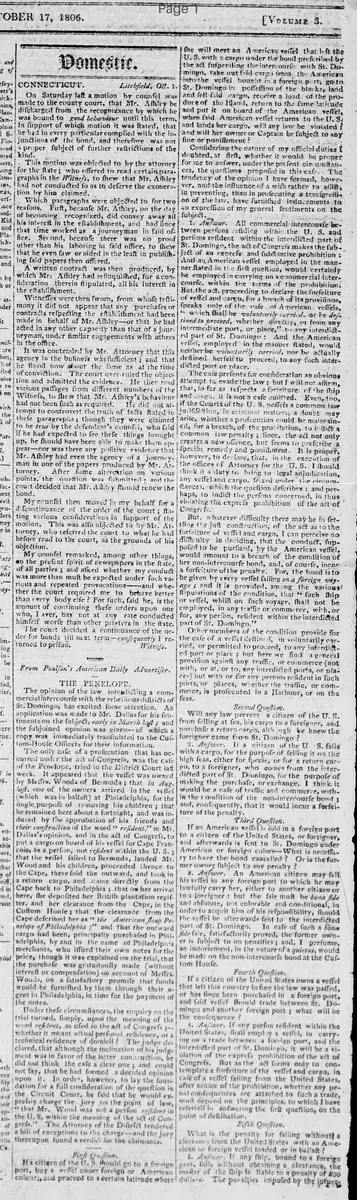
The opinion of the law interdicting a commercial intercourse with the rebellious districts of St. Domingo, has excited some attention. An application was made to Mr. Dallas for his sentiments on the subject, early in March last; and the subjoined opinion was given--of which a copy was immediately transmitted to the Custom-House Officers for their information.
The only case of a prosecution that has occurred under the act of Congress, was the case of the Penelope, tried in the District Court last week. It appeared that the vessel was owned by Messrs. Woods of Bermuda; that in Aug. last, one of the owners arrived in the vessel (which was in ballast) at Philadelphia, for the single purpose of removing his children; that he remained here about a fortnight, and was induced by the approbation of his friends and their construction of the word "resident," in Mr. Dallas's opinion, and in the act of Congress, to put a cargo on board of his vessel for Cape Francois, as a person, not resident within the U. S.; that the vessel sailed to Bermuda, landed Mr. Wood and his children, proceeded thence to the Cape, there sold the outward, and took in a return cargo, and came directly from the Cape back to Philadelphia; that on her arrival here, she deposited her British plantation register and her clearance from the Cape, in the Custom House; that the clearance from the Cape described her as "the American sloop Penelope of Philadelphia;" and that the outward cargo had been, principally purchased in Philadelphia, by and in the name of Philadelphia merchants, who issued their own notes for the price, though it was explained on the trial, that the purchase was gratuitously made (without interest or compensation) on account of Messrs. Woods, on a satisfactory promise that funds would be furnished by them through their agent in Philadelphia, in time for the payment of the notes.
Under these circumstances, the enquiry on the trial turned, simply, upon the meaning of the word resident, as used in the act of Congress;--whether it meant actual personal residence, or a technical residence of domicil? The judge declared, that although the inclination of his judgment was in favor of the latter construction, he did not think the case a clear one; and could not say, that he had formed a decided opinion upon it. In order, however, to lay the foundation for a full consideration of the question in the Circuit Court, he said that he would expressly charge the jury on the point of law, "that Mr. Wood was not a person resident in the U.S, within the meaning of the act of Congress." The Attorney of the District tendered a bill of exceptions to this charge--and the jury thereupon found a verdict for the claimants.
First Question.
If a citizen of the U. S. should go to a foreign port, buy a vessel under foreign or American colours, and proceed to a certain latitude where she will meet an American vessel that left the U.S. with a cargo under the bond prescribed by the act suspending the intercourse with St. Domingo, take out said cargo from the American into the vessel bought in a foreign port, go to St. Domingo in possession of the blacks, land and sell said cargo, receive a load of the product of the Island, return to the same latitude and put it on board of the American vessel, when said American vessel returns to the U.S and lands her cargo, will any law be violated? and will her owner or Captain be subject to any fine or punishment?
Considering the nature of my official duties I doubted, at first, whether it would be proper for me to answer, under the present circumstances, the questions proposed in this case. The tendency of the opinion I have formed, however, and the influence of a wish rather to assist, in preventing, than in prosecuting a transgression of the law, have furnished inducements to an expression of my general sentiments on the subject.
I. Answer. All commercial intercourse between persons residing within the U. S. and persons resident within the interdicted part of St. Domingo, the act of Congress makes the subject of an express, and substantive prohibition: And an American vessel employed in the manner stated in the first question, would certainly be employed in carrying on a commercial intercourse, within the terms of the prohibition! But the act, proceeding to declare the forfeiture of vessel and cargo, for a breach of its provisions, speaks only of the case of American vessels, "which shall be voluntarily carried or be destined to proceed, whether directly, or from any intermediate port, or place," to any interdicted part of St. Domingo: And the American vessel, employed in the manner stated, would neither be voluntarily carried, nor be actually destined herself to proceed, to any such interdicted port or place.
The case presents for consideration an obvious attempt to evade the law; but I will not affirm, that, so far as respects a forfeiture of the ship and cargo, it is not a case omitted. Even, too, if the Courts of the U. S. possess a common law jurisdiction, in criminal matters, a doubt may arise, whether a prosecution could be maintained, for a breach, of the prohibition, to inflict a common law penalty; since, the act not only creates a new offence, but seems to prescribe a specific remedy and punishment. It is proper, however, to declare, that, in the execution of the offices of Attorney for the U. S. I should think it a duty to bring to legal adjudication, any vessel and cargo seized under the circumstances, which the question describes: and perhaps, to indict the persons concerned, in thus violating the express prohibition of the act of Congress.
But, whatever difficulty there may be in attempting the just construction, of the act as to the forfeiture of vessel and cargo, I can perceive no difficulty in deciding, that the conduct, supposed to be pursued by the American vessel, would amount to a breach of the condition of her non-intercourse bond, and, of course, incur a forfeiture of the penalty. For, the bond is to be given by every vessel sailing on a foreign voyage; and it is provided, among the various stipulations of the condition, that "such ship or vessel, whilst on such voyage, shall not be employed, in any traffic or commerce, with, or for, any person, resident within the interdicted part of St. Domingo."
Other members of the condition provide for the case of a vessel destined, or voluntarily carried, or permitted to proceed, to any interdicted port or place; but here we find a general provision against any traffic, or commerce (not with, or at, or to, any interdicted ports, or places) but with or for any persons resident in such ports, or places, whether the traffic, or commerce, is prosecuted in a Harbour, or on the seas.
Second Question.
Will any law prevent a citizen of the U. S. from selling at sea, his cargo to a foreigner, and purchase a return cargo, although he knew the foreigner came from St. Domingo?
2. Answer. If a citizen of the U. S. sails with a cargo, for the purpose of selling it on the high seas, either for specie, or for a return cargo, to a foreigner, who comes from the interdicted part of St. Domingo, for the purpose of making the purchase, or exchange, I think it would be a case of traffic and commerce, within the condition of the non-intercourse bond; and, consequently, that it would incur a forfeiture of the penalty.
Third Question.
If an American vessel is sold in a foreign port to a citizen of the United States, or foreigner, and afterwards is sent to St. Domingo under American or foreign colors--What is necessary to have the bond cancelled? Or is the former owner subject to any penalty?
3. Answer. An American citizen may sell his vessel in any foreign port to which he may lawfully carry her, either to another citizen or to a foreigner: but the sale must be bona fide and absolute, not colorable and conditional, in order to acquit him of his responsibility, should the vessel be afterwards sent to the interdicted part of St. Domingo. In case of such a bona fide sale, satisfactorily proved, the former owner is subject to no penalties; and, I presume, an indorsement, in the nature of a quietus, would be made on the non-intercourse bond at the Custom House.
Fourth Question.
If a citizen of the United States owns a vessel that left this country before the law was passed, or has since been purchased in a foreign port, and said vessel should trade between St. Domingo and another foreign port; what will be the consequence?
4. Answer. If any person resident within the United States, shall employ a vessel, in carrying on a trade between a foreign port, and the interdicted part of S. Domingo, it will be a violation of the express prohibition of the act of Congress. But as the act seems only to contemplate a forfeiture of the vessel and cargo, in case of a vessel sailing from the United States, after notice of the prohibition, whether any penal consequences are attached to such a trade, must depend on the principles, to which I have referred in answering the first question, on the point of destination.
Fifth Question.
What is the penalty for sailing without a clearance from the United States with an American or foreign vessel loaded or in ballast?
5. Answer. If any ship, bound to a foreign port, sails without obtaining a clearance, the master of the ship is liable to a penalty of $500 dollars. The penalties imposed by the suppress act of Congress, upon vessels sailing without a clearance, are cumulative penalties; and, therefore, the master of a vessel, bound to St. Domingo, who should sail without a clearance, would incur the penalty of $500, under the general collection law, and the forfeiture of vessel and cargo, under the special St. Domingo law. Navigation laws of the state, from which she sails, may, also, be enforced.—And the ship's papers lodged at the Custom House, will of course be retained. If the ship sails, without a clearance, for the interdicted parts of St. Domingo, the ship and her cargo may be seized and confiscated.
Sixth Question.
Can a foreign vessel bring a cargo to the United States direct from St. Domingo, if so, can a citizen of the United States be interested in said cargo?
6. Answer. A foreign vessel not owned, hired or employed, wholly, or in part by any person resident within the United States, may bring a cargo hither, direct from St. Domingo. But I do not think, that any person, resident within the United States, can be interested in the cargo of such vessel. If the whole, or only a part, of the cargo belonging to such resident, the very act of transporting it, would be an act of employing the vessel, within the terms of the prohibition, and clause of forfeiture. If the foreign vessel had sailed from the United States, after notice of the prohibition, in the employment of a resident, both vessel and cargo would be liable to forfeiture, as well as to the penalty of the non-intercourse bond. If not, it would still be an infraction of the express prohibition, and must depend, in that respect, for the penal consequences, on the principles, to which my first answer refers.
Seventh Question.
If a foreign vessel should go from the United States to St. Domingo direct or after touching at an intermediate port, is the consignee, captain or any other person subject to any penalty?
7. Answer. A foreign vessel not owned, hired, or employed, wholly, or partially, by any person resident in the United States, may go from the United States directly, or after touching at an intermediate port, to the interdicted part of St. Domingo, without an infraction of the general prohibition of the act of Congress without being subject to forfeiture, and without giving a non-intercourse bond. But even such a vessel cannot receive a clearance, at our Custom House, for any part of St. Domingo, not in the actual possession of France. And a foreign vessel is as liable to the penalties of the act, as a domestic vessel, if she is wholly, or partially, owned, hired, or employed, by any person (foreigner or citizen) resident within the United States.
Eighth Question.
If an American vessel should proceed to a foreign port other than St. Domingo, land her cargo there, and then go in ballast to St. Domingo: will the bond given for vessel and cargo be divided and the part that relates to the cargo be cancelled?
8. Answer. The penalty of the non-intercourse bond would not admit of the apportionment suggested in the question. If the vessel is at all employed in the prohibited traffic, or commerce, whether with the original, or any subsequent cargo, the penalty is forfeited.
A. J. DALLAS.
March 21, 1806.
What sub-type of article is it?
What keywords are associated?
What entities or persons were involved?
Where did it happen?
Domestic News Details
Primary Location
Philadelphia
Event Date
March 21, 1806
Key Persons
Outcome
jury found a verdict for the claimants of the sloop penelope.
Event Details
The sloop Penelope, owned by Messrs. Woods of Bermuda, was tried in the Philadelphia District Court for violating the non-intercourse act with St. Domingo. Mr. Wood arrived in Philadelphia in August to remove his children, loaded cargo for Cape Francois interpreting himself as non-resident, traded via Bermuda, and returned. The trial hinged on the meaning of 'resident' in the act; the judge charged the jury that Mr. Wood was not a resident, leading to acquittal. A. J. Dallas's opinion from March 21, 1806, answers eight questions on trade scenarios, bonds, clearances, and penalties under the act.