Thank you for visiting SNEWPapers!
Sign up free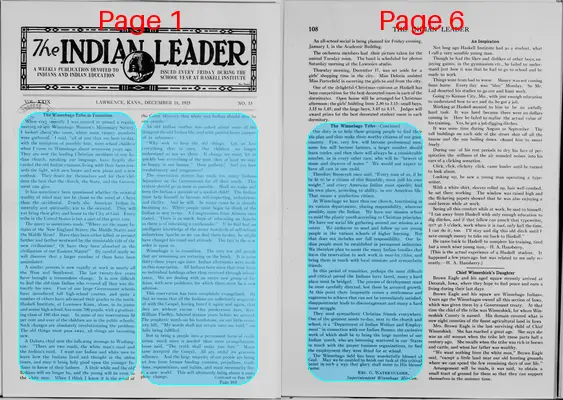
The Indian Leader
Lawrence, Douglas County, Kansas
What is this article about?
Rev. G. Watermulder reflects on the Winnebago Tribe's transition from traditional Indian life to Christian, educated, and self-reliant American citizenship, emphasizing education, assimilation, missionary work, and challenges on the reservation over the past 25-33 years.
Merged-components note: This is a continued story across pages, as indicated by 'Continued on Page 108 Page 103' in the first part and 'The Winnebago Tribe--Continued' in the second part.
Clippings
1 of 2
OCR Quality
Full Text
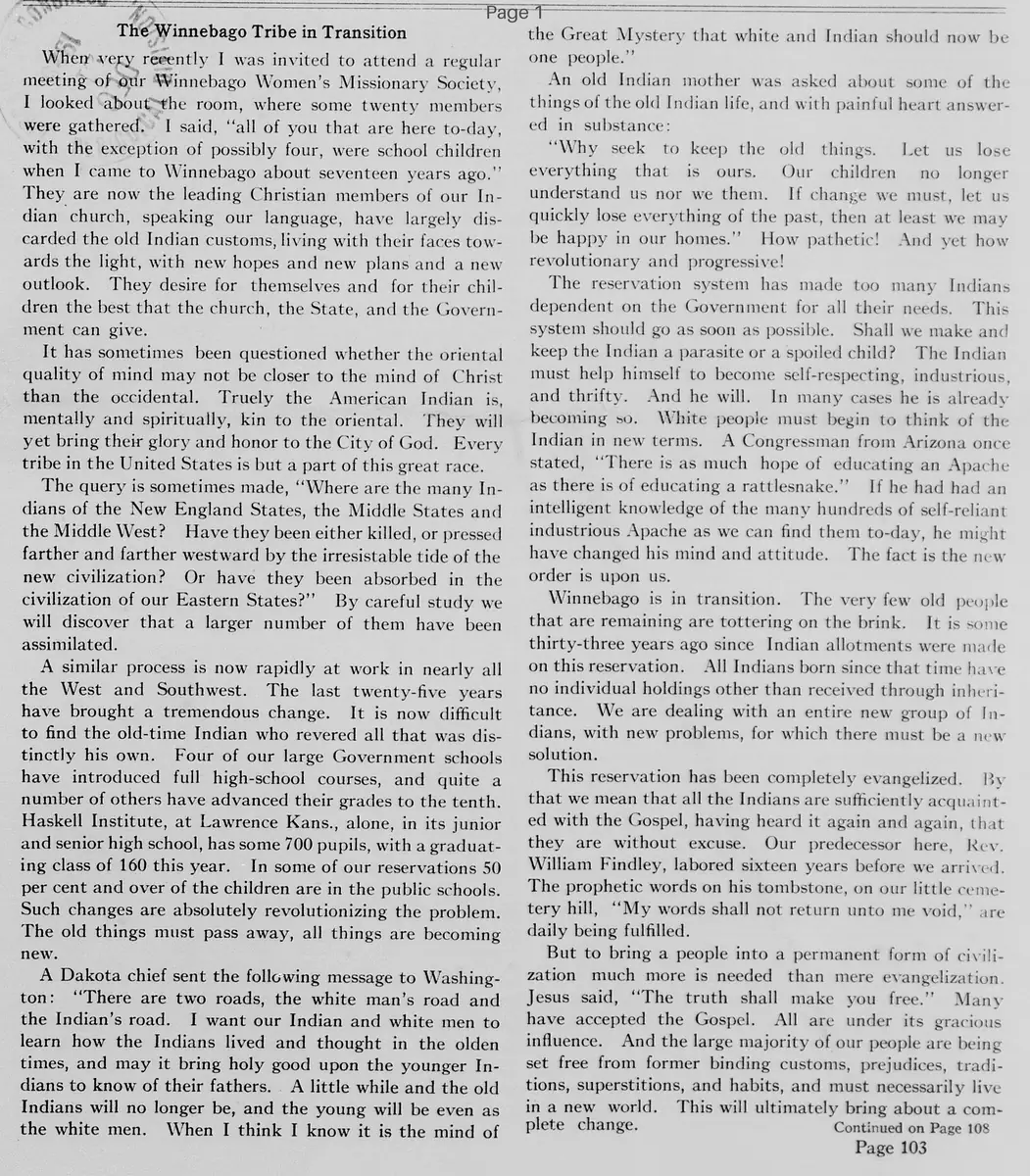
When very recently I was invited to attend a regular meeting of our Winnebago Women's Missionary Society, I looked about the room, where some twenty members were gathered. I said, "all of you that are here to-day, with the exception of possibly four, were school children when I came to Winnebago about seventeen years ago."
They are now the leading Christian members of our Indian church, speaking our language, have largely discarded the old Indian customs, living with their faces towards the light, with new hopes and new plans and a new outlook. They desire for themselves and for their children the best that the church, the State, and the Government can give.
It has sometimes been questioned whether the oriental quality of mind may not be closer to the mind of Christ than the occidental. Truly the American Indian is, mentally and spiritually, kin to the oriental. They will yet bring their glory and honor to the City of God. Every tribe in the United States is but a part of this great race.
The query is sometimes made, "Where are the many Indians of the New England States, the Middle States and the Middle West? Have they been either killed, or pressed farther and farther westward by the irresistible tide of the new civilization? Or have they been absorbed in the civilization of our Eastern States?" By careful study we will discover that a larger number of them have been assimilated.
A similar process is now rapidly at work in nearly all the West and Southwest. The last twenty-five years have brought a tremendous change. It is now difficult to find the old-time Indian who revered all that was distinctly his own. Four of our large Government schools have introduced full high-school courses, and quite a number of others have advanced their grades to the tenth. Haskell Institute, at Lawrence Kans., alone, in its junior and senior high school, has some 700 pupils, with a graduating class of 160 this year. In some of our reservations 50 per cent and over of the children are in the public schools. Such changes are absolutely revolutionizing the problem. The old things must pass away, all things are becoming new.
A Dakota chief sent the following message to Washington: "There are two roads, the white man's road and the Indian's road. I want our Indian and white men to learn how the Indians lived and thought in the olden times, and may it bring holy good upon the younger Indians to know of their fathers. A little while and the old Indians will no longer be, and the young will be even as the white men. When I think I know it is the mind of the Great Mystery that white and Indian should now be one people."
An old Indian mother was asked about some of the things of the old Indian life, and with painful heart answered in substance:
"Why seek to keep the old things. Let us lose everything that is ours. Our children no longer understand us nor we them. If change we must, let us quickly lose everything of the past, then at least we may be happy in our homes." How pathetic! And yet how revolutionary and progressive!
The reservation system has made too many Indians dependent on the Government for all their needs. This system should go as soon as possible. Shall we make and keep the Indian a parasite or a spoiled child? The Indian must help himself to become self-respecting, industrious, and thrifty. And he will. In many cases he is already becoming so. White people must begin to think of the Indian in new terms. A Congressman from Arizona once stated, "There is as much hope of educating an Apache as there is of educating a rattlesnake." If he had had an intelligent knowledge of the many hundreds of self-reliant industrious Apache as we can find them to-day, he might have changed his mind and attitude. The fact is the new order is upon us.
Winnebago is in transition. The very few old people that are remaining are tottering on the brink. It is some thirty-three years ago since Indian allotments were made on this reservation. All Indians born since that time have no individual holdings other than received through inheritance. We are dealing with an entire new group of Indians, with new problems, for which there must be a new solution.
This reservation has been completely evangelized. By that we mean that all the Indians are sufficiently acquainted with the Gospel, having heard it again and again, that they are without excuse. Our predecessor here, Rev. William Findley, labored sixteen years before we arrived. The prophetic words on his tombstone, on our little cemetery hill, "My words shall not return unto me void," are daily being fulfilled.
But to bring a people into a permanent form of civilization much more is needed than mere evangelization. Jesus said, "The truth shall make you free." Many have accepted the Gospel. All are under its gracious influence. And the large majority of our people are being set free from former binding customs, prejudices, traditions, superstitions, and habits, and must necessarily live in a new world. This will ultimately bring about a complete change.
Continued on Page 108 Page 103
The Winnebago Tribe--Continued
Our duty is to help these groping people to find their life-plan and thus make them worthy citizens of our great country. Few, very few, will become professional men, some few will become farmers, a larger number should learn trades, and then there will always be a considerable number, as in every other race, who will be "hewers of stone and drawers of water." We would not expect to have all cast in one mold.
Theodore Roosevelt once said, "Every man of us, if he be fit to be a citizen of this Republic, must pull his own weight," and every American Indian must speedily find his own place, according to ability, in our American life. That means a productive citizen.
At Winnebago we have thus our church, functioning in its various departments, placing responsibility, wherever possible, upon the Indian. We have our mission school to mold the plastic youth according to Christian principles. We have our social life gathering around our mission as a center. We endeavor to send and follow up our young people in the various schools of higher learning. But that does not include our full responsibility. Our Indian people must be established in permanent industries. We therefore plan to assist the many Indian families that leave the reservation to seek work in near-by cities, and bring them in touch with local missions and sympathetic friends.
In this period of transition, perhaps the most difficult and critical period the Indians have faced, many a hard place must be bridged. The process of development must be most carefully directed, lest there be arrested growth. At this point there frequently comes a restlessness and eagerness to achieve that can not be immediately satisfied, disappointment leads to discouragement and many a hard inner struggle.
They need sympathetic Christian friends everywhere. One of the greatest needs to-day, next to the church and school, is a "Department of Indian Welfare and Employment" in connection with our Indian Bureau, the exclusive work of which shall be to bring the large number of our Indian youth, who are becoming scattered in our States in touch with the proper business organizations, to find the employment they were fitted for at school.
The Winnebago field has been wonderfully blessed of God. May we be enabled to finish our task at this critical point in such a way that glory shall come to His blessed name.
REV. G. WATERMULDER,
Superintendent Winnebago Mission.
What sub-type of article is it?
What themes does it cover?
What keywords are associated?
What entities or persons were involved?
Where did it happen?
Story Details
Key Persons
Location
Winnebago Reservation
Event Date
Last Twenty Five Years
Story Details
The Winnebago Tribe undergoes rapid cultural and spiritual transition through Christian missionary work, education in government schools, and assimilation into American society, discarding old customs for new hopes, self-reliance, and citizenship, as observed by Rev. Watermulder after 17 years on the reservation.