Thank you for visiting SNEWPapers!
Sign up free
Literary
February 26, 1957
Atlanta Daily World
Atlanta, Fulton County, Georgia
What is this article about?
In Chapter 12 of Elizabeth Seifert's novel 'A Call for Doctor Barton,' Dr. Grady Barton settles into his medical practice in Green Holly, Wisconsin, treating patients, starting clinics, and gaining popularity. He builds community ties, enjoys social life, and develops a romance with June Cowan while keeping his marital issues secret.
Clipping
OCR Quality
95%
Excellent
Full Text
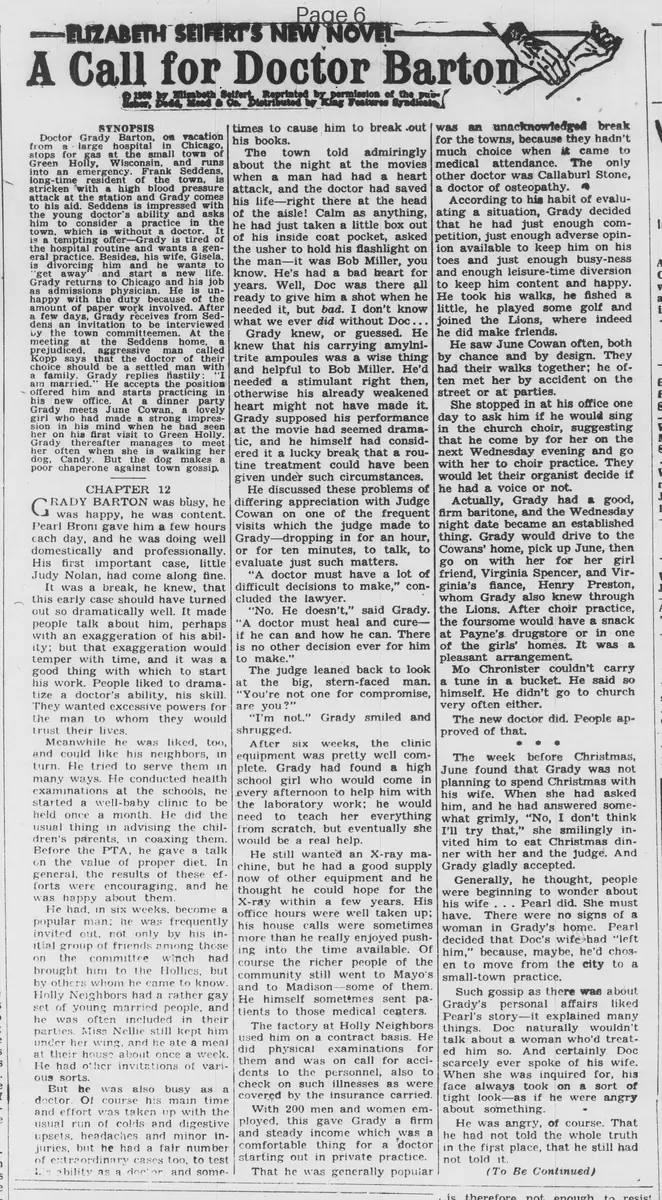
A Call for Doctor Barton
ELIZABETH SEIFERT'S NEW NOVEL
SYNOPSIS
Doctor Grady Barton, on vacation from a large hospital in Chicago, stops for gas at the small town of Green Holly, Wisconsin, and runs into an emergency. Frank Seddens, long-time resident of the town, is stricken with a high blood pressure attack at the station and Grady comes to his aid. Seddens is impressed with the young doctor's ability and asks him to consider a practice in the town, which is without a doctor. It is a tempting offer—Grady is tired of the hospital routine and wants a general practice. Besides, his wife, Gisela, is divorcing him and he wants to "get away" and start a new life.
Grady returns to Chicago and his job as admissions physician. He is unhappy with the duty because of the amount of paper work involved. After a few days, Grady receives from Seddens an invitation to be interviewed by the town committeemen. At the meeting at the Seddens home, a prejudiced, aggressive man called Kopp says that the doctor of their choice should be a settled man with a family. Grady replies hastily: "I am married." He accepts the position offered him and starts practicing in his new office. At a dinner party Grady meets June Cowan, a lovely girl who had made a strong impression in his mind when he had seen her on his first visit to Green Holly.
Grady thereafter manages to meet her often when she is walking her dog, Candy. But the dog makes a poor chaperone against town gossip.
CHAPTER 12
GRADY BARTON was busy, he was happy, he was content.
Pearl Broni gave him a few hours each day, and he was doing well domestically and professionally.
His first important case, little Judy Nolan, had come along fine.
It was a break, he knew, that this early case should have turned out so dramatically well. It made people talk about him, perhaps with an exaggeration of his ability; but that exaggeration would temper with time, and it was a good thing with which to start his work. People liked to dramatize a doctor's ability, his skill.
They wanted excessive powers for the man to whom they would trust their lives.
Meanwhile he was liked, too, and could like his neighbors, in turn. He tried to serve them in many ways. He conducted health examinations at the schools, he started a well-baby clinic to be held once a month. He did the usual thing in advising the children's parents, in coaxing them. Before the PTA, he gave a talk on the value of proper diet. In general, the results of these efforts were encouraging, and he was happy about them.
He had, in six weeks, become a popular man; he was frequently invited out, not only by his initial group of friends among those on the committee which had brought him to the Hollies, but by others whom he came to know.
Holly Neighbors had a rather gay set of young married people, and he was often included in their parties. Miss Nellie still kept him under her wing, and he ate a meal at their house about once a week.
He had other invitations of various sorts.
But he was also busy as a doctor. Of course his main time and effort was taken up with the usual run of colds and digestive upsets, headaches and minor injuries, but he had a fair number of extraordinary cases too, to test his ability as a doctor and sometimes to cause him to break out his books.
The town told admiringly about the night at the movies when a man had had a heart attack, and the doctor had saved his life—right there at the head of the aisle! Calm as anything, he had just taken a little box out of his inside coat pocket, asked the usher to hold his flashlight on the man—it was Bob Miller, you know. He's had a bad heart for years. Well, Doc was there all ready to give him a shot when he needed it, but bad. I don't know what we ever did without Doc...
Grady knew, or guessed. He knew that his carrying amylnitrite ampoules was a wise thing and helpful to Bob Miller. He'd needed a stimulant right then, otherwise his already weakened heart might not have made it.
Grady supposed his performance at the movie had seemed dramatic, and he himself had considered it a lucky break that a routine treatment could have been given under such circumstances.
He discussed these problems of differing appreciation with Judge Cowan on one of the frequent visits which the judge made to Grady—dropping in for an hour, or for ten minutes, to talk, to evaluate just such matters.
"A doctor must have a lot of difficult decisions to make," concluded the lawyer.
"No. He doesn't," said Grady. "A doctor must heal and cure if he can and how he can. There is no other decision ever for him to make."
The judge leaned back to look at the big, stern-faced man.
"You're not one for compromise, are you?"
"I'm not." Grady smiled and shrugged.
After six weeks, the clinic equipment was pretty well complete. Grady had found a high school girl who would come in every afternoon to help him with the laboratory work; he would need to teach her everything from scratch, but eventually she would be a real help.
He still wanted an X-ray machine, but he had a good supply now of other equipment and he thought he could hope for the X-ray within a few years. His office hours were well taken up; his house calls were sometimes more than he really enjoyed pushing into the time available. Of course the richer people of the community still went to Mayo's and to Madison—some of them.
He himself sometimes sent patients to those medical centers.
The factory at Holly Neighbors used him on a contract basis. He did physical examinations for them and was on call for accidents to the personnel, also to check on such illnesses as were covered by the insurance carried.
With 200 men and women employed, this gave Grady a firm and steady income which was a comfortable thing for a doctor starting out in private practice.
That he was generally popular was an unacknowledged break for the towns, because they hadn't much choice when it came to medical attendance. The only other doctor was Callaburl Stone, a doctor of osteopathy.
According to his habit of evaluating a situation, Grady decided that he had just enough competition, just enough adverse opinion available to keep him on his toes and just enough busy-ness and enough leisure-time diversion to keep him content and happy.
He took his walks, he fished a little, he played some golf and joined the Lions, where indeed he did make friends.
He saw June Cowan often, both by chance and by design. They had their walks together; he often met her by accident on the street or at parties.
She stopped in at his office one day to ask him if he would sing in the church choir, suggesting that he come by for her on the next Wednesday evening and go with her to choir practice. They would let their organist decide if he had a voice or not.
Actually, Grady had a good, firm baritone, and the Wednesday night date became an established thing. Grady would drive to the Cowans' home, pick up June, then go on with her for her girl friend, Virginia Spencer, and Virginia's fiance, Henry Preston, whom Grady also knew through the Lions. After choir practice, the foursome would have a snack at Payne's drugstore or in one of the girls' homes. It was a pleasant arrangement.
Mo Chronister couldn't carry a tune in a bucket. He said so himself. He didn't go to church very often either.
The new doctor did. People approved of that.
The week before Christmas, June found that Grady was not planning to spend Christmas with his wife. When she had asked him, and he had answered somewhat grimly, "No. I don't think I'll try that," she smilingly invited him to eat Christmas dinner with her and the judge. And Grady gladly accepted.
Generally, he thought, people were beginning to wonder about his wife ... Pearl did. She must have. There were no signs of a woman in Grady's home. Pearl decided that Doc's wife had "left him," because, maybe, he'd chosen to move from the city to a small-town practice.
Such gossip as there was about Grady's personal affairs liked Pearl's story—it explained many things. Doc naturally wouldn't talk about a woman who'd treated him so. And certainly Doc scarcely ever spoke of his wife.
When she was inquired for, his face always took on a sort of tight look—as if he were angry about something.
He was angry, of course. That he had not told the whole truth in the first place, that he still had not told it.
(To Be Continued)
ELIZABETH SEIFERT'S NEW NOVEL
SYNOPSIS
Doctor Grady Barton, on vacation from a large hospital in Chicago, stops for gas at the small town of Green Holly, Wisconsin, and runs into an emergency. Frank Seddens, long-time resident of the town, is stricken with a high blood pressure attack at the station and Grady comes to his aid. Seddens is impressed with the young doctor's ability and asks him to consider a practice in the town, which is without a doctor. It is a tempting offer—Grady is tired of the hospital routine and wants a general practice. Besides, his wife, Gisela, is divorcing him and he wants to "get away" and start a new life.
Grady returns to Chicago and his job as admissions physician. He is unhappy with the duty because of the amount of paper work involved. After a few days, Grady receives from Seddens an invitation to be interviewed by the town committeemen. At the meeting at the Seddens home, a prejudiced, aggressive man called Kopp says that the doctor of their choice should be a settled man with a family. Grady replies hastily: "I am married." He accepts the position offered him and starts practicing in his new office. At a dinner party Grady meets June Cowan, a lovely girl who had made a strong impression in his mind when he had seen her on his first visit to Green Holly.
Grady thereafter manages to meet her often when she is walking her dog, Candy. But the dog makes a poor chaperone against town gossip.
CHAPTER 12
GRADY BARTON was busy, he was happy, he was content.
Pearl Broni gave him a few hours each day, and he was doing well domestically and professionally.
His first important case, little Judy Nolan, had come along fine.
It was a break, he knew, that this early case should have turned out so dramatically well. It made people talk about him, perhaps with an exaggeration of his ability; but that exaggeration would temper with time, and it was a good thing with which to start his work. People liked to dramatize a doctor's ability, his skill.
They wanted excessive powers for the man to whom they would trust their lives.
Meanwhile he was liked, too, and could like his neighbors, in turn. He tried to serve them in many ways. He conducted health examinations at the schools, he started a well-baby clinic to be held once a month. He did the usual thing in advising the children's parents, in coaxing them. Before the PTA, he gave a talk on the value of proper diet. In general, the results of these efforts were encouraging, and he was happy about them.
He had, in six weeks, become a popular man; he was frequently invited out, not only by his initial group of friends among those on the committee which had brought him to the Hollies, but by others whom he came to know.
Holly Neighbors had a rather gay set of young married people, and he was often included in their parties. Miss Nellie still kept him under her wing, and he ate a meal at their house about once a week.
He had other invitations of various sorts.
But he was also busy as a doctor. Of course his main time and effort was taken up with the usual run of colds and digestive upsets, headaches and minor injuries, but he had a fair number of extraordinary cases too, to test his ability as a doctor and sometimes to cause him to break out his books.
The town told admiringly about the night at the movies when a man had had a heart attack, and the doctor had saved his life—right there at the head of the aisle! Calm as anything, he had just taken a little box out of his inside coat pocket, asked the usher to hold his flashlight on the man—it was Bob Miller, you know. He's had a bad heart for years. Well, Doc was there all ready to give him a shot when he needed it, but bad. I don't know what we ever did without Doc...
Grady knew, or guessed. He knew that his carrying amylnitrite ampoules was a wise thing and helpful to Bob Miller. He'd needed a stimulant right then, otherwise his already weakened heart might not have made it.
Grady supposed his performance at the movie had seemed dramatic, and he himself had considered it a lucky break that a routine treatment could have been given under such circumstances.
He discussed these problems of differing appreciation with Judge Cowan on one of the frequent visits which the judge made to Grady—dropping in for an hour, or for ten minutes, to talk, to evaluate just such matters.
"A doctor must have a lot of difficult decisions to make," concluded the lawyer.
"No. He doesn't," said Grady. "A doctor must heal and cure if he can and how he can. There is no other decision ever for him to make."
The judge leaned back to look at the big, stern-faced man.
"You're not one for compromise, are you?"
"I'm not." Grady smiled and shrugged.
After six weeks, the clinic equipment was pretty well complete. Grady had found a high school girl who would come in every afternoon to help him with the laboratory work; he would need to teach her everything from scratch, but eventually she would be a real help.
He still wanted an X-ray machine, but he had a good supply now of other equipment and he thought he could hope for the X-ray within a few years. His office hours were well taken up; his house calls were sometimes more than he really enjoyed pushing into the time available. Of course the richer people of the community still went to Mayo's and to Madison—some of them.
He himself sometimes sent patients to those medical centers.
The factory at Holly Neighbors used him on a contract basis. He did physical examinations for them and was on call for accidents to the personnel, also to check on such illnesses as were covered by the insurance carried.
With 200 men and women employed, this gave Grady a firm and steady income which was a comfortable thing for a doctor starting out in private practice.
That he was generally popular was an unacknowledged break for the towns, because they hadn't much choice when it came to medical attendance. The only other doctor was Callaburl Stone, a doctor of osteopathy.
According to his habit of evaluating a situation, Grady decided that he had just enough competition, just enough adverse opinion available to keep him on his toes and just enough busy-ness and enough leisure-time diversion to keep him content and happy.
He took his walks, he fished a little, he played some golf and joined the Lions, where indeed he did make friends.
He saw June Cowan often, both by chance and by design. They had their walks together; he often met her by accident on the street or at parties.
She stopped in at his office one day to ask him if he would sing in the church choir, suggesting that he come by for her on the next Wednesday evening and go with her to choir practice. They would let their organist decide if he had a voice or not.
Actually, Grady had a good, firm baritone, and the Wednesday night date became an established thing. Grady would drive to the Cowans' home, pick up June, then go on with her for her girl friend, Virginia Spencer, and Virginia's fiance, Henry Preston, whom Grady also knew through the Lions. After choir practice, the foursome would have a snack at Payne's drugstore or in one of the girls' homes. It was a pleasant arrangement.
Mo Chronister couldn't carry a tune in a bucket. He said so himself. He didn't go to church very often either.
The new doctor did. People approved of that.
The week before Christmas, June found that Grady was not planning to spend Christmas with his wife. When she had asked him, and he had answered somewhat grimly, "No. I don't think I'll try that," she smilingly invited him to eat Christmas dinner with her and the judge. And Grady gladly accepted.
Generally, he thought, people were beginning to wonder about his wife ... Pearl did. She must have. There were no signs of a woman in Grady's home. Pearl decided that Doc's wife had "left him," because, maybe, he'd chosen to move from the city to a small-town practice.
Such gossip as there was about Grady's personal affairs liked Pearl's story—it explained many things. Doc naturally wouldn't talk about a woman who'd treated him so. And certainly Doc scarcely ever spoke of his wife.
When she was inquired for, his face always took on a sort of tight look—as if he were angry about something.
He was angry, of course. That he had not told the whole truth in the first place, that he still had not told it.
(To Be Continued)
What sub-type of article is it?
Prose Fiction
What themes does it cover?
Love Romance
Moral Virtue
Social Manners
What keywords are associated?
Doctor Barton
Small Town Practice
Health Clinic
Romance June
Medical Cases
What entities or persons were involved?
Elizabeth Seifert
Literary Details
Title
Chapter 12
Author
Elizabeth Seifert
Key Lines
"A Doctor Must Heal And Cure If He Can And How He Can. There Is No Other Decision Ever For Him To Make."
"You're Not One For Compromise, Are You?"
"I'm Not." Grady Smiled And Shrugged.