Thank you for visiting SNEWPapers!
Sign up free
The National Intelligencer And Washington Advertiser
Washington, District Of Columbia
What is this article about?
In the U.S. House of Representatives on April 6, Mr. G. W. Campbell delivers a speech advocating for a bill to raise an additional 6,000-man military force, arguing it is necessary for defense against threats from Britain and France, while emphasizing reliance on militia and distinguishing it from a standing army in peacetime.
Merged-components note: Continuation of the congressional debate on raising a military force, seamlessly connecting from page 1 to page 2.
Clippings
1 of 2
OCR Quality
Full Text
WEDNESDAY, APRIL 6.
Debate on the passage of the bill for raising an additional military force.
(CONTINUED.)
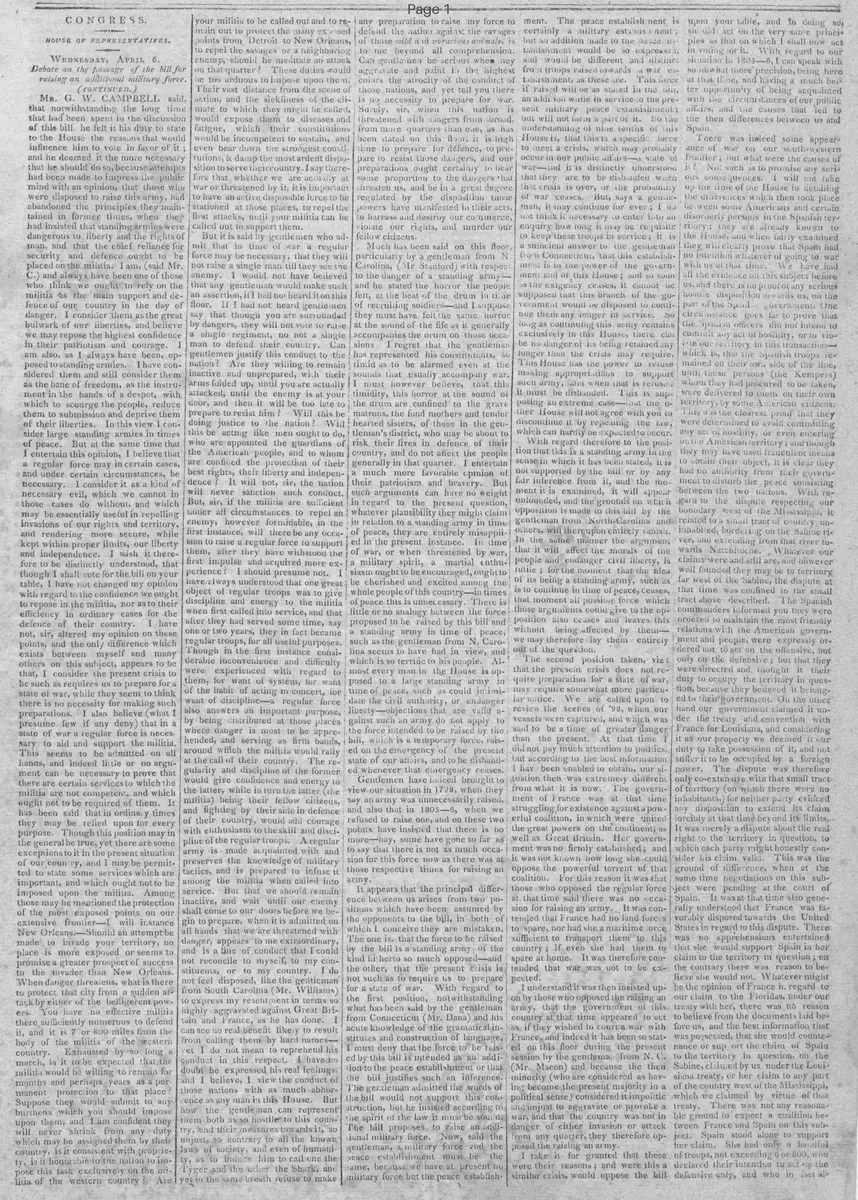
Mr. G. W. CAMPBELL said, that notwithstanding the long time that had been spent in the discussion of this bill, he felt it his duty to state to the House the reasons that would influence him to vote in favor of it; and he deemed it the more necessary that he should do so, because attempts had been made to impress the public mind with an opinion, that those who were disposed to raise this army, had abandoned the principles they maintained in former times, when they had insisted that standing armies were dangerous to liberty and the rights of man, and that the chief reliance for security and defence ought to be placed on the militia. I am, (said Mr. C.) and always have been one of those who think we ought to rely on the militia as the main support and defence of our country in the day of danger. I consider them as the great bulwark of our liberties, and believe we may repose the highest confidence in their patriotism and courage. I am also, as I always have been, opposed to standing armies. I have considered them and still consider them as the bane of freedom, as the instrument in the hands of a despot, with which to scourge the people, reduce them to submission and deprive them of their liberties. In this view I consider large standing armies in times of peace. But at the same time that I entertain this opinion, I believe that a regular force may in certain cases, and under certain circumstances, be necessary. I consider it as a kind of necessary evil, which we cannot in those cases do without, and which may be essentially useful in repelling invasions of our rights and territory, and rendering more secure, while kept within proper limits, our liberty and independence. I wish it therefore to be distinctly understood, that though I shall vote for the bill on your table, I have not changed my opinion with regard to the confidence we ought to repose in the militia, nor as to their efficiency in ordinary cases or the defence of their country. I have not, sir, altered my opinion on these points, and the only difference which exists between myself and many others on this subject, appears to be that, I consider the present crisis to be such as requires us to prepare for a state of war, while they seem to think there is no necessity for making such preparations. I also believe (what I presume few if any deny) that in a state of war a regular force is necessary to aid and support the militia. This seems to be admitted on all hands, and indeed little or no argument can be necessary to prove that there are certain services to which the militia are not competent, and which ought not to be required of them. It has been said that in ordinary times they may be relied upon for every purpose. Though this position may in the general be true, yet there are some exceptions to it in the present situation of our country, and I may be permitted to state some services which are important, and which ought not to be imposed upon the militia. Among those may be mentioned the protection of the most exposed points on our extensive frontier. I will instance New Orleans.—Should an attempt be made to invade your territory, no place is more exposed or seems to promise a greater prospect of success to the invader than New Orleans. When danger threatens, what is there to protect that city from a sudden attack by either of the belligerent powers. You have no effective militia there sufficiently numerous to defend it, and it is 7 or 800 miles from the body of the militia of the western country. Exhausted by so long a march, is it to be expected that the militia would be willing to remain for months and perhaps years as a permanent protection to that place? Suppose they would submit to any burthens which you should impose upon them, and I am confident they will never shrink from any duty which may be assigned them by their country, is it consistent with propriety, is it honorable to the nation to impose this task exclusively on the militia of the western country? Are you willing to call out your militia to remain out to protect the many exposed points from Detroit to New Orleans, to repel the savages or a neighboring enemy, should he meditate an attack on that quarter? These duties would be too arduous to impose upon them. Their vast distance from the scene of action, and the sickliness of the climate to which they might be called, would expose them to diseases and fatigue, which their constitutions would be incompetent to sustain, and even bear down the strongest constitutions, & damp the most ardent disposition to serve their country. I say therefore that whether we are actually at war or threatened by it, it is important to have an active disposable force to be stationed at those places, to repel the first attacks, until your militia can be called out to support them.
But it is said by gentlemen who admit that in time of war a regular force may be necessary, that they will not raise a single man till they see the enemy. I would not have believed that any gentleman would make such an assertion, if I had not heard it on this floor. If I had not heard gentlemen say that though you are surrounded by dangers, they will not vote to raise a single regiment, no not a single man to defend their country. Can gentlemen justify this conduct to the nation? Are they willing to remain inactive and unprepared, with their arms folded up, until you are actually attacked, until the enemy is at your door, and then it will be too late to prepare to resist him? Will this be doing justice to the nation? Will this be acting like men ought to do, who are appointed the guardians of the American people, and to whom are confided the protection of their best rights, their liberty and independence? It will not, sir, the nation will never sanction such conduct. But, sir, if the militia are sufficient under all circumstances to repel an enemy, however formidable, in the first instance, will there be any occasion to raise a regular force to support them, after they have withstood the first impulse and acquired more experience? I should presume not. I have always understood that one great object of regular troops was to give discipline and energy to the militia when first called into service, and that after they had served some time, say one or two years, they in fact became regular troops, for all useful purposes. Though in the first instance considerable inconvenience and difficulty were experienced with regard to them, for want of system, for want of the habit of acting in concert, for want of discipline—a regular force also answers an important purpose, by being distributed at those places where danger is most to be apprehended, and serving as firm bands, around which the militia would rally at the call of their country. The regularity and discipline of the former would give confidence and energy to the latter, while in turn the latter (the militia) being their fellow citizens, and fighting by their side in defence of their country, would add courage with enthusiasm to the skill and discipline of the regular troops. A regular army is made acquainted with and preserves the knowledge of military tactics, and is prepared to infuse it among the militia when called into service. But that we should remain inactive, and wait until our enemy shall come to our doors before we begin to prepare, when it is admitted on all hands that we are threatened with danger, appears to me extraordinary, and is a line of conduct that I could not reconcile to myself, to my constituents, or to my country. I do not feel disposed, like the gentleman from South Carolina (Mr. Williams) to express my resentment in terms so highly aggravated against Great Britain and France, as he has done. I can see no real benefit likely to result from calling them by hard names—yet I do not mean to reprehend his conduct in this respect. I have no doubt he expressed his real feelings, and I believe, I view the conduct of those nations with as much abhorrence as any man in this House. But how the gentleman can represent them both as so hostile to this country, and their measures towards it, so unjust, so contrary to all the known laws of society, and even of humanity, as to induce him to call one the Tiger and the other the Shark, and yet in the same breath refuse to make any preparation to raise any force to defend the nation against the ravages of those wild and voracious animals, is to me beyond all comprehension. Can gentlemen be serious when they aggravate and paint in the highest colors the atrocity of the conduct of those nations, and yet tell you there is no necessity to prepare for war. Surely, sir, when this nation is threatened with dangers from abroad, from more quarters than one, as has been stated on this floor, it is high time to prepare for defence, to prepare to resist those dangers, and our preparations ought certainly to bear some proportion to the dangers that threaten us, and be in a great degree regulated by the disposition those powers have manifested in their acts, to harass and destroy our commerce, violate our rights, and murder our fellow citizens.
Much has been said on this floor particularly by a gentleman from N Carolina, (Mr Stanford) with respect to the danger of a standing army—and he stated the horror the people felt, at the beat of the drum in time of recruiting soldiers—and I suppose they must have felt the same horror at the sound of the fife as it generally accompanies the drum on those occasions I regret that the gentleman has represented his constituents, so timid as to be alarmed even at the sounds that usually accompany war. I must however believe, that this timidity, this horror at the sound of the drum are confined to the grave matrons, the fond mothers and tender hearted sisters, of those in the gentleman's district, who may be about to risk their lives in defence of their country, and do not affect the people generally in that quarter. I entertain a much more favorable opinion of their patriotism and bravery. But such arguments can have no weight in regard to the present question, whatever plausibility they might claim in relation to a standing army in time of peace, they are entirely misapplied in the present instance. In time of war, or when threatened by war, a military spirit, a martial enthusiasm ought to be encouraged, ought to be cherished and excited among the whole people of this country—in times of peace this is unnecessary. There is little or no analogy between the force proposed to be raised by this bill and a standing army in time of peace, such as the gentleman from N. Carolina seems to have had in view, and which is so terrific to his people. Almost every man in the House is opposed to a large standing army in time of peace, such as could intimidate the civil authority, or endanger liberty—objections that are valid against such an army do not apply to the force intended to be raised by the bill, which is a temporary force, raised on the emergency of the present state of our affairs, and to be disbanded whenever that emergency ceases. Gentlemen have indeed brought to view our situation in 1798, when they say an army was unnecessarily raised, and also that in 1805-6, when we refused to raise one, and on these two points have insisted that there is no more—nay, some have gone so far as to say that there is not as much occasion for this force now as there was at those respective times for raising an army. It appears that the principal difference between us arises from two positions which have been assumed by the opponents to the bill, in both of which I conceive they are mistaken. The one is, that the force to be raised by the bill is a standing army of the kind hitherto so much opposed—and the other, that the present crisis is not such as to require us to prepare for a state of war. With regard to the first position, notwithstanding what has been said by the gentleman from Connecticut (Mr. Dana) and his acute knowledge of the grammatical institutes and construction of language, I must deny that the force to be raised by this bill is intended as an addition to the peace establishment or that the bill justifies such an inference. The gentleman admitted the words of the bill would not support this construction, but he insisted according to the spirit of the law it must be so. The bill proposes to raise an additional military force. Now, said the gentleman, a military force and the peace establishment must be the same, because we have at present no military force but the peace establishment. The peace establishment is certainly a military establishment; but an addition made to the peace establishment would be so expressed, and would be different and distinct from troops raised towards a war establishment, as these are. This force if raised will be as stated in the bill, an addition while in service to the present military peace establishment; but will not form a part of it. So the understanding of nine tenths of this House is, that this is a specific force to meet a crisis, which may probably occur in our public affairs—a state of war and it is distinctly understood that they are to be disbanded when that crisis is over, or the probability of war ceases. But, says a gentleman, it may continue for ever ; I do not think it necessary to enter into an enquiry how long it may be requisite to keep these troops in service; it is a sufficient answer to the gentleman from Connecticut, that this establishment is in the power of the government and of this House; and so soon as the exigency ceases, it cannot be supposed that this branch of the government would be disposed to continue them any longer in service. So long as continuing this army remains exclusively in this House, there can be no danger of its being retained any longer than the crisis may require. This House has the power to refuse making appropriations to support such army, and when that is refused it must be disbanded. This is supposing an extreme case—that the other House will not agree with you to discontinue it by repealing the law, which can hardly be expected to occur.
With regard therefore to the position that this is a standing army in the sense in which it has been stated, it is not supported by the bill or by any fair inference from it, and the moment it is examined, it will appear unfounded, and the grounds on which opposition is made to this bill by the gentleman from North-Carolina and others, will thereupon entirely vanish. In the same manner the argument that it will affect the morals of the people and endanger civil liberty, is futile ; for the moment that the idea of its being a standing army, such as is to continue in time of peace, ceases, that moment all possible force which those arguments could give to the opposition also ceases and leaves this bill without being affected by them— we may therefore lay them entirely out of the question. The second position taken, viz: that the present crisis does not require preparation for a state of war, nay require somewhat more particular notice. We are called upon to review the scenes of '98, when our vessels were captured, and which was said to be a time of greater danger than the present. At that time I did not pay much attention to politics, but according to the best information I have been enabled to obtain, our situation then was extremely different from what it is now. The government of France was at that time struggling for existence against a powerful coalition, in which were united the great powers on the continent, as well as Great Britain. Her government was not firmly established; and it was not known how long she could oppose the powerful torrent of that coalition. For this reason it was that those who opposed the regular force at that time said there was no occasion for raising an army. It was contended that France had no land forces to spare, nor had she a maritime force sufficient to transport them to this country ; if even she had them to spare at home. It was therefore contended that war was not to be expected. I understand it was then insisted upon by those who opposed the raising an army, that the government of this country at that time appeared to act as if they wished to court a war with France, and indeed it has been so stated on this floor during the present session by the gentleman from N. C. (Mr. Macon) and because the then minority (who are considered as having become the present majority in a political sense) considered it impolitic and unjust to aggravate or provoke a war, and that the country was not in danger of either invasion or attack from any quarter, they therefore opposed the raising an army. I take it for granted that these were their reasons; and were this a similar crisis, would oppose the bill is upon your table, and in doing so should act on the very same principles as that on which I shall now act in voting for it. With regard to our situation in 1805-6, I can speak with somewhat more precision, being here at that time, and having a much better opportunity of being acquainted with the circumstances of our public affairs, and the causes that led to the then differences between us and Spain. There was indeed some appearance of war on our south-western frontier ; but what were the causes of it ? Not such as to promise any serious consequences. I will not take up the time of the House in detailing the differences which then took place between some Americans and certain disorderly persons in the Spanish territory; they are already known to the House, and when fairly examined they will clearly prove that Spain had no intention whatever of going to war with us at that time. We have had all the evidence on this subject before us, and there is no proof of any serious hostile disposition towards us, on the part of the Spanish government. One circumstance goes far to prove that the Spanish officers did not intend to commit any act of hostility, or to violate our territory in this transaction—which is, that the Spanish troops remained on their own side of the line, until those persons (the Kempers) whom they had procured to be taken, were delivered to them on their own territory, by some American citizens. This was the clearest proof that they were determined to avoid committing any act of hostility, or even entering on the American territory; and though they may have used fraudulent means to obtain their object, it is clear they had no authority from their government to disturb the peace subsisting between the two nations. With regard to the dispute respecting our boundary west of the Mississippi, it related to a small tract of country uninhabited, bordering on the Sabine river, and extending from that river towards Natchitoches. Whatever our claims were and still are, and however well founded they may be to territory far west of the Sabine, the dispute at that time was confined to the small tract above described. The Spanish commanders informed you they were ordered to maintain the most friendly relations with the American government and people, were expressly ordered not to act on the offensive, but only on the defensive; but that they were directed and thought it their duty to occupy the territory in question, because they believed it belonged to their government. On the other hand our government claimed it under the treaty and convention with France for Louisiana, and considering it as our property we deemed it our duty to take possession of it, and not suffer it to be occupied by a foreign power. The dispute was therefore only co-extensive with that small tract of territory (on which there were no inhabitants,) for neither party evinced any disposition to extend its claim forcibly at that time beyond its limits. It was merely a dispute about the real right to the territory in question, to which each party right honestly consider his claim valid. This was the ground of difference, when at the same time negotiations on this subject were pending at the court of Spain. It was at that time also generally understood that France was favorably disposed towards the United States in regard to this dispute. There was no apprehensions entertained that she would support Spain in her claim to the territory in question ; on the contrary there was reason to believe she would not. Whatever might be the opinion of France in regard to our claim to the Floridas, under our treaty with her, there was no reason to believe from the documents laid before us, and the best information that was possessed, that she would countenance or support the claim of Spain to the territory in question, on the Sabine, claimed by us under the Louisiana treaty, or her claim to any part of the country west of the Mississippi, which we claimed by virtue of that treaty. There was not any reasonable ground to expect a coalition between France and Spain on this subject. Spain stood alone to support her claim. She had only a handful of troops, not exceeding 600 or 800, who declared their intention to act on the defensive only, and who in fact always retreated when our troops advanced towards them—she had no other troops within an immense distance of the place, and could not reinforce them in any short time. There could not therefore be much danger to be apprehended from that quarter. Those were the circumstances under which it was proposed to raise an army in 1805-6. I was then of opinion, and the event has proved the correctness of that opinion, that the circumstances did not require or justify such a measure. The situation of our country at those periods, which have been spoken of, was not therefore such as it is at this time. But in order to shew this the more clearly, it may be proper to enquire what our present situation is in regard to foreign powers.
On this subject it will not be in my power to say much that has not already been said, and I do not wish to repeat what others have advanced. In regard to G. Britain, it is said that we have no reason to apprehend any attack or invasion from her. Is it necessary for me to state that she has been for years committing aggressions on your commerce, and impressing your seamen. Has she not murdered your citizens in your merchant vessels as well as in your ships of war? And has not the scene of aggressions been completed by the unexampled outrageous attack on the Chesapeake? Have there not been negociations from time to time attempted on our part, and long pending between the two nations? Has not the late extraordinary mission been considered more important than any other—and what has been the result? A total failure, sir—a total denial on her part of reparation for an offence which she acknowledged she had committed. Instead of making reparation, it would seem as if the object of that nation was to mock negociation—to send a minister here under pretence of negociation, whose very first act was to call upon you, the injured party, to make concession for feeling the injury which she has done you, and for expressing those feelings and demanding reparation for the same. This was in substance the requisition; and the demand itself was in fact adding insult to injury. If we had public officers who would submit to such demands and degrade the nation by making such concessions as these, they would deserve to be immediately removed from office—they would be reprobated by the nation. I do not wish to be understood by saying so, as having any desire to go to war, no, I do not—but I trust the people of America are determined never to surrender or barter their honor, their rights or independence for a shameful peace; and should we ever concede one point, they would make further demands, and no one can say when or where they would stop. Let me ask them where is there a single circumstance which ought to quiet our feelings and calm our apprehensions—there is none. Some months ago, it was expressed on this floor by certain gentlemen, that we were either actually at war. or that we acted wrong in not going to war. And here I cannot help remarking as a singular fact, that the same gentlemen now tell us that we are in no danger, not even sufficiently so to induce us to make any preparations, who told us in the commencement of the session that we ought to have gone to war the moment the affair of the Chesapeake took place, that we ought to have seized upon Canada and made a descent upon Jamaica; they were in favor then of such decisive steps as these, and yet at this time they think it unnecessary to adopt any measures calculated to resist aggressions and put the nation in a state of defence. Surely, sir, the failure of the negociation is a strong reason to induce us to prepare for any event that may happen. It is the strongest proof that G. Britain is not favorably disposed towards us.
You are told however, that G. Britain and France press each other so severely and yet so equally at the same time that there is no danger of our having occasion to go to war with either. What evidence have we, supposing the reasoning correct, (which is not admitted) that this equal pressure will continue for a day, a week, or a month; must not one power eventually prevail and the other give way—and will it not be in the power of that nation which prevails to strike a decisive blow, if disposed to do so, which even now may be preparing for us. But if these powers at this moment do press each other so severely that they cannot turn their attention towards us, I ask how it is that one of them has refused to do you that justice which she seems to confess she owes you? I wish gentlemen to attend to this circumstance and they will see that this conduct is no evidence of a friendly disposition towards us—but directly the contrary. If when all the continent of Europe is in arms against her, she refuses to make reparation for an act which she acknowledges to be hostile, I ask what have you to expect when this pressure upon her is removed? Have you any thing to hope from her justice? And if it is not her interest now to make reparation, will it be more so when this pressure upon her ceases. And if that is the only reason why we are not in danger, viz. that those powers press equally upon each other, this would seem to be the inevitable result: if they are prevented from attacking us because they are opposed to each other, that moment in which they accommodate matters, they may and probably will wreak their vengeance on us. Let us then prepare as well against the one as against the other of those powers.
Here it may be proper further to observe, that G. Britain, not satisfied with these extraordinary aggressions on your vessels and seamen, has gone on by her orders of council to interdict your commerce from the whole continent of Europe. I am not disposed to go into a particular detail of the effects of these measures. They are known to all. It is sufficient to state that they are clearly understood in this country, as well as in that from which they originate, to have this effect, that every ship belonging to you that sails the ocean is either made liable to confiscation by G. Britain, or subjected to such conditions as to make it liable to certain confiscation by her enemies. I state this without hazarding a doubt of its correctness or a belief that it will be contradicted. Not a vessel can sail from your ports but is liable to be confiscated or subject to such conditions as will expose to confiscation by another nation. This is understood here as well as there; and though we do not choose to go to war yet it proves her disposition to injure and cripple us as far as it is her power. Gentlemen do not believe her disposition hostile, or that she will make war because she professes to be friendly to us. If we rely upon such professions we may be lulled into security and remain quiet, until it is her good pleasure to remove her restrictions from our commerce, or until she attacks our towns and march her armies into our country, and then gentlemen will consent to commence the work of preparation. But when her armies are in the bosom of your country it will be too late to raise your force to resist them, this must be evident to every man. I hope therefore we shall not adopt such short-sighted dangerous policy ; it is an insult to the understanding of any country to be told that it shall not prepare till war is actually commenced against it. War threatens and we should make preparations to provide against it not to raise large armies, and pour our whole energy into the field "whenever a speck of war appears in the horizon," but to make such preparation as will meet the first attacks, resist encroachments and sustain the contest until the energies of the nation could be called into actual service. But let us inquire, what is our situation in regard to France? I wish not to be misunderstood; I declare that I have no other enmity to Great Britain than what results from her acts of hostility towards us, and perhaps I might say that I have with others, very strong reasons to feel the contrary. I am disposed to prepare to meet any attack from whatever quarter it may come. But let us enquire what is our situation in regard to France? It is true, France has not impressed our seamen; she has not harrassed our commerce until very lately, as much as Great Britain, nor has she murdered your citizens, nor attacked your ships of war; but she has joined Great Britain in her commercial restrictions, and in her interdictions of your trade. Her blockading decrees operate on our commerce in the most injurious manner, and contribute very much to cut off our trade from Europe. They subject to confiscation every ship that is bound to a British port, that has British goods on board, or that submits to examination by a British ship of war—this is certainly no evidence of a friendly disposition on her part—no proof that we have nothing to fear from her, if it was her interest to attack us. We know that both those nations are disposed to bring us into the contest. We know it now officially; we knew it from newspapers long since ; and I cannot believe it proper that we should lull ourselves into security with respect to France, any more than in respect to Great Britain. You are told that France and Spain were identified in 1805-6 ; if they were so then, they are much more so now, when Spain is indeed but the vassal of France and there is much more probability of her being supported by her in any attack she might make upon our country. On that ground then we are not safe, and should not repose in security with regard to either. I need not on this occasion bring to the minds of this House the consequences which have resulted from such security as that in which we are called upon to rest. I need not bring to your recollection the case of Copenhagen, so often noticed on this floor—From the best information obtained on this subject, from the statements made in the British Parliament, it is manifest, that the Danish government apprehended no danger, that they were lulled into a state of security, that their troops were on the continent, in Holstein, maintaining inviolate their neutrality --that they had given no just ground of offence to G. Britain, and were reposing in security on the good understanding that appeared to subsist between the two nations, when she was suddenly attacked by a British fleet and army, and spoiled of her richest treasure. The so much famed British Lion, stretched forth his merciless paw—fastened its fangs upon her capital, murdered her people, and robbed her of her navy, the most valuable possession on which was placed her chief reliance for defence. This great national robbery may by some be considered excusable, which if committed in private life would be a criminal offence liable to capital punishment. But if Denmark when innocent, was treated in this manner, what sufficient reason have we to rest assured that a similar line of conduct is not meditated, and will not be adopted in regard to us? What evidence have we that we are safe from the effects of the overgrown power and ambition of either G. Britain or France? For I do not mean to say that France would not pursue the same line of conduct, if it was her interest so to do. When threatened with danger from each of those powers, ought we not to prepare to meet a treatment similar to that other nations have experienced? I presume no one will deny that we ought; and the only difference of opinion must be as to the means to be employed. I cannot see the force of the arguments urged against the bill—to me they are incomprehensible—and gentlemen seem to speak as if they viewed the present state of our public affairs through the medium of jaundiced eyes, and not through clear optics.
There is another circumstance which deserves notice—the disposition which the British government has manifested in her colonies bordering on our territory towards the north east. Have not her officers from the best information which we possess incited the savages on those frontiers to prepare to make war on our citizens, and has she not fortified her towns, and thrown a considerable number of troops into that quarter? For what purpose are those measures adopted? Are they not proof of her disposition to act offensively ? We are told indeed that she does all this for her own defence, and that it is evidence of her pacific disposition, as she is apprehensive of an attack from you. In my mind it wears a very different appearance—I consider it as a proof of her hostility to this country, and such as ought to induce us to put the nation in a state of defence. She may not indeed intend to attack us by a force from Canada, but to prepare for an attack by us on Canada in consequence of an assault by her on some quarter of our territory. She may mean to make an attack on New-York or N. Orleans, and may thus prepare herself to repel retaliation on our part. Your attention is called to our finances, and you are told that the expence ought to prevent you from raising these troops. It is true that the present state of our commerce will affect the revenue; but surely that is no argument in the present case; for if the measure be necessary, the expence ought not to prevent its adoption. Will gentlemen tell you that they are willing to risk the lives, the property, and the liberty of their fellow citizens, rather than incur such expence as may be necessary to preserve them. I presume they will not. The expence can be no objection if the measure be necessary. If it be not necessary, it ought not to be adopted, even suppose it cost you nothing.
You are also told by some gentlemen that the embargo will effect all your purposes; that you have nothing to do but to continue that measure and you will bring those nations to terms. I am extremely happy that gentlemen who formerly thought otherwise, have now come into opinions which a great majority of this House entertained in substance, and expressed when the measure of the embargo was discussed in this House; they are certainly at liberty to change misconceived opinions, and are correct in so doing. I have myself considerable reliance on the embargo, and believe it has had, and will have a good effect; but I would not rely on it alone. It is not a measure to protect us in case of war—it is not a measure to keep off an invading foe. And if in fact there be danger of war, we cannot rely on the embargo, to repel it. It was intended to preserve our resources, and prepare us for war, and it is calculated to have that effect.
But another objection is made to this bill, which seems to be a kind of forlorn hope: that it is a half-way measure, neither calculated for war nor peace. One gentleman tells you he would vote for troops to take Canada and drive the English out of the continent, and yet that he will not vote for this bill. I cannot understand the correctness of this doctrine. If the crisis be such as to justify us in raising such a force as would be competent to make war, and conquer and take possession of Canada, it certainly is sufficient to justify the raising a few troops to defend our country in the first instance, and, if it should be necessary to assist in carrying into effect that great design Mr. Stanford said that he had said if gentlemen in the majority would come forward and say that the invasion of Canada was the object, he would vote for that number of men which experienced gentlemen should say was proper. If it were judged proper to root out the British name from the continent, he would vote such a force as was sufficient. Mr. Campbell The gentleman's meaning then is, that if gentlemen declare that to be the object, he will call for raising a sufficient force to effect it, of course I must understand him as saying that this is such a crisis as would induce him to give his vote for a force sufficient to conquer Canada, if other gentlemen thought it expedient ; that is, this is such a crisis as would induce him to give his vote to drive the subjects of Great Britain out of this continent and destroy her power therein, and yet it would not justify the raising 6,000 men to meet any emergency that may happen. I cannot comprehend this sort of reasoning. It is saying that you must remain in perfect tranquility, and submit to every insult and injury, or you must make war in the first instance before you prepare for it. But, sir, war or peace does not depend upon us. We do not wish to go to war, if we could preserve peace, this however may not be in our power. But it is our duty to prepare to defend ourselves from impending danger, from which we ought not to shrink. But this has been reverberated in your ears as a half way measure ; and you are asked what this force can effect. It might as well be asked what 60,000 men can do, as to ask what 6,000 are good for. It is only pushing the argument a little further in order to shew its absurdity. One thousand men even at New York would be of considerable advantage to assist the people against an attack there. Regular troops well trained, give spirit to the militia. Why then ask the use of six thousand men? They will be of proportionate use with a body of an hundred thousand. With respect to this half way measure, I believe it is the first time that it was ever argued that we must not raise a force except it be sufficient for conquest. It has been considered proper when you raise a force to make the number proportionate to the emergency of the times. But that we should calculate the precise number that may eventually be required is impossible.
I am sorry to detain the House so long ; but will make one or two remarks on what fell from the gentleman from Connecticut (Mr. Dana.) I am not much acquainted with commercial transactions or the hardships experienced by our seamen, but really there can be no great difficulty in answering the question asked by the gentleman, what injury the impressment of her own seamen by Great Britain from our vessels can do our own seamen. It has exposed and still does expose our seamen to impressment by her; they have been impressed from our ships, and forced to serve in British vessels, and treated in a manner which need not be repeated here. The gentleman meant, no doubt, that this principle of impressing her own seamen would not do injury to ours if it were not abused ; but it has been abused, and will still be abused in practice; and when the expediency of permitting the principle to be acted upon is enquired into, the result must depend on the effect of the practice. Abuse is the necessary consequence of the practice, and there are more American seamen taken out of our ships under it, than there are British subjects—as the principle is therefore radically wrong, and also highly injurious in its practice, it ought not to be submitted to.
The same gentleman, in shewing that the British were so much engaged in other parts of the world that they could not attack us, told us that they held in subjection 40 millions of souls in Asia. This I believe to be correct; and it is the strongest proof on earth of their tyrannical disposition, and the determination on their part if in their power to add the American people to those millions. If then these powers have no principle but that which results from power and interest, what confidence can the American people have either in British humanity or French friendship? I presume very, very little.
I need not state to this House that the 6,000 men proposed to be raised by this bill, are not the only force, nor indeed the chief force we rely upon for the defence of the nation. We have authorised the erection of fortifications and the building of gun-boats. These are intended for the protection of your towns and sea coasts ; and it would seem equally important that a sufficient force should be provided for the defence of our extensive and exposed frontiers. If the country was not in danger, why erect fortifications and build gun-boats? If it was and still is in danger, why refuse to raise this force to aid in defending it against such danger. We who are more immediately interested in the security of the western country joined you in those measures, calculated to protect your sea coast, because we considered it our duty to promote the general welfare of the nation; and we trust that you will join us in raising this force, which may be highly necessary for the defence of our frontiers. Every part of the union ought to be protected ; and experience has sufficiently shewn, that we ought not to place too much reliance on the justice or forbearance of those powers when their interest comes in question. In addition to those measures, the President is authorised to call into actual service 100,000 militia, should the exigency require it. Should the bill on your table pass, we shall then have, including the present peace establishment, a regular force of about 10,000 men, which together with the 100,000 militia, would be sufficient to repel any foe that dare attack us. I would however be willing myself to go still further, and organise an additional body of volunteer militia, of 20 or 24,000 men, as proposed by a message to this House. This would in my view provide in a very great degree for the national security. It would furnish, in case of danger, disposable force of about 130,000 men, which would be sufficient to meet any emergency we have a right to calculate upon. These, I presume, ought not to be called half way measures.
Gentlemen insist that these 6,000 men are not adequate for defence in case of war. If they were alone relied upon this might be true ; but that is not a fair way to judge of their efficiency or usefulness. It might as well be said that no gun-boat is not sufficient to defend your coast, and therefore you ought not to build it, or indeed that 100 are not sufficient, and then you ought to build none, unless you can build as many at once as will defend you against the whole world ; or that a single fortification will not defend all your harbors, and therefore, though it would defend one important point, it must not be erected. Such logic as this I do not pretend to understand, such reasoning will not go down with the American people, their good sense will detect its fallacy and discover its weakness. This force taken in connection with the other forces and means of defence provided by law, will, we trust, be found competent to answer all our present purposes, and in case of hostility, will be the commencement of a war establishment ; but in case of peace will be immediately disbanded.
I sincerely wish these troops may not be called into actual service. I hope there may be no occasion for them. Should this be the case I shall rejoice at the event ; but I shall still think I have discharged an important duty to my country, in providing the means of defence against the apparent impending dangers; and I shall consider that duty as honestly and faithfully performed, as if this force should actually have repelled an invading foe.
What sub-type of article is it?
What themes does it cover?
What keywords are associated?
What entities or persons were involved?
Where did it happen?
Story Details
Key Persons
Location
House Of Representatives
Event Date
Wednesday, April 6
Story Details
Mr. G. W. Campbell argues in favor of a bill to raise 6,000 additional regular troops to supplement the militia and defend against threats from Great Britain and France, distinguishing it from a peacetime standing army, and contrasting the current crisis with past situations in 1798 and 1805-6.