Thank you for visiting SNEWPapers!
Sign up free
Litchfield Enquirer
Litchfield, Litchfield County, Connecticut
What is this article about?
Historical account of Benjamin Tappan's arrival in Northampton in 1768, his impressions of the plain local life including Col. Seth Pomeroy and Maj. Hawley, and description of the town's agricultural simplicity, with tax and assistance details from the 1760s.
Clipping
OCR Quality
Full Text
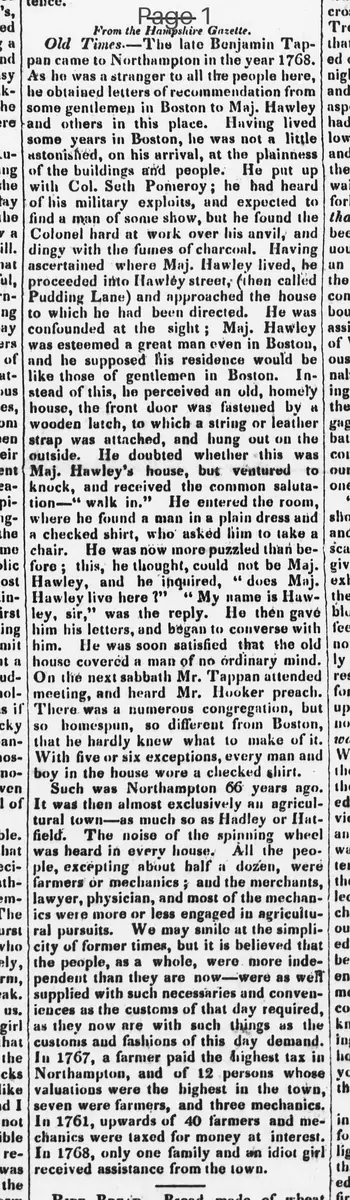
Old Times.—The late Benjamin Tappan came to Northampton in the year 1768. As he was a stranger to all the people here, he obtained letters of recommendation from some gentlemen in Boston to Maj. Hawley and others in this place. Having lived some years in Boston, he was not a little astonished, on his arrival, at the plainness of the buildings and people. He put up with Col. Seth Pomeroy; he had heard of his military exploits, and expected to find a man of some show, but he found the Colonel hard at work over his anvil, and dingy with the fumes of charcoal. Having ascertained where Maj. Hawley lived, he proceeded into Hawley street, (then called Pudding Lane) and approached the house to which he had been directed. He was confounded at the sight; Maj. Hawley was esteemed a great man even in Boston, and he supposed his residence would be like those of gentlemen in Boston. Instead of this, he perceived an old, homely house, the front door was fastened by a wooden latch, to which a string or leather strap was attached, and hung out on the outside. He doubted whether this was Maj. Hawley's house, but ventured to knock, and received the common salutation—"walk in." He entered the room, where he found a man in a plain dress and a checked shirt, who asked him to take a chair. He was now more puzzled than before: this, he thought, could not be Maj. Hawley, and he inquired, "does Maj. Hawley live here?" "My name is Hawley, sir," was the reply. He then gave him his letters, and began to converse with him. He was soon satisfied that the old house covered a man of no ordinary mind. On the next sabbath Mr. Tappan attended meeting, and heard Mr. Hooker preach. There was a numerous congregation, but so homespun, so different from Boston, that he hardly knew what to make of it. With five or six exceptions, every man and boy in the house wore a checked shirt. Such was Northampton 66 years ago. It was then almost exclusively an agricultural town—as much so as Hadley or Hatfield. The noise of the spinning wheel was heard in every house. All the people, excepting about half a dozen, were farmers or mechanics; and the merchants, lawyer, physician, and most of the mechanics were more or less engaged in agricultural pursuits. We may smile at the simplicity of former times, but it is believed that the people, as a whole, were more independent than they are now—were as well supplied with such necessaries and conveniences as the customs of that day required, as they now are with such things as the customs and fashions of this day demand. In 1767, a farmer paid the highest tax in Northampton, and of 12 persons whose valuations were the highest in the town, seven were farmers, and three mechanics. In 1761, upwards of 40 farmers and mechanics were taxed for money at interest. In 1768, only one family and an idiot girl received assistance from the town.
What sub-type of article is it?
What keywords are associated?
What entities or persons were involved?
Where did it happen?
Domestic News Details
Primary Location
Northampton
Event Date
1768
Key Persons
Outcome
in 1768, only one family and an idiot girl received assistance from the town. people were more independent than now, well-supplied with necessaries per customs.
Event Details
Benjamin Tappan arrived in Northampton in 1768 from Boston, astonished by the plain buildings and people. Stayed with Col. Seth Pomeroy, found working at anvil. Visited Maj. Hawley's simple home with latch-string door, met him in checked shirt. Attended church where most wore checked shirts. Town was agricultural like Hadley or Hatfield, spinning wheels everywhere, most were farmers or mechanics engaged in agriculture. Highest taxpayers in 1767 were farmers, many taxed on interest in 1761.