Thank you for visiting SNEWPapers!
Sign up free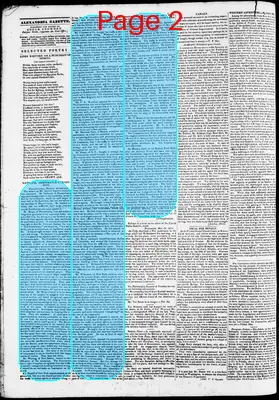
Phenix Gazette
Alexandria, Virginia
What is this article about?
The National Temperance Convention in Philadelphia debated a resolution declaring the traffic and use of ardent spirits morally wrong, with objections from some delegates citing expediency. The resolution passed, along with forming a National Union Temperance Society and recommending pure water over spirits.
Clipping
OCR Quality
Full Text
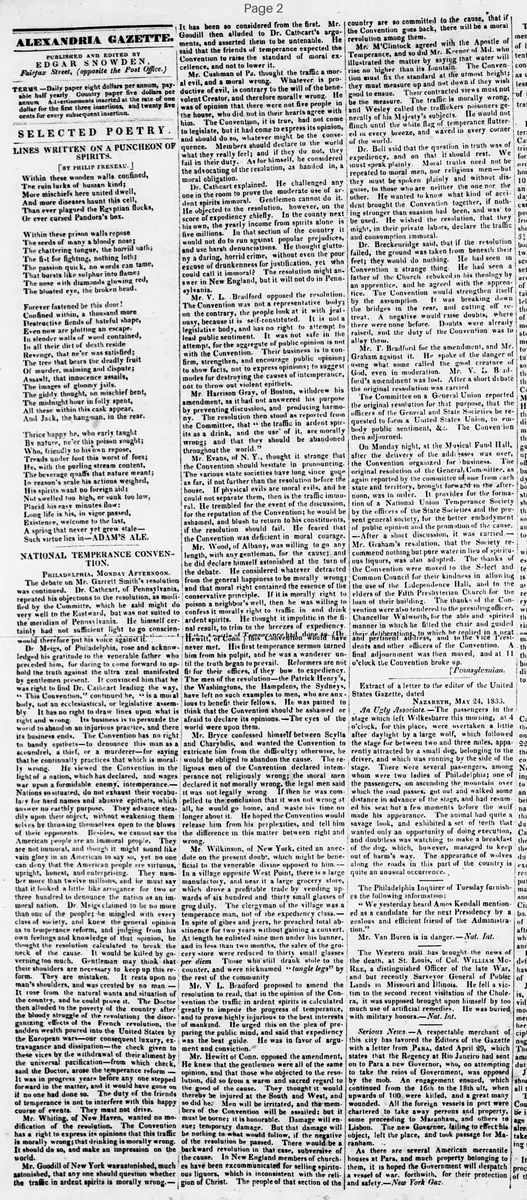
Philadelphia, Monday Afternoon.
The debate on Mr. Gerrit Smith's resolution was continued. Dr. Cathcart, of Pennsylvania, repeated his objections to the resolution, as modified by the Committee, which he said might do very well to the Eastward, but was not suited to the meridian of Pennsylvania. He himself certainly had not sufficient light to go conscientiously with it, and would therefore put his voice against it.
Dr. Meigs, of Philadelphia, rose and acknowledged his gratitude to the venerable father who preceded him, for daring to come forward to uphold the truth against the ultra zeal manifested by gentlemen present. It convinced him that he was right to find Dr. Cathcart leading the way. "This Convention," continued he, "is a moral body, not an ecclesiastical or legislative assembly. It has no right to draw lines upon what is right and wrong. Its business is to persuade the world to abandon an injurious practice, and there its business ends. The Convention has no right to bandy epithets-to denounce this man as a scoundrel, a thief, or a murderer-for saying that he continually practices that which is morally wrong."
He viewed the Convention in the light of a nation, which has declared, and wages war upon a formidable enemy-intemperance. Nations so situated, do not exhaust their vocabulary for hard names and abusive epithets, which answer no earthly purpose. They advance steadily upon their object, without weakening themselves by throwing themselves open to the blows of their opponents. Besides, we cannot say the American people are an immoral people. They are not immoral, and though it might sound like vain glory in an American to say so, yet no one can deny that the American people are virtuous, upright, honest, and enterprising. They number more than twelve millions, and he must say that it looked a little like arrogance for two or three hundred to denounce the nation as an immoral nation. Dr. Meigs claimed to be no more than one of the people; he mingled with every class of society, and knew the general opinion as to temperance reform, and judging from his own feelings and knowledge of that opinion, he thought the resolution calculated to break the neck of the cause.
It would be killed by governing too much. Gentlemen may think that their shoulders are necessary to keep up this reform. They are mistaken. It rests upon no man's shoulders, and was created by no man. It rose from the natural wants and situation of the country, and he could prove it. The Doctor then alluded to the poverty of the country after the bloody struggle of the revolution; the disorganizing effects of the French revolution, the sudden wealth poured into the United States by the European wars-our consequent luxury, extravagance and dissipation-the check given to these vices by the withdrawal of their aliment by the universal pacification-from which check, said the Doctor, arose the temperance reform. It was in progress years before any one stepped forward in the matter, and it would have gone on if no one had done so. The duty of the friends of temperance is not to interfere with this happy course of events. They must not drive.
Mr. Whiting, of New Haven, wanted no modification of the resolution. The Convention has a right to express its opinions that this traffic is morally wrong; that drinking is morally wrong. It should do so, and make an impression on the world.
Mr. Goodell of New York was astonished, much astonished, that any one should question whether the traffic in ardent spirits is morally wrong. It has been so considered from the first. Mr. Goodell then alluded to Dr. Cathcart's arguments, and asserted them to be untenable. He said that the friends of temperance expected the Convention to raise the standard of moral excellence, and not to lower it.
Mr. Cushman of Pa. thought the traffic a moral evil, and a moral wrong. Whatever is productive of evil, is contrary to the will of the benevolent Creator, and therefore morally wrong. He was of opinion that there were not five people in the house, who did not in their hearts agree with him. The Convention, it is true, had not come to legislate, but it had come to express its opinion, and should do so, whatever might be the consequence. Members should declare to the world what they really feel; and if they do not, they fail in their duty. As for himself, he considered the advocating of the resolution, as handed in, a moral obligation.
Dr. Cathcart explained. He challenged any one in the room to prove the moderate use of ardent spirits immoral. Gentlemen cannot do it. He objected to the resolution, however, on the score of expediency chiefly. In the county next his own, the yearly income from spirits alone is five millions. In that section of the country it would not do to run against popular prejudices, and use harsh denunciations. He thought gluttony a daring, horrid crime, without even the poor excuse of drunkenness for justification, yet who could call it immoral? The resolution might answer in New England, but it will not do in Pennsylvania.
Mr. V. L. Bradford opposed the resolution. The Convention was not a representative body; on the contrary, the people look at it with jealousy, because it is self-constituted. It is not a legislative body, and has no right to attempt to lead public sentiment. It was not safe in the attempt, for the aggregate of public opinion is not with the Convention. Their business is to confirm, strengthen, and encourage public opinion; to show facts, not to express opinions; to suggest modes for destroying the causes of intemperance, not to throw out violent epithets.
Mr. Harrison Gray, of Boston, withdrew his amendment, as it had not answered his purpose by preventing discussion, and producing harmony. The resolution then stood as reported from the Committee, that "the traffic in ardent spirits as a drink, and the use of it, are morally wrong; and that they should be abandoned throughout the world."
Mr. Evans, of N. Y., thought it strange that the Convention should hesitate in pronouncing. The various state societies have long since gone as far, if not further than the resolution before the house. If physical evils are moral evils, and he could not separate them, then is the traffic immoral. He trembled for the event of the discussion, for the reputation of the Convention; he would be ashamed, and blush to return to his constituents, if the resolution should fail. He feared that the Convention was deficient in moral courage.
Mr. Wood, of Albany, was willing to go any length, with any gentleman, for the cause; and he did declare himself astonished at the turn of the debate. He considered whatever detracted from the general happiness to be morally wrong; and that moral right contained the essence of the conservative principle. If it is morally right to poison a neighbor's well, then he was willing to confess it morally right to traffic in and drink ardent spirits. He thought it impolitic in the final result, to trim to the breezes of expediency.
Mr. Hewitt, of Conn., thought that if the resolution passed, it would be like Uncle Tom's conversion-he would never met. His first temperance sermon turned him from his pulpit, and he was a wanderer until the truth began to prevail. Reformers are not fit for their offices, if they bow to expediency. The men of the revolution-the Patrick Henry's, the Washingtons, the Hampdens, the Sydneys-have left no such examples to men, who are anxious to benefit their fellows. He was pained to think that the Convention should be ashamed or afraid to declare its opinions. The eyes of the world were upon them.
Mr. Bryce confessed himself between Scylla and Charybdis, and wanted the Convention to extricate him from the difficulty; otherwise, he would be obliged to abandon the cause. The religious men of the Convention declared intemperance not religiously wrong; the moral men declared it not morally wrong; the legal men said it was not legally wrong. If then he was compelled to the conclusion that it was not wrong at all, he would go home, and waste his time no longer about it. He hoped the Convention would release him from his perplexities, and tell him the difference in this matter between right and wrong.
Mr. Wilkinson, of New York, cited an anecdote on the present doubt, which might be beneficial to the venerable divine opposed to him. In a village opposite West Point, there is a large manufactory, and near it a large grocery store, which drove a profitable trade by vending upwards of six hundred and thirty small glasses of grog daily. The clergyman of the village was a temperance man, not of the expediency class. In spite of gibes and jeers, he preached total abstinence for two years without gaining a convert. At length he enlisted nine men under his banner, and in less than two months, the sales of the grocery store were reduced to thirty small glasses per diem. Those who still drank stole to the counter, and were nicknamed "long legs" by the rest of the community.
Mr. V. L. Bradford proposed to amend the resolution to read, that in the opinion of the Convention the traffic in ardent spirits is calculated greatly to impede the progress of temperance, and to prove highly injurious to the best interests of mankind. He urged this on the plea of preparing the public mind, and said that expediency was the best guide. He was in favor of argument and conviction.
Mr. Hewitt of Conn. opposed the amendment. He knew that the gentlemen were all of the same opinion, and that those who objected to the resolution, did so from a warm and sacred regard to the good of the cause. They thought it would thereby be injured at the South and West, and so did he. Men will be irritated, and the members of the Convention will be assailed: but it must be borne; it is honorable. Damage will ensue; temporary damage. But that damage will be nothing to what would follow, if the negative of the resolution be passed. There would be a backward revolution in that case, subversive of the cause. In New England members of churches have been excommunicated for selling spirituous liquors, which is inconsistent with the religion of Christ. The people of that section of the country are so committed to the cause, that if the Convention goes back, there will be a moral revolution among them.
Mr. M'Clintock agreed with the Apostle of Temperance, and so did Mr. Keener of Md. who illustrated the matter by saying that water will rise no higher than its fountain. The Convention must fix the standard at the utmost height; they must measure up and not down if they wish good to ensue. Their contracted views must not be the measure. The traffic is morally wrong, and Wesley called the traffickers poisoners generally of his Majesty's subjects. He would not flinch until the white flag of temperance fluttered in every breeze, and waved in every corner of the world.
Dr. Bell said that the question in truth was of expediency, and on that it should rest. We must speak plainly. Moral truths need not be repeated to moral men, nor religious men-but they must be spoken plainly and without disguise, to those who are neither the one nor the other. He wanted to know what kind of accident brought the Convention together, if nothing stronger than suasion had been, and was to be used. He wished the resolution, that they might, in their private labors, declare the traffic and consumption immoral.
Dr. Breckenridge said, that if the resolution failed, the ground was taken from beneath their feet; they would do nothing. Ye had seen in Convention a strange thing. He had seen a father of the Church rebuked in his theology by an apprentice, and he agreed with the apprentice. The Convention would strengthen itself by the assumption. It was breaking down the bridges in the rear, and cutting off retreat. A negative would raise doubts, where there were none before. Doubts were already raised, and the duty of the Convention was to allay them.
Mr. T. Bradford for the amendment, and Mr. Graham against it. He spoke of the danger of using what some called the good creature of God, even in moderation. Mr. V. L. Bradford's amendment was lost. After a short debate the original resolution was carried.
The Committee on a General Union reported the original resolution for that purpose, that the officers of the General and State Societies be requested to form a United States Union, to embody public sentiment, &c. The Convention then adjourned.
On Monday night, at the Musical Fund Hall, after the delivery of the addresses was over, the Convention organized for business. The original resolution of the General Committee, as again reported by the committee of one from each state and territory, brought forward in the afternoon, was in order. It provides for the formation of a National Union Temperance Society by the officers of the State Societies and the present general society, for the better embodiment of public opinion and the promotion of the cause. After a short discussion, it was carried.
Mr. Graham's resolution, that the Society recommend nothing but pure water in lieu of spirituous liquors, was also adopted. The thanks of the Convention were moved to the Select and Common Council for their kindness in allowing the use of the Independence Hall, and to the elders of the Fifth Presbyterian Church for the loan of their building. The thanks of the Convention were also tendered to the presiding officer, Chancellor Walworth, for the able and spirited manner in which he filled the chair and guided their deliberations, to which he replied in a neat and pertinent address, and to the Vice Presidents and other officers of the Convention. A final adjournment was then moved, and at 11 o'clock the Convention broke up.
[Pennsylvanian.]
What sub-type of article is it?
What keywords are associated?
What entities or persons were involved?
Where did it happen?
Domestic News Details
Primary Location
Philadelphia
Event Date
Monday Afternoon
Key Persons
Outcome
the original resolution declaring the traffic and use of ardent spirits morally wrong was passed after debate and amendments were rejected. a national union temperance society was formed, and a resolution recommending pure water over spirits was adopted. the convention adjourned with thanks to hosts and officers.
Event Details
The National Temperance Convention debated Mr. Gerrit Smith's resolution on the moral wrongness of the traffic and use of ardent spirits, with objections from Dr. Cathcart and Dr. Meigs on grounds of expediency and the convention's role. Supporters like Mr. Goodell and Mr. Cushman argued for expressing moral opinions. Amendments were proposed and lost, and the original resolution passed. Further resolutions on forming a union and recommending water were adopted.