Thank you for visiting SNEWPapers!
Sign up free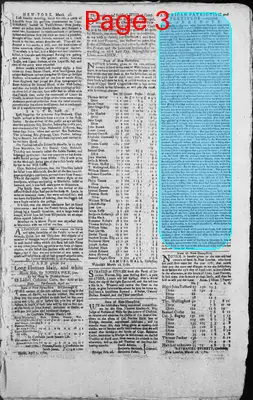
The New Hampshire Gazette And General Advertiser
Portsmouth, Exeter, Rockingham County, New Hampshire
What is this article about?
Account of the Battle of Bennington in August 1777, where American militia under General Stark defeated British Col. Baum's forces, saving the town. Amid victory, false alarms arise but are dispelled. An old father nobly mourns his slain son, exemplifying patriotism.
Clipping
OCR Quality
Full Text
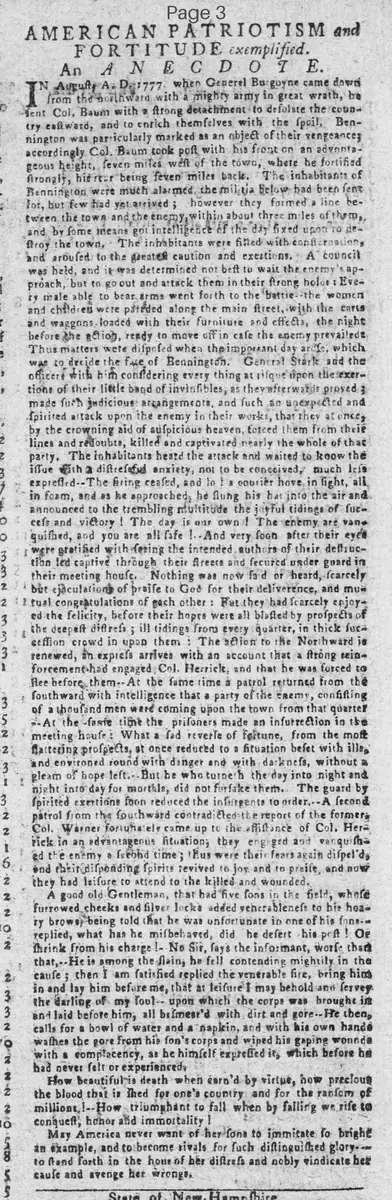
An ANECDOTE.
In August, A. D. 1777, when General Burgoyne came down from the northward with a mighty army in great wrath, he sent Col. Baum with a strong detachment to desolate the country eastward, and to enrich themselves with the spoil, Bennington was particularly marked as an object of their vengeance; accordingly Col. Baum took post with his front on an advantageous height, seven miles west of the town, where he fortified strongly, his rear being seven miles back. The inhabitants of Bennington were much alarmed, the militia below had been sent for, but few had yet arrived; however they formed a line between the town and the enemy, within about three miles of them, and by some means got intelligence of the day fixed upon to destroy the town. The inhabitants were filled with consternation, and aroused to the greatest caution and exertions. A council was held, and it was determined not best to wait the enemy's approach, but to go out and attack them in their strong hold: Every male able to bear arms went forth to the battle—the women and children were paraded along the main street, with the carts and waggons, loaded with their furniture and effects, the night before the action, ready to move off in case the enemy prevailed.
Thus matters were disposed when the important day arrived, which was to decide the fate of Bennington. General Stark and the officers with him considering every thing at risque upon the exertions of their little band of invincibles, as they afterwards proved; made such judicious arrangements, and such an unexpected and spirited attack upon the enemy in their works, that they at once, by the crowning aid of auspicious heaven, forced them from their lines and redoubts, killed and captivated nearly the whole of that party. The inhabitants heard the attack and waited to know the issue with a distressing anxiety, not to be conceived, much less expressed—The firing ceased, and lo! a courier hove in sight, all in a foam, and as he approached, he slung his hat into the air and announced to the trembling multitude the joyful tidings of success and victory! The day is our own! The enemy are vanquished, and you are all safe!.—And very soon after their eyes were gratified with seeing the intended authors of their destruction led captive through their streets and secured under guard in their meeting house. Nothing was now said or heard, scarcely but ejaculations of praise to God for their deliverance, and mutual congratulations of each other: But they had scarcely enjoyed the felicity, before their hopes were all blasted by prospects of the deepest distress; ill tidings from every quarter, in thick succession crowd in upon them: The action to the Northward is renewed, an express arrives with an account that a strong reinforcement had engaged Col. Herrick, and that he was forced to flee before them—At the same time a patrol returned from the southward with intelligence that a party of the enemy, consisting of a thousand men were coming upon the town from that quarter—At the same time the prisoners made an insurrection in the meeting house: What a sad reverse of fortune, from the most flattering prospects, at once reduced to a situation beset with ills and environed round with danger and with darkness, without a gleam of hope left.—But he who turneth the day into night and night into day for mortals, did not forsake them. The guard by spirited exertions soon reduced the insurgents to order,—A second patrol from the southward contradicted the report of the former—Col. Warner fortunately came up to the assistance of Col. Herrick in an advantageous situation; they engaged and vanquished the enemy a second time; thus were their fears again dispelled, and their desponding spirits revived to joy and to praise, and now they had leisure to attend to the killed and wounded.
A good old Gentleman, that had five sons in the field, whose furrowed cheeks and silver locks added venerableness to his hoary brows, being told that he was unfortunate in one of his sons.—replied, what has he misbehaved, did he desert his post! Or shrink from his charge!—No Sir, was the informant, worse than that,—He is among the slain, he fell contending mightily in the cause; then I am satisfied replied the venerable sire, bring him in and lay him before me, that at leisure I may behold and survey the darling of my soul—upon which the corpse was brought in and laid before him, all bemired with dirt and gore—He then calls for a bowl of water and a napkin, and with his own hands washes the gore from his son's corpse and wiped his gaping wounds with a complacency, as he himself expressed it, which before he had never felt or experienced.
How beautiful is death when earned by virtue, how precious the blood that is shed for one's country and for the ransom of millions!—How triumphant to fall when by falling we rise to conquest, honor and immortality!
May America never want of her sons to imitate so bright an example, and to become rivals for such distinguished glory—to stand forth in the hour of her distress and nobly vindicate her cause and avenge her wrongs.
What sub-type of article is it?
What themes does it cover?
What keywords are associated?
What entities or persons were involved?
Where did it happen?
Story Details
Key Persons
Location
Bennington
Event Date
August, A. D. 1777
Story Details
American militia under General Stark attack and defeat British Col. Baum's forces at Bennington, capturing most. Amid victory celebrations, false alarms of enemy reinforcements and prisoner uprising cause panic, but are resolved. An old father with five sons in battle stoically washes and honors his slain son's body, exemplifying patriotism.