Thank you for visiting SNEWPapers!
Sign up free
The Northern Star, And Farmers' And Mechanics' Advocate
Warren, Bristol County, Rhode Island
What is this article about?
President's message to Congress highlighting domestic prosperity, health, peace, abundance, flourishing commerce and industry; overview of honorable foreign relations seeking just policy; updates on negotiations with Britain regarding North-Eastern Boundary and Bahamas lighthouses; unfulfilled French convention stipulations from 1831; new Russia treaty; Spanish indemnification for claims and tonnage/discriminating duties issues; delay in Florida archives delivery.
Merged-components note: Merged continuation of the President's Message to Congress across pages.
Clippings
1 of 2
OCR Quality
Full Text
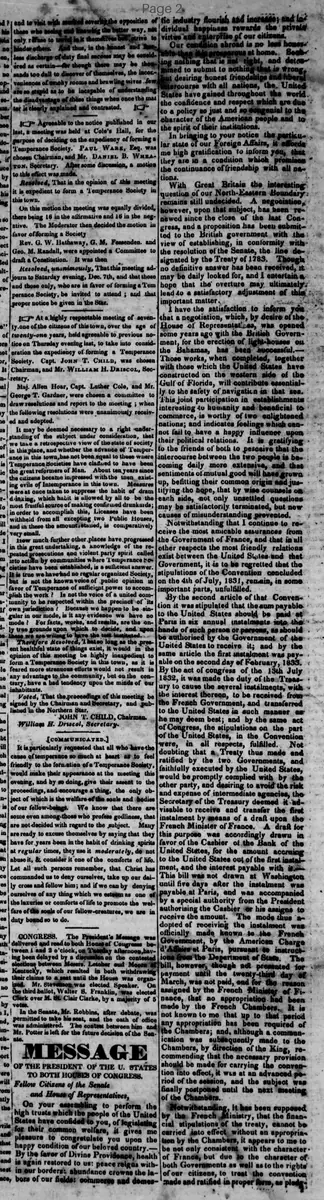
OF THE PRESIDENT OF THE U. STATES
TO BOTH HOUSES OF CONGRESS.
Fellow Citizens of the Senate and House of Representatives,
On your assembling to perform the high trusts which the people of the United States have confided to you, of legislating for their common welfare, it gives me pleasure to congratulate you upon the happy condition of our beloved country. By the favor of Divine Providence, health is again restored to us: peace reigns within our borders: abundance crowns the labors of our fields: commerce and domestic industry flourish and increase; and individual happiness rewards the private virtue and enterprise of our citizens.
Our condition abroad is no less honorable than this prosperous at home. Seeking nothing that is not right, and determined to submit to nothing that is wrong, but desiring honest friendships and liberal intercourse with all nations, the United States have gained throughout the world the confidence and respect which are due to a policy so just and so congenial to the character of the American people and to the spirit of their institutions.
In bringing to your notice the particular state of our Foreign Affairs, it affords me high gratification to inform you that they are in a condition which promises the continuance of friendship with all nations. With Great Britain the interesting question of our North-Eastern Boundary remains still undecided. A negotiation, however, upon that subject, has been renewed since the close of the last Congress, and a proposition has been submitted to the British government with the view of establishing, in conformity with the resolution of the Senate, the line designated by the Treaty of 1783. Though no definitive answer has been received, it may be daily looked for, and I entertain a hope that the overture may, ultimately lead to a satisfactory adjustment of this important matter.
I have the satisfaction to inform you that a negotiation, which, by desire of the House of Representatives, was opened some years ago with the British Government, for the erection of light-houses on the Bahamas, has been successful. Those works, when completed, together with those which the United States have constructed on the western side of the Gulf of Florida, will contribute essentially to the safety of navigation in that sea. This joint participation in establishments interesting to humanity and beneficial to commerce, is worthy of two enlightened nations; and indicates feelings which cannot fail to have a happy influence upon their political relations. It is gratifying to the friends of both to perceive that the intercourse between the two people is becoming daily more extensive, and that sentiments of mutual good will have grown up, befitting their common origin and justifying the hope, that by wise counsels on each side, not only unsettled questions may be satisfactorily terminated, but new causes of misunderstanding prevented.
Notwithstanding that I continue to receive the most amicable assurances from the Government of France, and that in all other respects the most friendly relations exist between the United States and that Government, it is to be regretted that the stipulations of the Convention concluded on the 4th of July, 1831, remain, in some important parts, unfulfilled.
By the second article of that Convention it was stipulated that the sum payable to the United States should be paid at Paris in six annual instalments into the hands of such person or persons, as should be authorised by the Government of the United States to receive it; and by the same article the first instalment was payable on the second day of February, 1833. By the act of congress of the 13th July 1832, it was made the duty of the Treasury to cause the several instalments, with the interest thereon, to be received from the French Government, and transferred to the United States in such manner as he may deem best; and by the same act of Congress, the stipulations on the part of the United States, in the Convention were, in all respects, fulfilled. Not doubting that a Treaty thus made and ratified by the two Governments, and faithfully executed by the United States, would be promptly complied with by the other party, and desiring to avoid the risk and expense of intermediate agencies, the Secretary of the Treasury deemed it advisable to receive and transfer the first instalment by means of a draft upon the French Minister of France. A draft for this purpose was accordingly drawn in favor of the Cashier of the Bank of the United States, for the amount accruing to the United States out of the first instalment, and the interest payable with it. This bill was not drawn at Washington until five days after the instalment was payable at Paris, and was accompanied by a special authority from the President authorising the Cashier or his assigns to receive the amount. The mode thus adopted of receiving the instalment was officially made known to the French Government, by the American Charge d'Affairs at Paris, pursuant to instructions from the Department of State. The bill, however, though not presented for payment until the twenty-third day of March, was not paid, and for the reason assigned by the French Minister of Finance, that no appropriation had been made by the French Chambers. It is not known to me that up to that period any appropriation has been required of the Chambers; and, although a communication was subsequently made to the Chambers, by direction of the King, recommending that the necessary provision should be made for carrying the convention into effect, it was at an advanced period of the session, and the subject was finally postponed until the next meeting of the Chambers.
Notwithstanding, it has been supposed by the French Ministry, that the financial stipulations of the treaty, cannot be carried into effect without an appropriation by the Chambers, it appears to me to be not only consistent with the character of France, but due to the character of both Governments as well as to the rights of our citizens, to treat the convention made and ratified in proper form, as pledging the faith of the contracting parties, and to hold France to a compliance with its obvious import.
It is the good faith of the French Government for its execution, and as imposing upon each Department an obligation to fulfill it—and I have received, through Chargé d'Affaires at Paris and through the French Minister Plenipotentiary at Washington, and more recently through the Minister of the United States at Paris, that the delay has not proceeded from any indisposition on the part of the King and his Ministers to fulfill the treaty, and that measures will be presented at the next meeting of the Chambers, and with a reasonable hope of success, to obtain the necessary appropriations.
It is necessary to state, however, that the documents, except certain lists of vessels captured, condemned or burnt at sea proper to facilitate the examination and liquidation of the reclamations comprised in the stipulation of the Convention, and which by the 6th Article France engaged to communicate to the United States by the intermediary of the legation; though repeatedly applied for by the American Chargé d'Affaires, under instructions from this Government, have not yet been communicated; and this delay, it is apprehended, will necessarily prevent completion of the duties assigned to the Commissioners within the time at present prescribed by law.
The reasons for delaying to communicate these documents have not been explicitly stated; and this is the more to be regretted, as it is not understood that the interposition of the Chambers is in any manner required for the delivery of those papers.
Under these circumstances, in a case so important to the interest of our citizens and to the character of our country, and under disappointments so unexpected, I deemed it my duty, however I might respect the general assurances to which I have adverted, no longer to delay the appointment of Minister Plenipotentiary to Paris, but to despatch him in season to communicate the result of his application to the French Government at an early period of your session. I accordingly appointed a distinguished citizen for this purpose, who proceeded on his mission on August last, and was presented to the King, early in the month of October, since which time no despatches have been received from him. He is particularly instructed as to all matters connected with the present posture of affairs, and I indulge the hope, that with the representations he is instructed to make, and from the disposition manifested by the King and his ministers, in their recent assurances to our Minister at Paris, the subject will be early considered and satisfactorily disposed of at the meeting of the Chambers.
As this subject involves important interests and has attracted a considerable share of the public attention, I have deemed it proper to make this explicit statement of its actual condition: and should I be disappointed in the hope now entertained, the subject will be again brought to the notice of Congress in such manner as the occasion may require.
The friendly relations which have always been maintained between the United States and Russia, have been further extended and strengthened by the treaty of navigation and commerce concluded on the 6th of December last, and sanctioned by the Senate before the close of its last session. The ratifications have since been exchanged, the liberal provisions of the treaty are now in full force; and, under the encouragement which they have received a flourishing and increasing commerce, yielding benefits to the enterprise of both nations, affords to each the just recompense of wise measures, and adds new motives for that mutual friendship which the two countries have hitherto cherished towards each other.
It affords me peculiar satisfaction to state that the Government of Spain has at length yielded to the justice of the claims which have been so long urged in behalf of our citizens, and has expressed a willingness to provide an indemnification, as soon as the proper amount can be agreed upon. Upon this latter point, it is probable an understanding had taken place between the Minister of the United States and the Spanish Government, before the decease of the late King of Spain, and, unless that event may have delayed its completion, there is reason to hope that it may be in my power to announce to you, early in your present session, the conclusion of convention upon terms not less favorable than those entered into for similar objects with other nations. That act of justice would well accord with the character of Spain, and is due to the U. States from their ancient friend. It could not fail to strengthen the sentiments of amity and good will between the two nations which it is so much the wish of the United States to cherish, and so truly the interest of both to maintain.
By the first section of an act of Congress passed on the 13th July, 1823, the tonnage duty on Spanish ships arriving from the ports of Spain, was limited to the duty payable on American vessels in the ports of Spain previous to the 20th October, 1817, being five cents per ton. That act was intended to give effect, on our side, to an arrangement made with the Spanish government, by which discriminating duties of tonnage were to be abolished in the ports of the United States and Spain on the vessels of the two nations. Pursuant to that arrangement which was carried into effect on the part of Spain on the 20th of May, 1832, by a Royal order, dated the 29th of April, 1832, American vessels in the ports of Spain have paid five cents per ton, which rate of duty is also paid in those ports by Spanish ships: but as American vessels pay no tonnage duty in ports of the United States the duty of five cents payable in our ports by Spanish vessels under the act above mentioned, is really a discriminating duty, operating to the disadvantage of Spain. Though no complaint has yet been made on the part of Spain, we are not the less bound by obligations of good faith to remove the discrimination; and recommend the act be amended accordingly. As the Royal order above alluded to includes the Ports of the Balearic and Canary Islands, as well as those of Spain, it would seem that the provision of the act of Congress should be equally extensive; and that for the repayment of such duties as may have been improperly received, an addition should be made to the sum appropriated at the last session of Congress for refunding discriminating duties.
As the arrangement referred to, however, did not embrace the islands of Cuba and Porto Rico, discriminating duties, to the prejudice of American shipping, continue to be levied there. From the extent of the commerce carried on between the United States and those islands, particularly the former, this discrimination causes serious injury to those great national interests which it has been considered an essential part of our policy to cherish, and has given rise to complaints on the part of our merchants. Under instructions given to our Minister at Madrid; earnest representations have been made by him to the Spanish Government upon this subject, and there is reason to expect, from the friendly disposition which is entertained towards this country that a beneficial change will be produced. The disadvantage, however; to which our shipping is subjected by the operation of these discriminating duties, requires that they be met by suitable countervailing duties during your present session; power being at the same time vested in the President to modify or discontinue them, as the discriminating duties on American vessels or their cargoes may be modified or discontinued at these islands. Intimations have been given to the Spanish government, that the United States may be obliged to resort to such measures as are of necessary self-defence; and there is no reason to apprehend that it would be unfavorably received. The proposed proceeding, if adopted, would not be permitted, however, in any degree, to induce a relaxation in the efforts of our Minister to effect a repeal of this irregularity by friendly negotiation, and it might serve to give force to his representations by showing the dangers to which that valuable trade is exposed by the obstructions, and burthens which a system of discriminating and countervailing duties necessarily produces.
The selection and preparation of the Florida archives for the purpose of being delivered over to the U. States, in conformity with the Royal order, as mentioned in my last annual message, though in progress, has not yet been completed. This delay has been produced partly by causes which were unavoidable, particularly the prevalence of the cholera at Havana; but measures have been taken which it is believed will expedite the delivery of those important records.
[Concluded in our next.]
What sub-type of article is it?
What keywords are associated?
Where did it happen?
Domestic News Details
Primary Location
United States
Event Details
The President congratulates Congress on the prosperous domestic condition including restored health, peace, abundance in fields, flourishing commerce and industry, and individual happiness. Abroad, the U.S. maintains honorable relations based on just policy, gaining world confidence. Specific foreign affairs include ongoing North-Eastern Boundary negotiation with Britain per 1783 Treaty; successful negotiation for Bahamas lighthouses contributing to navigation safety; unfulfilled 1831 French Convention stipulations on payments and document delivery despite U.S. compliance; new navigation and commerce treaty with Russia effective after ratification exchange; Spain's agreement to indemnify U.S. claims; need to amend U.S. law on Spanish tonnage duties to remove discrimination; countervailing duties proposed for Cuba and Porto Rico discriminations; delay in delivering Florida archives due to cholera and other causes.