Thank you for visiting SNEWPapers!
Sign up free
Editorial
September 22, 1931
Douglas Daily Dispatch
Douglas, Cochise County, Arizona
What is this article about?
The Decatur Herald editorial satirically criticizes Illinois' legalization of horse and dog racing, justified as advancing agriculture but actually draining money from local merchants and harming business, with ongoing legal fights to close dog tracks near Chicago and St. Louis.
Clipping
OCR Quality
95%
Excellent
Full Text
With Other Editors
AS FOR THE FARMER
(Decatur Herald)
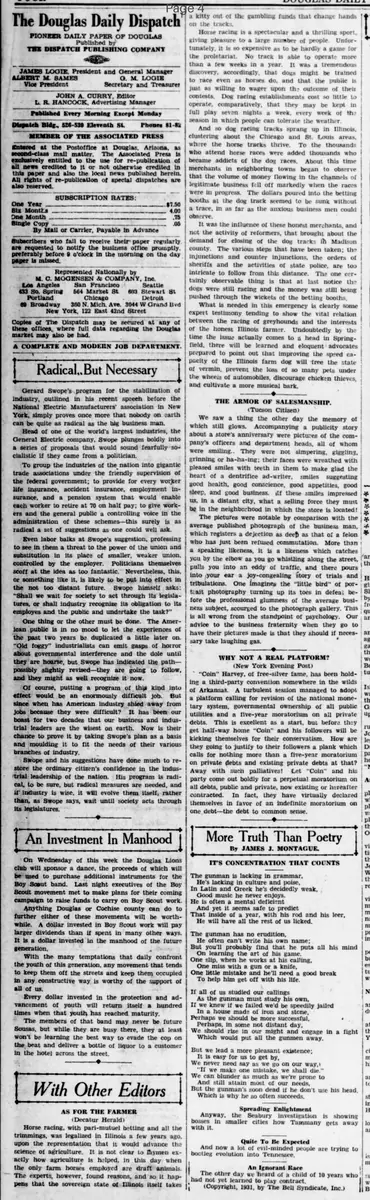
Horse racing, with pari-mutuel betting and all the trimmings, was legalized in Illinois a few years ago, upon the representation that it would advance the science of agriculture. It is not clear to Raymen exactly how agriculture is helped, in this day when the only farm horses employed are draft animals. The experts, however, found reasons, and so it happens that the sovereign state of Illinois itself takes a kitty out of the gambling funds that change hands on the tracks.
Horse racing is a spectacular and a thrilling sport, giving pleasure to a large number of people. Unfortunately, it is so expensive as to be hardly a game for the proletariat. No track is able to operate more than a few weeks in a year. It was a tremendous discovery, accordingly, that dogs might be trained to race even as horses do, and that the public is just as willing to wager upon the outcome of their contests. Dog racing establishments cost so little to operate, comparatively, that they may be kept in full play seven nights a week, every week of the season in which people can tolerate the weather.
And so dog racing tracks sprang up in Illinois, clustering about the Chicago and St. Louis areas, where the horse tracks thrive. To the thousands who attend horse races were added thousands who became addicts of the dog races. About this time merchants in neighboring towns began to observe that the volume of money flowing in the channels of legitimate business fell off markedly when the races were in progress. The dollars poured into the betting booths at the dog tracks seemed to be sunk without a trace, in as far as the anxious business men could observe.
It was the influence of these honest merchants, and not the activity of reformers, that brought about the demand for closing of the dog tracks in Madison county. The various steps that have been taken: the injunctions and counterinjunctions, the orders of sheriffs and the activities of state police, are too intricate to follow from this distance. The one certainly observable thing is that at last notice the dogs were still racing and the money was still being pushed through the wickets of the betting booths.
What is needed in this emergency is clearly some expert testimony tending to show the vital relation between the racing of greyhounds and the interests of the honest Illinois farmer. Undoubtedly by the time the issue actually comes to a head in Springfield, there will be learned and eloquent advocates prepared to point out that improving the speed capacity of the Illinois farm dog will free the state of vermin, prevent the loss of so many pets under the wheels of automobiles, discourage chicken thieves, and cultivate a more musical bark.
AS FOR THE FARMER
(Decatur Herald)
Horse racing, with pari-mutuel betting and all the trimmings, was legalized in Illinois a few years ago, upon the representation that it would advance the science of agriculture. It is not clear to Raymen exactly how agriculture is helped, in this day when the only farm horses employed are draft animals. The experts, however, found reasons, and so it happens that the sovereign state of Illinois itself takes a kitty out of the gambling funds that change hands on the tracks.
Horse racing is a spectacular and a thrilling sport, giving pleasure to a large number of people. Unfortunately, it is so expensive as to be hardly a game for the proletariat. No track is able to operate more than a few weeks in a year. It was a tremendous discovery, accordingly, that dogs might be trained to race even as horses do, and that the public is just as willing to wager upon the outcome of their contests. Dog racing establishments cost so little to operate, comparatively, that they may be kept in full play seven nights a week, every week of the season in which people can tolerate the weather.
And so dog racing tracks sprang up in Illinois, clustering about the Chicago and St. Louis areas, where the horse tracks thrive. To the thousands who attend horse races were added thousands who became addicts of the dog races. About this time merchants in neighboring towns began to observe that the volume of money flowing in the channels of legitimate business fell off markedly when the races were in progress. The dollars poured into the betting booths at the dog tracks seemed to be sunk without a trace, in as far as the anxious business men could observe.
It was the influence of these honest merchants, and not the activity of reformers, that brought about the demand for closing of the dog tracks in Madison county. The various steps that have been taken: the injunctions and counterinjunctions, the orders of sheriffs and the activities of state police, are too intricate to follow from this distance. The one certainly observable thing is that at last notice the dogs were still racing and the money was still being pushed through the wickets of the betting booths.
What is needed in this emergency is clearly some expert testimony tending to show the vital relation between the racing of greyhounds and the interests of the honest Illinois farmer. Undoubtedly by the time the issue actually comes to a head in Springfield, there will be learned and eloquent advocates prepared to point out that improving the speed capacity of the Illinois farm dog will free the state of vermin, prevent the loss of so many pets under the wheels of automobiles, discourage chicken thieves, and cultivate a more musical bark.
What sub-type of article is it?
Satire
Agriculture
Economic Policy
What keywords are associated?
Horse Racing
Dog Racing
Pari Mutuel Betting
Agriculture
Illinois
Gambling
Merchants
Farmers
What entities or persons were involved?
Decatur Herald
Illinois
Madison County
Illinois Farmer
Merchants
Editorial Details
Primary Topic
Critique Of Dog Racing Legalization Under Agricultural Pretext
Stance / Tone
Satirical Opposition To Gambling And Its Economic Impact
Key Figures
Decatur Herald
Illinois
Madison County
Illinois Farmer
Merchants
Key Arguments
Horse Racing Legalized In Illinois Claiming Agricultural Benefits, But Unclear How It Helps Modern Farming
Dog Racing Emerged As Cheaper Alternative, Attracting Gamblers And Harming Local Business
Merchants Observed Money Loss During Races, Leading To Demands For Closing Dog Tracks
Legal Battles Ongoing, But Tracks Still Operate
Satirical Suggestion: Invent Benefits Like Improving Farm Dog Speed For Vermin Control And Other Absurd Gains