Thank you for visiting SNEWPapers!
Sign up free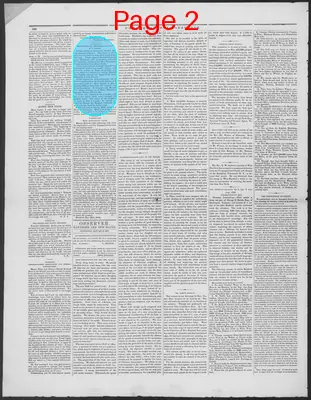
Literary
January 2, 1841
The Congregational Observer
Hartford, New Haven, Hartford County, New Haven County, Connecticut
What is this article about?
Noah Webster presents his third set of observations on orthography, advocating for simplified and etymologically consistent spellings such as 'afterward' without 's', 'mold' instead of 'mould', 'hainous' for 'heinous', 'tun' for 'ton', and 'Mode' over 'Mood' in grammar.
Clipping
OCR Quality
98%
Excellent
Full Text
SAYBROOK PLATFORM.
Communicated.
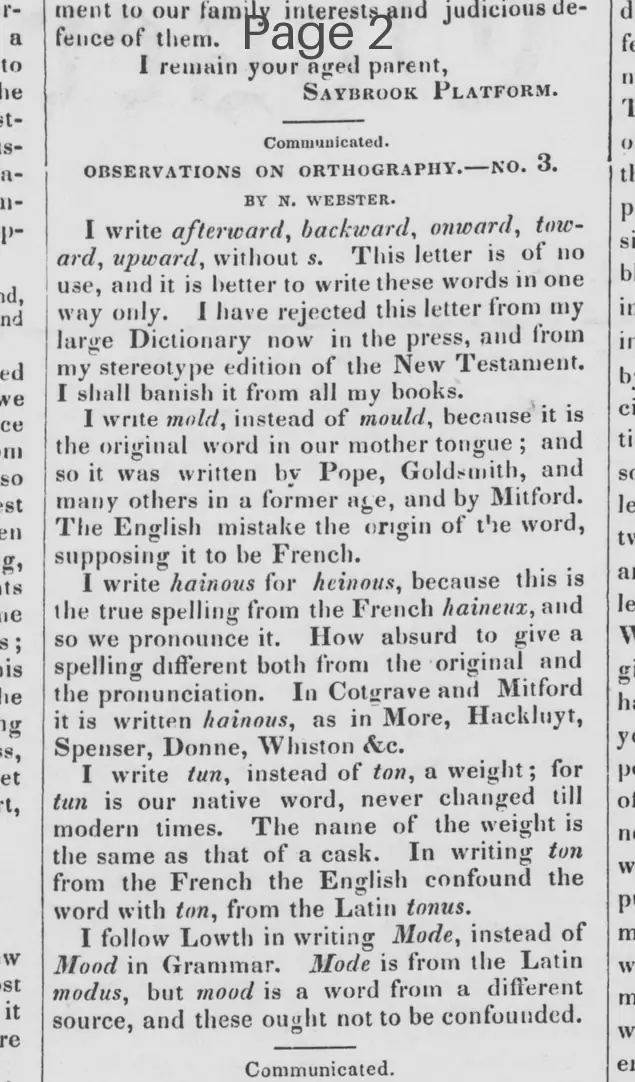
OBSERVATIONS ON ORTHOGRAPHY.—NO. 3.
BY N. WEBSTER.
I write afterward, backward, onward, toward, upward, without s. This letter is of no use, and it is better to write these words in one way only. I have rejected this letter from my large Dictionary now in the press, and from my stereotype edition of the New Testament. I shall banish it from all my books.
I write mold, instead of mould, because it is the original word in our mother tongue; and so it was written by Pope, Goldsmith, and many others in a former age, and by Mitford. The English mistake the origin of the word, supposing it to be French.
I write hainous for heinous, because this is the true spelling from the French haineux, and so we pronounce it. How absurd to give a spelling different both from the original and the pronunciation. In Cotgrave and Mitford it is written hainous, as in More, Hackluyt, Spenser, Donne, Whiston &c.
I write tun, instead of ton, a weight; for tun is our native word, never changed till modern times. The name of the weight is the same as that of a cask. In writing ton from the French the English confound the word with ton, from the Latin tonus.
I follow Lowth in writing Mode, instead of Mood in Grammar, Mode is from the Latin modus, but mood is a word from a different source, and these ought not to be confounded.
Communicated.
OBSERVATIONS ON ORTHOGRAPHY.—NO. 3.
BY N. WEBSTER.
I write afterward, backward, onward, toward, upward, without s. This letter is of no use, and it is better to write these words in one way only. I have rejected this letter from my large Dictionary now in the press, and from my stereotype edition of the New Testament. I shall banish it from all my books.
I write mold, instead of mould, because it is the original word in our mother tongue; and so it was written by Pope, Goldsmith, and many others in a former age, and by Mitford. The English mistake the origin of the word, supposing it to be French.
I write hainous for heinous, because this is the true spelling from the French haineux, and so we pronounce it. How absurd to give a spelling different both from the original and the pronunciation. In Cotgrave and Mitford it is written hainous, as in More, Hackluyt, Spenser, Donne, Whiston &c.
I write tun, instead of ton, a weight; for tun is our native word, never changed till modern times. The name of the weight is the same as that of a cask. In writing ton from the French the English confound the word with ton, from the Latin tonus.
I follow Lowth in writing Mode, instead of Mood in Grammar, Mode is from the Latin modus, but mood is a word from a different source, and these ought not to be confounded.
What sub-type of article is it?
Essay
What keywords are associated?
Orthography
Spelling
Webster
Dictionary
Etymology
Reform
What entities or persons were involved?
By N. Webster.
Literary Details
Title
Observations On Orthography.—No. 3.
Author
By N. Webster.
Subject
Observations On Orthography
Key Lines
I Write Afterward, Backward, Onward, Toward, Upward, Without S. This Letter Is Of No Use, And It Is Better To Write These Words In One Way Only.
I Write Mold, Instead Of Mould, Because It Is The Original Word In Our Mother Tongue; And So It Was Written By Pope, Goldsmith, And Many Others In A Former Age, And By Mitford.