Thank you for visiting SNEWPapers!
Sign up free
The Memphis Appeal
Memphis, Shelby County, Tennessee
What is this article about?
In Washington on March 18, the Ways and Means Committee advances the Mills tariff bill amid strict party divisions. Democrats, backed by President Cleveland, expect passage after debate, targeting a House vote in early May despite Republican obstruction and initial vote shortfall.
Clipping
OCR Quality
Full Text
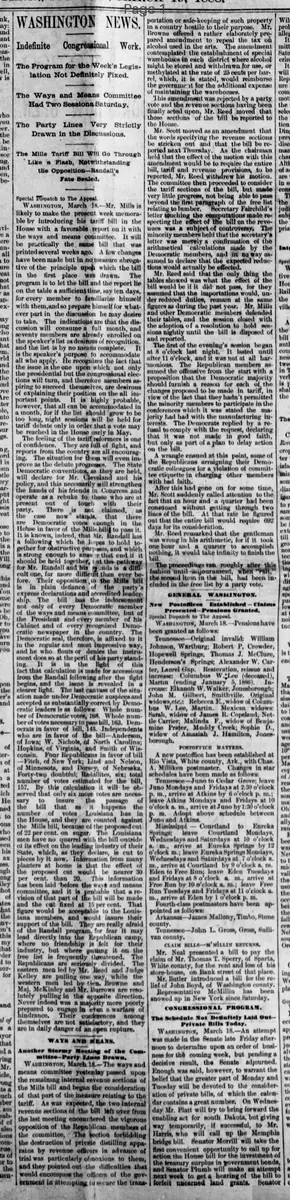
Indefinite Congressional Work.
The Program for the Week's Legislation Not Definitely Fixed.
The Ways and Means Committee Had Two Sessions Saturday.
The Party Lines Very Strictly Drawn in the Discussions.
The Mills Tariff Bill Will Go Through Like a Flash, Notwithstanding the Opposition--Randall's Fate Sealed,
Special Dispatch to The Appeal
WASHINGTON, March 18.-Mr. Mills is likely to make the present week memorable by introducing his tariff bill in the House with a favorable report on it with the ways and means committee. It will be practically the same bill that was printed several weeks ago. A few changes have been made but in no measure abrogative of the principle upon which the bill in the first place was drawn. The program is to let the bill and the report lie on the table a sufficient time, say ten days, for every member to familiarize himself with them, and so prepare himself for whatever part in the discussion he may desire to take. The indications are that the discussion will consume a full month, and seventy members are already enrolled on the speaker's list as desirous of recognition, and the list is by no means complete. It is the speaker's purpose to accommodate all who apply. He recognizes the fact that the issue is the one upon which not only the presidential but the congressional elections will turn, and therefore members aspiring to succeed themselves, are desirous of explaining their position on the all important points. It is highly probable, however, that all can be accommodated in a month, for if the list should grow to be too long, night sessions will be held for tariff debate only in order that a vote may be reached in the House early in May.
The feeling of the tariff reformers is one of confidence. They are full of fight, and reports from the country are all encouraging. The situation for them will even improve as the debate progresses. The State Democratic conventions, as they are held, will declare for Mr. Cleveland and his policy, and this necessarily will strengthen the hands of his friends in Congress and operate as a rebuke to those who are at present out of touch with their party. There is not claimed, as the case now stands, that there are Democratic votes enough in the House in favor of the Mills bill to pass it. It is known, indeed, that Mr. Randall has a following which he hopes to hold together for obstructive purposes, and which is strong enough to answer that end if it should be held together, but the pathway for Mr. Randall and his friends is a difficult one, far more difficult than ever before. Their opposition to the Mills bill is in plain defiance of the party's express declarations and accredited leadership. The bill has the indorsement not only of every Democratic member of the ways and means committee, but of the President and every member of his Cabinet and of every recognized Democratic newspaper in the country. The Democratic seal, therefore, is affixed to it in the regular and most impressive way, and he who flouts or denies the instrument does so at the peril of his party standing. It is in the light of this fact that calculation is made for accessions from the Randall following after the fight begins, and the issue is revealed in a clearer light. The last canvass of the situation made under Democratic auspices and accepted as substantially correct by Democratic leaders is as follows: Whole number of Democratic votes, 168. Whole number of votes necessary to pass bill, 163, Democrats in favor of bill, 143. Independents who are in favor of the bill--Anderson, of Iowa; W. Nichols, of North Carolina; Hopkins, of Virginia, and Smith of Wisconsin. Four Republicans in favor of bill--Fitch, of New York; Lind and Nelson, of Minnesota, and Dorsey, of Nebraska. Forty-two doubtful; Randallites, six; total number of votes estimated for the bill 157. By this calculation it will be observed that only six more votes are necessary to insure the passage of the bill that as it happens the number of votes Louisiana has in the House, and they are counted against the Mills bill, because of the proposed cut of 22 per cent. on sugar. The Louisiana men have no quarrel with the bill outside of its effect on the leading industry of their State, which, as they declare, is cut to pieces by it now. Information from many planters at home is that the effect of the proposed cut would be nearer 30 per cent. than 20. This information has been laid before the ways and means committee, and it is probable that a revision of that part of the bill will be made and the cut fixed at 15 per cent. That figure would be acceptable to the Louisiana members, and would insure their support of the bill. They are really afraid of the Randall program, for fear it may lend directly into the Republican camp, where no friendship is felt for their industry, but where putting it on the free list is frequently threatened. The Republicans are seriously divided. The eastern men led by Mr. Reed and Judge Kelley are pulling one way, while the western men led by Gen. Browne and Maj. McKinley and Mr. Burrows are resolutely pulling in the opposite direction. Never indeed was a majority more poorly prepared to engage in even a warfare of hindrance. Their conferences among themselves are not satisfactory, and they are in daily danger of an open rupture.
WAYS AND MEANS.
Another Stormy Meeting of the Committee--Party Lines Drawn,
Washington, March 18.-The ways and means committee yesterday passed upon the remaining internal revenue sections of the Mills bill and began the consideration of that part of the measure relating to the tariff. As was expected, the two internal revenue sections of the bill left over from the last meeting encountered the vigorous opposition of the Republican members of the committee. The section forbidding the destruction of private distilling apparatus by revenue officers in advance of trial was particularly obnoxious to them, and they pointed out the difficulties that would encompass the officers of the government in attempting to secure the transportation or safe-keeping of such property in a country hostile to their purpose. Mr. Browne offered a rather elaborately prepared amendment to repeal the tax on alcohol used in the arts. The amendment contemplated the establishment of special warehouses in each district where alcohol might be stored and withdrawn for use, or methylated at the rate of 25 cents per barrel, which, it is stated, would reimburse the government for the additional expense of maintaining the warehouses. This amendment was rejected by a party vote and the revenue sections having been finally acted upon, Mr. Reed moved that those sections of the bill be reported to the House.
Mr. Scott moved as an amendment that the words specifying the revenue sections be stricken out and that the bill be reported next Thursday. As the chairman held that the effect of the motion with this amendment would be to require the entire bill, tariff and revenue provisions, to be reported, Mr. Reed withdrew his motion. The committee then proceeded to consider the tariff sections of the bill, but made very little progress, not being able to pass beyond the first paragraph of the free list relating to lumber. Secretary Fairchild's letter touching the computations made respecting the effect of the bill on the revenues was a subject of controversy. The minority members held that the secretary's letter was merely a confirmation of the arithmetical calculations made by the Democratic members, and in no way assumed to declare that the expected reductions would actually be effected. Mr. Reed said that the only thing the tables showed was what the effect of the bill would be if it did not pass, for they assumed that the importations would, under reduced duties, remain at the same figures as during the past year. Mr. Mills and other Democratic members defended their tables, and the session closed with the adoption of a resolution to hold sessions nightly until the bill is disposed of and reported.
The first of the evening's session began at 8 o'clock last night. It lasted until after 11 o'clock, and it was not at all harmonious. The Republican members assumed the offensive from the start with a proposition that the Democratic majority should furnish a reason for each of the changes proposed to be made in tariff, in view of the fact that they hadn't permitted the minority members to participate in the conferences which it was stated the majority had had with the manufacturing interests. The Democrats replied by a refusal to comply with the request, declaring that it was not made in good faith, but only as part of a plan to delay action on the bill.
A wrangle ensued at this point, some of the Republicans arraigning their Democratic colleagues for a violation of committee etiquette in charging other members with bad faith. After this had gone on for some time, Mr. Scott suddenly called attention to the fact that an hour and a quarter had been consumed without getting through two lines of the bill. At that rate he figured out that the entire bill would require 692 days for its consideration.
Mr. Reed remarked that the gentleman was wrong in his arithmetic, for if it took one hour and a quarter to accomplish nothing, it would take infinity to finish the bill.
The proceedings ran roughly after this fashion until adjournment, when "salt," the second item in the bill, had been included in the free list by a party vote.
What sub-type of article is it?
What keywords are associated?
What entities or persons were involved?
Where did it happen?
Domestic News Details
Primary Location
Washington
Event Date
March 18
Key Persons
Outcome
estimated 157 votes for the mills bill, needing 163 to pass; potential revisions to sugar tariff to gain louisiana support; committee sessions ongoing with party divisions; bill expected to be reported and debated, aiming for house vote in early may.
Event Details
The Ways and Means Committee is advancing the Mills tariff bill, with Democratic support and Republican opposition. The bill will be introduced in the House this week, allowing time for debate. Party lines are strictly drawn in committee meetings, focusing on internal revenue and tariff sections. Democrats confident of passage despite initial vote shortfall, anticipating accessions from opponents.