Thank you for visiting SNEWPapers!
Sign up free
Phenix Gazette
Alexandria, Virginia
What is this article about?
A defense of Henry Clay's modest hesitation in accepting the Secretary of State role against critics, contrasting it with Andrew Jackson's admitted incompetence for civil offices and unsuitability for the Presidency, based on his brief and resigned political career.
Clipping
OCR Quality
Full Text
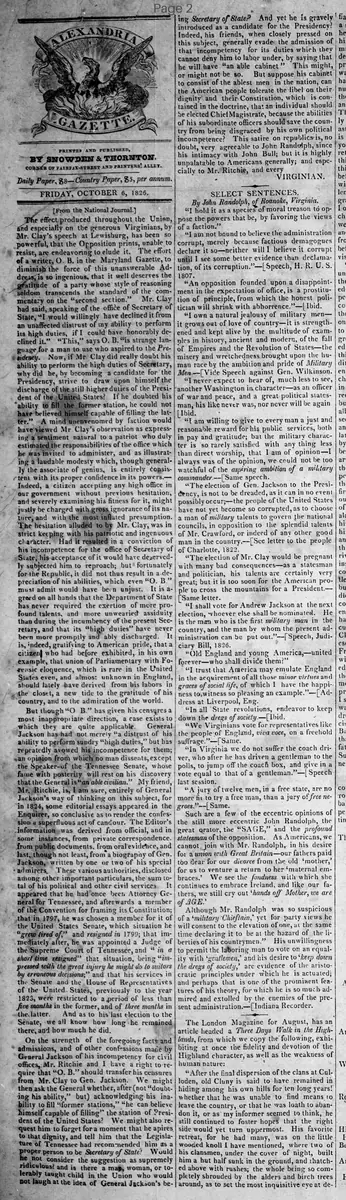
The effect produced throughout the Union, and especially on the generous Virginians, by Mr. Clay's speech at Lewisburg, has been so powerful, that the Opposition prints, unable to resist, are endeavoring to elude it. The effort of a writer, O. B. in the Maryland Gazette, to diminish the force of this unanswerable Address, is so ingenious, that it well deserves the gratitude of a party whose style of reasoning seldom transcends the standard of the commentary on the "second section." Mr. Clay had said, speaking of the office of Secretary of State, "I would willingly have declined it from an unaffected distrust of my ability to perform its high duties, if I could have honorably declined it." "This," says O. B. "is strange language for a man to use who aspired to the Presidency. Now, if Mr. Clay did really doubt his ability to perform the high duties of Secretary, why did he, by becoming a candidate for the Presidency, strive to draw upon himself the discharge of the still higher duties of the President of the United States? If he doubted his ability to fill the former station, he could not have believed himself capable of filling the latter." A mind unenvenomed by faction would have viewed Mr. Clay's observation as expressing a sentiment natural to a patriot who duly estimated the responsibilities of the office which he was invited to administer, and as illustrating a laudable modesty which, though generally the associate of genius, is entirely consistent with its proper confidence in its powers. Indeed, a citizen accepting any high office in our government without previous hesitation, and severely examining his fitness for it, might justly be charged with gross ignorance of its nature, and with the most inflated presumption. The hesitation alluded to by Mr. Clay, was in strict keeping with his patriotic and ingenuous character. Had it resulted in a conviction of his incompetence for the office of Secretary of State, his acceptance of it would have deservedly subjected him to reproach; but fortunately for the Republic, it did not thus result in a depreciation of his abilities, which even "O. B." must admit would have been unjust. It is agreed on all hands that the Department of State has never required the exertion of more profound talents, and more unwearied assiduity than during the incumbency of the present Secretary, and that its "high duties" have never been more promptly and ably discharged. It is, indeed, gratifying to American pride, that a citizen who had before exhibited, in his own example, that union of Parliamentary with Forensic eloquence, which is rare in the United States even, and almost unknown in England, should lately have derived from his labors in the closet, a new title to the gratitude of his country, and to the admiration of the world. But though "O. B." has given his censures a most inappropriate direction, a case exists to which they are quite applicable. General Jackson has had not merely "a distrust of his ability to perform sundry 'high duties,'" but has repeatedly avowed his incompetence for them; an opinion from which no man dissents, except the Speaker of the Tennessee Senate, whose fame with posterity will rest on his discovery that the General is "an able civilian." My friend, Mr. Ritchie, is, I am sure, entirely of General Jackson's way of thinking on this subject, for in 1824, some editorial essays appeared in the Enquirer, so conclusive as to render the confession a superfluous act of candour. The Editor's information was derived from official, and in some instances, from private correspondence, from public documents, from oral evidence, and last, though not least, from a biography of Gen. Jackson, written by one or two of his special admirers. These various authorities, disclosed among other important particulars, the sum total of his political and other civil services. It appeared that he had once been Attorney General for Tennessee, and afterwards a member of the Convention for framing its Constitution; that in 1797, he was chosen a member for it of the United States Senate, which situation he "grew tired of," and resigned in 1799; that immediately after, he was appointed a Judge of the Supreme Court of Tennessee, and "in a short time resigned" that situation, being "impressed with the great injury he might do to suitors by erroneous decisions;" and that his services in the Senate and the House of Representatives of the United States, previously to the year 1823, were restricted to a period of less than five months in the former, and of three months in the latter. And as to his last election to the Senate, we all know how long he remained there, and how much he did.
On the strength of the foregoing facts and admissions, and of other confessions made by General Jackson of his incompetency for civil offices, Mr. Ritchie and I have a right to require that "O. B." should transfer his censures from Mr. Clay to Gen. Jackson. We might then ask the General whether, after (not "doubting his ability," but) acknowledging his inability to fill "former stations," "he can believe himself capable of filling" the station of President of the United States? We might also request him to forget for a moment that he aspires to that dignity, and tell him that the Legislature of Tennessee had recommended him as a proper person to be Secretary of State! Would he not consider the suggestion as supremely ridiculous? and is there a man, woman, or tolerably taught child in the Union who would not laugh at the idea of General Jackson's being Secretary of State? And yet he is gravely introduced as a candidate for the Presidency?
Indeed, his friends, when closely pressed on this subject, generally evade the admission of that incompetency for its duties which they cannot deny him to labor under, by saying that he will have "an able cabinet." This might, or might not be so. But suppose his cabinet to consist of the ablest men in the nation, can the American people tolerate the libel on their dignity and their Constitution, which is contained in the doctrine that an individual should be elected Chief Magistrate, because the abilities of his subordinate officers should save the country from being disgraced by his own political incompetence? This satire on republics is, no doubt, very agreeable to John Randolph, since his intimacy with John Bull; but it is highly unpalatable to Americans generally; and especially to Mr. Ritchie, and every VIRGINIAN.
What sub-type of article is it?
What themes does it cover?
What keywords are associated?
What entities or persons were involved?
Where did it happen?
Story Details
Key Persons
Location
Throughout The Union
Story Details
The article defends Mr. Clay's expression of modest hesitation in accepting the Secretary of State position as patriotic, refuting critic O. B.'s attack by highlighting Clay's successful performance, while arguing that General Jackson's repeated admissions of incompetence and brief, resigned civil service roles make him unfit for the Presidency, despite claims of an able cabinet.