Thank you for visiting SNEWPapers!
Sign up free
Alexandria Daily Advertiser
Alexandria, Virginia
What is this article about?
Extract from Morse's Gazetteer and Robertson's history provides background on Caraccas province in South America, detailing its geography, cocoa production, trade neglect by Spaniards, and economic improvements via exclusive company since 1731, amid interest in Miranda's revolutionary project.
Clipping
OCR Quality
Full Text
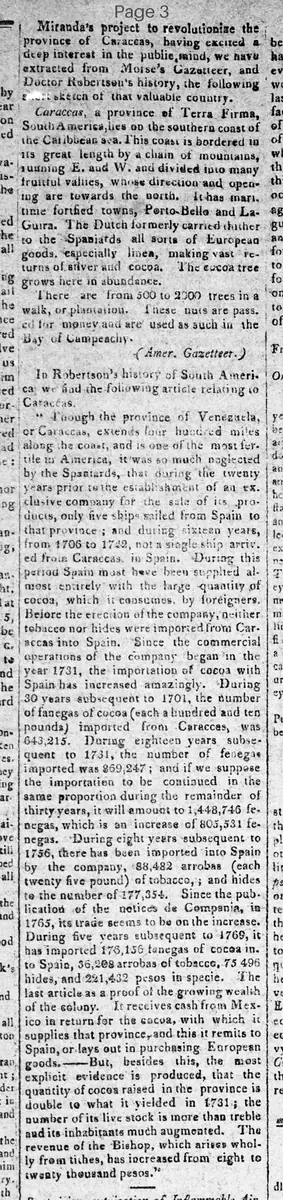
Caraccas, a province of Terra Firma, South America, lies on the southern coast of the Caribbean sea. This coast is bordered in its great length by a chain of mountains, running E. and W. and divided into many fruitful valleys, whose direction and opening are towards the north, it has maritime fortified towns, Porto-Bello and La Guira. The Dutch formerly carried thither to the Spaniards all sorts of European goods, especially linen, making vast returns of silver and cocoa. The cocoa tree grows here in abundance. There are from 500 to 2000 trees in a walk, or plantation. These nuts are passed for money and are used as such in the Bay of Campeachy.
(Amer. Gazetteer.)
In Robertson's history of South America we have the following article relating to Caraccas.
'Though the province of Venezuela, or Caraccas, extends four hundred miles along the coast, and is one of the most fertile in America, it was so much neglected by the Spaniards, that during the twenty years prior to the establishment of an exclusive company for the sale of its products, only five ships sailed from Spain to that province; and during sixteen years, from 1706 to 1722, not a single ship arrived from Caraccas in Spain. During this period Spain must have been supplied almost entirely with the large quantity of cocoa, which it consumes, by foreigners. Before the erection of the company, neither tobacco nor hides were imported from Caraccas into Spain. Since the commercial operations of the company began in the year 1731, the importation of cocoa into Spain has increased amazingly. During 30 years subsequent to 1701, the number of fanegas of cocoa (each a hundred and ten pounds) imported from Caraccas, was 643,215. During eighteen years subsequent to 1731, the number of fanegas imported was 869,247; and if we suppose the importation to be continued in the same proportion during the remainder of thirty years, it will amount to 1,448,746 fanegas, which is an increase of 805,531 fanegas. During eight years subsequent to 1756, there has been imported into Spain by the company, 88,482 arrobas (each twenty five pounds) of tobacco, and hides to the number of 177,354. Since the publication of the Noticia de Compania, in 1765, its trade seems to be on the increase. During five years subsequent to 1769, it has imported 175,156 fanegas of cocoa into Spain, 36,208 arrobas of tobacco, 75,496 hides, and 221,432 pesos in specie. The last article as a proof of the growing wealth of the colony. It receives cash from Mexico in return for the cocoa, with which it supplies that province, and this it remits to Spain, or lays out in purchasing European goods.---But, besides this, the most explicit evidence is produced, that the quantity of cocoa raised in the province is double to what it yielded in 1731.; the number of its live stock is more than treble and its inhabitants much augmented. The revenue of the Bishop, which arises wholly from tithes, has increased from eight to twenty thousand pesos.'
What sub-type of article is it?
What keywords are associated?
What entities or persons were involved?
Where did it happen?
Foreign News Details
Primary Location
Caraccas
Event Date
1701 1774
Key Persons
Outcome
increased cocoa imports from 643,215 fanegas (1701-1731) to projected 1,448,746 (1731-1761); tobacco 88,482 arrobas and 177,354 hides (1756-1764); cocoa doubled since 1731, livestock trebled, population augmented, bishop's revenue from 8,000 to 20,000 pesos.
Event Details
Historical sketch of Caraccas province: fertile South American region on Caribbean coast with mountains, valleys, towns Porto-Bello and La Guira; Dutch trade in European goods for silver and cocoa; cocoa plantations abundant, used as currency. Neglected by Spaniards pre-1731 exclusive company: few ships, no tobacco/hides imports. Post-1731: massive increase in cocoa, tobacco, hides exports to Spain; growing wealth, trade with Mexico, doubled cocoa production, trebled livestock, population growth.