Thank you for visiting SNEWPapers!
Sign up free
Poem
May 11, 1759
The New Hampshire Gazette
Portsmouth, Rockingham County, New Hampshire
What is this article about?
Patriotic verses by William Whitehead, new Poet Laureate, urging Britons to rouse for war against enemies, criticizing empty rhetoric, praising historical battles like Agincourt and Poitiers, and invoking liberty and naval heroism.
Clipping
OCR Quality
80%
Good
Full Text
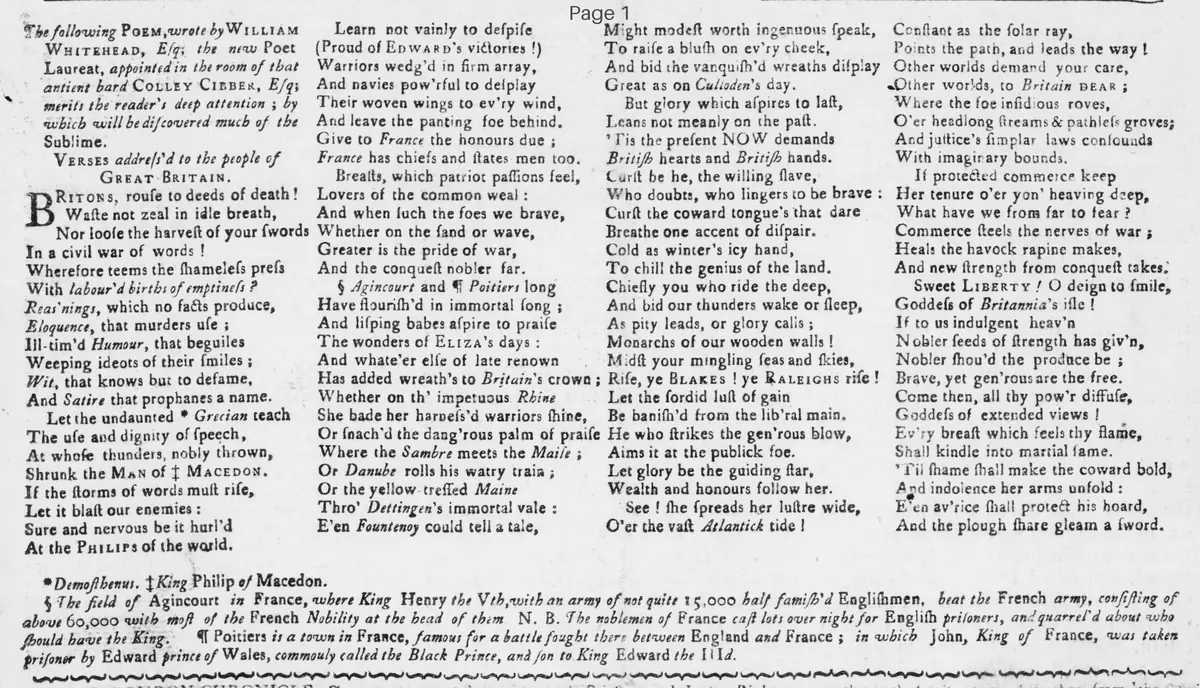
The following Poem, wrote by WILLIAM WHITEHEAD, Esq; the new Poet Laureat, appointed in the room of that antient bard COLLEY CIBBER, Esq; merits the reader's deep attention; by which will be discovered much of the Sublime.
Verses address'd to the people of Great Britain.
Britons. rouze to deeds of death!
Waste not zeal in idle breath,
Nor lose the harvest of your swords
In a civil war of words!
Wherefore teems the shameless press
With labour'd births of emptiness?
Reasonings, which no facts produce,
Eloquence, that murders use;
Ill-tim'd Humour. that beguiles
Weeping idiots of their smiles;
Wit, that knows but to defame.
And Satire that profanes a name.
Let the undaunted Grecian teach
The use and dignity of speech,
At whose thunders, nobly thrown,
Shrunk the Man of Macedon.
If the storms of words must rise.
Let it blast our enemies:
Sure and nervous be it hurl'd
At the Philips of the world.
*Demosthenes. King Philip of Macedon.
Learn not vainly to despise
(Proud of Edward's victories!)
Warriors wedg'd in firm array,
And navies powerful to display
Their woven wings to ev'ry wind,
And leave the panting foe behind.
Give to France the honours due;
France has chiefs and states men too.
Breasts, which patriot passions feel,
Lovers of the common weal:
And when such the foes we brave,
Whether on the sand or wave,
Greater is the pride of war,
And the conquest nobler far.
Agincourt and Poitiers long
Have flourish'd in immortal song:
And lisping babes aspire to praise
The wonders of Eliza's days:
And whate'er else of late renown
Has added wreaths to Britain's crown:
Whether on th' impetuous Rhine
She bade her harpefs'd warriors shine,
Or match'd the dang'rous palm of praise
Where the Sambre meets the Meuse:
Or Danube rolls his watry train;
Or the yellow-tressed Maine
Thro' Dettingen's immortal vale:
E'en Fontenoy could tell a tale,
Might modest worth ingenuous speak,
To raise a blush on ev'ry cheek.
And bid the vanquish'd wreaths display
Great as on Culloden's day.
But glory which aspires to last,
Leans not meanly on the past.
'Tis the present NOW demands
British hearts and British hands.
Curst be he, the willing slave,
Who doubts, who lingers to be brave:
Curst the coward tongues that dare
Breathe one accent of despair.
Cold as winter's icy hand,
To chill the genius of the land.
Chiefly you who ride the deep.
And bid our thunders wake or sleep,
As pity leads, or glory calls;
Monarchs of our wooden walls!
Midst your mingling Seas and skies
Rise, ye Blakes! ye Raleighs rise!
Let the sordid lust of gain
Be banish'd from the lib'ral main.
He who strikes the gen'rous blow,
Aims it at the publick foe.
Let glory be the guiding star.
Wealth and honours follow her.
See! she spreads her lustre wide,
O'er the vast Atlantick tide!
Constant as the solar ray,
Points the path, and leads the way
Other worlds demand your care,
Other worlds, to Britain DEAr;
Where the foe insidious roves,
O'er headlong streams & pathless groves;
And justice's simple laws confounds
With imaginary bounds.
If protected commerce keep
Her tenure o'er yon' heaving deep,
What have we from far to fear?
Commerce steels the nerves of war;
Heals the havock rapine makes.
And new strength from conquest takes.
Sweet Liberty! O deign to smile,
Goddess of Britannia's isle!
If to us indulgent heav'n
Nobler deeds of strength has giv'n,
Nobler shou'd the produce be:
Brave, yet gen'rous are the free.
Come then, all thy pow'r diffuse.
Goddess of extended views!
Ev'ry breast which feels thy flame,
Shall kindle into martial fame.
'Til shame shall make the coward bold.
And indolence her arms unfold:
E'en av'rice shall protect his hoard,
And the ploughshare gleam a sword.
§ The field of Agincourt in France, where King Henry the Vth, with an army of not quite 15,000 half famish'd Englishmen, beat the French army, consisting of above 60,000 with most of the French Nobility at the head of them N. B. The noblemen of France cast lots over night for English prisoners, and quarrel'd about who should have the King. ¶ Poitiers is a town in France, famous for a battle fought there between England and France; in which John, King of France, was taken prisoner by Edward prince of Wales, commonly called the Black Prince, and son to King Edward the III.
Verses address'd to the people of Great Britain.
Britons. rouze to deeds of death!
Waste not zeal in idle breath,
Nor lose the harvest of your swords
In a civil war of words!
Wherefore teems the shameless press
With labour'd births of emptiness?
Reasonings, which no facts produce,
Eloquence, that murders use;
Ill-tim'd Humour. that beguiles
Weeping idiots of their smiles;
Wit, that knows but to defame.
And Satire that profanes a name.
Let the undaunted Grecian teach
The use and dignity of speech,
At whose thunders, nobly thrown,
Shrunk the Man of Macedon.
If the storms of words must rise.
Let it blast our enemies:
Sure and nervous be it hurl'd
At the Philips of the world.
*Demosthenes. King Philip of Macedon.
Learn not vainly to despise
(Proud of Edward's victories!)
Warriors wedg'd in firm array,
And navies powerful to display
Their woven wings to ev'ry wind,
And leave the panting foe behind.
Give to France the honours due;
France has chiefs and states men too.
Breasts, which patriot passions feel,
Lovers of the common weal:
And when such the foes we brave,
Whether on the sand or wave,
Greater is the pride of war,
And the conquest nobler far.
Agincourt and Poitiers long
Have flourish'd in immortal song:
And lisping babes aspire to praise
The wonders of Eliza's days:
And whate'er else of late renown
Has added wreaths to Britain's crown:
Whether on th' impetuous Rhine
She bade her harpefs'd warriors shine,
Or match'd the dang'rous palm of praise
Where the Sambre meets the Meuse:
Or Danube rolls his watry train;
Or the yellow-tressed Maine
Thro' Dettingen's immortal vale:
E'en Fontenoy could tell a tale,
Might modest worth ingenuous speak,
To raise a blush on ev'ry cheek.
And bid the vanquish'd wreaths display
Great as on Culloden's day.
But glory which aspires to last,
Leans not meanly on the past.
'Tis the present NOW demands
British hearts and British hands.
Curst be he, the willing slave,
Who doubts, who lingers to be brave:
Curst the coward tongues that dare
Breathe one accent of despair.
Cold as winter's icy hand,
To chill the genius of the land.
Chiefly you who ride the deep.
And bid our thunders wake or sleep,
As pity leads, or glory calls;
Monarchs of our wooden walls!
Midst your mingling Seas and skies
Rise, ye Blakes! ye Raleighs rise!
Let the sordid lust of gain
Be banish'd from the lib'ral main.
He who strikes the gen'rous blow,
Aims it at the publick foe.
Let glory be the guiding star.
Wealth and honours follow her.
See! she spreads her lustre wide,
O'er the vast Atlantick tide!
Constant as the solar ray,
Points the path, and leads the way
Other worlds demand your care,
Other worlds, to Britain DEAr;
Where the foe insidious roves,
O'er headlong streams & pathless groves;
And justice's simple laws confounds
With imaginary bounds.
If protected commerce keep
Her tenure o'er yon' heaving deep,
What have we from far to fear?
Commerce steels the nerves of war;
Heals the havock rapine makes.
And new strength from conquest takes.
Sweet Liberty! O deign to smile,
Goddess of Britannia's isle!
If to us indulgent heav'n
Nobler deeds of strength has giv'n,
Nobler shou'd the produce be:
Brave, yet gen'rous are the free.
Come then, all thy pow'r diffuse.
Goddess of extended views!
Ev'ry breast which feels thy flame,
Shall kindle into martial fame.
'Til shame shall make the coward bold.
And indolence her arms unfold:
E'en av'rice shall protect his hoard,
And the ploughshare gleam a sword.
§ The field of Agincourt in France, where King Henry the Vth, with an army of not quite 15,000 half famish'd Englishmen, beat the French army, consisting of above 60,000 with most of the French Nobility at the head of them N. B. The noblemen of France cast lots over night for English prisoners, and quarrel'd about who should have the King. ¶ Poitiers is a town in France, famous for a battle fought there between England and France; in which John, King of France, was taken prisoner by Edward prince of Wales, commonly called the Black Prince, and son to King Edward the III.
What sub-type of article is it?
Ode
Satire
What themes does it cover?
Patriotism
War Military
Liberty Independence
What keywords are associated?
British Patriotism
War Exhortation
Naval Heroism
Liberty Goddess
Historical Battles
What entities or persons were involved?
William Whitehead, Esq; The New Poet Laureat
Poem Details
Title
Verses Address'd To The People Of Great Britain.
Author
William Whitehead, Esq; The New Poet Laureat
Subject
Patriotic Exhortation To Britons For War
Form / Style
Rhymed Couplets
Key Lines
Britons. Rouze To Deeds Of Death! / Waste Not Zeal In Idle Breath, / Nor Lose The Harvest Of Your Swords / In A Civil War Of Words!
Sweet Liberty! O Deign To Smile, / Goddess Of Britannia's Isle!
Midst Your Mingling Seas And Skies / Rise, Ye Blakes! Ye Raleighs Rise!
Let Glory Be The Guiding Star. / Wealth And Honours Follow Her.