Thank you for visiting SNEWPapers!
Sign up free
New Orleans Daily Crescent
New Orleans, Orleans County, Louisiana
What is this article about?
Civil War correspondent's report from Columbus, KY, on Feb. 16, 1862, detailing the ongoing Siege of Fort Donelson, weather and river conditions, Gen. Beauregard's delayed arrival, and bureaucratic obstacles with Gen. Polk's haughty staff majors.
Clipping
OCR Quality
Full Text
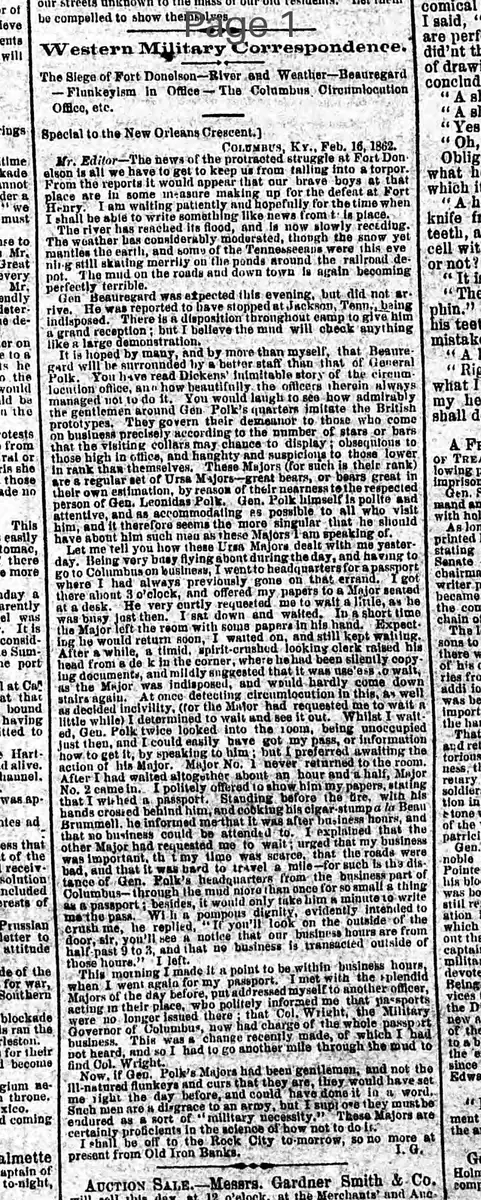
The Siege of Fort Donelson—River and Weather—Beauregard—Flunkeyism in Office—The Columbus Circumlocution Office, etc.
Special to the New Orleans Crescent.
COLUMBUS, KY., Feb. 16, 1862.
Mr. Editor—The news of the protracted struggle at Fort Donelson is all we have to get to keep us from falling into a torpor. From the reports it would appear that our brave boys at that place are in some measure making up for the defeat at Fort Henry. I am waiting patiently and hopefully for the time when I shall be able to write something like news from the place.
The river has reached its flood, and is now slowly receding. The weather has considerably moderated, though the snow yet mantles the earth, and some of the Tennesseans were this eve ning still skating merrily on the ponds around the railroad de pot. The mud on the roads and down town is again becoming perfectly terrible.
Gen. Beauregard was expected this evening, but did not arrive. He was reported to have stopped at Jackson, Tenn., being indisposed. There is a disposition throughout camp to give him a grand reception; but I believe the mud will check anything like a large demonstration.
It is hoped by many, and I note that it is said, Beauregard will be surrounded by a better staff than that of General Polk. You have read Dickens' inimitable story of the Circumlocution Office, and how beautifully, the officers therein always managed not to do it. You would laugh to see how admirably the gentlemen around Gen. Polk's quarters imitate the British prototypes. They govern their demeanor to those who come on business precisely according to the number of stars or bars that the visiting collars may chance to display; obsequious to those high in office, and haughty and suspicious to those lower in rank than themselves. These Majors (for such is their rank) are a regular set of Ursa Majors—great bears, or bears great in their own estimation, by reason of their nearness to the respected person of Gen. Leonidas Polk. Gen. Polk himself is polite and attentive, and as accommodating as possible to all who visit him, and it therefore seems the more singular that he should have about him such men as these Majors I am speaking of.
Let me tell you how these Ursa Majors dealt with me yesterday. Being very busy flying about during the day, and having to go to Columbus on business, I went to headquarters for a passport where I had always previously gone on that errand. I go there about 3 o'clock, and offered my papers to a Major seated at a desk. He very curtly requested me to wait a little, as he was busy just then.
I sat down and waited. In a short time the Major left the room with some papers in his hand. Expecting he would return soon, I waited on, and still kept waiting.
After a while, a timid, spirit-crushed looking clerk raised his head from a desk in the corner, where he had been silently copying documents, and mildly suggested that it was useless to wait, as the Major was indisposed, and would hardly come down stairs again. At once detecting circumlocution in this, as well as decided incivility, (for the Major had requested me to wait a little while) I determined to wait and see it out. Whilst I waited, Gen. Polk twice looked into the room, being unoccupied just then, and I could easily have got my pass, or information how to get it, by speaking to him; but I preferred awaiting the action of his Major. Major No. 1 never returned to the room.
After I had waited altogether about an hour and a half, Major No. 2 came in. I politely offered to show him my papers, stating that I wished a passport. Standing before the fire, with his hands crossed behind him, and cocking his cigar-stump a la Beau Brummell, he informed me that it was after business hours, and that no business could be attended to. I explained that the other Major had requested me to wait; urged that my business was important, that my time was scarce, that the roads were bad, and that it was hard to travel a mile—for such is the distance of Gen. Polk's headquarters from the business part of Columbus—through the mud more than once for so small a thing as a passport; besides, it would only take him a minute to write me the pass. With a pompous dignity, evidently intended to crush me, he replied, "If you'll look on the outside of the door, sir, you'll see a notice that our business hours are from half-past 9 to 3, and that no business is transacted outside of those hours." I left.
This morning I made it a point to be within business hours, when I went again for my passport. I met with the splendid Majors of the day before, but addressed myself to another officer, acting in their place, who politely informed me that passports were no longer issued there; that Col. Wright, the Military Governor, attended to that business.
This was a change recently made, of which I had not heard, and so I had to go another mile through the mud to find Col. Wright.
Now, if Gen. Polk's Majors had been gentlemen, and not the ill-natured flunkeys and curs that they are, they would have set me right the day before, and could have done it in a word.
Such men are a disgrace to an army, but I suppose they must be endured as a sort of "military necessity." These Majors are certainly proficients in the science of how not to do it.
I shall be off to the Rock City to-morrow, so no more at present from Old Iron Banks.
I. G.
What sub-type of article is it?
What themes does it cover?
What keywords are associated?
What entities or persons were involved?
Where did it happen?
Story Details
Key Persons
Location
Columbus, Ky
Event Date
Feb. 16, 1862
Story Details
Correspondent reports on the protracted Siege of Fort Donelson where Confederate forces are compensating for the Fort Henry defeat; describes flooding river, moderating weather with snow and mud; notes Gen. Beauregard's delayed arrival due to indisposition; criticizes Gen. Polk's staff majors for bureaucratic incivility and haughtiness in handling a passport request, contrasting with Polk's politeness.