Thank you for visiting SNEWPapers!
Sign up free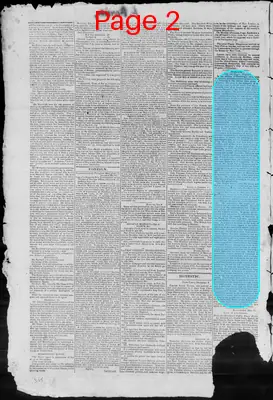
Literary
December 17, 1812
Virginia Argus
Richmond, Virginia
What is this article about?
Historical account of Moscow from 1762-1800 sources like Busching, Coxe, and Olvarius, detailing its circumference, churches, buildings, population, and fortifications. Assesses city's weak defenses against French invasion in 1812, predicting its likely sacrifice amid Russian retreat.
Clipping
OCR Quality
95%
Excellent
Full Text
MOSCOW
From the Essex Register.
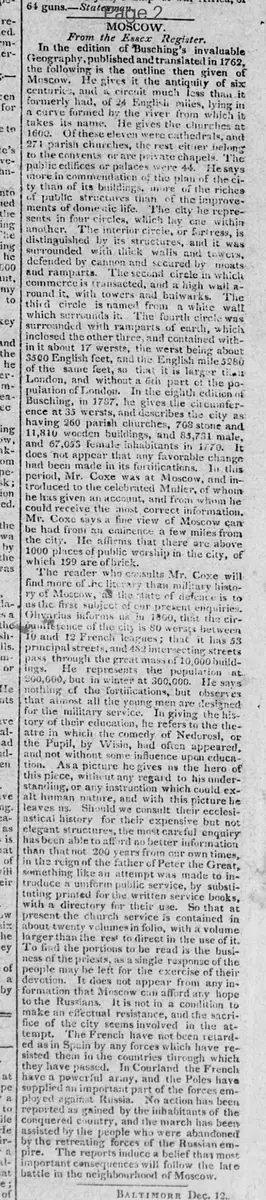
In the edition of Busching's invaluable Geography, published and translated in 1762, the following is the outline then given of Moscow. He gives it the antiquity of six centuries, and a circuit much less than it formerly had, of 24 English miles, lying in a curve formed by the river from which it takes its name. He gives the churches at 1600. Of these eleven were cathedrals, and 271 parish churches, the rest either belong to the convents or are private chapels. The public edifices or palaces were 44.' He says more in commendation of the plan of the city than of its buildings. more of the riches of public structures than of the improvements of domestic life. The city he represents in four circles, which lay one within another. The interior circle, or fortress, is distinguished by its structures, and it was surrounded with thick walls and towers. defended by cannon and secured by moats and ramparts. The second circle in which commerce is transacted, and a high wall around it, with towers and bulwarks. The third circle is named from a white wall which surrounds it. The fourth circle was surrounded with ramparts of earth, which inclosed the other three, and contained within it about 17 wersts, the werst being about 3500 English feet, and the English mile 5280 of the same feet, so that it is larger than London, and without a 6th part of the population of London. In the eighth edition of Busching, in 1787. he gives the circumference at 35 wersts, and describes the city as: having 260 parish churches, 708 stone and 11,810 wooden buildings, and 83,731 male. and 67,053 female inhabitants in 1770. It does not appear that any favorable change had been made in its fortifications. In this period, Mr. Coxe was at Moscow, and introduced to the celebrated Muller. of whom he has given an account, and from whom he could receive the most correct information.
Mr. Coxe says a fine view of Moscow can be had from an eminence a few miles from the city. He affirms that there are above 1000 places of public worship in the city, of which 199 are of brick.
The reader who consults Mr. Coxe will find more of the literary than military history of Moscow, as the state of defence is to us the first subject of our present enquiries.
Olvarius informs us in 1800, that the circumference of the city is 80 wersts between 10 and 12 French leagues; that it has 53 principal streets, and 482 intersecting streets pass through the great mass of 10,000 buildings. He represents the population at 500,000, but in winter at 300,000. He says nothing of the fortifications, but observes that almost all the young men are designed for the military service. In giving the history of their education, he refers to the theatre in which the comedy of Nedorosl, or the Pupil, by Wisin, had often appeared, and not without some influence upon education. As a picture he gives us the hero of this piece, without any regard to his understanding, or any instruction which could exalt human nature, and with this picture he leaves us. Should we consult their ecclesiastical history for their expensive but not elegant structures, the most careful enquiry has been able to afford no better information than that not 200 years from our own times, in the reign of the father of Peter the Great, something like an attempt was made to introduce a uniform public service, by substituting printed for the written service books, with a directory for their use. So that at present the church service is contained in about twenty volumes in folio, with a volume larger than the rest to direct in the use of it.
To find the portions to be read is the business of the priests, as a single response of the people may be left for the exercise of their devotion. It does not appear from any information that Moscow Can afford any hope to the Russians. It is not in a condition to make an effectual resistance, and the sacrifice of the city seems involved in the attempt. The French have not been retarded as in Spain by any forces which have resisted them in the countries through which they have passed. In Courland the French have a powerful army, and the Poles have supplied an important part of the forces employed against Russia. No action has been reported as gained by the inhabitants of the conquered country, and the march has been assisted by the people who were abandoned by the retreating forces of the Russian empire. The reports induce a belief that most important consequences will follow the late battle in the neighbourhood of Moscow.
From the Essex Register.
In the edition of Busching's invaluable Geography, published and translated in 1762, the following is the outline then given of Moscow. He gives it the antiquity of six centuries, and a circuit much less than it formerly had, of 24 English miles, lying in a curve formed by the river from which it takes its name. He gives the churches at 1600. Of these eleven were cathedrals, and 271 parish churches, the rest either belong to the convents or are private chapels. The public edifices or palaces were 44.' He says more in commendation of the plan of the city than of its buildings. more of the riches of public structures than of the improvements of domestic life. The city he represents in four circles, which lay one within another. The interior circle, or fortress, is distinguished by its structures, and it was surrounded with thick walls and towers. defended by cannon and secured by moats and ramparts. The second circle in which commerce is transacted, and a high wall around it, with towers and bulwarks. The third circle is named from a white wall which surrounds it. The fourth circle was surrounded with ramparts of earth, which inclosed the other three, and contained within it about 17 wersts, the werst being about 3500 English feet, and the English mile 5280 of the same feet, so that it is larger than London, and without a 6th part of the population of London. In the eighth edition of Busching, in 1787. he gives the circumference at 35 wersts, and describes the city as: having 260 parish churches, 708 stone and 11,810 wooden buildings, and 83,731 male. and 67,053 female inhabitants in 1770. It does not appear that any favorable change had been made in its fortifications. In this period, Mr. Coxe was at Moscow, and introduced to the celebrated Muller. of whom he has given an account, and from whom he could receive the most correct information.
Mr. Coxe says a fine view of Moscow can be had from an eminence a few miles from the city. He affirms that there are above 1000 places of public worship in the city, of which 199 are of brick.
The reader who consults Mr. Coxe will find more of the literary than military history of Moscow, as the state of defence is to us the first subject of our present enquiries.
Olvarius informs us in 1800, that the circumference of the city is 80 wersts between 10 and 12 French leagues; that it has 53 principal streets, and 482 intersecting streets pass through the great mass of 10,000 buildings. He represents the population at 500,000, but in winter at 300,000. He says nothing of the fortifications, but observes that almost all the young men are designed for the military service. In giving the history of their education, he refers to the theatre in which the comedy of Nedorosl, or the Pupil, by Wisin, had often appeared, and not without some influence upon education. As a picture he gives us the hero of this piece, without any regard to his understanding, or any instruction which could exalt human nature, and with this picture he leaves us. Should we consult their ecclesiastical history for their expensive but not elegant structures, the most careful enquiry has been able to afford no better information than that not 200 years from our own times, in the reign of the father of Peter the Great, something like an attempt was made to introduce a uniform public service, by substituting printed for the written service books, with a directory for their use. So that at present the church service is contained in about twenty volumes in folio, with a volume larger than the rest to direct in the use of it.
To find the portions to be read is the business of the priests, as a single response of the people may be left for the exercise of their devotion. It does not appear from any information that Moscow Can afford any hope to the Russians. It is not in a condition to make an effectual resistance, and the sacrifice of the city seems involved in the attempt. The French have not been retarded as in Spain by any forces which have resisted them in the countries through which they have passed. In Courland the French have a powerful army, and the Poles have supplied an important part of the forces employed against Russia. No action has been reported as gained by the inhabitants of the conquered country, and the march has been assisted by the people who were abandoned by the retreating forces of the Russian empire. The reports induce a belief that most important consequences will follow the late battle in the neighbourhood of Moscow.
What sub-type of article is it?
Essay
What themes does it cover?
Political
War Peace
What keywords are associated?
Moscow
History
Fortifications
Population
Churches
French Invasion
Russian Defense
Busching
Coxe
Olvarius
What entities or persons were involved?
From The Essex Register
Literary Details
Title
Moscow
Author
From The Essex Register
Subject
Historical Description And Defenses Of Moscow Amid French Invasion
Form / Style
Prose Historical Reflection
Key Lines
It Does Not Appear From Any Information That Moscow Can Afford Any Hope To The Russians. It Is Not In A Condition To Make An Effectual Resistance, And The Sacrifice Of The City Seems Involved In The Attempt.
The Reports Induce A Belief That Most Important Consequences Will Follow The Late Battle In The Neighbourhood Of Moscow.