Thank you for visiting SNEWPapers!
Sign up free
Letter to Editor
February 26, 1874
The Weekly Kansas Chief
Troy, Doniphan County, Kansas
What is this article about?
In a letter dated February 19, 1874, from Leavenworth, Kansas, 'Elaine' describes recent city events including the installation of Rev. I. S. Kalloch as pastor, drownings in the Missouri River, Academy of Science meetings, a religious revival by Rev. Knowles Shaw, a performance by Mrs. Scott-Siddons, and the Masonic Temple dedication.
Clipping
OCR Quality
98%
Excellent
Full Text
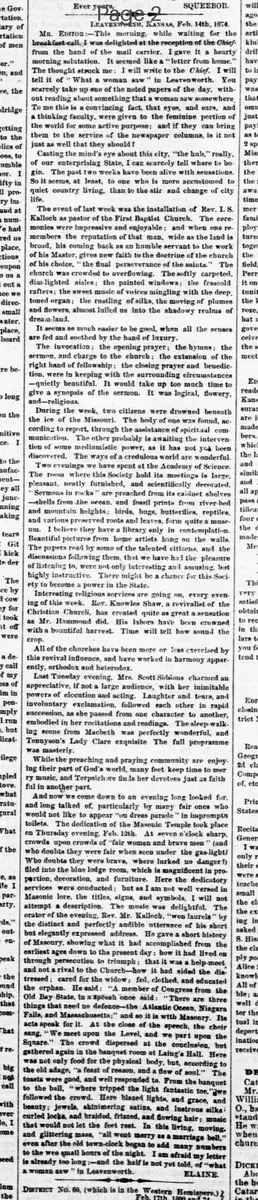
Leavenworth, Kansas, Feb. 19th, 1874.
Mr. Editor:-This morning, while waiting for the breakfast-call, I was delighted at the reception of the Chief, from the hand of the mail carrier. I gave it a hearty morning salutation. It seemed like a "letter from home."
The thought struck me: I will write to the Chief. I will tell it of "What a woman saw" in Leavenworth. You scarcely take up one of the noted papers of the day, without reading about something that a woman saw somewhere. To me this is a convincing fact, that eyes, and ears, and a thinking faculty, were given to the feminine portion of the world for some active purpose; and if they can bring them to the service of the newspaper columns, is it not just as well that they should?
Casting the mind's eye about this city, "the hub," really, of our enterprising State, I can scarcely tell where to begin. The past two weeks have been alive with sensations. So it seems, at least, to one who is more accustomed to quiet country living, than to the stir and change of city life.
The event of last week was the installation of Rev. I. S. Kalloch as pastor of the First Baptist Church. The ceremonies were impressive and enjoyable; and when one remembers the reputation of that man, wide as the land is broad, his coming back as an humble servant to the work of his Master, gives new faith to the doctrine of the church of his choice, "the final perseverance of the saints."
The church was crowded to overflowing. The softly carpeted, dim-lighted aisles; the painted windows; the frescoed rafters; the sweet music of voices mingling with the deep-toned organ; the rustling of silks, the moving of plumes and flowers, almost lulled us into the shadowy realms of dream-land.
It seems so much easier to be good, when all the senses are fed and soothed by the hand of luxury.
The invocation; the opening prayer; the hymns; the sermon, and charge to the church; the extension of the right hand of fellowship; the closing prayer and benediction, were in keeping with the surrounding circumstances-quietly beautiful. It would take up too much time to give a synopsis of the sermon. It was logical, flowery, and religious.
During the week, two citizens were drowned beneath the ice of the Missouri. The body of one was found, according to report, through the assistance of spiritual communication. The other probably is awaiting the intervention of some mediumistic power, as it has not yet been discovered. The ways of a credulous world are wonderful.
Two evenings we have spent at the Academy of Science. The room where this Society hold its meetings is large, pleasant, neatly furnished, and scientifically decorated. "Sermons in rocks" are preached from its cabinet shelves-shells from the ocean, and fossil prints from river-bed and mountain heights; birds, bugs, butterflies, reptiles, and various preserved roots and leaves, form quite a museum. I believe they have a library only in contemplation.
Beautiful pictures from home artists hang on the walls. The papers read by some of the talented citizens, and the discussions following them, that we have had the pleasure of listening to, were not only interesting and amusing, but highly instructive. There might be a chance for this Society to become a power in the State.
Interesting religious services are going on, every evening of this week. Rev. Knowles Shaw, a revivalist of the Christian Church, has created quite as great a sensation as Mr. Hammond did. His labors have been crowned with a bountiful harvest. Time will tell how sound the crop.
All of the churches have been more or less exercised by this revival influence, and have worked in harmony apparently, orthodox and heterodox.
Last Tuesday evening, Mrs. Scott-Siddons charmed an appreciative, if not a large audience, with her inimitable powers of elocution and acting. Laughter and tears, and involuntary exclamation, followed each other in rapid succession, as she passed from one character to another, embodied in her recitations and readings. The sleep-walking scene from Macbeth was perfectly wonderful, and Tennyson's Lady Clare exquisite. The full programme was masterly.
While the preaching and praying community are enjoying their part of God's world, many feet keep time to merry music, and Terpsichore finds her devotees just as faithful in another part.
And now we come down to an evening long looked for, and long talked of, particularly by many fair ones who would not like to appear "on dress parade" in impromptu toilets. The dedication of the Masonic Temple took place on Thursday evening, Feb. 12th. At seven o'clock sharp, crowds upon crowds of "fair women and brave men" (and who doubts they were fair when seen under the gas-light! Who doubts they were brave, where lurked no danger?) filed into the blue lodge room, which is magnificent in proportion, decoration, and furniture. Here the dedicatory services were conducted; but as I am not well versed in Masonic lore, the titles, signs, and symbols, I will not attempt a description. The music was delightful. The orator of the evening, Rev. Mr. Kalloch, "won laurels" by the distinct and perfectly audible utterance of his short but elegantly expressed address. He gave a short history of Masonry, showing what it had accomplished from the earliest ages down to the present day; how it had lived on through persecution to triumph; that it was a help-meet and not a rival to the Church-how it had aided the distressed; cared for the widow; fed, clothed, and educated the orphan. He said: "A member of Congress from the Old Bay State, in a speech once said: 'There are three things that need no defence-the Atlantic Ocean, Niagara Falls, and Massachusetts;' and so it is with Masonry. Its acts speak for it." At the close of the speech, the choir sang, "We meet upon the Level, and we part upon the Square." The crowd dispersed at the conclusion, but gathered again in the banquet room at Laing's Hall. Here was not only food for the physical body, but, according to the old adage, "a feast of reason, and a flow of soul." The toasts were good, and well responded to. From the banquet to the ball, "where tripped the light fantastic toe," we followed the crowd. Here blazed lights, and grace, and beauty; jewels, shimmering satins, and lustrous silks; curled locks, and braided, frizzed, and flowing hair; music that would not let the feet rest. In this living, moving, and glittering mass, "all went merry as a marriage bell," even after the old town-clock began to add many numbers to the wee small hours of the night. I am afraid my letter is already too long;-and the half is not yet told, of "what a woman saw" in Leavenworth.
ELAINE.
Mr. Editor:-This morning, while waiting for the breakfast-call, I was delighted at the reception of the Chief, from the hand of the mail carrier. I gave it a hearty morning salutation. It seemed like a "letter from home."
The thought struck me: I will write to the Chief. I will tell it of "What a woman saw" in Leavenworth. You scarcely take up one of the noted papers of the day, without reading about something that a woman saw somewhere. To me this is a convincing fact, that eyes, and ears, and a thinking faculty, were given to the feminine portion of the world for some active purpose; and if they can bring them to the service of the newspaper columns, is it not just as well that they should?
Casting the mind's eye about this city, "the hub," really, of our enterprising State, I can scarcely tell where to begin. The past two weeks have been alive with sensations. So it seems, at least, to one who is more accustomed to quiet country living, than to the stir and change of city life.
The event of last week was the installation of Rev. I. S. Kalloch as pastor of the First Baptist Church. The ceremonies were impressive and enjoyable; and when one remembers the reputation of that man, wide as the land is broad, his coming back as an humble servant to the work of his Master, gives new faith to the doctrine of the church of his choice, "the final perseverance of the saints."
The church was crowded to overflowing. The softly carpeted, dim-lighted aisles; the painted windows; the frescoed rafters; the sweet music of voices mingling with the deep-toned organ; the rustling of silks, the moving of plumes and flowers, almost lulled us into the shadowy realms of dream-land.
It seems so much easier to be good, when all the senses are fed and soothed by the hand of luxury.
The invocation; the opening prayer; the hymns; the sermon, and charge to the church; the extension of the right hand of fellowship; the closing prayer and benediction, were in keeping with the surrounding circumstances-quietly beautiful. It would take up too much time to give a synopsis of the sermon. It was logical, flowery, and religious.
During the week, two citizens were drowned beneath the ice of the Missouri. The body of one was found, according to report, through the assistance of spiritual communication. The other probably is awaiting the intervention of some mediumistic power, as it has not yet been discovered. The ways of a credulous world are wonderful.
Two evenings we have spent at the Academy of Science. The room where this Society hold its meetings is large, pleasant, neatly furnished, and scientifically decorated. "Sermons in rocks" are preached from its cabinet shelves-shells from the ocean, and fossil prints from river-bed and mountain heights; birds, bugs, butterflies, reptiles, and various preserved roots and leaves, form quite a museum. I believe they have a library only in contemplation.
Beautiful pictures from home artists hang on the walls. The papers read by some of the talented citizens, and the discussions following them, that we have had the pleasure of listening to, were not only interesting and amusing, but highly instructive. There might be a chance for this Society to become a power in the State.
Interesting religious services are going on, every evening of this week. Rev. Knowles Shaw, a revivalist of the Christian Church, has created quite as great a sensation as Mr. Hammond did. His labors have been crowned with a bountiful harvest. Time will tell how sound the crop.
All of the churches have been more or less exercised by this revival influence, and have worked in harmony apparently, orthodox and heterodox.
Last Tuesday evening, Mrs. Scott-Siddons charmed an appreciative, if not a large audience, with her inimitable powers of elocution and acting. Laughter and tears, and involuntary exclamation, followed each other in rapid succession, as she passed from one character to another, embodied in her recitations and readings. The sleep-walking scene from Macbeth was perfectly wonderful, and Tennyson's Lady Clare exquisite. The full programme was masterly.
While the preaching and praying community are enjoying their part of God's world, many feet keep time to merry music, and Terpsichore finds her devotees just as faithful in another part.
And now we come down to an evening long looked for, and long talked of, particularly by many fair ones who would not like to appear "on dress parade" in impromptu toilets. The dedication of the Masonic Temple took place on Thursday evening, Feb. 12th. At seven o'clock sharp, crowds upon crowds of "fair women and brave men" (and who doubts they were fair when seen under the gas-light! Who doubts they were brave, where lurked no danger?) filed into the blue lodge room, which is magnificent in proportion, decoration, and furniture. Here the dedicatory services were conducted; but as I am not well versed in Masonic lore, the titles, signs, and symbols, I will not attempt a description. The music was delightful. The orator of the evening, Rev. Mr. Kalloch, "won laurels" by the distinct and perfectly audible utterance of his short but elegantly expressed address. He gave a short history of Masonry, showing what it had accomplished from the earliest ages down to the present day; how it had lived on through persecution to triumph; that it was a help-meet and not a rival to the Church-how it had aided the distressed; cared for the widow; fed, clothed, and educated the orphan. He said: "A member of Congress from the Old Bay State, in a speech once said: 'There are three things that need no defence-the Atlantic Ocean, Niagara Falls, and Massachusetts;' and so it is with Masonry. Its acts speak for it." At the close of the speech, the choir sang, "We meet upon the Level, and we part upon the Square." The crowd dispersed at the conclusion, but gathered again in the banquet room at Laing's Hall. Here was not only food for the physical body, but, according to the old adage, "a feast of reason, and a flow of soul." The toasts were good, and well responded to. From the banquet to the ball, "where tripped the light fantastic toe," we followed the crowd. Here blazed lights, and grace, and beauty; jewels, shimmering satins, and lustrous silks; curled locks, and braided, frizzed, and flowing hair; music that would not let the feet rest. In this living, moving, and glittering mass, "all went merry as a marriage bell," even after the old town-clock began to add many numbers to the wee small hours of the night. I am afraid my letter is already too long;-and the half is not yet told, of "what a woman saw" in Leavenworth.
ELAINE.
What sub-type of article is it?
Informative
Reflective
What themes does it cover?
Religion
Social Issues
What keywords are associated?
Leavenworth Kansas
Church Installation
Religious Revival
Masonic Dedication
Academy Of Science
Theater Performance
City Life
What entities or persons were involved?
Elaine
Mr. Editor
Letter to Editor Details
Author
Elaine
Recipient
Mr. Editor
Main Argument
the writer shares vivid observations of recent social, religious, and cultural events in leavenworth, kansas, highlighting the vibrancy of city life compared to rural quietude.
Notable Details
Installation Of Rev. I. S. Kalloch As Pastor Of First Baptist Church
Drownings In Missouri River With Spiritualist Involvement
Academy Of Science Meetings And Museum
Revival By Rev. Knowles Shaw
Performance By Mrs. Scott Siddons Including Macbeth And Tennyson's Lady Clare
Masonic Temple Dedication With Address By Rev. Kalloch
Quote On Masonry Needing No Defense Like The Atlantic Ocean