Thank you for visiting SNEWPapers!
Sign up free
National Gazette
Philadelphia, Philadelphia County, Pennsylvania
What is this article about?
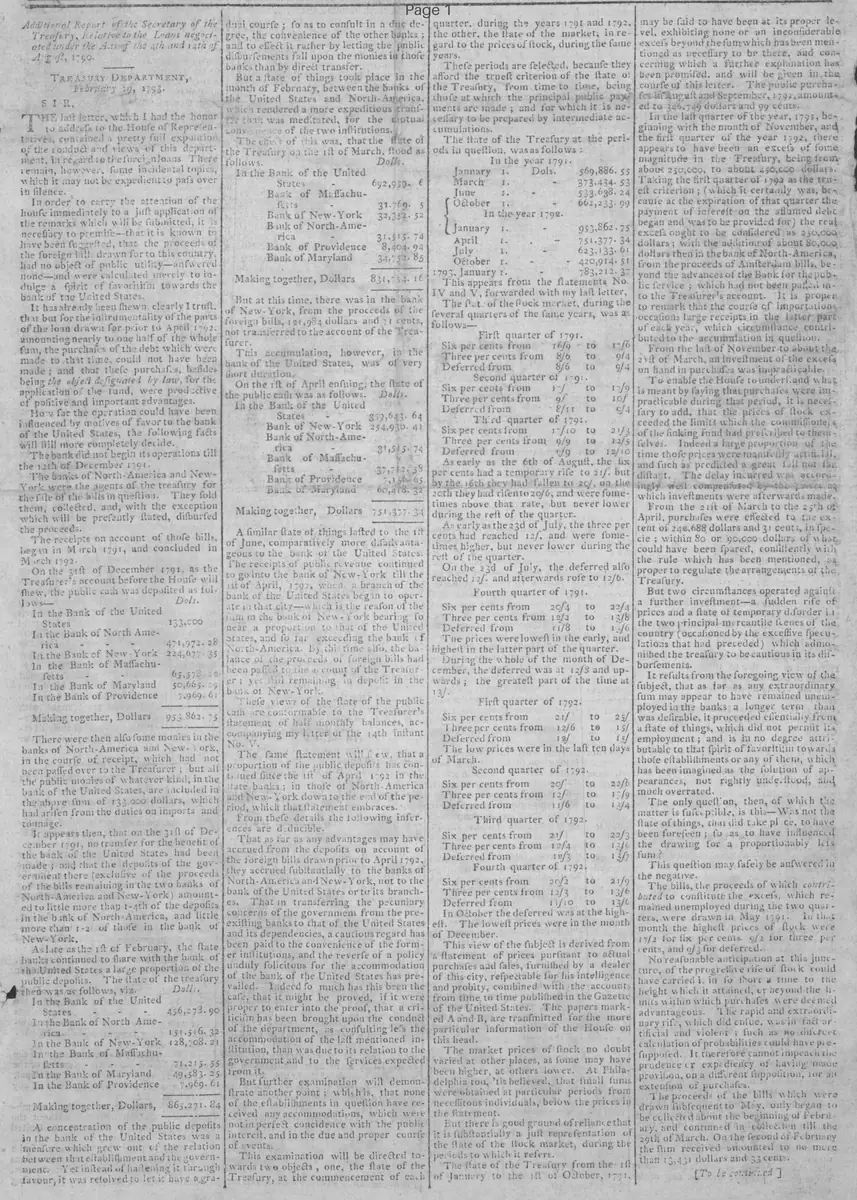
Secretary of the Treasury's report dated February 19, 1793, to the House of Representatives defending the management of foreign loans under 1790 acts, detailing public deposits in U.S. and state banks from 1791-1792, and stock market prices to justify purchase timings and refute favoritism claims.
Merged-components note: The table provides the quarterly Treasury balances explicitly referenced in the text of the report, and its bbox overlaps spatially with the text columns, indicating it is part of the same Treasury report component.
Clipping
OCR Quality
Full Text
TREASURY DEPARTMENT,
February 19, 1793.
SIR,
The last letter, which I had the honor to address to the House of Representatives, contained a pretty full exposition of the conduct and views of this department, in regard to the foreign loans. There remain, however, some incidental topics, which it may not be expedient to pass over in silence.
In order to carry the attention of the house immediately to a just application of the remarks which will be submitted, it is necessary to premise—that it is known to have been suggested, that the proceeds of the foreign bills drawn for to this country, had no object of public utility answered none—and were calculated merely to indulge a spirit of favoritism towards the bank of the United States.
It has already been shown clearly I trust, that but for the instrumentality of the parts of the loan drawn for prior to April 1792, amounting nearly to one half of the whole sum, the purchases of the debt which were made to that time, could not have been made; and that these purchases, besides being the object designated by law, for the application of the fund, were productive of positive and important advantages.
So far the operation could have been influenced by motives of favor to the bank of the United States, the following facts will still more completely decide.
The bank did not begin its operations till the 12th of December 1791.
The banks of North-America and New-York were the agents of the treasury for the sale of the bills in question. They sold them, collected, and, with the exception which will be presently stated, disbursed the proceeds.
The receipts on account of those bills, begin in March 1791, and concluded in March 1792.
On the 31st of December 1791, as the Treasurer's account before the House will show, the public cash was deposited as follows—
Dols.
In the Bank of the United States 133,000
In the Bank of North America 471,272.28
In the Bank of New-York 224,677.35
In the Bank of Massachusetts 65,578.20
In the Bank of Maryland 50,665.90
In the Bank of Providence 7,969.61
Making together, Dollars 953,862.95
There were then also some monies in the banks of North-America and New-York, in the course of receipt, which had not been passed over to the Treasurer; but all the public monies of whatever kind, in the bank of the United States, are included in the above sum of 133,000 dollars, which had arisen from the duties on imports and tonnage.
It appears then, that on the 31st of December 1791, no transfer for the benefit of the bank of the United States had been made; and that the deposits of the government there (exclusive of the proceeds of the bills remaining in the two banks of North-America and New-York) amounted to little more than 1-4th of the deposits in the bank of North-America, and little more than 1-2 of those in the bank of New-York.
As late as the 1st of February, the state banks continued to share with the bank of the United States a large proportion of the public deposits. The state of the treasury then was as follows, viz.
Dolls.
In the Bank of the United States 456,273.90
In the Bank of North America 151,516.32
In the Bank of New-York 128,608.21
In the Bank of Massachusetts 71,215.55
In the Bank of Maryland 49,583.25
In the Bank of Providence 7,969.61
Making together, Dollars, 865,271.84
A concentration of the public deposits in the bank of the United States was a measure which grew out of the relation between that establishment and the government. Yet instead of hastening it through favor, it was resolved to let it have a gradual course: so as to consult in a due degree, the convenience of the other banks; and to effect it rather by letting the public disbursements fall upon the monies in those banks than by direct transfer.
But a state of things took place in the month of February, between the banks of the United States and North-America, which rendered a more expeditious transfer than was meditated, for the mutual convenience of the two institutions.
The close of this was, that the state of the Treasury on the 1st of March, stood as follows.
Dols.
In the Bank of the United States 652,959
Bank of Massachusetts 31,769.05
Bank of New-York 32,352.52
Bank of North-America 31,515.74
Bank of Providence 8,404.94
Bank of Maryland 34,753.85
Making together, Dollars 831,754.10
But at this time, there was in the bank of New-York, from the proceeds of the foreign bills, 121,984 dollars and 71 cents, not transferred to the account of the Treasurer.
This accumulation, however, in the bank of the United States, was of very short duration.
On the 1st of April ensuing, the state of the public cash was as follows. Dolls.
In the Bank of the United States 352,643.64
Bank of New-York 254,930.41
Bank of North-America 31,515.74
Bank of Massachusetts 37,713.58
Bank of Providence 7,156.65
Bank of Maryland 60,418.32
Making together, Dollars 751,377.34
A similar state of things lasted to the 1st of June, comparatively more disadvantageous to the bank of the United States.
The receipts of public revenue continued to go into the bank of New-York till the 1st of April, 1792, when a branch of the bank of the United States began to operate in that city—which is the reason of the sum in the bank of New-York bearing so near a proportion to that of the United States, and so far exceeding the bank of North-America. By this time also, the balance of the proceeds of foreign bills had been passed to the account of the Treasurer; yet still remaining in deposit in the bank of New-York.
These views of the state of the public cash are conformable to the Treasurer's statement of half monthly balances, accompanying my letter of the 14th instant No. V.
The same statement will show, that a proportion of the public deposits has continued since the 1st of April 1792 in the state banks; in those of North-America and New-York down to the end of the period, which that statement embraces.
From these details the following inferences are deducible.
That as far as any advantages may have accrued from the deposits on account of the foreign bills drawn prior to April 1792, they accrued substantially to the banks of North-America and New-York, not to the bank of the United States or to its branches. That in transferring the pecuniary concerns of the government from the pre-existing banks to that of the United States and its dependencies, a cautious regard has been paid to the convenience of the former institutions, and the reverse of a policy unduly solicitous for the accommodation of the bank of the United States has prevailed. Indeed so much has this been the case, that it might be proved, if it were proper to enter into the proof, that a criticism has been brought upon the conduct of the department, as consulting less the accommodation of the last mentioned institution, than was due to its relation to the government and to the services expected from it.
But further examination will demonstrate another point: which is, that none of the establishments in question have received any accommodations, which were not in perfect coincidence with the public interest, and in the due and proper course of events.
This examination will be directed towards two objects, one, the state of the Treasury, at the commencement of each quarter, during the years 1791 and 1792. The other, the state of the market, in regard to the prices of stock, during the same years.
These periods are selected, because they afford the truest criterion of the state of the Treasury, from time to time, being those at which the principal public payments are made; and for which it is necessary to be prepared by intermediate accumulations.
The state of the Treasury at the periods in question, was as follows:
This appears from the statements No. IV and V. forwarded with my last letter,
The state of the stock market, during the several quarters of the same years, was as follows—
First quarter of 1791.
Six per cents from 16/9 to 1/16
Three per cents from 8/6 to 9/4
Deferred from 8/6 to 9/4
Second quarter of 1791.
Six per cents from 1/6 to 17/9
Three per cents from 9/ to 10/
Deferred from 8/11 to 9/4
Third quarter of 1791.
Six per cents from 1/10 to 21/3
Three per cents from 9/9 to 12/
Deferred from 9/ to 12/10
As early as the 6th of August, the six per cents had a temporary rise to 21/, but by the 16th they had fallen to 20/, on the 20th they had risen to 20/6, and were sometimes above that rate, but never lower during the rest of the quarter.
As early as the 23d of July, the three per cents had reached 12/, and were sometimes higher, but never lower during the rest of the quarter.
On the 23d of July, the deferred also reached 12/, and afterwards rose to 12/6.
Fourth quarter of 1791.
Six per cents from 20/ to 22/4
Three per cents from 12/2 to 13/8
Deferred from 11/8 to 12/6
The prices were lowest in the early, and highest in the latter part of the quarter.
During the whole of the month of December, the deferred was at 12/3 and upwards; the greatest part of the time at 13/.
First quarter of 1792.
Six per cents from 21/ to 25/
Three per cents from 12/6 to 15/
Deferred from 12/ to 15/
The low prices were in the last ten days of March.
Second quarter of 1792.
Six per cents from 20/ to 22/6
Three per cents from 12/ to 13/9
Deferred from 11/6 to 13/4
Third quarter of 1792.
Six per cents from 21/ to 22/3
Three per cents from 12/4 to 13/6
Deferred from 12/3 to 13/
Fourth quarter of 1792.
Six per cents from 20/ to 21/9
Three per cents from 12/3 to 13/6
Deferred from 11/10 to 13/6
In October the deferred was at the highest. The lowest prices were in the month of December.
This view of the subject is derived from a statement of prices pursuant to actual purchases and sales, furnished by a dealer of this city, respectable for his intelligence and probity, combined with the accounts from time to time published in the Gazette of the United States. The papers marked A and B, are transmitted for the more particular information of the House on this head.
The market prices of stock no doubt varied at other places, as some may have been higher, at others lower. At Philadelphia too, 'tis believed, that small sums were obtained at particular periods from necessitous individuals, below the prices in the statement.
But there is good ground of reliance that it is substantially a just representation of the state of the stock market, during the periods to which it refers.
The state of the Treasury from the 1st of January to the 1st of October, 1792, may be said to have been at its proper level, exhibiting none or an inconsiderable excess beyond the sum which has been mentioned as necessary to be there, and concerning which a further explanation has been promised, and will be given in the course of this letter. The public purchases in August and September, 1791, amounted to 346,749 dollars and 99 cents.
In the last quarter of the year, 1791, beginning with the month of November, and the first quarter of the year 1792, there appears to have been an excess of some magnitude in the Treasury, being from about 250,000, to about 450,000 dollars.
Taking the first quarter of 1792 as the truest criterion; (which it certainly was, because at the expiration of that quarter the payment of interest on the assumed debt began and was to be provided for) the real excess ought to be considered as 250,000 dollars; with the addition of about 80,000 dollars then in the bank of North-America, from the proceeds of Amsterdam bills, beyond the advances of the Bank for the public service; which had not been passed over to the Treasurer's account. It is proper to remark that the course of importations occasions large receipts in the latter part of each year, which circumstance contributed to the accumulation in question.
From the last of November to about the 21st of March, an investment of the excess on hand in purchases was impracticable.
To enable the House to understand what is meant by saying that purchases were impracticable during that period, it is necessary to add, that the prices of stock exceeded the limits which the commissioners of the sinking fund had prescribed to themselves. Indeed a large proportion of the time those prices were manifestly artificial, and such as predicted a great fall not far distant. The delay incurred was accordingly well compensated by those views as investments were afterwards made.
From the 21st of March to the 28th of April, purchases were effected to the extent of 242,688 dollars and 31 cents, in specie; within 50 or 60,000 dollars of what could have been spared, consistently with the rule which has been mentioned, as proper to regulate the arrangements of the Treasury.
But two circumstances operated against a further investment—a sudden rise of prices and a state of temporary disorder in the two principal mercantile scenes of the country (occasioned by the excessive speculations that had preceded) which admonished the treasury to be cautious in its disbursements.
It results from the foregoing view of the subject, that as far as any extraordinary sum may appear to have remained unemployed in the banks a longer term than was desirable, it proceeded essentially from a state of things, which did not permit its employment; and is in no degree attributable to that spirit of favoritism towards those establishments or any of them, which has been imagined as the solution of appearances, not rightly understood, and much overrated.
The only question, then, of which the matter is susceptible, is this—Was not the state of things, that did take place, to have been foreseen; so as to have influenced the drawing for a proportionably less sum?
This question may safely be answered in the negative.
The bills, the proceeds of which contributed to constitute the excess, which remained unemployed during the two quarters, were drawn in May 1791. In that month the highest prices of stock were 17/2 for six per cents, 9/2 for three per cents, and 9/ for deferred.
No reasonable anticipation at this juncture, of the progressive rise of stock could have carried it in so short a time to the height which it attained, or beyond the limits within which purchases were deemed advantageous. The rapid and extraordinary rise, which did ensue, was in fact or artificial and violent; such as no discreet calculation of probabilities could have presupposed. It therefore cannot impeach the prudence or expediency of having made provision, on a different supposition, for an extension of purchases.
The proceeds of the bills which were drawn subsequent to May, only began to be collected about the beginning of February, and continued in collection till the 29th of March. On the second of February the sum received amounted to no more than 13,431 dollars and 33 cents.
[To be continued]
| January | 1. | Dols. | 569,886.55 |
| March | 1. | - | 373,434.53 |
| June | 1. | - | 533,638.24 |
| October | 1. | - | 662,233.99 |
| In the year 1792. | |||
| January | 1. | - | 953,862.75 |
| April | 1. | - | 751,377.34 |
| July | 1. | - | 623,133.61 |
| October | 1. | - | 420,914.51 |
| January | 1. | - | 783,212.37 |
What sub-type of article is it?
What keywords are associated?
Where did it happen?
Domestic News Details
Primary Location
Philadelphia
Event Date
1793 02 19
Event Details
The Secretary of the Treasury submits a report to the House of Representatives explaining the handling of foreign loans, public deposits in various banks, stock purchases, and market conditions from 1791-1792, refuting claims of favoritism toward the Bank of the United States.