Thank you for visiting SNEWPapers!
Sign up free
The Diamond Drill
Crystal Falls, Iron County, Michigan
What is this article about?
A Washington correspondent critiques William Jennings Bryan's free silver doctrine during his Mexico visit, highlighting Mexico's gold outflow and US economic gains in gold circulation, exports, and wages without bimetallism, using 1896-1897 treasury data.
Merged-components note: Table of money circulation figures is integral to the Bryan financial story; spatial overlap confirmed.
Clipping
OCR Quality
Full Text
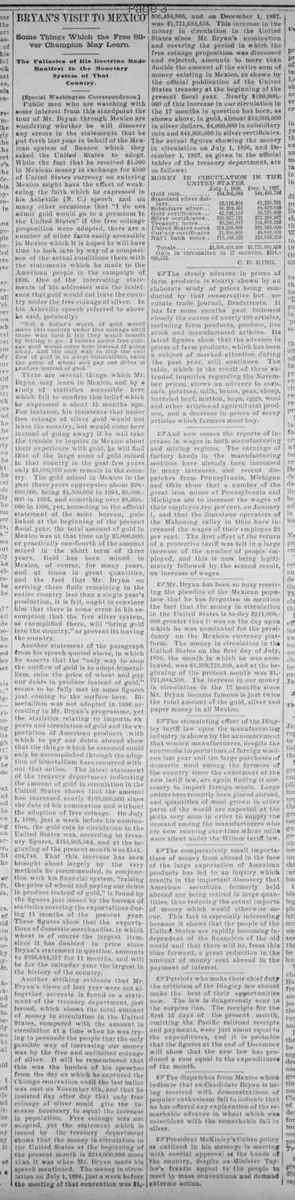
Some Things Which the Free Silver
Champion May Learn
The Fallacies of His Doctrine Made
Manifest
in the Monetary
System of That
Country.
[Special Washington Correspondence.]
Public men who are watching with
some interest from this standpoint the
tour of Mr. Bryan through Mexico are
wondering whether he will discover
any errors in the statements that he
put forth last year in behalf of the Mex-
ican system of finance which they
asked the United States to adopt.
While the fact that he received $1,090
in Mexican money in exchange for $500
of United States currency on entering
Mexico might have the effect of weak-
ening the faith which he expressed in
his Asheville (N. C.) speech and on
many other occasions that "I do not
admit gold would go to a premium in
the United States" if the free coinage
proposition were adopted, there are a
umber of other facts easily accessible
in Mexico which it is hoped he will have
time to look into by way of a compari-
son of the actual conditions there with
the statements which he made to the
American people in the campaign of
1896. One of the interesting state-
ments of his addresses was the insist-
ence that gold would not leave the coun-
try under the free coinage of silver. In
his Asheville speech referred to above
he said, pointedly:
"Not a dollar's worth of gold would
leave this country under free coinage until
those who held it felt they would benefit
by letting it go. I believe under free coin-
age gold would come here instead of going
away, and the only way to stop the out-
flow of gold is to adopt bimetallism, raise
the price of wheat and pay our debts in
produce instead of gold."
There are several things which Mr.
Bryan may learn in Mexico, and by a
study of statistics accessible here
which fail to confirm this belief which
he expressed a short 15 months ago.
For instance, his insistence that under
free coinage of silver gold would not
leave the country, but would come here
instead of going away; if he will take
the trouble to inquire in Mexico about
their experience with gold, he will find
that of the large sums of gold mined
in that country in the past few years
only $5,000,000 now remain in the coun-
try. The gold mined in Mexico in the
past three years aggregates about $20,-
000,000, being $4,500,000 in 1894, $6,000,
000 in 1895, and something over $9,000,
000 in 1896, yet, according to the official
statement of the mint bureau, pub-
lished at the beginning of the present
fiscal year, the total amount of gold in
Mexico was at that time only $5,000,000,
or practically one-fourth of the amount
mined in the short term of three
years. Gold has been mined in
Mexico, of course, for many years,
and at times in great quantities,
and the fact that Mr. Bryan on
arriving there finds remaining in the
entire country less than a single year's
production, it is felt, ought to convince
him that there is some error in his as-
sumption that the free silver system,
as exemplified there, will "bring gold
into the country," or prevent its leaving
the country.
Another statement of the paragraph
from his speech quoted above, in which
he asserts that the "only way to stop
the outflow of gold is to adopt bimetal-
lism, raise the price of wheat and pay
our debts in produce instead of gold,"
seems to be fully met by some figures
just coming to the surface here. Bi-
metallism was not adopted in 1896 ac-
cording to Mr. Bryan's programme, yet
the statistics relating to imports, ex-
ports and circulation of gold and the ex-
portation of American products with
which to pay our debts abroad show
that the things which he assumed could
only be accomplished through the adop-
tion of bimetallism have occurred with-
out that action. The latest statement
of the treasury department indicating
the amount of gold in circulation in the
United States shows that the amount
has increased nearly $100,000,000 since
the date of his nomination and without
the adoption of free coinage. On July
1, 1896, just a week before his nomina-
tion, the gold coin in circulation in the
United States was, according to treas-
ury figures, $454,905,064, and at the be-
ginning of the present month was $544,-
494,748. That this increase has been
brought about largely by the very
methods he recommended, in conjunc-
tion with his financial system, "raising
the price of wheat and paying our debts
in produce instead of gold," is found by
the figures just issued by the bureau of
statistics covering the exportations dur-
ing 11 months of the present year.
These figures show that the exporta-
tions of domestic merchandise, in which
wheat is of course the largest item,
since it has doubled in price since
Bryan's statement in question, amounts
to $956,644,357 for 11 months, and will
be for the calendar year the largest in
the history of the country.
Another striking evidence that Mr.
Bryan's views of last year were not al-
together accurate is found in a state-
ment of the treasury department, just
issued, which shows the total amount
of money in circulation in the United
States, compared with the amount in
circulation at a time when he was try-
ing to persuade the people that the only
possible way of increasing our money
was by the free and unlimited coinage
of silver. It will be remembered that
this was the burden of his speeches
from the day on which he captured the
Chicago convention until the last ballot
was cast on November 3d, and that he
insisted day after day that only free
coinage of silver could give the in-
crease necessary to equal the increase
in population. Free coinage was not
adopted, yet the statement which is
issued by the treasury department
shows that the money in circulation in
the United States at the beginning of
the present month is $214,000,000 more
than it was when Mr. Bryan made his
speech mentioned. The money in circu-
lation on July 1, 1896, just a week before
the meeting of that convention was $1,-
506,454,966, and on December 1, 1897
was $1,721,084,538. This increase in the
money in circulation in the United
States since Mr. Bryan's nomination
and covering the period in which the
free coinage proposition was discussed
and rejected, amounts to more than
double the amount of the entire sum of
money existing in Mexico, as shown by
the official publication of the United
States treasury at the beginning of the
present fiscal year. Nearly $100,000,
000 of this increase in our circulation in
the 17 months in question has been, as
shown above, in gold, almost $10,000,000
in silver dollars, $4,000,000 in subsidiary
coin and $45,000,000 in silver certificates.
The actual figures showing the money
in circulation on July 1, 1896, and De-
cember 1, 1897, as given in the official
tables of the treasury department, are
as follows:
MONEY
IN
CIRCULATION IN THE
UNITED STATES.
Totals............$1,506,454,966 $1,721,084,538
Gain in circulation in 17 months. $214,
649,572.
C. D. KING.
The steady advance in prices of
farm products is clearly shown by an
elaborate study of prices being con-
ducted by that conservative but ac-
curate trade journal, Bradstreet's. It
has for some months past followed
closely the course of nearly 100 articles,
including farm products, produce, live
stock and manufactured articles. Its
latest figures show that the advance in
prices of farm products, which has been
a subject of marked attention during
the past year, still continues. The
table, which is the result of these ex-
tended inquiries regarding the Novem-
ber prices, shows an advance in corn,
oats, potatoes, milk, beans, peas, sheep,
barreled beef, mutton, hops, eggs, wool
and other articles of agricultural pro-
duce, and a decrease in prices of many
articles which farmers must buy.
And now comes the reports of in-
crease in wages in both manufacturing
and mining regions. The earnings of
factory hands in the manufacturing
sections have already been increased
in many instances, and recent dis-
patches from Pennsylvania, Michigan
and Ohio show that a number of the
great iron mines of Pennsylvania and
Michigan are to increase the wages of
their employes ten per cent. on January
1, and that the limestone operators of
the Mahoning valley in Ohio have in-
creased the wages of their employes 20
per cent. The first effect of the return
of a protective tariff was felt in a large
increase of the number of people em-
ployed, and this is now being legiti-
imately followed by the second result
an increase of wages.
Mr. Bryan has been so busy receiv-
ing the plaudits of the Mexican popu-
lace that he has forgotten to mention
the fact that the money in circulation
in the United States is to-day $211,000,
000 greater than it was on the day upon
which he was nominated for the presl-
dency on the Mexican currency plat-
form. The money in circulation in the
United States on the first day of July,
1896, the month in which he was nom-
inated, was $1,509,725,200, and at the be-
ginning of the present month was $1,-
721,084,538. The increase in our money
in circulation in the 17 months since
Mr. Bryan became famous is just twice
the total amount of the gold, silver and
paper money in all Mexico.
The stimulating effect of the Ding-
ley tariff law upon the manufacturing
industry is shown by the announcement
that woolen manufacturers, despite the
enormous importations of foreign wool-
ens last year and the large purchases of
domestic wool among the farmers of
the country since the enactment of the
new tariff law, are again finding it nee-
essary to import foreign wools. Large
orders have recently been placed abroad,
and quantities of wool grown in other
parts of the world are expected at the
ports very soon in order to supply the
demand among the manufacturers who
are now running over-time where mills
were silent under the Wilson tariff law.
The comparatively small importa-
tions of money from abroad in the face
of the large exportation of American
products has led to an inquiry which
results in the important discovery that
American securities formerly held
abroad are being retired in large quan-
tities, thus reducing the actual imports
of money which would otherwise oc-
cur. This fact is especially interesting
because it shows that the people of the
United States are rapidly becoming in-
dependent of the financiers of the old
world and that there will be, from this
time forward, a great reduction in the
amount of money sent abroad in the
payment of interest.
Patriots who make their chief duty
the criticism of the Dingley law should
make the best of their opportunities
now. The law is dangerously near to
the surplus line. The receipts for the
first 15 days of the present month,
committing the Pacific railroad receipts
and payments, were just about equal to
the expenditures, and it is probable
that the figures at the end of December
will show that the new law has pro-
duced a sum equal to the expenditures
of the month.
The dispatches from Mexico which
indicate that ex-Candidate Bryan is be-
ing received with demonstrations of
popular enthusiasm fail to indicate that
he has offered any explanation of the re-
markable advance in wheat which was
coincident with the remarkable fall in
silver.
President McKinley's Cuban policy
as outlined in his message is meeting
with cordial approval at the hands of
the country, despite ex-Minister Tay-
lor's frantic appeal to the people to
meet in mass conventions and demand
extreme action.
| July 1, 1896 | Dec. 1, 1897 |
| 454,905,064 | 544,494,746 |
| Standard silver dollars | 61,280,761 |
| 52,116,904 | 64,829,045 |
| 60,204,451 | 36,725,409 |
| 42,196,119 | 373,298,967 |
| 350,657,191 | 104,676,398 |
| 95,245,047 | 262,183,000 |
| 224,249,868 | 48,640,000 |
| 31,890,000 | 224,956,210 |
| 215,168,122 | — |
What sub-type of article is it?
What themes does it cover?
What keywords are associated?
What entities or persons were involved?
Where did it happen?
Story Details
Key Persons
Location
Mexico, United States
Event Date
1896 1897
Story Details
Critique of Bryan's free silver advocacy via his Mexico visit, showing Mexico's gold depletion and US economic improvements in circulation, exports, prices, and wages without bimetallism.