Thank you for visiting SNEWPapers!
Sign up free
Letter to Editor
February 27, 1883
Daily Republican
Wilmington, New Castle County, Delaware
What is this article about?
In a letter dated Feb. 26, 1883, from Hockessin, Del., J. G. Jackson explains the 1882 comet's elliptical orbit, distinct from 1843 and 1880 comets, with a 793,689-year period and return expected in A.D. 2675. He provides its current position and velocity based on Prof. Frisby's data.
Clipping
OCR Quality
98%
Excellent
Full Text
HOCKESSIN, Del., Feb. 26, 1883.
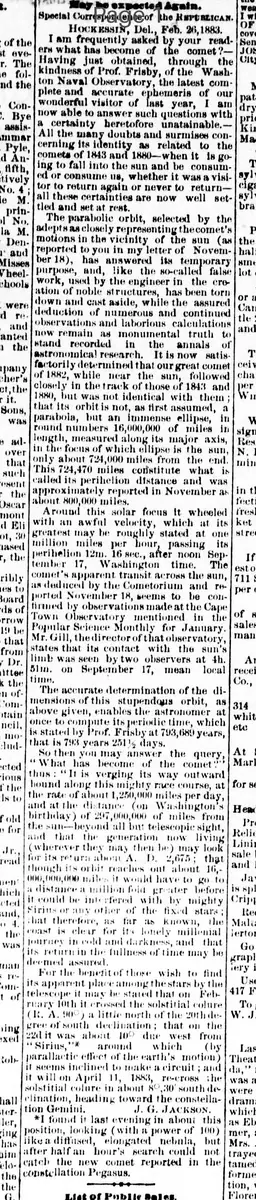
I am frequently asked by your readers what has become of the comet?—Having just obtained, through the kindness of Prof. Frisby, of the Washington Naval Observatory, the latest complete and accurate ephemeris of our wonderful visitor of last year, I am now able to answer such questions with a certainty heretofore unattainable.—All the many doubts and surmises concerning its identity as related to the comets of 1843 and 1880—when it is going to fall into the sun and be consumed or consume us, whether it was a visitor to return again or never to return—all these certainties are now well settled and set at rest.
The parabolic orbit, selected by the adepts as closely representing the comet's motions in the vicinity of the sun (as reported to you in my letter of November 18), has answered its temporary purpose, and, like the so-called false work, used by the engineer in the creation of noble structures, has been torn down and cast aside, while the assured deduction of numerous and continued observations and laborious calculations now remain as monumental truth to stand recorded in the annals of astronomical research. It is now satisfactorily determined that our great comet of 1882, while near the sun, followed closely in the track of those of 1843 and 1880, but was not identical with them; that its orbit is not, as first assumed, a parabola, but an immense ellipse, in round numbers 16,000,000 of miles in length, measured along its major axis, in the focus of which ellipse is the sun, only about 724,000 miles from the end. This 724,470 miles constitute what is called its perihelion distance and was approximately reported in November as about 800,000 miles.
Around this solar focus it wheeled with an awful velocity, which at its greatest may be roughly stated at one million miles per hour, passing its perihelion 12m. 16 sec., after noon September 17, Washington time. The comet's apparent transit across the sun, as deduced by the Cometarium and reported November 18, seems to be confirmed by observations made at the Cape Town Observatory mentioned in the Popular Science Monthly for January. Mr. Gill, the director of that observatory, states that its contact with the sun's limb was seen by two observers at 4h. 51m. on September 17, mean local time.
The accurate determination of the dimensions of this stupendous orbit, as above given, enables the astronomer at once to compute its periodic time, which is stated by Prof. Frisby at 793,689 years, that is 793 years 251 days.
So then you may answer the query "What has become of the comet?" thus: "It is verging its way outward bound along this mighty race course, at the rate of about 1,250,000 miles per day, and at the distance (on Washington's birthday) of 297,000,000 of miles from the sun—beyond all but telescopic sight, and that the generation now living (wherever they may then be) may look for its return about A. D. 2675; that though its orbit reaches out about 16,000,000,000 miles it would have to go to a distance a million fold greater before it could be interfered with by mighty Sirius or any other of the fixed stars; that therefore, as far as known, the coast is clear for its lonely millenial journey in cold and darkness, and that its return in the fullness of time may be deemed assured."
For the benefit of those who wish to find its apparent place among the stars by the telescope it may be stated that on February 20th it crossed the solstitial colure (R. A. 6h) a little north of the 20th degree of south declination: that on the 22d it was about 10° due west from "Sirius," around which (by parallactic effect of the earth's motion) it seems inclined to make a circuit: and it will on April 11, 1883, re-cross the solstitial colure in about 80,30' south declination, heading toward the constellation Gemini.
J. G. JACKSON.
*I found it last evening in about this position, looking (with a power of 100) like a diffused, elongated nebula, but after half an hour's search could not catch the new comet reported in the constellation Pegasus.
I am frequently asked by your readers what has become of the comet?—Having just obtained, through the kindness of Prof. Frisby, of the Washington Naval Observatory, the latest complete and accurate ephemeris of our wonderful visitor of last year, I am now able to answer such questions with a certainty heretofore unattainable.—All the many doubts and surmises concerning its identity as related to the comets of 1843 and 1880—when it is going to fall into the sun and be consumed or consume us, whether it was a visitor to return again or never to return—all these certainties are now well settled and set at rest.
The parabolic orbit, selected by the adepts as closely representing the comet's motions in the vicinity of the sun (as reported to you in my letter of November 18), has answered its temporary purpose, and, like the so-called false work, used by the engineer in the creation of noble structures, has been torn down and cast aside, while the assured deduction of numerous and continued observations and laborious calculations now remain as monumental truth to stand recorded in the annals of astronomical research. It is now satisfactorily determined that our great comet of 1882, while near the sun, followed closely in the track of those of 1843 and 1880, but was not identical with them; that its orbit is not, as first assumed, a parabola, but an immense ellipse, in round numbers 16,000,000 of miles in length, measured along its major axis, in the focus of which ellipse is the sun, only about 724,000 miles from the end. This 724,470 miles constitute what is called its perihelion distance and was approximately reported in November as about 800,000 miles.
Around this solar focus it wheeled with an awful velocity, which at its greatest may be roughly stated at one million miles per hour, passing its perihelion 12m. 16 sec., after noon September 17, Washington time. The comet's apparent transit across the sun, as deduced by the Cometarium and reported November 18, seems to be confirmed by observations made at the Cape Town Observatory mentioned in the Popular Science Monthly for January. Mr. Gill, the director of that observatory, states that its contact with the sun's limb was seen by two observers at 4h. 51m. on September 17, mean local time.
The accurate determination of the dimensions of this stupendous orbit, as above given, enables the astronomer at once to compute its periodic time, which is stated by Prof. Frisby at 793,689 years, that is 793 years 251 days.
So then you may answer the query "What has become of the comet?" thus: "It is verging its way outward bound along this mighty race course, at the rate of about 1,250,000 miles per day, and at the distance (on Washington's birthday) of 297,000,000 of miles from the sun—beyond all but telescopic sight, and that the generation now living (wherever they may then be) may look for its return about A. D. 2675; that though its orbit reaches out about 16,000,000,000 miles it would have to go to a distance a million fold greater before it could be interfered with by mighty Sirius or any other of the fixed stars; that therefore, as far as known, the coast is clear for its lonely millenial journey in cold and darkness, and that its return in the fullness of time may be deemed assured."
For the benefit of those who wish to find its apparent place among the stars by the telescope it may be stated that on February 20th it crossed the solstitial colure (R. A. 6h) a little north of the 20th degree of south declination: that on the 22d it was about 10° due west from "Sirius," around which (by parallactic effect of the earth's motion) it seems inclined to make a circuit: and it will on April 11, 1883, re-cross the solstitial colure in about 80,30' south declination, heading toward the constellation Gemini.
J. G. JACKSON.
*I found it last evening in about this position, looking (with a power of 100) like a diffused, elongated nebula, but after half an hour's search could not catch the new comet reported in the constellation Pegasus.
What sub-type of article is it?
Informative
What themes does it cover?
Science Nature
What keywords are associated?
Comet 1882
Elliptical Orbit
Astronomical Ephemeris
Perihelion
Periodic Time
Telescopic Position
What entities or persons were involved?
J. G. Jackson
Letter to Editor Details
Author
J. G. Jackson
Main Argument
the 1882 comet followed an elliptical orbit similar to those of 1843 and 1880 but is distinct, with a period of about 793,689 years, currently heading outward from the sun at high speed, expected to return around a.d. 2675.
Notable Details
References Prof. Frisby Of Washington Naval Observatory
Perihelion Distance 724,470 Miles On September 17, 1882
Periodic Time 793 Years 251 Days
Position Details For Telescopic Observation