Thank you for visiting SNEWPapers!
Sign up free
Letter to Editor
May 30, 1803
Jenks' Portland Gazette. Maine Advertiser
Portland, Cumberland County, Maine
What is this article about?
A letter from Elm-Town criticizes President Jefferson's removal of federal officers based on political opinions rather than merit, accusing him of favoritism toward supporters, moral corruption, and establishing a precedent for patronage that undermines governance and the Constitution.
Clipping
OCR Quality
95%
Excellent
Full Text
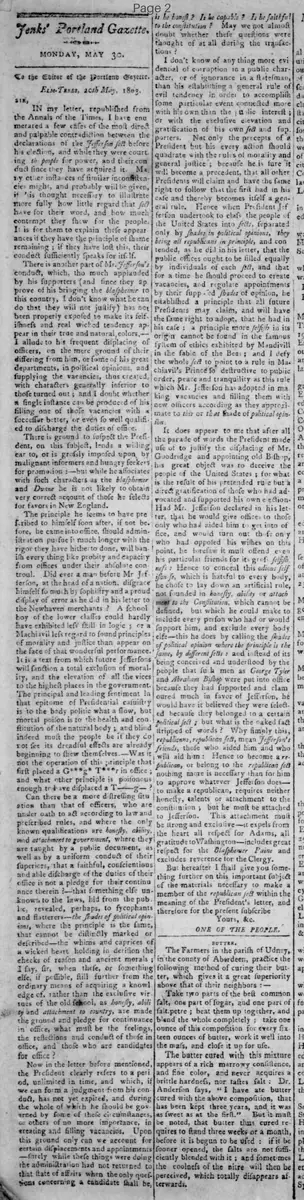
JENKS' PORTLAND GAZETTE.
MONDAY, MAY 30.
To the Editor of the Portland Gazette.
Elm-Town, 26th May, 1803.
IN my letter, republished from the Annals of the Times, I have enumerated a few cases of the most dire and palpable contradiction between the declarations of the Jeffersonians before his election, and while they were courting the people for power, and their conduct since they have acquired it. Many other instances of similar inconsistencies might, and probably will be given, if it is thought necessary to illustrate more fully how little regard that sect have for their word, and how much contempt they shew for the people.
It is for them to explain these appearances if they have the principle of shame remaining; if they have lost this, their conduct sufficiently speaks for itself.
There is another part of Mr. Jefferson's conduct, which, tho much applauded by his supporters (and since they approve of his bringing the blasphemer to this country, I don't know what he can do that they will not justify) has not been properly exposed to make its filthiness and real wicked tendency appear in their true and natural colors,-- I allude to his frequent displacing of officers, on the mere ground of their differing from him, or one of his great departments, in political opinions, and supplying the vacancies, thus created, with characters generally inferior to those turned out; and I doubt whether a single instance can be produced of his filling one of those vacancies with a successor better, or even so well qualified to discharge the duties of office.
There is ground to suspect the President, on this subject, lends a willing ear to, or is grossly imposed upon by malignant informers and hungry seekers for promotion :-but while he associates with such characters as the blasphemer and Duane he is not likely to obtain very correct account of those he selects for favors in New England.
The principle he seems to have prescribed to himself soon after, if not before, he came into office, should administration pursue it much longer with the rigor they have hitherto done, will banish every thing like probity and capacity from offices under their absolute control. Did ever a man before Mr. Jefferson, at the head of a nation, disgrace himself so much by sophistry and a proud display of error as he did in his letter to the Newhaven merchants? A school boy of the lower class could hardly have exhibited less skill in logic; or a Machiavelli less regard to sound principles of morality and justice than appear on the face of that wonderful performance.
It is a text from which future Jeffersons will sanction a total exclusion of morality, and the elevation of all the vices to the highest places in the government.
The principal and leading sentiment in that epitome of Presidential cautery is to the body politic what a slow, but mortal poison is to the health and constitution of the natural body; and blind indeed must the people be if they do not see its dreadful effects are already beginning to shew themselves.--Was it not the operation of this principle that first placed a G***g* T***r in office; and what other principle is poisonous enough to have displaced a Ti-g-?
Can there be a more distressing situation than that of officers, who are under oath to act according to law and prescribed rules, and where the only known qualifications are honesty, ability, and attachment to government, where they are taught by a public document, as well as by a uniform conduct of their superiors. that a faithful, conscientious and able discharge of the duties of their office is not a pledge for their continuance therein --that something else unknown to the laws, hid from the public, revealed, perhaps, to sycophants and flatterers--the shades of political opinions, where the principle is the same, that cannot be distinctly marked or described-the whims and caprices of a wicked heart holding in derision the checks of reason and ancient morals : I say, sir, when these, or something else, if possible, still further from the ordinary means of acquiring a knowledge of. rather than the exclusive virtues of the old school, as honesty, ability and attachment to country, are made the ground and pledge for continuance in office, what must be the feelings. the reflections and conduct of those in office, and those who are candidates for office?
Now in the letter before mentioned, the President clearly refers to a period, unlimited in time, and which, if we can form a judgment from his conduct, has not yet expired, and during the whole of which he should be governed by some of these circumstances, or others of no more importance, in creating and filling vacancies. Upon this ground only can we account for certain displacements and appointments -while these things were doing the administration had not returned to that state of affairs when the only questions concerning a candidate shall be,
is he honest? Is he capable? Is he faithful to the constitution? May we not almost doubt whether these questions were thought of at all during the transactions?
I don't know of any thing more evidential of corruption in a public character, or of ignorance in a statesman. than his establishing a general rule of evil tendency in order to accomplish some particular event connected more with his own than the public interest; or with the exclusive elevation and gratification of his own sect and supporters. Not only the precepts of a President but his every action should quadrate with the rules of morality and general justice; because he is sure it will become a precedent, that all other Presidents will claim and have the same right to follow that the first had in his case and thereby becomes itself a general rule. Hence when President Jefferson undertook to class the people of the United States into sects, separated only by shades in political opinions, they being all republicans in principle, and contended, as he did in his letter, that the public offices ought to be filled equally by individuals of each sect, and that for a time he should proceed to create vacancies, and regulate appointments by their supposed shades of opinion, he established a principle that all future Presidents may claim, and will have the same right to adopt, that he had in his case : a principle more selfish in its origin cannot be found in the famous system of ethics exhibited by Mandeville in the fable of the Bees; and I defy the whole sect to point to a rule in Machiavelli's Prince so destructive to public order, peace and tranquility as this rule which Mr. Jefferson has adopted in making vacancies and filling them with new officers according as they approximate to this or that shade of political opinion.
It does appear to me that after all the parade of words the President made use of to justify the displacing of Mr. Goodridge and appointing old Bishop, his great object was to deceive the people of the United States; for what is the result of his pretended rule but a direct gratification of those who had advocated and supported his own election Had Mr. Jefferson declared in his letter, that he would give offices to those only who had aided him to get into office, and would turn out those only who had opposed his wishes on this point, he foresaw it must offend even his particular friends for its gross selfishness : Hence to conceal this odious selfishness, which is hateful to every body, he chose to lay down an artificial rule, not founded in honesty, ability or attachment to the Constitution, which cannot be defined, but which he could make to include every person who had or would support him, and exclude every body else-this he does by calling the shades of political opinion where the principle is the same, by different sects : and instead of its being conceived and understood by the people that such men as George Tyler and Abraham Bishop were put into office because they had supported and clamoured much in favor of Jefferson, he would have it believed they were selected because they belonged to a certain political sect; but what is the naked fact stripped of words? Why simply this, republicans, republican sect, mean Jefferson's friends, those who aided him and who will aid him: Hence to become a republican, or belong to the republican sect nothing more is necessary than for him to approve whatever Jefferson does-- to make a republican, requires neither honesty, talents or attachment to the constitution ; but he must be attached to Jefferson. This attachment must be strong and exclusive-it expels from the heart all respect for Adams, all gratitude to Washington-includes great respect for the Blasphemer Paine and excludes reverence for the Clergy.
But hereafter I shall give you something further on this important subject of the materials necessary to make a member of the republican sect within the meaning of the President's letter, and therefore for the present subscribe
Yours, &c.
ONE OF THE PEOPLE.
MONDAY, MAY 30.
To the Editor of the Portland Gazette.
Elm-Town, 26th May, 1803.
IN my letter, republished from the Annals of the Times, I have enumerated a few cases of the most dire and palpable contradiction between the declarations of the Jeffersonians before his election, and while they were courting the people for power, and their conduct since they have acquired it. Many other instances of similar inconsistencies might, and probably will be given, if it is thought necessary to illustrate more fully how little regard that sect have for their word, and how much contempt they shew for the people.
It is for them to explain these appearances if they have the principle of shame remaining; if they have lost this, their conduct sufficiently speaks for itself.
There is another part of Mr. Jefferson's conduct, which, tho much applauded by his supporters (and since they approve of his bringing the blasphemer to this country, I don't know what he can do that they will not justify) has not been properly exposed to make its filthiness and real wicked tendency appear in their true and natural colors,-- I allude to his frequent displacing of officers, on the mere ground of their differing from him, or one of his great departments, in political opinions, and supplying the vacancies, thus created, with characters generally inferior to those turned out; and I doubt whether a single instance can be produced of his filling one of those vacancies with a successor better, or even so well qualified to discharge the duties of office.
There is ground to suspect the President, on this subject, lends a willing ear to, or is grossly imposed upon by malignant informers and hungry seekers for promotion :-but while he associates with such characters as the blasphemer and Duane he is not likely to obtain very correct account of those he selects for favors in New England.
The principle he seems to have prescribed to himself soon after, if not before, he came into office, should administration pursue it much longer with the rigor they have hitherto done, will banish every thing like probity and capacity from offices under their absolute control. Did ever a man before Mr. Jefferson, at the head of a nation, disgrace himself so much by sophistry and a proud display of error as he did in his letter to the Newhaven merchants? A school boy of the lower class could hardly have exhibited less skill in logic; or a Machiavelli less regard to sound principles of morality and justice than appear on the face of that wonderful performance.
It is a text from which future Jeffersons will sanction a total exclusion of morality, and the elevation of all the vices to the highest places in the government.
The principal and leading sentiment in that epitome of Presidential cautery is to the body politic what a slow, but mortal poison is to the health and constitution of the natural body; and blind indeed must the people be if they do not see its dreadful effects are already beginning to shew themselves.--Was it not the operation of this principle that first placed a G***g* T***r in office; and what other principle is poisonous enough to have displaced a Ti-g-?
Can there be a more distressing situation than that of officers, who are under oath to act according to law and prescribed rules, and where the only known qualifications are honesty, ability, and attachment to government, where they are taught by a public document, as well as by a uniform conduct of their superiors. that a faithful, conscientious and able discharge of the duties of their office is not a pledge for their continuance therein --that something else unknown to the laws, hid from the public, revealed, perhaps, to sycophants and flatterers--the shades of political opinions, where the principle is the same, that cannot be distinctly marked or described-the whims and caprices of a wicked heart holding in derision the checks of reason and ancient morals : I say, sir, when these, or something else, if possible, still further from the ordinary means of acquiring a knowledge of. rather than the exclusive virtues of the old school, as honesty, ability and attachment to country, are made the ground and pledge for continuance in office, what must be the feelings. the reflections and conduct of those in office, and those who are candidates for office?
Now in the letter before mentioned, the President clearly refers to a period, unlimited in time, and which, if we can form a judgment from his conduct, has not yet expired, and during the whole of which he should be governed by some of these circumstances, or others of no more importance, in creating and filling vacancies. Upon this ground only can we account for certain displacements and appointments -while these things were doing the administration had not returned to that state of affairs when the only questions concerning a candidate shall be,
is he honest? Is he capable? Is he faithful to the constitution? May we not almost doubt whether these questions were thought of at all during the transactions?
I don't know of any thing more evidential of corruption in a public character, or of ignorance in a statesman. than his establishing a general rule of evil tendency in order to accomplish some particular event connected more with his own than the public interest; or with the exclusive elevation and gratification of his own sect and supporters. Not only the precepts of a President but his every action should quadrate with the rules of morality and general justice; because he is sure it will become a precedent, that all other Presidents will claim and have the same right to follow that the first had in his case and thereby becomes itself a general rule. Hence when President Jefferson undertook to class the people of the United States into sects, separated only by shades in political opinions, they being all republicans in principle, and contended, as he did in his letter, that the public offices ought to be filled equally by individuals of each sect, and that for a time he should proceed to create vacancies, and regulate appointments by their supposed shades of opinion, he established a principle that all future Presidents may claim, and will have the same right to adopt, that he had in his case : a principle more selfish in its origin cannot be found in the famous system of ethics exhibited by Mandeville in the fable of the Bees; and I defy the whole sect to point to a rule in Machiavelli's Prince so destructive to public order, peace and tranquility as this rule which Mr. Jefferson has adopted in making vacancies and filling them with new officers according as they approximate to this or that shade of political opinion.
It does appear to me that after all the parade of words the President made use of to justify the displacing of Mr. Goodridge and appointing old Bishop, his great object was to deceive the people of the United States; for what is the result of his pretended rule but a direct gratification of those who had advocated and supported his own election Had Mr. Jefferson declared in his letter, that he would give offices to those only who had aided him to get into office, and would turn out those only who had opposed his wishes on this point, he foresaw it must offend even his particular friends for its gross selfishness : Hence to conceal this odious selfishness, which is hateful to every body, he chose to lay down an artificial rule, not founded in honesty, ability or attachment to the Constitution, which cannot be defined, but which he could make to include every person who had or would support him, and exclude every body else-this he does by calling the shades of political opinion where the principle is the same, by different sects : and instead of its being conceived and understood by the people that such men as George Tyler and Abraham Bishop were put into office because they had supported and clamoured much in favor of Jefferson, he would have it believed they were selected because they belonged to a certain political sect; but what is the naked fact stripped of words? Why simply this, republicans, republican sect, mean Jefferson's friends, those who aided him and who will aid him: Hence to become a republican, or belong to the republican sect nothing more is necessary than for him to approve whatever Jefferson does-- to make a republican, requires neither honesty, talents or attachment to the constitution ; but he must be attached to Jefferson. This attachment must be strong and exclusive-it expels from the heart all respect for Adams, all gratitude to Washington-includes great respect for the Blasphemer Paine and excludes reverence for the Clergy.
But hereafter I shall give you something further on this important subject of the materials necessary to make a member of the republican sect within the meaning of the President's letter, and therefore for the present subscribe
Yours, &c.
ONE OF THE PEOPLE.
What sub-type of article is it?
Political
Persuasive
Provocative
What themes does it cover?
Politics
Morality
What keywords are associated?
Jefferson Criticism
Political Appointments
Patronage
Republican Sect
Moral Corruption
Federal Officers
Constitutional Fidelity
What entities or persons were involved?
One Of The People
To The Editor Of The Portland Gazette.
Letter to Editor Details
Author
One Of The People
Recipient
To The Editor Of The Portland Gazette.
Main Argument
president jefferson's policy of removing federal officers based on political differences rather than merit promotes corruption, favoritism toward his supporters, and sets a dangerous precedent that undermines honest governance and constitutional principles.
Notable Details
References Jefferson's Letter To Newhaven Merchants
Mentions 'Blasphemer' (Thomas Paine) And Duane
Cites Machiavelli And Mandeville's Fable Of The Bees
Discusses Appointments Of G***G* T***R, Ti G , George Tyler, Abraham Bishop, Mr. Goodridge, Old Bishop