Thank you for visiting SNEWPapers!
Sign up free
Phenix Gazette
Alexandria, Virginia
What is this article about?
Excerpt from Continental Congress debates on July 12, 22, 30, 31, and August 1 regarding Articles of Confederation, specifically Article XI on funding common treasury by inhabitant quotas, including whether to count only white inhabitants or all, with arguments from delegates like Chase, Adams, Harrison, Wilson, Payne, and Witherspoon; amendment to exclude non-whites rejected by northern states' votes.
Clipping
OCR Quality
Full Text
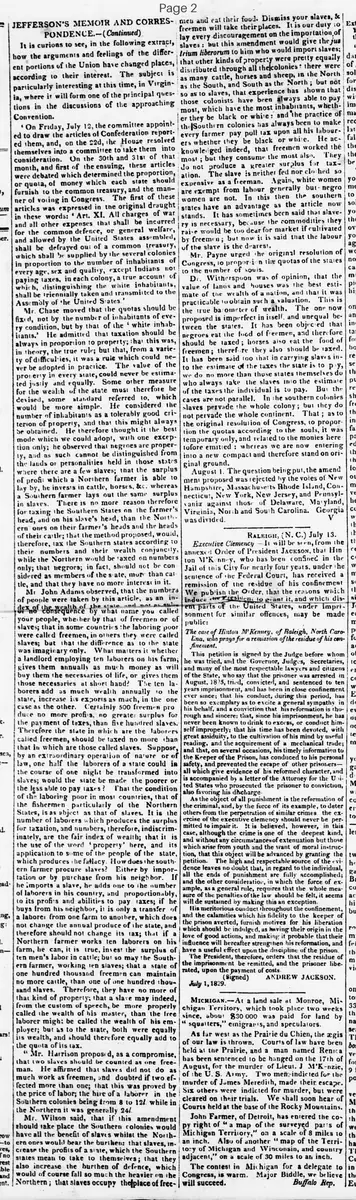
It is curious to see, in the following extract,
particularly interesting at this time, in Virginia,
where it will form one of the principal ques-
tions in the discussions of the approaching
Convention.
'On Friday, July 12, the committee appoint-
ed to draw the articles of Confederation report-
ed them, and, on the 22d, the House resolved
themselves into a committee to take them into
consideration. On the 30th and 31st of that
month, and first of the ensuing, these articles
were debated which determined the proportion,
or quota, of money which each state should
furnish to the common treasury, and the man-
ner of voting in Congress. The first of these
articles was expressed in the original draught
in these words: "Art. XI. All charges of war
and all other expenses that shall be incurred
for the common defence, or general welfare,
and allowed by the United States assembled,
shall be defrayed out of a common treasury,
which shall be supplied by the several colonies
in proportion to the number of inhabitants of
every age, sex and quality, except Indians not
paying taxes, in each colony, a true account of
which, distinguishing the white inhabitants,
shall be triennially taken and transmitted to the
Assembly of the United States."
Mr. Chase moved that the quotas should be
fixed, not by the number of inhabitants of eve-
ry condition, but by that of the "white inhab-
itants." He admitted that taxation should be
always in proportion to property; that this was,
in theory, the true rule; but that, from a varie-
ty of difficulties, it was a rule which could ne-
ver be adopted in practice. The value of the
property in every state, could never be estima-
ted justly and equally. Some other measure
for the wealth of the state must therefore be
devise, some standard referred to, which
would be more simple. He considered the
number of inhabitants as a tolerably good cri-
terion of property, and that this might always
be obtained. He therefore thought it the best
mode which we could adopt, with one excep-
tion only: he observed that negroes are proper-
ty, and as such cannot be distinguished from
the lands or personalities held in those states
where there are a few slaves; that the surplus
of profit which a Northern farmer is able to
lay by, he invests in cattle, horses, &c. whereas
a Southern farmer lays out the same surplus
in slaves. There is no more reason therefore
for taxing the Southern States on the farmer's
head, and on his slave's head, than the North-
tern ones on their farmer's heads and the heads
of their cattle; that the method proposed, would,
therefore, tax the Southern states according to
their numbers and their wealth conjunctly.
while the Northern would be taxed on numbers
only; that negroes, in fact, should not be con-
sidered as members of the state, more than cat-
tle, and that they have no more interest in it.
Mr. John Adams observed, that the numbers
of people were taken by this article, as an in-
dex of the wealth of the state
of no consequence by what name you called
your people, whether by that of freemen or of
slaves; that in some countries the laboring poor
were called freemen, in others they were called
slaves; but that the difference as to the state
was imaginary only. What matters it whether
a landlord employing ten laborers on his farm,
gives them annually as much money as will
buy them the necessaries of life, or gives them
those necessaries at short hand? The ten la-
borers add as much wealth annually to the
state, increase its exports as much, in the one
case as the other. Certainly 500 freemen pro-
duce no more profits, no greater surplus for
the payment of taxes, than five hundred slaves.
Therefore the state in which are the laborers
called freemen, should be taxed no more than
that in which are those called slaves. Suppose,
by an extraordinary operation of nature or of
law, one half the laborers of a state could in
the course of one night be transformed into
slaves; would the state be made the poorer or
the less able to pay taxes? That the condition
of the laboring poor in most countries, that of
the fishermen particularly of the Northern
States, is as abject as that of slaves. It is the
number of laborers which produces the surplus
for taxation, and numbers, therefore, indiscrim-
inately, are the fair index of wealth; that it is
the use of the word "property" here, and its
application to some of the people of the state,
which produces the fallacy. How does the south-
tern farmer procure slaves? Either by impor-
tation or by purchase from his neighbor. If
he imports a slave, he adds one to the number
of laborers in his country, and proportionably,
to its profits and abilities to pay taxes; if he
buys from his neighbor, it is only a transfer of
a laborer from one farm to another, which does
not change the annual produce of the state, and
therefore should not change its tax; that if a
Northern farmer works ten laborers on his
farm, he can, it is true, invest the surplus of
ten men's labor in cattle; but so may the South-
tern farmer, working ten slaves; that a state of
one hundred thousand freemen can maintain
no more cattle, than one of one hundred thou-
sand slaves. Therefore, they have no more of
that kind of property: that a slave may indeed,
from the custom of speech, be more properly
called the wealth of his master, than the free
laborer might be called the wealth of his em-
ployer; but as to the state, both were equally
its wealth, and should therefore equally add to
the quota of its tax.
"Mr. Harrison proposed, as a compromise,
that two slaves should be counted as one free-
man. He affirmed that slaves did not do as
much work as freemen, and doubted if two ef-
fected more than one; that this was proved by
the price of labor; the hire of a laborer in the
Souihern colonies being from 8 to 12l. while in
the Northern it was generally 24l.
Mr. Wilson said, that if this amendment
should take place the Southern colonies would
have all the benefit of slaves whilst the North-
tern ones would bear the burthen: that slaves, in-
crease the profits of a state, which the Southern
states mean to take to themselves; that they
also increase the burthen of defence, which
would of course fall so much the heavier on the
Northern; that slaves occupy the place of free-
men and eat their food. Dismiss your slaves, &
freemen will take their places. It is our duty to
lay every discouragement on the importation of
slaves: but this amendment would give the jus
trium liberorum to him who would import slaves:
that other kinds of property were pretty equaily
as many cattle, horses and sheep, in the North
distributed through all the colonies: there were
so as to slaves, that experience has shown that
as the South, and South as the North; but not
most, which have the most inhabitants, wheth-
those colonists have been always able to pay
er they be black or white: and the practice of
every farmer pay poll tax upon all his labour-
the Southern colonies has always been to make
knowledged indeed, that freemen worked the
ers whether they be black or white. He ac-
most; but they consume the most also. They
do not produce a greater surplus for tax-
ation. The slave is neither fed nor clothed so
expensive as a freeman. Again, white women
are exempt from labour generally but negro
states have an advantage as the article now
women are not. In this then the southern
stands. It has sometimes been said that slave-
ry is necessary, because the commodities they
raise would be too dear for market if cultivated
by freemen; but now it is said that the labour
of the slave is the dearest.
Mr. Payne urged the original resolution of
Congress, to proportion the quotas of the states
to the number of souls.
Dr. Witherspoon was of opinion, that the
value of lands and houses was the best esti-
mate of the wealth of a nation, and that it was
practicable to obtain such a valuation. This is
the true barometer of wealth. The one now
proposed is imperfect in itself, and unequal be-
tween the states. It has been objected that
negroes eat the food of freemen, and therefore
should be taxed; horses also eat the food of
freemen: therefore they also should be taxed.
It has been said too that in carrying slaves in-
to the estimate of the taxes the state is to pay,
we do no more than those states themselves do
who always take the slaves into the estimate
of the taxes the individual is to pay. But the
cases are not parallel. In the southern colonies
slaves pervade the whole colony; but they do
not pervade the whole continent. That, as to
the original resolution of Congress, to propor-
tion the quotas according to the souls, it was
temporary only, and related to the monies here-
to fore emitted: whereas we are now entering
into a new compact and therefore stand on ori-
ginal ground.
August 1. The question being put, the amend-
ment proposed was rejected by the voices of New
Hampshire, Massachusetts, Rhode Island, Con-
necticut, New York, New Jersey, and Pennsyl-
vania against those of Delaware, Maryland,
Virginia, North and South Carolina. Georgia
was divided.
What sub-type of article is it?
What keywords are associated?
What entities or persons were involved?
Domestic News Details
Event Date
Friday, July 12; 22d; 30th And 31st; First Of The Ensuing; August 1
Key Persons
Outcome
the amendment proposed was rejected by the voices of new hampshire, massachusetts, rhode island, connecticut, new york, new jersey, and pennsylvania against those of delaware, maryland, virginia, north and south carolina. georgia was divided.
Event Details
Debate in the House on articles of Confederation determining proportion of money each state should furnish to common treasury and manner of voting in Congress. Original Article XI proposed supplying treasury in proportion to number of inhabitants of every age, sex and quality, except Indians not paying taxes. Mr. Chase moved quotas fixed by number of white inhabitants only, arguing negroes are property like cattle. Mr. John Adams argued numbers of people as index of wealth, regardless of freemen or slaves. Mr. Harrison proposed compromise of two slaves as one freeman. Mr. Wilson opposed, saying Southern states would benefit from slaves while Northern bear burden. Mr. Payne urged original resolution by number of souls. Dr. Witherspoon favored value of lands and houses as estimate of wealth.