Thank you for visiting SNEWPapers!
Sign up free
The Nome Nugget
Nome, Nome County, Alaska
What is this article about?
President Kennedy briefed top US Congressional leaders on his Vienna summit with Soviet Premier Khrushchev, detailing discussions on Berlin crisis, UN secretariat changes, Cuba, Laos, potential wars, and nuclear testing, revealing Khrushchev's firm positions without major concessions.
Clipping
OCR Quality
Full Text
Editor's Note
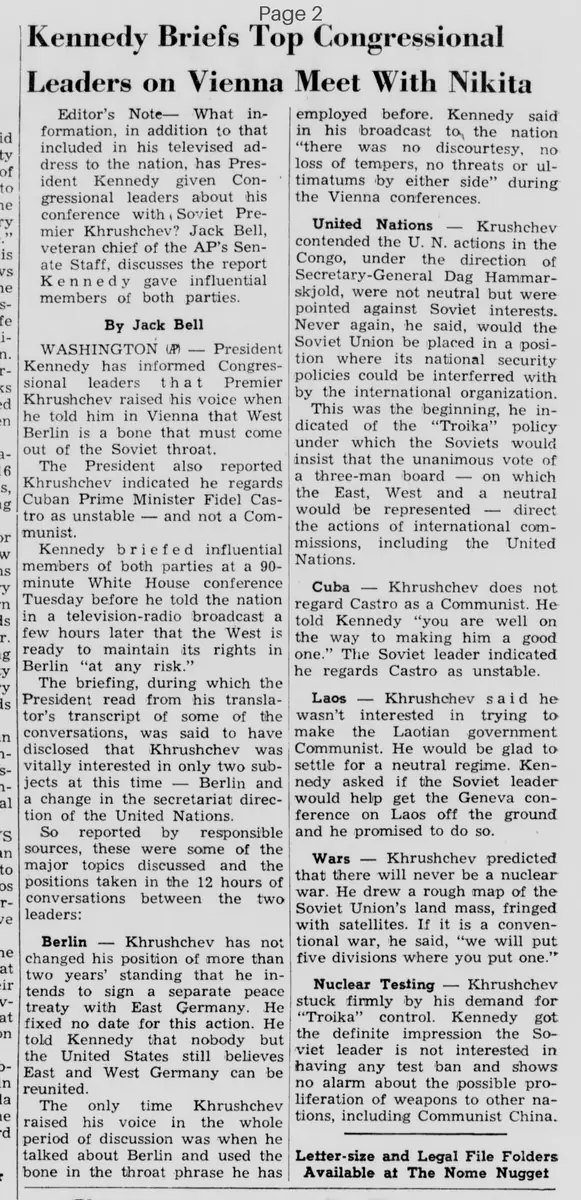
What information, in addition to that included in his televised address to the nation, has President Kennedy given Congressional leaders about his conference with Soviet Premier Khrushchev? Jack Bell, veteran chief of the AP's Senate Staff, discusses the report Kennedy gave influential members of both parties.
By Jack Bell
WASHINGTON (AP) - President Kennedy has informed Congressional leaders that Premier Khrushchev raised his voice when he told him in Vienna that West Berlin is a bone that must come out of the Soviet throat.
The President also reported Khrushchev indicated he regards Cuban Prime Minister Fidel Castro as unstable - and not a Communist.
Kennedy briefed influential members of both parties at a 90-minute White House conference Tuesday before he told the nation in a television-radio broadcast a few hours later that the West is ready to maintain its rights in Berlin "at any risk."
The briefing, during which the President read from his translator's transcript of some of the conversations, was said to have disclosed that Khrushchev was vitally interested in only two subjects at this time - Berlin and a change in the secretariat direction of the United Nations.
So reported by responsible sources, these were some of the major topics discussed and the positions taken in the 12 hours of conversations between the two leaders:
Berlin
Khrushchev has not changed his position of more than two years' standing that he intends to sign a separate peace treaty with East Germany. He fixed no date for this action. He told Kennedy that nobody but the United States still believes East and West Germany can be reunited.
The only time Khrushchev raised his voice in the whole period of discussion was when he talked about Berlin and used the bone in the throat phrase he has employed before. Kennedy said in his broadcast to the nation "there was no discourtesy, no loss of tempers, no threats or ultimatums by either side" during the Vienna conferences.
United Nations
Khrushchev contended the U. N. actions in the Congo, under the direction of Secretary-General Dag Hammarskjold, were not neutral but were pointed against Soviet interests.
Never again, he said, would the Soviet Union be placed in a position where its national security policies could be interfered with by the international organization.
This was the beginning, he indicated of the "Troika" policy under which the Soviets would insist that the unanimous vote of a three-man board on which the East, West and a neutral would be represented direct the actions of international commissions, including the United Nations.
Cuba
Khrushchev does not regard Castro as a Communist. He told Kennedy "you are well on the way to making him a good one." The Soviet leader indicated he regards Castro as unstable.
Laos
Khrushchev said he wasn't interested in trying to make the Laotian government Communist. He would be glad to settle for a neutral regime. Kennedy asked if the Soviet leader would help get the Geneva conference on Laos off the ground and he promised to do so.
Wars
Khrushchev predicted that there will never be a nuclear war. He drew a rough map of the Soviet Union's land mass, fringed with satellites. If it is a conventional war, he said, "we will put five divisions where you put one."
Nuclear Testing - Khrushchev stuck firmly by his demand for "Troika" control. Kennedy got the definite impression the Soviet leader is not interested in having any test ban and shows no alarm about the possible proliferation of weapons to other nations, including Communist China.
What sub-type of article is it?
What keywords are associated?
What entities or persons were involved?
Where did it happen?
Foreign News Details
Primary Location
Vienna
Key Persons
Outcome
no agreements reached; khrushchev reiterated demands for separate peace treaty with east germany, un troika system, viewed castro as unstable, agreed to support laos neutrality, predicted no nuclear war but superiority in conventional war, opposed test ban without troika control.
Event Details
During the 12-hour Vienna summit, Kennedy and Khrushchev discussed Berlin, where Khrushchev insisted on signing a separate peace treaty with East Germany and described West Berlin as a bone in the Soviet throat; UN actions in Congo and push for Troika secretariat; Castro's instability and non-Communist status; Laos neutrality with Soviet support for Geneva conference; potential wars, with Khrushchev asserting Soviet superiority; and nuclear testing, demanding Troika control and showing disinterest in a test ban.