Thank you for visiting SNEWPapers!
Sign up free
The Enquirer
Richmond, Henrico County, Virginia
What is this article about?
Eyewitness account of the February 1, 1814 eruption of the Albay volcano (Mayon) in Camarines, Philippines, destroying five towns including Cagsaua and Budino, killing over 1,200 people, and leaving 20,000 survivors destitute. Fr. Francisco Aragoneses appeals for charity from Manila.
Clipping
OCR Quality
Full Text
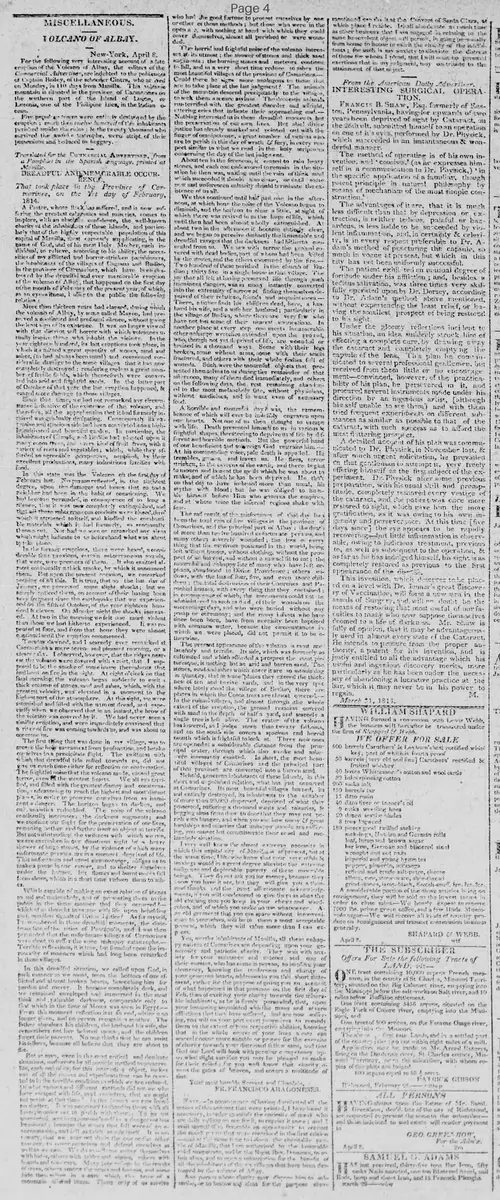
VOLCANO OF ALBAY.
New-York, April 8.
For the following very interesting account of a late eruption of the Volcano of Albay, the editors of the Commercial Advertiser are indebted to the politeness of Captain Bailey, of the schooner Cintra, who arrived on Monday, in 110 days from Manilla. This volcanic mountain is situated in the province of Camarines on the southern part of the Island of Luzon, or Luconia, one of the Philippine Isles, in the Indian Ocean.
Five parish towns were entirely destroyed by the eruption; more than three hundred of their inhabitants perished amid the ruins; & the twenty thousand who survived the awful catastrophe, were stripped of their possessions and reduced to beggary.
Translated for the Commercial Advertiser, from a Pamphlet in the Spanish language, printed at Manilla.
DREADFUL AND MEMORABLE OCCURRENCE
That took place in the Province of Camarines, on the 1st day of February, 1814.
A Pastor, whose Flock has suffered, and is now suffering the greatest calamities and miseries, comes to implore, with an absolute confidence, the well-known charity of the inhabitants of these islands, and particularly that of the highly respectable population of this capital of Manilla, most earnestly supplicating, in the name of God, and of his most Holy Mother, each individual, to relieve, according to his ability, the necessities of my afflicted and horror-stricken parishioners, the inhabitants of the villages of Cagsaua and Budino, in the province of Camarines, which have been destroyed by the dreadful and ever memorable eruption of the volcano of Albay, that happened on the first day of the month of February of the present year, of which, as an eye-witness, I offer to the public the following relation:
More than thirteen years had elapsed, during which the volcano of Albay, by some called Mayon, had preserved a continued and profound silence, without giving the least sign of its existence. It was no longer viewed with that distrust and horror with which volcanoes usually inspire those who inhabit the vicinity. In the year eighteen hundred, its last eruptions took place, in which it emitted a great quantity of stones, sand and ashes, (as had always been usual) and occasioned considerable damage to the same villages that it has now completely destroyed: rendering useless a great number of fertile fields, which thenceforth were converted into arid and frightful sands. In the latter part of October of that year the last eruption happened, & caused more damage to those villages.
Since that time, we had not remarked any circumstance indicative of the existence of the volcano, and therefore, all the apprehension that it had formerly inspired was gradually dissipating. Consequently its extensive and spacious side had been converted into a highly cultivated and beautiful garden. In particular, the inhabitants of Cagsaua and Budino had planted upon it many cocoa trees, and several kind of fruit trees, with a variety of roots and vegetables: which, while they afforded an agreeable perspective, supplied, by their excellent productions, many industrious families with food.
In this state was the Volcano on the first day of February last. No person reflected, in the slightest degree, upon the damages and losses that so bad a neighbor had been in the habit of occasioning. We had become persuaded, in consequence of so long a silence, that it was now completely extinguished, and that all those subterraneous conduits were closed, through which it attracted to itself, and kindled the combustible materials which it had formerly, so continually thrown out. Nor had we seen or remarked any signs which might indicate to us beforehand what was about to take place.
In the former eruptions, there were heard, considerable time previous, certain subterraneous sounds, that were sure presages of them. It also emitted almost continually a thick smoke, by which it announced them. But upon the present occasion, we remarked nothing of all this. It is true, that on the last day of January, we perceived some slight shocks; but we scarcely noticed them, on account of their having been very frequent since the earthquake that we experienced on the fifth of October, of the year eighteen hundred & eleven. On Monday night the shocks increased. At two in the morning we felt one more violent than those we had hitherto experienced. It was repeated at four, and from that hour they were almost continual until the eruption commenced.
Tuesday dawned, and I scarcely ever remarked at Camarines a more serene and pleasant morning, or a clearer sky. I observed, however, that the ridges nearest the volcano were covered with a mist, that I supposed to be the smoke of some house thereabouts that had been on fire in the night. At eight o'clock on that fatal morning, the volcano began suddenly to emit a thick column of stones, sand and ashes, which, with the greatest velocity, was elevated in a moment to the highest part of the atmosphere. At this sight, we were astonished and filled with the utmost dread, and especially when we observed that in an instant, the brow of the volcano was covered by it. We had never seen a similar eruption, and were immediately convinced that a river of fire was coming towards us, and was about to consume us.
The first thing that was done in my village, was to secure the holy sacrament from profanation, and betake ourselves to a precipitate flight. The swiftness with which that dreadful tide rolled towards us, did not give us much time either for reflection or conversation. The frightful noise that the volcano made, caused great terror, even in the stoutest hearts. We all ran terrified, and filled with the greatest dismay and consternation, endeavoring to reach the highest and most distant places, in order to preserve ourselves from so imminent a danger. The horizon began to darken, and our anxieties redoubled. The noise of the volcano continually increases: the darkness augments; and we continue our flight for the preservation of our lives, removing farther and farther, from an object so terrific.
But notwithstanding the swiftness with which we run, we are overtaken in our disastrous flight by a heavy shower of huge stones, by the violence of which many unfortunate persons are in a moment deprived of life. This unforeseen and cruel circumstance, obliges us to make a pause in our career, and to shelter ourselves under the houses. In flames and burnt stones fall from above, which in a short time reduce them to ashes.
Who is capable of making an exact relation of scenes so sad and melancholy, and of presenting them to the public in the same manner that they occurred? Which of us thought to escape with life upon beholding such manifest signals of divine justice? As for myself, it occurred in those dreadful moments, the disgraceful fate of the cities of Pompeii, and I was then persuaded that the unfortunate villages of Camarines were about to suffer the same unhappy catastrophe.
Terrible reflections, it is true, but founded upon the immorality of manners which had long been remarked in those villages.
In this dreadful situation, we called upon God, in such manner as we could, from the bottom of our afflicted and almost broken hearts, beseeching him for pardon and mercy. It became completely dark, and we remained enveloped and immersed in the most thick and palpable darkness, comparable only to that which in the time of Moses was seen in Egypt.
From this moment reflection is at an end, advice is no longer given, and no person recognizes any other. The father abandons his children, the husband his wife, she remembers not her beloved spouse, and the children forget their parents. No one thinks that he can assist his fellows, because all believe that they are about to die.
But as men, even in the most critical and desperate situations, endeavor by all possible method to preserve life, each one of us, for this interesting object, makes use of all the means and expedients that can be resorted to in the terrible condition in which we are reduced. Of the various and different methods did not we who have escaped with life, avail ourselves, that we might not perish at that time in the lowest way from? To deliver, I conjecture to abandon them with all mother rest to push with cheer. To go uncovered, was to expose oneself to a longer while imminent: fleeing the one was that fall were an e. torrpomeeize, and ioll astviete ae rarieedf It n. ewar, that we oarr ooe thin the cre oet alher taar ner. to cover eangelveg rd defend onrseleee as W.llge we can. W.dome crer 'henerlve with had-s, othroe with tahlee qhd eimir ethrere with h ards and t s. ras. Msey Lote In the reuke of ireee, ohems amome the mene a and hed ro, and eame hide then, leee in a eave alick th brnw of a mounlain o ated them. (lane or iy ofus survive who had dhe good fortune to protcet curselves by one orotheroi those methols : but those who were in the open a with nothing athandwith which they could cover dhiemselves, alniost all perished or were woun ded.
Thye horrid and frigbtful noise of the voleano increa ses its utmost : the shower ofstones andthick saad auginents : theburning stones and meteors continue to hall, and in a very short time reduce to ashes the most beautiful villages of the province of Camarines.
Cculd there be signs more analogous to those tiut are to take place at thelast judgment? The anioals of the mountxin descend precipitatcir to the vilfag s, to seek them a secure asyium The rloruestie anitnals run terrified with the greatest disorder and ailright. rttering eries that indieate their approaching end.
Notbinginterested us in those drendfal moments but the preservation of our own lives But alas! divine justice has already marked and pointed ont with the finger ofoionipotenee, a great number of victirns who are to perish in this day of wrath & ury, in every res pect similar to what we read in the holy scriptures congerning the day of the last judgnent.
About ten in the forenoon, it ceased to rain heary stones, and each ond endeavored toremain in the siti ation he then was, waiting uutil :he rain of thick sand which succceded it should also e -ase, or dntil some ne w and unforesecn calamity should terminnte the ex istence of us all.
We thus continued until haif past oñe in the after noou, at which hourthe noise of the Volcano began to diminish, and the horizon to clear a little, at sight of which there was revived in us the hope oflife. which until then had been almost wholly extingui-hed. At abont twoin the aftcrnoon it became ehticey clear. and we began to perceive distinctly the lamentable and dreadful ravages that the darkness had hitherto con cealed from us. We saw with terror the groand co vered with dead bodies, part of r hom had been &iled by the stones, and the oihers consuped by the fire.
Two hundred of those perished in the churuh of Bu diao: thirty Sive in a single bogse inthat vllage. The iny that all felt at having preserved life through such imminent dangers, was in many instantly converted into the extreinity of sorrow at finding themselves de prived of their relations, friends and acquintances.
There, atather finds Jis children dead. bere. a hus bard bis wife, and a wife her husband: partienlarly in the village of Budiao, where thercwre very few who have notlost some oftheir nearest conneetions. In snother place at every step one meets innamerabin otherunharpy wretches extended upon the grounrl, who, though not yet deprived of life, are woundad or bruised in a thousand ways. Some with their legs broken, some without arms, some with their sculls ractured, and others with their whole bodies full of wounds. Such were the mournfut objects that pre sented themselvesto us during tie remainder of that aft rnoon, many ofthem died irmmedintely, and others on the following davs. the rest remaining abandon ed to the most melancholy fate, witbout phy sicians, withbut medicines, and in want even of neoessary food.
A. horribleand mouenfui day was. the remem brance of which will ever be indeliblycngraven upon oor hearts. Not one of us then thonght to eieape with life. Death presented himself to ui in various & frightful shapes, threateringto deprive usof tife by dif ferent aot horrible methods. But the powerful hand of our beneficient and sooreign God restrains him.
Athis compabding voice, pale death is appa'led. Iie trembles, groa s, and leaves ns. He flees, terror strickcn, to the caverns of the earth, and there begins to mourn and larnent the sp ils which he was aboutto make, and of wbich he has been derrived. He tho't on that day to have imbrued more than usual, his seythe with blood; but he was obliged to bun bie himself before Him who governs the empires, and at whose voice the inferual regions shake with fear.
The sad result of the misfortunrs of thai dw has been the total ruin of five villoges in the province of Camarinee, and the prineipal part of Aibay : the death of more than tveive huudred nnfortu.ate persons, and many others severely wounded; the loss of every thing that the survivors possessed in the world, bemg left withont houses, witbout clothing. withont the pros: pect of an harvest, and without a morsel fit to eat; the mournfil and nhappy Fate of many who have left or phans, ahandonedto Divine Providenee : others wi dows, with the loss of four, five, and even rnore chil dren : (he total destruction of their Churches and Pa rochial houses, with every thing that they cortained ; in congegvence of which, the saeraments conld not be administ red to such as dadoftheir wouods on the succeedings cays, and who were huried without any pomp or cereinony; and the maoy infants who have since been born. have from necessity been baptized with common water, because the circomstances in which we were placed, did not perrnit it to be o therwise.
The vresont appearance ofth volesno is most me lancholy and terrifie. Its side, which was formerly so cultivatedand which afforded a prospect tiie moat pie turesque, is nothing but an arid andbarren sand. 'The stones, sand and ashes which cover it are so astonis ning in quantity, that in some places they exeeed the thick ness of ten and tweive vards. andin the very spot where lately stood the villege of Budiao. there ire plares in which theCooca trees are al most covered.
In the ruined villages, and almost throngh the whole extent of tbe eruption, the ground remains covered with sand to the depth ofhaif a yard, andscarcely a single treeis left alive. The erater ofthe volcano haslowered, as I indge more than twenty fathoms, apd on the soutl side covers a spacious and horrd maouth which is frightful tolonk at. Three new ones are openedat a cobsiderable distance from the prin cipal crater, through which aiso smoke and ashe were incessantiy emited. In short, the mort bean titul villages of Cainarines and the principal part of that provinoe are converted into a barren sand
Sehold, generous inbabitants of these Islands, in this short and upolished reiation, what has just occurred at Camarines. Its most beantiful villages bunned. its soil entircly destroyed, its inhabitwnts to the nttaber of more than 2o,oeO diapersed, deprived of what they posseesed, saffering a thodsand wants and miseries, & begging aims firomdoor to doorthat they may pot pe rich with bunger. and when you se how moany & great hardhips and miseries that unbappy peoole are safer. ing. you connot lnt commiaserate their ergel and me lancholy simuation.
I very well knew (he almost ev'reme necessity in which this capital city or Marila s at present, bit at the snme time, Uikewise know that vonr verv ofls & lenvings would in agrent degree alieviate tne evtreme indligs nee and deplorable poverty of these mrer,ble beings. They do not ask you for money, becanse they snow you have it not, but they will give you a thyon. gand thanks and the most affierionate ackncziedg. ments, "f con will condescend to give thuer as alins the old elothingthat you keep in your ches's and ward. robes, and of which you make no use whatsoever. A. av cld garmerte that yon can spare withont inernveni e ee to yourselves, will be to them a most aereptable prevent, which they will value more thanI can ex pess.
Yes, wcrthr inhabitants of Mauilla, all these nnbap py natives of Comarines are depending upon your ge nerosity and patriotic charity. Ihey wuit with anx iety for your assistance and sugcour and one of their curates, who has come in person, to impldre your clemeney, knowing the tenderness and chanty of your generous hearts, addressesto von thii short state. ment, rather for the porpose of giving yon en secoint of what haupened in that province ou the firat day ot Feb. than of exeiting your charity towerds the misera ble inhabitants, as he is firmly persuaded, thot, upon your becoming acquninted with the many and severe aflietions thst they bave suffered, ind are now snffer. ing. you wilt on tour part cxert yourseives to remedy them to the extent orgour respective abilities, knowing that in the wfidde ceurse of your lives a care can seurcelv ocen" more sutable or pr mper for the exerdise ofcharity towards yotr" rlistr ssed fellew nen, wnd tist God our Lord will look with pecy iar e nyetency up on what slight sieriice voi miay be pleased to make for their relief, for you well know that charitv o. nens the gates of heaven, and covers a mnoltitade of sins.
Your mnoy hamble Sorvant snd! (hanlsin, FR.FRANCISCO ARAGONESES.
Myrt, -In congeidgee ofhaving detriruted all the crtae ofthis seee gnt thnt were printed. I have lraund it necetary, inegler zo satfe the enrinsite of msat who are ddaily edlmg om me fr-it, to reprint it anew : and I aail mye:faI favorable an opp etunly to corrgct the manf e y it teat w te eoptelond in the first ernin -ooad or dje rame t se toifoern the cherdalde pro. -le of lola. ille. tint er authoriend b the Iomorabile evi-f magstrate, mrl ln the Hognt Rv, Dooeen, 'o en Irit alms, aod to mgn a sabaerintion for the hemefit of all ·he rlohitane or thev vifl, es that have been den troved be tiwe volernr of A" ay.
Any Pemm whbo-charie; mny diennen him to mh soril, or to bestow ans alins for the purpose ateve mentioned gon do Itat the Canvent of Santn Ciara, at which place I resile. Iehatl aisodevote as ruch tinne as other hesivesy that I amn engaged in retating to the same benerolent ohiect uifl perm't, in going personally from house to bouse te solicit the chsity of the iobibi tants; for snoh is my auxiety toxilevinte the distress ofthose for whom I plead, that I will oouit no persahal exertions that in mny juiginent, nay cot tribute to the attainment of tint ol ject.
What sub-type of article is it?
What keywords are associated?
What entities or persons were involved?
Where did it happen?
Foreign News Details
Primary Location
Albay, Camarines, Luzon, Philippines
Event Date
1st Day Of February, 1814
Key Persons
Outcome
five parish towns entirely destroyed; more than twelve hundred persons dead and many wounded; twenty thousand survivors stripped of possessions, reduced to beggary; total ruin of villages, churches, and fields; appeal for charity issued.
Event Details
The volcano of Albay, silent for 13 years, erupted suddenly on February 1, 1814, without prior warnings beyond minor shocks. It emitted stones, sand, ashes, and fire, destroying villages of Cagsaua and Budino and three others. Inhabitants fled in panic amid darkness and noise; many sheltered in houses that burned, others died from falling stones or suffocation. After the eruption, survivors found devastation, dead bodies, and widespread injuries; the landscape turned to barren sand.