Thank you for visiting SNEWPapers!
Sign up free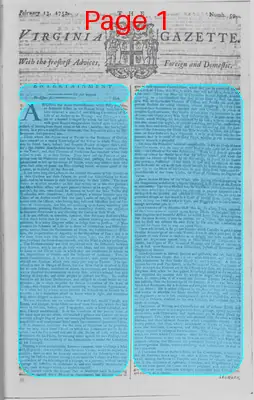
Literary
February 13, 1752
The Virginia Gazette
Richmond, Williamsburg, Richmond County, Virginia
What is this article about?
This essay examines the frequent inconsistency between an author's moral writings and their personal life, using examples like Milton and analogies to rulers and mathematicians. It argues that while living perfectly is difficult, writers should avoid hypocrisy to preserve the impact of their teachings on virtue.
Merged-components note: The epigraph is an introductory Latin quote directly preceding and thematically related to the literary essay, so merge into a single literary component.
Clipping
OCR Quality
90%
Excellent
Full Text
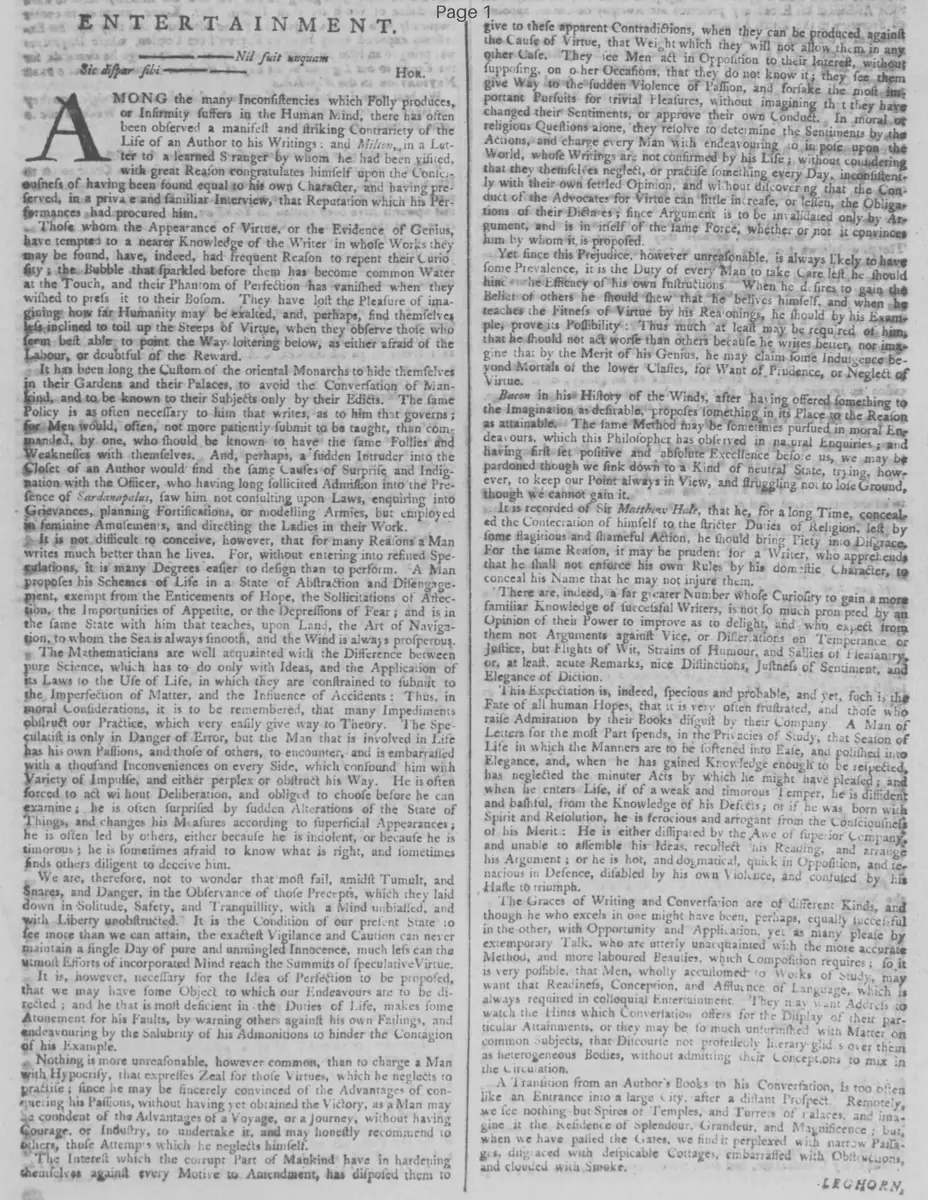
— Nil fuit unquam sic dispar sibi —
Hor.
AMONG the many Inconsistencies which Folly produces,
or Infirmity suffers in the Human Mind, there has often
been observed a manifest and striking Contrariety of the
Life of an Author to his Writings: and Milton in a Let-
ter to a learned Stranger by whom he had been visited,
with great Reason congratulates himself upon the Conscious-
ness of having been found equal to his own Character, and having pre-
served, in a private and familiar Interview, that Reputation which his Per-
formances had procured him.
Those whom the Appearance of Virtue, or the Evidence of Genius,
have tempted to a nearer Knowledge of the Writer in whose Works they
may be found, have, indeed, had frequent Reason to repent their Curio-
sity; the Bubble that sparkled before them has become common Water
at the Touch, and their Phantom of Perfection has vanished when they
wished to press it to their Bosom. They have lost the Pleasure of ima-
gining how far Humanity may be exalted, and, perhaps, find themselves
less inclined to toil up the Steeps of Virtue, when they observe those who
seem best able to point the Way loitering below, as either afraid of the
Labour, or doubtful of the Reward.
It has been long the Custom of the oriental Monarchs to hide themselves
in their Gardens and their Palaces, to avoid the Conversation of Man-
kind, and to be known to their Subjects only by their Edicts. The same
Policy is as often necessary to him that writes, as to him that governs;
for Men would, often, not more patiently submit to be taught, than com-
manded, by one, who should be known to have the same Follies and
Weaknesses themselves. And, perhaps, a sudden Intruder into the
Closet of an Author would find the same Causes of Surprise and Indig-
nation with the Officer, who having long solicited Admission into the Pre-
sence of Sardanapalus, saw him not consulting upon Laws, enquiring into
Grievances, planning Fortifications, or modelling Armies, but employed
in feminine Amusements, and directing the Ladies in their Work.
It is not difficult to conceive, however, that for many Reasons a Man
writes much better than he lives. For, without entering into refined Spe-
culations, it is many Degrees easier to design than to perform. A Man
proposes his Schemes of Life in a State of Abstraction and Disengage-
ment, exempt from the Enticements of Hope, the Solicitations of Affec-
tion, the Importunities of Appetite, or the Depressions of Fear; and is in
the same State with him that teaches, upon Land, the Art of Naviga-
tion, to whom the Sea is always smooth, and the Wind is always prosperous.
The Mathematicians are well acquainted with the Difference between
pure Science, which has to do only with Ideas, and the Application of
its Laws to the Use of Life, in which they are constrained to submit to
the Imperfection of Matter, and the Influence of Accidents: Thus, in
moral Considerations, it is to be remembered, that many Impediments
obstruct our Practice, which very easily give way to Theory. The Spe-
culator is only in Danger of Error, but the Man that is involved in Life
has his own Passions, and those of others, to encounter, and is embarrassed
with a thousand Inconveniences on every Side, which confound him with
Variety of Impulse, and either perplex or obstruct his Way. He is often
forced to act without Deliberation, and obliged to choose before he can
examine; he is often surprised by sudden Alterations of the State of
Things, and changes his Measures according to superficial Appearances;
he is often led by others, either because he is indolent, or because he is
timorous; he is sometimes afraid to know what is right, and sometimes
finds others diligent to deceive him.
We are, therefore, not to wonder that most fail, amidst Tumult, and
Snares, and Danger, in the Observance of those Precepts, which they laid
down in Solitude, Safety, and Tranquillity, with a Mind unbiased, and
with Liberty unobstructed. It is the Condition of our present State to
see more than we can attain, the exactest Vigilance and Caution can never
maintain a single Day of pure and unmingled Innocence, much less can the
utmost Efforts of incorporated Mind reach the Summits of speculative Virtue.
It is, however, necessary for the Idea of Perfection to be proposed,
that we may have some Object to which our Endeavours are to be di-
rected; and he that is most deficient in the Duties of Life, makes some
Atonement for his Faults, by warning others against his own Failings, and
endeavouring by the Salubrity of his Admonitions to hinder the Contagion
of his Example.
Nothing is more unreasonable, however common, than to charge a Man
with Hypocrisy, that expresses Zeal for those Virtues which he neglects to
practise; since he may be sincerely convinced of the Advantages of con-
quering his Passions, without having yet obtained the Victory, as a Man may
be confident of the Advantages of a Voyage, or a Journey, without having
Courage, or Industry, to undertake it, and may honestly recommend to
others, those Attempts which he neglects himself.
The Interest which the corrupt Part of Mankind have in hardening
themselves against every Motive to Amendment, has disposed them to
give to these apparent Contradictions, when they can be produced against
the Cause of Virtue, that Weight which they will not allow them in any
other Case. They see Men act in Opposition to their Interest, without
supposing, on other Occasions, that they do not know it; they see them
give Way to the sudden Violence of Passion, and forsake the most im-
portant Pursuits for trivial Pleasures, without imagining that they have
changed their Sentiments, or approve their own Conduct. In moral or
religious Questions alone, they resolve to determine the Sentiments by the
Actions, and charge every Man with endeavouring to impose upon the
World, whose Writings are not confirmed by his Life; without considering
that they themselves neglect, or practise something every Day, inconsistently
with their own settled Opinion, and without discovering that the Con-
duct of the Advocates for Virtue can little increase, or lessen, the Obliga-
tions of their Dictates; since Argument is to be invalidated only by Ar-
gument, and is in itself of the same Force, whether or not it convinces
him by whom it is proposed.
Yet since this Prejudice, however unreasonable, is always likely to have
some Prevalence, it is the Duty of every Man to take Care lest he should
hinder the Efficacy of his own Instructions. When he desires to gain the
Belief of others he should show that he believes himself, and when he
teaches the Fitness of Virtue by his Reasonings, he should by his Exam-
ple, prove its Possibility: Thus much at least may be required of him,
that he should not act worse than others because he writes better, nor ima-
gine that by the Merit of his Genius, he may claim some Indulgence be-
yond Mortals of the lower Classes, for Want of Prudence, or Neglect of
Virtue.
Bacon in his History of the Winds, after having offered something to
the Imagination as desirable, proposes something in its Place to the Reason
as attainable. The same Method may be sometimes pursued in moral En-
deavours, which this Philosopher has observed in natural Enquiries; and
having first set positive and absolute Excellence before us, we may be
pardoned though we sink down to a Kind of neutral State, trying, how-
ever, to keep our Point always in View, and struggling not to lose Ground,
though we cannot gain it.
It is recorded of Sir Matthew Hale, that he, for a long Time, concealed
the Consecration of himself to the stricter Duties of Religion, lest by
some flagitious and Shameful Action, he should bring Piety into Disgrace.
For the same Reason, it may be prudent for a Writer, who apprehends
that he shall not enforce his own Rules by his domestic Character, to
conceal his Name that he may not injure them.
There are, indeed, a far greater Number whose Curiosity to gain a more
familiar Knowledge of successful Writers, is not so much prompted by an
Opinion of their Power to improve as to delight, and who expect from
them not Arguments against Vice, or Dissertations on Temperance or
Justice, but Flights of Wit, Strains of Humour, and Sallies of Pleasantry.
or, at least, acute Remarks, nice Distinctions, Justness of Sentiment, and
Elegance of Diction.
This Expectation is, indeed, precious and probable, and yet, such is the
Fate of all human Hopes, that it is very often frustrated, and those who
raise Admiration by their Books disgust by their Company. A Man of
Letters for the most Part spends, in the Privacies of Study, that Season of
Life in which the Manners are to be softened into Ease, and polished into
Elegance, and, when he has gained Knowledge enough to be respected,
has neglected the minuter Acts by which he might have pleased; and
when he enters Life, if of a weak and timorous Temper, he is diffident
and bashful, from the Knowledge of his Deficits; or if he was born with
Spirit and Resolution, he is ferocious and arrogant from the Consciousness
of his Merit: He is either dissipated by the Awe of superior Company.
and unable to assemble his Ideas, recollect his Reading, and arrange
his Argument; or he is hot, and dogmatical, quick in Opposition, and te-
nacious in Defence, disabled by his own Violence, and confused by his
Haste to triumph.
The Graces of Writing and Conversation are of different Kinds, and
though he who excels in one might have been, perhaps, equally successful
in the other, with Opportunity and Application, yet as many please by
extemporary Talk, who are utterly unacquainted with the more accurate
Method, and more laboured Beauties, which Composition requires; so it
is very possible, that Men, wholly accustomed to Works of study, may
want that Readiness, Conception, and Affluence of Language, which is
always required in colloquial Entertainment. They may want Address to
watch the Hints which Conversation offers for the Display of their par-
ticular Attainments, or they may be so much unfurnished with Matter on
common subjects, that Discourse not professedly literary glides over them
as heterogeneous Bodies, without admitting their Conceptions to mix in
the Circulation.
A Transition from an Author's Books to his Conversation, is too often
like an Entrance into a large City after a distant Prospect. Remotely.
we see nothing but Spires of Temples, and Turrets of Palaces, and ima-
gine it the Residence of Splendour, Grandeur, and Magnificence; but,
when we have passed the Gates, we find it perplexed with narrow Pas-
sages, disgraced with despicable Cottages, embarrassed with Obstructions,
and clouded with Smoke,
Hor.
AMONG the many Inconsistencies which Folly produces,
or Infirmity suffers in the Human Mind, there has often
been observed a manifest and striking Contrariety of the
Life of an Author to his Writings: and Milton in a Let-
ter to a learned Stranger by whom he had been visited,
with great Reason congratulates himself upon the Conscious-
ness of having been found equal to his own Character, and having pre-
served, in a private and familiar Interview, that Reputation which his Per-
formances had procured him.
Those whom the Appearance of Virtue, or the Evidence of Genius,
have tempted to a nearer Knowledge of the Writer in whose Works they
may be found, have, indeed, had frequent Reason to repent their Curio-
sity; the Bubble that sparkled before them has become common Water
at the Touch, and their Phantom of Perfection has vanished when they
wished to press it to their Bosom. They have lost the Pleasure of ima-
gining how far Humanity may be exalted, and, perhaps, find themselves
less inclined to toil up the Steeps of Virtue, when they observe those who
seem best able to point the Way loitering below, as either afraid of the
Labour, or doubtful of the Reward.
It has been long the Custom of the oriental Monarchs to hide themselves
in their Gardens and their Palaces, to avoid the Conversation of Man-
kind, and to be known to their Subjects only by their Edicts. The same
Policy is as often necessary to him that writes, as to him that governs;
for Men would, often, not more patiently submit to be taught, than com-
manded, by one, who should be known to have the same Follies and
Weaknesses themselves. And, perhaps, a sudden Intruder into the
Closet of an Author would find the same Causes of Surprise and Indig-
nation with the Officer, who having long solicited Admission into the Pre-
sence of Sardanapalus, saw him not consulting upon Laws, enquiring into
Grievances, planning Fortifications, or modelling Armies, but employed
in feminine Amusements, and directing the Ladies in their Work.
It is not difficult to conceive, however, that for many Reasons a Man
writes much better than he lives. For, without entering into refined Spe-
culations, it is many Degrees easier to design than to perform. A Man
proposes his Schemes of Life in a State of Abstraction and Disengage-
ment, exempt from the Enticements of Hope, the Solicitations of Affec-
tion, the Importunities of Appetite, or the Depressions of Fear; and is in
the same State with him that teaches, upon Land, the Art of Naviga-
tion, to whom the Sea is always smooth, and the Wind is always prosperous.
The Mathematicians are well acquainted with the Difference between
pure Science, which has to do only with Ideas, and the Application of
its Laws to the Use of Life, in which they are constrained to submit to
the Imperfection of Matter, and the Influence of Accidents: Thus, in
moral Considerations, it is to be remembered, that many Impediments
obstruct our Practice, which very easily give way to Theory. The Spe-
culator is only in Danger of Error, but the Man that is involved in Life
has his own Passions, and those of others, to encounter, and is embarrassed
with a thousand Inconveniences on every Side, which confound him with
Variety of Impulse, and either perplex or obstruct his Way. He is often
forced to act without Deliberation, and obliged to choose before he can
examine; he is often surprised by sudden Alterations of the State of
Things, and changes his Measures according to superficial Appearances;
he is often led by others, either because he is indolent, or because he is
timorous; he is sometimes afraid to know what is right, and sometimes
finds others diligent to deceive him.
We are, therefore, not to wonder that most fail, amidst Tumult, and
Snares, and Danger, in the Observance of those Precepts, which they laid
down in Solitude, Safety, and Tranquillity, with a Mind unbiased, and
with Liberty unobstructed. It is the Condition of our present State to
see more than we can attain, the exactest Vigilance and Caution can never
maintain a single Day of pure and unmingled Innocence, much less can the
utmost Efforts of incorporated Mind reach the Summits of speculative Virtue.
It is, however, necessary for the Idea of Perfection to be proposed,
that we may have some Object to which our Endeavours are to be di-
rected; and he that is most deficient in the Duties of Life, makes some
Atonement for his Faults, by warning others against his own Failings, and
endeavouring by the Salubrity of his Admonitions to hinder the Contagion
of his Example.
Nothing is more unreasonable, however common, than to charge a Man
with Hypocrisy, that expresses Zeal for those Virtues which he neglects to
practise; since he may be sincerely convinced of the Advantages of con-
quering his Passions, without having yet obtained the Victory, as a Man may
be confident of the Advantages of a Voyage, or a Journey, without having
Courage, or Industry, to undertake it, and may honestly recommend to
others, those Attempts which he neglects himself.
The Interest which the corrupt Part of Mankind have in hardening
themselves against every Motive to Amendment, has disposed them to
give to these apparent Contradictions, when they can be produced against
the Cause of Virtue, that Weight which they will not allow them in any
other Case. They see Men act in Opposition to their Interest, without
supposing, on other Occasions, that they do not know it; they see them
give Way to the sudden Violence of Passion, and forsake the most im-
portant Pursuits for trivial Pleasures, without imagining that they have
changed their Sentiments, or approve their own Conduct. In moral or
religious Questions alone, they resolve to determine the Sentiments by the
Actions, and charge every Man with endeavouring to impose upon the
World, whose Writings are not confirmed by his Life; without considering
that they themselves neglect, or practise something every Day, inconsistently
with their own settled Opinion, and without discovering that the Con-
duct of the Advocates for Virtue can little increase, or lessen, the Obliga-
tions of their Dictates; since Argument is to be invalidated only by Ar-
gument, and is in itself of the same Force, whether or not it convinces
him by whom it is proposed.
Yet since this Prejudice, however unreasonable, is always likely to have
some Prevalence, it is the Duty of every Man to take Care lest he should
hinder the Efficacy of his own Instructions. When he desires to gain the
Belief of others he should show that he believes himself, and when he
teaches the Fitness of Virtue by his Reasonings, he should by his Exam-
ple, prove its Possibility: Thus much at least may be required of him,
that he should not act worse than others because he writes better, nor ima-
gine that by the Merit of his Genius, he may claim some Indulgence be-
yond Mortals of the lower Classes, for Want of Prudence, or Neglect of
Virtue.
Bacon in his History of the Winds, after having offered something to
the Imagination as desirable, proposes something in its Place to the Reason
as attainable. The same Method may be sometimes pursued in moral En-
deavours, which this Philosopher has observed in natural Enquiries; and
having first set positive and absolute Excellence before us, we may be
pardoned though we sink down to a Kind of neutral State, trying, how-
ever, to keep our Point always in View, and struggling not to lose Ground,
though we cannot gain it.
It is recorded of Sir Matthew Hale, that he, for a long Time, concealed
the Consecration of himself to the stricter Duties of Religion, lest by
some flagitious and Shameful Action, he should bring Piety into Disgrace.
For the same Reason, it may be prudent for a Writer, who apprehends
that he shall not enforce his own Rules by his domestic Character, to
conceal his Name that he may not injure them.
There are, indeed, a far greater Number whose Curiosity to gain a more
familiar Knowledge of successful Writers, is not so much prompted by an
Opinion of their Power to improve as to delight, and who expect from
them not Arguments against Vice, or Dissertations on Temperance or
Justice, but Flights of Wit, Strains of Humour, and Sallies of Pleasantry.
or, at least, acute Remarks, nice Distinctions, Justness of Sentiment, and
Elegance of Diction.
This Expectation is, indeed, precious and probable, and yet, such is the
Fate of all human Hopes, that it is very often frustrated, and those who
raise Admiration by their Books disgust by their Company. A Man of
Letters for the most Part spends, in the Privacies of Study, that Season of
Life in which the Manners are to be softened into Ease, and polished into
Elegance, and, when he has gained Knowledge enough to be respected,
has neglected the minuter Acts by which he might have pleased; and
when he enters Life, if of a weak and timorous Temper, he is diffident
and bashful, from the Knowledge of his Deficits; or if he was born with
Spirit and Resolution, he is ferocious and arrogant from the Consciousness
of his Merit: He is either dissipated by the Awe of superior Company.
and unable to assemble his Ideas, recollect his Reading, and arrange
his Argument; or he is hot, and dogmatical, quick in Opposition, and te-
nacious in Defence, disabled by his own Violence, and confused by his
Haste to triumph.
The Graces of Writing and Conversation are of different Kinds, and
though he who excels in one might have been, perhaps, equally successful
in the other, with Opportunity and Application, yet as many please by
extemporary Talk, who are utterly unacquainted with the more accurate
Method, and more laboured Beauties, which Composition requires; so it
is very possible, that Men, wholly accustomed to Works of study, may
want that Readiness, Conception, and Affluence of Language, which is
always required in colloquial Entertainment. They may want Address to
watch the Hints which Conversation offers for the Display of their par-
ticular Attainments, or they may be so much unfurnished with Matter on
common subjects, that Discourse not professedly literary glides over them
as heterogeneous Bodies, without admitting their Conceptions to mix in
the Circulation.
A Transition from an Author's Books to his Conversation, is too often
like an Entrance into a large City after a distant Prospect. Remotely.
we see nothing but Spires of Temples, and Turrets of Palaces, and ima-
gine it the Residence of Splendour, Grandeur, and Magnificence; but,
when we have passed the Gates, we find it perplexed with narrow Pas-
sages, disgraced with despicable Cottages, embarrassed with Obstructions,
and clouded with Smoke,
What sub-type of article is it?
Essay
What themes does it cover?
Moral Virtue
What keywords are associated?
Author Inconsistencies
Virtue Practice
Writing Vs Living
Moral Hypocrisy
Literary Reputation
Literary Details
Subject
Inconsistencies Between Authors' Lives And Writings
Form / Style
Philosophical Prose Essay
Key Lines
— Nil Fuit Unquam Sic Dispar Sibi — Hor.
Among The Many Inconsistencies Which Folly Produces, Or Infirmity Suffers In The Human Mind, There Has Often Been Observed A Manifest And Striking Contrariety Of The Life Of An Author To His Writings
It Is Not Difficult To Conceive, However, That For Many Reasons A Man Writes Much Better Than He Lives.
Nothing Is More Unreasonable, However Common, Than To Charge A Man With Hypocrisy, That Expresses Zeal For Those Virtues Which He Neglects To Practise