Thank you for visiting SNEWPapers!
Sign up free
Story
November 19, 1838
The Daily Herald
New Haven, New Haven County, Connecticut
What is this article about?
Report on the observation of Encke's Comet on Saturday evening, the 17th, visible in the western sky. Describes its appearance, naming after astronomer Mr. Encke, short 3-year orbital period, and evidence of a resisting medium in space affecting its motion.
Clipping
OCR Quality
98%
Excellent
Full Text
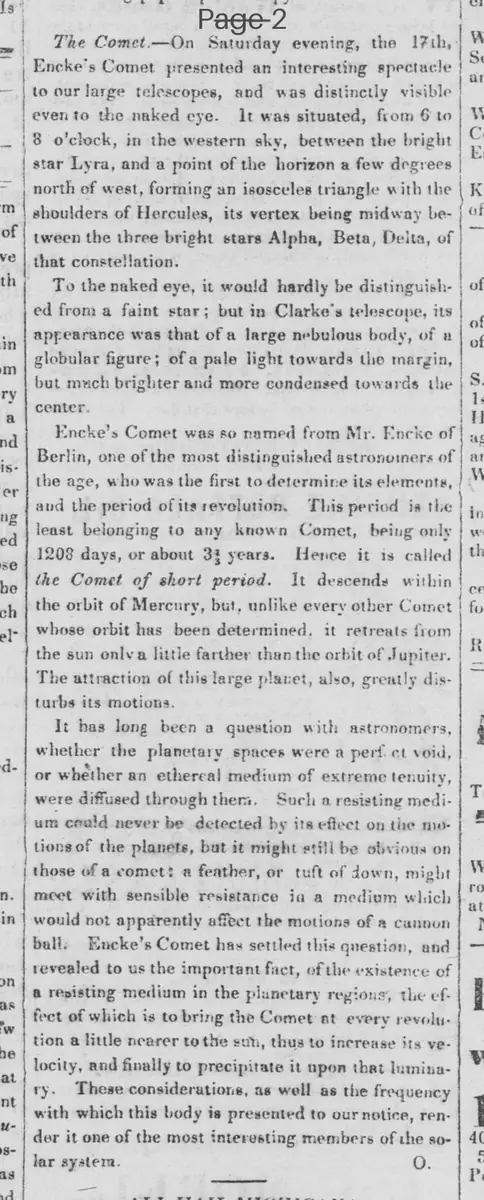
The Comet.--On Saturday evening, the 17th, Encke's Comet presented an interesting spectacle to our large telescopes, and was distinctly visible even to the naked eye. It was situated, from 6 to 8 o'clock, in the western sky, between the bright star Lyra, and a point of the horizon a few degrees north of west, forming an isosceles triangle with the shoulders of Hercules, its vertex being midway between the three bright stars Alpha, Beta, Delta, of that constellation.
To the naked eye, it would hardly be distinguished from a faint star: but in Clarke's telescope, its appearance was that of a large nebulous body, of a globular figure; of a pale light towards the margin, but much brighter and more condensed towards the center.
Encke's Comet was so named from Mr. Encke of Berlin, one of the most distinguished astronomers of the age, who was the first to determine its elements and the period of its revolution. This period is the least belonging to any known Comet, being only 1208 days, or about 3 years. Hence it is called the Comet of short period. It descends within the orbit of Mercury, but, unlike every other Comet whose orbit has been determined, it retreats from the sun only a little farther than the orbit of Jupiter. The attraction of this large planet, also, greatly disturbs its motions.
It has long been a question with astronomers, whether the planetary spaces were a perfect void, or whether an ethereal medium of extreme tenuity, were diffused through them. Such a resisting medium could never be detected by its effect on the motions of the planets, but it might still be obvious on those of a comet: a feather, or tuft of down, might meet with sensible resistance in a medium which would not apparently affect the motions of a cannon ball. Encke's Comet has settled this question, and revealed to us the important fact, of the existence of a resisting medium in the planetary regions, the effect of which is to bring the Comet at every revolution a little nearer to the sun, thus to increase its velocity, and finally to precipitate it upon that luminary. These considerations, as well as the frequency with which this body is presented to our notice, render it one of the most interesting members of the solar system.
O.
To the naked eye, it would hardly be distinguished from a faint star: but in Clarke's telescope, its appearance was that of a large nebulous body, of a globular figure; of a pale light towards the margin, but much brighter and more condensed towards the center.
Encke's Comet was so named from Mr. Encke of Berlin, one of the most distinguished astronomers of the age, who was the first to determine its elements and the period of its revolution. This period is the least belonging to any known Comet, being only 1208 days, or about 3 years. Hence it is called the Comet of short period. It descends within the orbit of Mercury, but, unlike every other Comet whose orbit has been determined, it retreats from the sun only a little farther than the orbit of Jupiter. The attraction of this large planet, also, greatly disturbs its motions.
It has long been a question with astronomers, whether the planetary spaces were a perfect void, or whether an ethereal medium of extreme tenuity, were diffused through them. Such a resisting medium could never be detected by its effect on the motions of the planets, but it might still be obvious on those of a comet: a feather, or tuft of down, might meet with sensible resistance in a medium which would not apparently affect the motions of a cannon ball. Encke's Comet has settled this question, and revealed to us the important fact, of the existence of a resisting medium in the planetary regions, the effect of which is to bring the Comet at every revolution a little nearer to the sun, thus to increase its velocity, and finally to precipitate it upon that luminary. These considerations, as well as the frequency with which this body is presented to our notice, render it one of the most interesting members of the solar system.
O.
What sub-type of article is it?
Curiosity
Extraordinary Event
Historical Event
What themes does it cover?
Nature
Exploration
What keywords are associated?
Encke's Comet
Comet Observation
Astronomical Phenomenon
Resisting Medium
Short Period Comet
Solar System
What entities or persons were involved?
Mr. Encke
Where did it happen?
Western Sky
Story Details
Key Persons
Mr. Encke
Location
Western Sky
Event Date
Saturday Evening, The 17th
Story Details
Encke's Comet observed in western sky, visible to naked eye and telescopes as nebulous body. Named after astronomer Encke; shortest period of 1208 days. Reveals resisting medium in space causing it to approach sun over revolutions.