Thank you for visiting SNEWPapers!
Sign up free
Virginia Argus
Richmond, Virginia
What is this article about?
On March 27, 1813, Prussian envoy Krusemarck delivers a manifesto in Paris announcing Prussia's break from its alliance with Napoleonic France, citing treaty violations and humiliations, and its new alliance with Russia to restore independence amid the advancing Russian armies.
Clipping
OCR Quality
Full Text
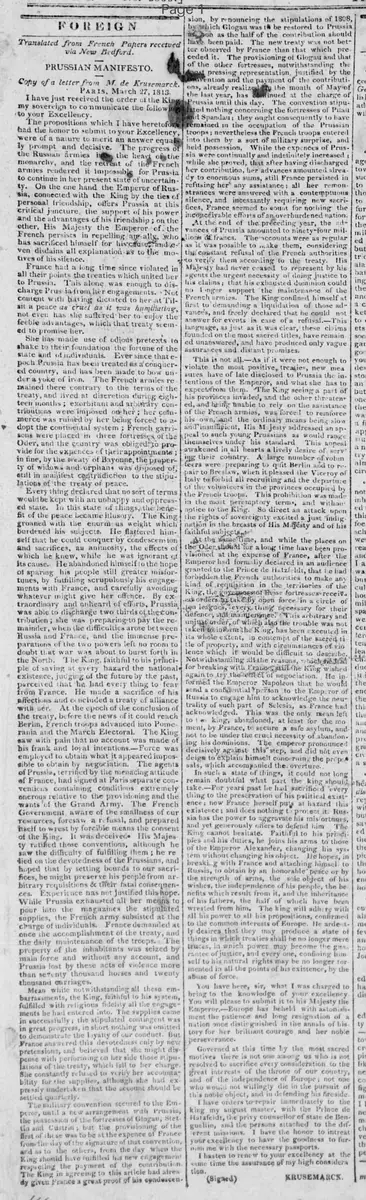
Translated from French Papers received via New Bedford.
PRUSSIAN MANIFESTO.
Copy of a letter from M. de Krusemarck.
Paris, March 27, 1813.
I have just received the order of the King my sovereign to communicate the following to your Excellency.
The propositions which I have heretofore had the honor to submit to your Excellency were of a nature to merit an answer equally prompt and decisive. The progress of the Russian armies into the heart of the monarchy, and the retreat of the French armies render it impossible for Prussia to continue in her present state of uncertainty. On the one hand the Emperor of Russia, connected with the King by the ties of personal friendship, offers Prussia at this critical juncture, the support of his power and the advantages of his friendship; on the other, His Majesty the Emperor of the French persists in repelling an ally, who has sacrificed himself for his cause and even disdains all explanation as to the motives of his silence.
France had a long time since violated in all their points the treaties which united her to Prussia. This alone was enough to discharge Prussia from her engagements. Not content with having dictated to her at Tilsit a peace as cruel as it was humiliating, not even has she suffered her to enjoy the feeble advantages, which that treaty seemed to promise her.
She has made use of odious pretexts to shake to their foundation the fortune of the state and of individuals. Ever since that epoch Prussia has been treated as a conquered country, and has been made to bow under a yoke of iron. The French armies remained there contrary to the terms of the treaty, and lived at discretion during eighteen months; exorbitant and arbitrary contributions were imposed on her; her commerce was ruined by her being forced to adopt the continental system; French garrisons were placed in three fortresses of the Oder, and the country was obliged to provide for the expenses of their appointments; in fine, by the treaty of Bayonne, the property of widows and orphans was disposed of, still in manifest contradiction to the stipulations of the treaty of peace.
Every thing declared that no sort of terms would be kept with an unhappy and oppressed state. In this state of things, the benefit of the peace became illusory. The King groaned with the enormous weight which burdened his subjects. He flattered himself that he could conquer by condescension and sacrifices, an animosity, the effects of which he knew, while he was ignorant of its cause. He abandoned himself to the hope of sparing his people still greater misfortunes, by fulfilling scrupulously his engagements with France, and carefully avoiding whatever might give her offence. By extraordinary and unheard of efforts, Prussia was able to discharge two thirds of the contribution; she was preparing to pay the remainder, when the difficulties arose between Russia and France, and the immense preparations of the two powers left no room to doubt that war was about to burst forth in the North. The King, faithful to his principle of saving at every hazard the national existence, judging of the future by the past, perceived that he had every thing to fear from France. He made a sacrifice of his affections and concluded a treaty of alliance with her. At the epoch of the conclusion of the treaty, before the news of it could reach Berlin, French troops advanced into Pomerania and the March Electoral. The King saw with pain that no account was made of his frank and loyal intentions. Force was employed to obtain what it appeared impossible to obtain by negociation. The agents of Prussia, terrified by the menacing attitude of France, had signed at Paris separate conventions containing conditions extremely onerous relative to the provisioning and the wants of the Grand Army. The French Government aware of the smallness of our resources, foresaw a refusal, and prepared itself to wrest by forcible means the consent of the King. It was deceived His Majesty ratified those conventions, although he saw the difficulty of fulfilling them; he relied on the devotedness of the Prussians, and hoped that by setting bounds to our sacrifices, he might preserve his people from arbitrary requisitions & their fatal consequences. Experience has not justified this hope.
While Prussia exhausted all her means to pour into the magazines the stipulated supplies, the French army subsisted at the charge of individuals. France demanded at once the accomplishment of the treaty, and the daily maintenance of the troops. The property of the inhabitants was seized by main force and without any account, and Prussia lost by these acts of violence more than seventy thousand horses and twenty thousand carriages.
Mean while notwithstanding all these embarrassments, the King, faithful to his system, fulfilled with religious fidelity all the engagements he had entered into. The supplies came in successfully; the stipulated contingent was in great progress, in short nothing was omitted to demonstrate the loyalty of our conduct. But France answered this devotedness only by new pretensions, and believed that she might dispense with performing on her side those stipulations of the treaty, which fell to her charge. She constantly refused to verify her accountability for the supplies, although she had expressly undertaken that the account should be settled quarterly.
The military convention secured to the Emperor, until a new arrangement with Prussia, the possession of the fortresses of Glogau, Stettin and Custrin; but the provisioning of the first of these was to be at the expense of France from the day of the signature of that convention, and as to the others, from the day when the King should have fulfilled his new engagement respecting the payment of the contribution The King in agreeing to this article had already given France a great proof of his condescension, by renouncing the stipulations of 1808 by which Glogau was to be restored to Prussia as soon as the half of the contribution should have been paid. The new treaty was not better observed by France than that which preceded it. The provisioning of Glogau and that of the other fortresses, notwithstanding the most pressing representations, justified by the convention and the payment of the contributions, already realized by the month of May of the last year, has continued at the charge of Prussia until this day. The convention stipulated nothing concerning the fortresses of Pillau and Spandau; they ought consequently to have remained in the occupation of the Prussian troops; nevertheless the French troops entered into them by a sort of military surprize, and held possession. While the expenses of Prussia were continually and indefinitely increased; while she proved, that after having discharged her contribution, her advances amounted already to enormous sums, still France persisted in refusing her any assistance; all her remonstrances were answered with a contemptuous silence, and incessantly requiring new sacrifices, France seemed to count for nothing the inconceivable efforts of an overburdened nation.
At the end of the preceding year, the advances of Prussia amounted to ninety-four millions of francs. The accounts were as regular as it was possible to make them, considering the constant refusal of the French authorities to verify them according to the treaty. His Majesty had never ceased to represent by his agents the urgent necessity of doing justice to his claims; that his exhausted dominion could no longer support the maintenance of the French armies. The King confined himself at first to demanding a liquidation of those advances, and freely declared that he could not answer for events in case of a refusal. This language, as just as it was clear, these claims founded on the most sacred titles, have remained unanswered, and have produced only vague assurances and distant promises.
This is not all. As if it were not enough to violate the most positive treaties, new measures have of late disclosed to Prussia the intentions of the Emperor, and what she has to expect from them. The King seeing a part of his provinces invaded, and the other threatened, and being unable to rely on the assistance of the French armies, was forced to reinforce his own, and the ordinary means being slow and insufficient, His Majesty addressed an appeal to such young Prussians as would range themselves under his standard This appeal awakened in all hearts a lively desire of serving their country. A large number of volunteers were preparing to quit Berlin and to repair to Breslau, when it pleased the Viceroy of Italy to forbid all recruiting and the departure of the volunteers in the provinces occupied by the French troops. This prohibition was made in the most peremptory terms, and without notice to the King. So direct an attack upon the rights of sovereignty excited a just indignation in the breasts of His Majesty and of his faithful subjects
At the same time, and while the places on the Oder, situated for a long time have been provisioned at the expense of France, after the Emperor had formally declared in an audience granted to the Prince de Hatzfeldt, that he had forbidden the French authorities to make any kind of requisition in the territories of the King, the governors of these fortresses received orders to take by open force in a circle of ten leagues, every thing necessary for their defence, and maintenance. This arbitrary and unjust order, of which also the trouble was not taken to inform the King, has been executed in its whole extent, in contempt of the sacred title of property, and with circumstances of violence which it would be difficult to describe.
Notwithstanding all the reasons, which cried for breaking with France still the King wished again to try the effect of negociation. He informed the Emperor Napoleon that he would send a confidential person to the Emperor of Russia to engage him to acknowledge the neutrality of such part of Silesia, as France had acknowledged. This was the only mean left to the King, abandoned, at least for the moment, by France, to secure a safe asylum, and not to be under the cruel necessity of abandoning his dominions. The emperor pronounced decisively against this step, and did not even deign to explain himself concerning the proposals, which accompanied the overture.
In such a state of things, it could not long remain doubtful what part the king should take. For years past he had sacrificed every thing to the preservation of his political existence; now France herself puts at hazard this existence; and does nothing to protect it. Russia has the power to aggravate his misfortunes, and yet generously offers to defend him The King cannot hesitate. Faithful to his principles and his duties, he joins his arms to those of the Emperor Alexander, changing his system without changing his object. He hopes, in breaking with France and attaching himself to Russia, to obtain by an honorable peace or by the strength of arms, the sole object of his wishes, the independence of his people, the benefits which result from it, and the inheritance of his fathers, the half of which have been wrested from him, The king will adhere with all his power to all his propositions, confirmed to the common interests of Europe. He ardently desires that they may produce a state of things in which treaties shall be no longer mere truces, in which power may become the guarantee of justice, and every one, confining himself to his natural rights may be no longer tormented in all the points of his existence, by the abuse of force.
You have here, sir, what I was charged to bring to the knowledge of your excellency You will please to submit it to his Majesty the Emperor. Europe has beheld with astonishment the patience and long resignation of a nation once distinguished in the annals of history for her brilliant courage and her noble perseverance.
Governed at this time by the most sacred motives there is not one among us who is not resolved to sacrifice every consideration to the great interests of the throne of our country, and of the independence of Europe; not one who would not willingly die in the pursuit of this noble object, and in defending his fireside.
I have orders to repair immediately to the king my august master, with the Prince de Hatzfeldt, the privy counsellor of state de Benguellin, and the persons attached to the different missions. I have the honor to intreat your excellency to have the goodness to furnish me with the necessary passports.
I hasten to renew to your excellency at the same time the assurance of my high consideration.
(Signed) KRUSEMARCK.
What sub-type of article is it?
What keywords are associated?
What entities or persons were involved?
Where did it happen?
Foreign News Details
Primary Location
Prussia
Event Date
March 27, 1813
Key Persons
Outcome
prussia breaks alliance with france and forms alliance with russia to regain independence and territories lost to france.
Event Details
The Prussian King instructs envoy Krusemarck to inform French authorities in Paris of grievances against France for violating treaties, imposing burdens, and mistreating Prussia since Tilsit. Despite loyalty, France's actions force Prussia to ally with Russia against France, aiming for peace or victory to restore Prussian independence.