Thank you for visiting SNEWPapers!
Sign up free
Norfolk Gazette And Publick Ledger
Norfolk, Virginia
What is this article about?
President Thomas Jefferson transmits to the US Senate documents from French officials, including Minister Turreau and Talleyrand, complaining about American citizens' commerce supplying rebels in St. Domingo, violating neutrality and treaties, with letters dated from August to January 1806.
Clipping
OCR Quality
Full Text
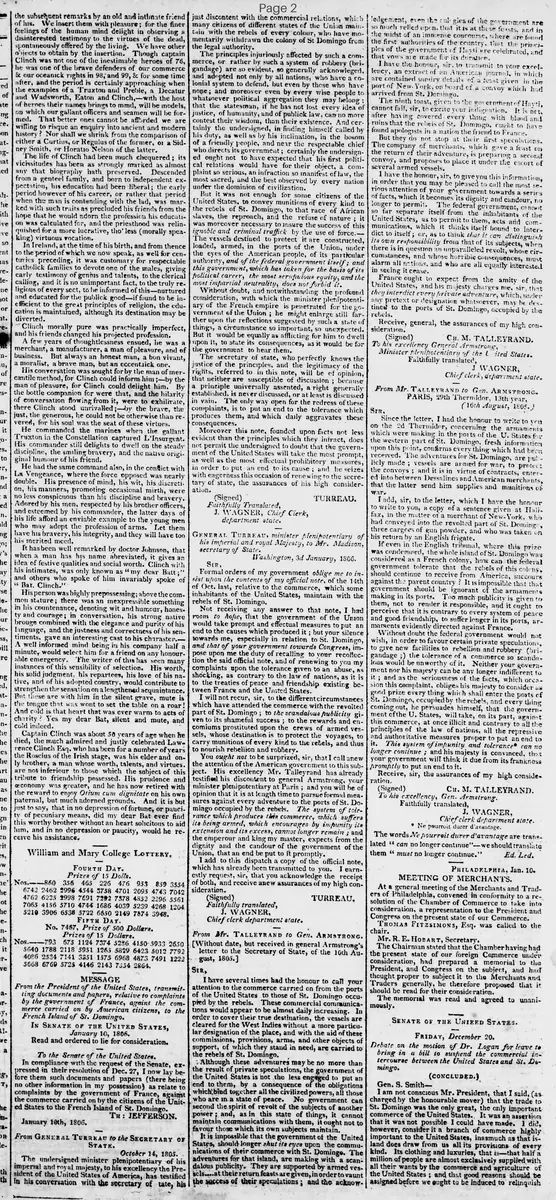
From the President of the United States, transmitting documents and papers, relative to complaints by the government of France, against the commerce carried on by American citizens, to the French Island of St. Domingo.
In Senate of the United States,
January 10, 1806.
Read and ordered to lie for consideration.
To the Senate of the United States.
In compliance with the request of the Senate, expressed in their resolution of Dec. 27, I now lay before them such documents and papers (there being no other information in my possession) as relate to complaints by the government of France, against the commerce carried on by the citizens of the United States to the French Island of St. Domingo.
TH: JEFFERSON.
January 10th, 1806.
From General Turreau to the Secretary of State.
Philadelphia, October 14, 1805.
The undersigned minister plenipotentiary of his imperial and royal majesty, to his excellency the President of the United States of America, has testified in his conversation with the secretary of state, his just discontent with the commercial relations, which many citizens of different states of the Union maintain with the rebels of every colour, who have momentarily withdrawn the colony of St Domingo from the legal authority.
The principles injuriously affected by such a commerce, or rather by such a system of robbery (brigandage) are so evident, so generally acknowledged, and adopted not only by all nations, who have a colonial system to defend, but even by those who have none; and moreover even by every wise people to whatsoever political aggregation they may belong: that the statesman, if he has not lost every idea of justice, of humanity, and of publick law, can no more contest their wisdom, than their existence. And certainly the undersigned, in finding himself called by his duty, as well as by his inclination, in the bosom of a friendly people, and near the respectable chief who directs its government; certainly the undersigned ought not to have expected that his first political relations would have for their object, a complaint so serious, an infraction so manifest of law, the most sacred, and the best observed by every nation under the dominion of civilization.
But it was not enough for some citizens of the United States, to convey munitions of every kind to the rebels of St. Domingo, to that race of African slaves, the reproach, and the refuse of nature; it was moreover necessary to insure the success of this ignoble and criminal traffick by the use of force. The vessels destined to protect it are constructed, loaded, armed, in the ports of the Union, under the eyes of the American people, of its particular authority, and of the federal government itself; and this government, which has taken for the basis of its political career, the most scrupulous equity, and the most impartial neutrality, does not forbid it.
Without doubt, and notwithstanding the profound consideration, with which the minister plenipotentiary of the French empire is penetrated for the government of the Union; he might enlarge still farther upon the reflections suggested by such a state of things, a circumstance so important, so unexpected. But it would be equally as afflicting for him to dwell upon it, to state its consequences, as it would be for the government to hear them.
The secretary of state, who perfectly knows the justice of the principles, and the legitimacy of the rights, referred to in this note, will be of opinion, that neither are susceptible of discussion; because a principle universally assented, a right generally established, is never discussed, or at least is discussed in vain. The only way open for the redress of these complaints, is to put an end to the tolerance which produces them, and which daily aggravates these consequences.
Moreover this note, founded upon facts not less evident than the principles which they infract, does not permit the undersigned to doubt that the government of the United States will take the most prompt, as well as the most effectual prohibitory measures, in order to put an end to its cause; and he seizes with eagerness this occasion of renewing to the secretary of state, the assurances of his high consideration.
(Signed) TURREAU.
Faithfully Translated,
J. WAGNER, Chief Clerk, department state.
General Turreau, minister plenipotentiary of his imperial and royal Majesty, to Mr. Madison, secretary of State.
Washington, 3d January, 1806.
SIR,
Formal orders of my government oblige me to insist upon the contents of my official note, of the 14th of Oct. last, relative to the commerce, which some inhabitants of the United States, maintain with the rebels of St. Domingo.
Not receiving any answer to that note, I had room to hope, that the government of the Union would take prompt and effectual measures to put an end to the causes which produced it; but your silence towards me, especially in relation to St. Domingo, and that of your government towards Congress, impose upon me the duty of recalling to your recollection the said official note, and of renewing to you my complaints upon the tolerance given to an abuse, as shocking, as contrary to the law of nations, as it is to the treaties of peace and friendship existing between France and the United States.
I will not recur, sir, to the different circumstances which have attended the commerce with the revolted part of St. Domingo; to the scandalous publicity given to its shameful success; to the rewards and encomiums prostituted upon the crews of armed vessels, whose destination is to protect the voyages, to carry munitions of every kind to the rebels, and thus to nourish rebellion and robbery.
You ought not to be surprized, sir, that I call anew the attention of the American government to this subject. His excellency Mr. Talleyrand has already testified his discontent to general Armstrong, your minister plenipotentiary at Paris; and you will be of opinion that it is at length time to pursue formal measures against every adventure to the ports of St. Domingo occupied by the rebels. The system of tolerance which produces this commerce, which suffers its being armed, which encourages by impunity its extension and its excess, cannot longer remain; and the emperor and king my master, expects from the dignity and the candour of the government of the Union, that an end be put to it promptly.
I add to this dispatch a copy of the official note, which has already been transmitted to you. I earnestly request, sir, that you acknowledge the receipt of both, and receive anew assurances of my high consideration.
(Signed) TURREAU.
Faithfully translated,
J. WAGNER,
Chief clerk department state.
From Mr. Talleyrand to Gen. Armstrong.
[Without date, but received in general Armstrong's letter to the Secretary of State, of the 10th August, 1805.]
SIR,
I have several times had the honour to call your attention to the commerce carried on from the ports of the United States to those of St. Domingo occupied by the rebels. These commercial communications would appear to be almost daily increasing. In order to cover their true destination, the vessels are cleared for the West Indies without a more particular designation of the place, and with the aid of these commissions, provisions, arms, and other objects of support, of which they stand in need, are carried to the rebels of St. Domingo.
Although these adventures may be no more than the result of private speculations, the government of the United States is not the less engaged to put an end to them, by a consequence of the obligations which bind together all the civilized powers, all those who are in a state of peace. No government can second the spirit of revolt of the subjects of another power; and, as in this state of things, it cannot maintain communications with them, it ought not to favour those which its own subjects maintain.
It is impossible that the government of the United States, should longer shut its eyes upon the communications of their commerce with St. Domingo. The adventures for that island, are making with a scandalous publicity. They are supported by armed vessels...at their return feasts are given, in order to vaunt the success of their speculations; and the acknowledgement, even the eulogies of the government are so much relied upon. that it is at these feasts. and in the midst of an immense concourse, where are found the first authorities of the country. that the principles of the government of Hayti. are celebrated, and that vows are made for its duration.
I have the honour, sir, to transmit to your excellency, an extract of an American journal, in which are contained sundry details of a feast given in the port of New-York, on board of a convoy which had arrived from St. Domingo.
The ninth toast, given to the government of Hayti, cannot fail, sir, to excite your indignation. It is not, after having covered every thing with blood and ruins that the rebels of St. Domingo, ought to have found apologists in a nation the friend to France. But they do not stop at their first speculations.
The company of merchants, which gave a feast on the return of their adventure, is preparing a second convoy, and proposes to place it under the escort of several armed vessels.
I have the honour, sir, to give you this information, in order that you may be pleased to call the most serious attention of your government towards a series of facts, which it becomes its dignity and candour, no longer to permit. The federal government, cannot so far separate itself from the inhabitants of the United States, as to permit to them, acts and communications, which it thinks itself bound to interdict to itself: or, as to think that it can distinguish its own responsibility from that of its subjects, when there is in question an unparalleled revolt, whose circumstances, and whose horrible consequences, must alarm all nations, and who are all equally interested in seeing it cease.
France ought to expect from the amity of the United States, and his majesty charges me, sir, that they interdict every private adventure, which, under any pretext or designation whatsoever, may be destined to the ports of St. Domingo, occupied by the rebels.
Receive, general, the assurances of my high consideration.
(Signed) CH. M. TALLEYRAND.
To his excellency General Armstrong,
Minister plenipotentiary of the United States.
Faithfully translated,
J WAGNER,
Chief clerk, department state.
From Mr. Talleyrand to Gen. Armstrong.
PARIS, 29th Thermidor, 13th year,
(16th August, 1805.)
SIR.
Since the letter, I had the honour to write to you on the 2d Thermidor, concerning the armaments which were making in the ports of the U. States for the western part of St. Domingo, fresh information upon this point, confirms every thing which had been received. The adventures for St. Domingo, are publicly made; vessels are armed for war, to protect the convoys; and it is in virtue of contracts, entered into between Dessalines and American merchants, that the latter send him supplies and munitions of war.
I add, sir, to the letter, which I have the honour to write to you, a copy of a sentence given at Halifax, in the matter of a merchant of New-York, who had conveyed into the revolted part of St. Domingo, three cargoes of gun powder, and who was taken on his return by an English frigate.
If even in the English tribunal, where this prize was condemned, the whole island of St. Domingo was considered as a French colony, how can the federal government tolerate that the rebels of this colony, should continue to receive from America, succours against the parent country? It is impossible that that government should be ignorant of the armaments making in its ports. Too much publicity is given to them, not to render it responsible, and it ought to perceive that it is contrary to every system of peace and good friendship, to suffer longer in its ports, armaments evidently directed against France.
Without doubt the federal government would not wish, in order to favour certain private speculations, to give new facilities to rebellion and robbery (brigandage;) the tolerance of a commerce so scandalous would be unworthy of it. Neither your government nor his majesty can be any longer indifferent to it; and as the seriousness of the facts, which occasion this complaint, obliges his majesty to consider as good prize every thing which shall enter the ports of St. Domingo, occupied by the rebels, and every thing coming out, he persuades himself, that the government of the U. States, will take, on its part, against this commerce, at once illicit and contrary to all the principles of the law of nations, all the repressive and authoritative measures proper to put an end to it. This system of impunity and tolerance can no longer continue; and his majesty is convinced, that your government will think it due from its frankness promptly to put an end to it.
Receive, sir, the assurances of my high consideration.
(Signed) CH. M. TALLEYRAND.
To his excellency, Gen. Armstrong.
Faithfully translated,
J. WAGNER,
Chief clerk department state.
What sub-type of article is it?
What keywords are associated?
What entities or persons were involved?
Where did it happen?
Foreign News Details
Primary Location
St. Domingo
Event Date
1805 1806
Key Persons
Outcome
french officials demand us government prohibit american commerce and armaments to rebels in st. domingo, citing violations of neutrality, law of nations, and treaties; no specific casualties reported.
Event Details
French Minister Turreau complains to US Secretary of State Madison about American citizens supplying munitions and provisions to rebels in St. Domingo via armed vessels from US ports, demanding prohibition. Talleyrand writes to US Minister Armstrong in Paris detailing public armaments, feasts celebrating successes, and contracts with Dessalines, urging US to interdict such adventures. Jefferson transmits these documents to Senate on January 10, 1806.