Thank you for visiting SNEWPapers!
Sign up free
The Crook County Monitor
Sundance, Crook County, Wyoming
What is this article about?
1896 political article exposes Democratic Wyoming State Treasurer candidate Luke Voorhees' financial troubles, including unsatisfied judgments over $25,000 for misappropriating funds and bank debts, questioning his honesty and competence amid Republican defense of treasury safeguards.
Clipping
OCR Quality
Full Text
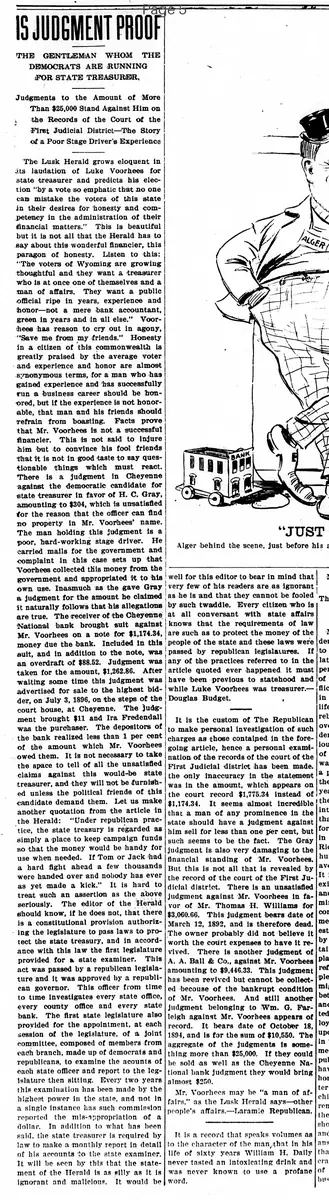
THE GENTLEMAN WHOM THE DEMOCRATS ARE RUNNING FOR STATE TREASURER.
Judgments to the Amount of More Than $25,000 Stand Against Him on the Records of the Court of the First Judicial District—The Story of a Poor Stage Driver's Experience.
'The Lusk Herald grows eloquent in its laudation of Luke Voorhees for state treasurer and predicts his election "by a vote so emphatic that no one can mistake the voters of this state in their desires for honesty and competency in the administration of their financial matters." This is beautiful but it is not all that the Herald has to say about this wonderful financier, this paragon of honesty. Listen to this:
"The voters of Wyoming are growing thoughtful and they want a treasurer who is at once one of themselves and a man of affairs. They want a public official ripe in years, experience and honor—not a mere bank accountant, green in years and in all else." Voorhees has reason to cry out in agony, "Save me from my friends." Honesty in a citizen of this commonwealth is greatly praised by the average voter and experience and honor are almost synonymous terms, for a man who has gained experience and has successfully run a business career should be honored. But if the experience is not honorable, that man and his friends should refrain from boasting. Facts prove that Mr. Voorhees is not a successful financier. This is not said to injure him but to convince his fool friends that it is not in good taste to say questionable things which must react.
There is a judgment in Cheyenne against the democratic candidate for state treasurer in favor of H. C. Gray, amounting to $304, which is unsatisfied for the reason that the officer can find no property in Mr. Voorhees' name. The man holding this judgment is a poor, hard-working stage driver. He carried mails for the government and complaint in this case sets up that Voorhees collected this money from the government and appropriated it to his own use. Inasmuch as the gave Gray a judgment for the amount he claimed it naturally follows that his allegations are true. The receiver of the Cheyenne National bank brought suit against Mr. Voorhees on a note for $1,174.34, money due the bank. Included in this suit, and in addition to the note, was an overdraft of $88.52. Judgment was taken for the amount, $1,262.86. After waiting some time this judgment was advertised for sale to the highest bidder, on July 3, 1896, on the steps of the court house, at Cheyenne. The judgment brought $11 and Ira Fredendall was the purchaser. The depositors of the bank realized less than 1 per cent of the amount which Mr. Voorhees owed them. It is not necessary to take the space to tell of all the unsatisfied claims against this would-be state treasurer, and they will not be furnished unless the political friends of this candidate demand them. Let us make another quotation from the article in the Herald: "Under republican practice, the state treasury is regarded as simply a place to keep campaign funds so that the money would be handy for use when needed. If Tom or Jack had a hard fight ahead a few thousands were handed over and nobody has ever as yet made a kick." It is hard to treat such an assertion as the above seriously. The editor of the Herald should know, if he does not, that there is a constitutional provision authorizing the legislature to pass laws to protect the state treasury, and in accordance with this law the first legislature provided for a state examiner. This act was passed by a republican legislature and it was approved by a republican governor. This officer from time to time investigates every state office, every county office and every state bank. The first state legislature also provided for the appointment, at each session of the legislature, of a joint committee, composed of members from each branch, made up of democrats and republicans, to examine the accounts of each state officer and report to the legislature then sitting. Every two years this examination has been made by the highest power in the state, and not in a single instance has such commission reported the mis-appropriation of a dollar. In addition to what has been said, the state treasurer is required by law to make a monthly report in detail of his accounts to the state examiner. It will be seen by this that the statement of the Herald is as silly as it is ignorant and malicious. It would be well for this editor to bear in mind that very few of his readers are as ignorant as he is and that they cannot be fooled by such twaddle. Every citizen who is at all conversant with state affairs knows that the requirements of law are such as to protect the money of the people of the state and these laws were passed by republican legislatures. If any of the practices referred to in the article quoted ever happened it must have been previous to statehood and while Luke Voorhees was treasurer.—Douglas Budget.
It is the custom of The Republican to make personal investigation of such charges as those contained in the foregoing article, hence a personal examination of the records of the court of the First Judicial district has been made. The only inaccuracy in the statement was in the amount, which appears on the court record $1,775.34 instead of $1,174.34. It seems almost incredible that a man of any prominence in the state should have a judgment against him sell for less than one per cent, but such seems to be the fact. The Gray judgment is also very damaging to the financial standing of Mr. Voorhees. But this is not all that is revealed by the record of the court of the First Judicial district. There is an unsatisfied judgment against Mr. Voorhees in favor of Mr. Thomas H. Williams for $3,060.66. This judgment bears date of March 12, 1892, and is therefore dead. The owner probably did not believe it worth the court expenses to have it revived. There is another judgment of A. A. Ball & Co., against Mr. Voorhees amounting to $9,446.33. This judgment has been revived but cannot be collected because of the bankrupt condition of Mr. Voorhees. And still another judgment belonging to Wm. G. Farleigh against Mr. Voorhees appears of record. It bears date of October 18, 1894, and is for the sum of $10,550. The aggregate of the judgments is something more than $25,000. If they could be sold as well as the Cheyenne National bank judgment they would bring almost $250.
Mr. Voorhees may be "a man of affairs," as the Lusk Herald says—other people's affairs.—Laramie Republican.
What sub-type of article is it?
What themes does it cover?
What keywords are associated?
What entities or persons were involved?
Where did it happen?
Story Details
Key Persons
Location
Cheyenne, Wyoming, First Judicial District
Event Date
1892 1896
Story Details
Republican newspapers expose Democratic candidate Luke Voorhees' multiple unsatisfied judgments totaling over $25,000, including for misappropriating government mail funds from stage driver H.C. Gray and unpaid bank note sold for $11, portraying him as financially unreliable and unfit for State Treasurer while defending Republican treasury protections.