Thank you for visiting SNEWPapers!
Sign up free
Editorial
June 1, 1836
Morning Star
Limerick, York County, Maine
What is this article about?
Editorial defines patriotism as virtuous principle, essential to counter evils like mobs, partisan corruption, and infidelity, ensuring survival of American free institutions. Warns of dissolution without moral renewal. Dover, June 1, 1836.
Clipping
OCR Quality
95%
Excellent
Full Text
DOVER:
WEDNESDAY. JUNE 1, 1836.
WHAT IS PATRIOTISM?
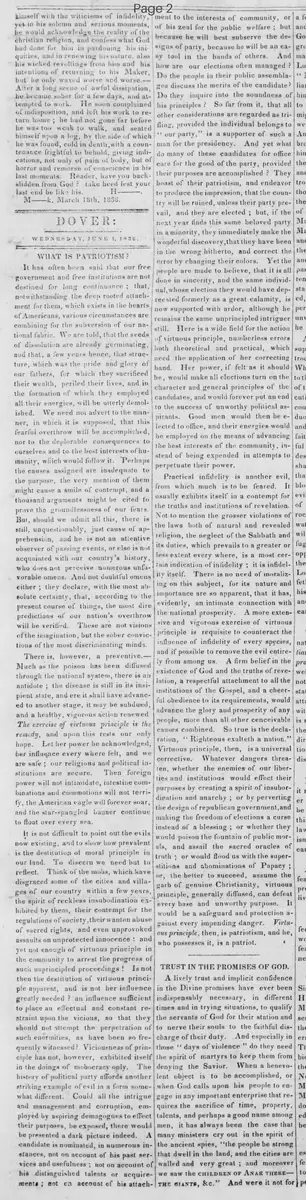
It has often been said that our free government and free institutions are not destined for long continuance; that, notwithstanding the deep rooted attachment for them, which exists in the hearts of Americans, various circumstances are combining for the subversion of our national fabric. We are told, that the seeds of dissolution are already germinating, and that, a few years hence, that structure, which was the pride and glory of our fathers, for which they sacrificed their wealth, periled their lives, and in the formation of which they employed all their energies, will be utterly demolished. We need not advert to the manner, in which it is supposed, that this fearful overthrow will be accomplished, nor to the deplorable consequences to ourselves and to the best interests of humanity, which would follow it. Perhaps the causes assigned are inadequate to the purpose, the very mention of them might cause a smile of contempt, and a thousand arguments might be cited to prove the groundlessness of our fears.
But, should we admit all this, there is still, unquestionably, just cause of apprehension, and he is not an attentive observer of passing events, or else is not acquainted with our country's history, who does not perceive numerous unfavorable omens. And not doubtful omens either; they declare, with the most absolute certainty, that, according to the present course of things, the most dire predictions of our nation's overthrow will be verified. These are not visions of the imagination, but the sober convictions of the most discriminating minds.
There is, however, a preventive. Much as the poison has been diffused through the national system, there is an antidote: the disease is still in its incipient state, and ere it shall have advanced to another stage, it may be subdued, and a healthy, vigorous action renewed. The exercise of virtuous principle is the remedy, and upon this rests our only hope. Let her power be acknowledged, her influence every where felt, and we are safe; our religious and political institutions are secure. Then foreign power will not intimidate, intestine combinations and commotions will not terrify, the American eagle will forever soar, and the star-spangled banner continue to float over every sea.
It is not difficult to point out the evils now existing, and to show how prevalent is the destitution of moral principle in our land. To discern we need but to reflect. Think of the mobs, which have disgraced some of the cities and villages of our country within a few years, the spirit of reckless insubordination exhibited by them, their contempt for the regulations of society, their wanton abuse of sacred rights, and even unprovoked assaults on unprotected innocence: and yet not enough of virtuous principle in the community to arrest the progress of such unprincipled proceedings! Is not then the destitution of virtuous principle apparent, and is not her influence greatly needed? an influence sufficient to place an effectual and constant restraint upon the vicious, so that they should not attempt the perpetration of such enormities, as have been so frequently witnessed?
Viciousness of principle has not, however, exhibited itself in the doings of mobocracy only. The history of political party affords another striking example of evil in a form somewhat different. Could all the intrigue and management and corruption, employed by aspiring demagogues to effect their purposes, be exposed, there would be presented a dark picture indeed. A candidate is nominated, in numerous instances, not on account of his past services and usefulness; not on account of his distinguished talents or acquirements; not on account of his attachment to the interests of community, or of his zeal for the public welfare; but because he will best subserve the designs of party, because he will be an easy tool in the hands of others. And how are our elections often managed? Do the people in their public assemblies discuss the merits of the candidate? Do they inquire into the soundness of his principles? So far from it, that all other considerations are regarded as trifling, provided the individual belongs to "our party," is a supporter of such a man for the presidency. And yet what do many of these candidates for office care for the good of the party, provided their purposes are accomplished? They boast of their patriotism, and endeavor to produce the impression, that the country will be ruined, unless their party prevail, and they are elected; but, if the next year finds this same beloved party in a minority, they immediately make the wonderful discovery that they have been in the wrong hitherto, and correct the error by changing their colors. Yet the people are made to believe, that it is all done in sincerity, and the same individual, whose election they would have deprecated formerly as a great calamity, is now supported with ardor, although he remains the same unprincipled intriguer still. Here is a wide field for the action of virtuous principle, numberless errors both theoretical and practical, which need the application of her correcting hand. Her power, if felt as it should be, would make all elections turn on the character and general principles of the candidates, and would forever put an end to the success of unworthy political aspirants. Good men would then be elected to office, and their energies would be employed on the means of advancing the best interests of the community, instead of being expended in attempts to perpetuate their power.
Practical infidelity is another evil, from which much is to be feared. It usually exhibits itself in a contempt for the truths and institutions of revelation. Not to mention the grosser violations of the laws both of natural and revealed religion, the neglect of the Sabbath and its duties, which prevails to a greater or less extent every where, is a most certain indication of infidelity; it is infidelity itself. There is no need of moralizing on this subject, for its nature and importance are so apparent, that it has, evidently, an intimate connection with the national prosperity. A more extensive and vigorous exercise of virtuous principle is requisite to counteract the influence of infidelity of every species, and if possible to remove the evil entirely from among us. A firm belief in the existence of God and the truths of revelation, a respectful attachment to all the institutions of the Gospel, and a cheerful obedience to its requirements, would advance the glory and prosperity of any people, more than all other conceivable causes combined. So true is the declaration, "Righteousness exalteth a nation."
Virtuous principle, then, is a universal corrective. Whatever dangers threaten, whether the enemies of our liberties and institutions would effect their purposes by creating a spirit of insubordination and anarchy; or by perverting the design of republican government, and making the freedom of elections a curse instead of a blessing; or whether they would poison the fountain of public morals, and assail the sacred oracles of truth; or would flood us with the superstitions and abominations of Papacy; or, the better to succeed, assume the garb of genuine Christianity, virtuous principle, generally diffused, can defeat every base and unworthy purpose. It would be a safeguard and protection against every impending danger. Virtuous principle, then, is patriotism, and he, who possesses it, is a patriot.
WEDNESDAY. JUNE 1, 1836.
WHAT IS PATRIOTISM?
It has often been said that our free government and free institutions are not destined for long continuance; that, notwithstanding the deep rooted attachment for them, which exists in the hearts of Americans, various circumstances are combining for the subversion of our national fabric. We are told, that the seeds of dissolution are already germinating, and that, a few years hence, that structure, which was the pride and glory of our fathers, for which they sacrificed their wealth, periled their lives, and in the formation of which they employed all their energies, will be utterly demolished. We need not advert to the manner, in which it is supposed, that this fearful overthrow will be accomplished, nor to the deplorable consequences to ourselves and to the best interests of humanity, which would follow it. Perhaps the causes assigned are inadequate to the purpose, the very mention of them might cause a smile of contempt, and a thousand arguments might be cited to prove the groundlessness of our fears.
But, should we admit all this, there is still, unquestionably, just cause of apprehension, and he is not an attentive observer of passing events, or else is not acquainted with our country's history, who does not perceive numerous unfavorable omens. And not doubtful omens either; they declare, with the most absolute certainty, that, according to the present course of things, the most dire predictions of our nation's overthrow will be verified. These are not visions of the imagination, but the sober convictions of the most discriminating minds.
There is, however, a preventive. Much as the poison has been diffused through the national system, there is an antidote: the disease is still in its incipient state, and ere it shall have advanced to another stage, it may be subdued, and a healthy, vigorous action renewed. The exercise of virtuous principle is the remedy, and upon this rests our only hope. Let her power be acknowledged, her influence every where felt, and we are safe; our religious and political institutions are secure. Then foreign power will not intimidate, intestine combinations and commotions will not terrify, the American eagle will forever soar, and the star-spangled banner continue to float over every sea.
It is not difficult to point out the evils now existing, and to show how prevalent is the destitution of moral principle in our land. To discern we need but to reflect. Think of the mobs, which have disgraced some of the cities and villages of our country within a few years, the spirit of reckless insubordination exhibited by them, their contempt for the regulations of society, their wanton abuse of sacred rights, and even unprovoked assaults on unprotected innocence: and yet not enough of virtuous principle in the community to arrest the progress of such unprincipled proceedings! Is not then the destitution of virtuous principle apparent, and is not her influence greatly needed? an influence sufficient to place an effectual and constant restraint upon the vicious, so that they should not attempt the perpetration of such enormities, as have been so frequently witnessed?
Viciousness of principle has not, however, exhibited itself in the doings of mobocracy only. The history of political party affords another striking example of evil in a form somewhat different. Could all the intrigue and management and corruption, employed by aspiring demagogues to effect their purposes, be exposed, there would be presented a dark picture indeed. A candidate is nominated, in numerous instances, not on account of his past services and usefulness; not on account of his distinguished talents or acquirements; not on account of his attachment to the interests of community, or of his zeal for the public welfare; but because he will best subserve the designs of party, because he will be an easy tool in the hands of others. And how are our elections often managed? Do the people in their public assemblies discuss the merits of the candidate? Do they inquire into the soundness of his principles? So far from it, that all other considerations are regarded as trifling, provided the individual belongs to "our party," is a supporter of such a man for the presidency. And yet what do many of these candidates for office care for the good of the party, provided their purposes are accomplished? They boast of their patriotism, and endeavor to produce the impression, that the country will be ruined, unless their party prevail, and they are elected; but, if the next year finds this same beloved party in a minority, they immediately make the wonderful discovery that they have been in the wrong hitherto, and correct the error by changing their colors. Yet the people are made to believe, that it is all done in sincerity, and the same individual, whose election they would have deprecated formerly as a great calamity, is now supported with ardor, although he remains the same unprincipled intriguer still. Here is a wide field for the action of virtuous principle, numberless errors both theoretical and practical, which need the application of her correcting hand. Her power, if felt as it should be, would make all elections turn on the character and general principles of the candidates, and would forever put an end to the success of unworthy political aspirants. Good men would then be elected to office, and their energies would be employed on the means of advancing the best interests of the community, instead of being expended in attempts to perpetuate their power.
Practical infidelity is another evil, from which much is to be feared. It usually exhibits itself in a contempt for the truths and institutions of revelation. Not to mention the grosser violations of the laws both of natural and revealed religion, the neglect of the Sabbath and its duties, which prevails to a greater or less extent every where, is a most certain indication of infidelity; it is infidelity itself. There is no need of moralizing on this subject, for its nature and importance are so apparent, that it has, evidently, an intimate connection with the national prosperity. A more extensive and vigorous exercise of virtuous principle is requisite to counteract the influence of infidelity of every species, and if possible to remove the evil entirely from among us. A firm belief in the existence of God and the truths of revelation, a respectful attachment to all the institutions of the Gospel, and a cheerful obedience to its requirements, would advance the glory and prosperity of any people, more than all other conceivable causes combined. So true is the declaration, "Righteousness exalteth a nation."
Virtuous principle, then, is a universal corrective. Whatever dangers threaten, whether the enemies of our liberties and institutions would effect their purposes by creating a spirit of insubordination and anarchy; or by perverting the design of republican government, and making the freedom of elections a curse instead of a blessing; or whether they would poison the fountain of public morals, and assail the sacred oracles of truth; or would flood us with the superstitions and abominations of Papacy; or, the better to succeed, assume the garb of genuine Christianity, virtuous principle, generally diffused, can defeat every base and unworthy purpose. It would be a safeguard and protection against every impending danger. Virtuous principle, then, is patriotism, and he, who possesses it, is a patriot.
What sub-type of article is it?
Moral Or Religious
Partisan Politics
Social Reform
What keywords are associated?
Patriotism
Virtuous Principle
Moral Decay
Political Corruption
National Institutions
Religious Infidelity
American Republic
What entities or persons were involved?
Political Parties
Demagogues
Infidels
Editorial Details
Primary Topic
Patriotism As Virtuous Principle
Stance / Tone
Exhortative Promotion Of Moral Virtue
Key Figures
Political Parties
Demagogues
Infidels
Key Arguments
Free Government Faces Threats From Moral Decay
Virtuous Principle Is The Antidote To National Subversion
Mobs Demonstrate Lack Of Moral Restraint
Political Intrigue And Party Loyalty Corrupt Elections
Practical Infidelity Undermines Religious Institutions
Righteousness Exalts A Nation
Virtuous Principle Defeats All Threats To Liberty