Thank you for visiting SNEWPapers!
Sign up free
Story
April 26, 1888
Iron County Register
Ironton, Iron County, Missouri
What is this article about?
Critique of U.S. protective tariffs claiming they prohibit cheap imports, forcing consumers to pay more; benefits go to manufacturers, not workers, as shown by 1880 data on worsted goods ($12.6M duty vs. $5.7M wages), iron/steel ($85M duty vs. $55M wages), and hosiery ($10.8M duty vs. $6.7M wages).
Clipping
OCR Quality
95%
Excellent
Full Text
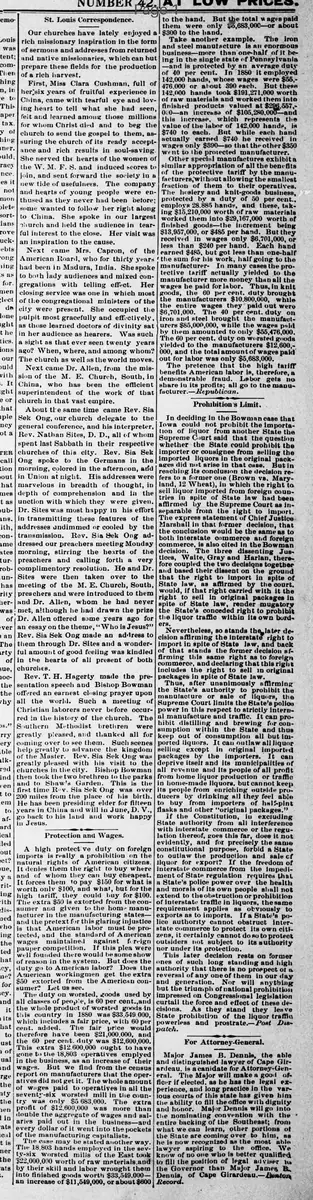
Protection and Wages.
A high protective duty on foreign imports is really a prohibition on the natural rights of American citizens. It denies them the right to buy where and of whom they can buy cheapest. It forces them to pay $150 for what is worth only $100, and what, but for the high tariff, they could buy for $100. The extra $50 is extorted from the consumer and given to the home manufacturer in the manufacturing states - and the pretext for this glaring injustice is that American labor must be protected, and the standard of American wages maintained against foreign pauper competition. If this plea were well founded there would be some show of reason in the system. But does the duty go to American labor? Does the American workingmen get the extra $50 extorted from the American consumer? Let us see.
The duty on worsted goods used by all classes of people, is 60 per cent., and the whole product of worsted goods in this country in 1880 was $33,549,000, which includes a fair price, with 60 per cent. added. The fair price would therefore have been $21,000,000, and the 60 per cent. duty was $12,600,000. This extra $12,600,000 ought to have gone to the 18,803 operatives employed in the business, as an increase of their wages. But we find from the census report on manufacturers that the operatives did not get it. The whole amount of wages paid to operatives in all the seventy-six worsted mills in the country was only $5,683,000. The extra profit of $12,600,000 was more than double the aggregate of wages and salaries paid out in the business - and every dollar of it went into the pockets of the manufacturing capitalists.
The case may be stated another way. The 18,803 hands employed in the seventy-six worsted mills of the East took $22,000,000 worth of raw materials, and by their skill and labor wrought them into finished goods worth $33,549,000 - an increase of $11,549,000, or about $600 to the hand. But the total wages paid them were only $5,683,000 - or about $300 to the hand.
Take another example. The iron and steel manufacture is an enormous business - more than one-half of it being in the single state of Pennsylvania - and is protected by an average duty of 40 per cent. In 1880 it employed 142,000 hands, whose wages were $55,476,000 or about $390 each. But these 142,000 hands took $191,271,000 worth of raw materials and worked them into finished products valued at $296,557,000 - an increase of $105,280,000 - and this increase, which represents the value of the labor of 142,000 hands, is $740 to each. But while each hand actually earned $740 he received in wages only $390 - so that the other $350 went to the protected manufacturer.
Other special manufactures exhibit a similar appropriation of all the benefits of the protective tariff by the manufacturers, without allowing the smallest fraction of them to their operatives. The hosiery and knit-goods business, protected by a duty of 50 per cent. employs 28,885 hands, and these, taking $15,210,000 worth of raw materials worked them into $29,167,000 worth of finished goods - the increment being $13,957,000, or $485 per hand. But they received in wages only $6,701,000, or less than $240 per hand. Each hand earned $485, but got less than one-half the sum for his work, half going to the manufacturer. In many cases the protective tariff actually yielded to the manufacturer more money than all the wages he paid for labor. Thus, in knit goods, the 60 per cent. duty brought the manufacturers $10,800,000, while the entire wages they paid out were $6,701,000. The 40 per cent. duty on iron and steel brought the manufacturers $85,000,000, while the wages paid by them amounted to only $55,476,000. The 60 per cent. duty on worsted goods yielded to the manufacturers $12,600,000, and the total amount of wages paid out for labor was only $5,683,000.
The pretense that the high tariff benefits American labor is, therefore, a demonstrable fraud. Labor gets no share in its profits; all go to the manufacturer. - Republican.
A high protective duty on foreign imports is really a prohibition on the natural rights of American citizens. It denies them the right to buy where and of whom they can buy cheapest. It forces them to pay $150 for what is worth only $100, and what, but for the high tariff, they could buy for $100. The extra $50 is extorted from the consumer and given to the home manufacturer in the manufacturing states - and the pretext for this glaring injustice is that American labor must be protected, and the standard of American wages maintained against foreign pauper competition. If this plea were well founded there would be some show of reason in the system. But does the duty go to American labor? Does the American workingmen get the extra $50 extorted from the American consumer? Let us see.
The duty on worsted goods used by all classes of people, is 60 per cent., and the whole product of worsted goods in this country in 1880 was $33,549,000, which includes a fair price, with 60 per cent. added. The fair price would therefore have been $21,000,000, and the 60 per cent. duty was $12,600,000. This extra $12,600,000 ought to have gone to the 18,803 operatives employed in the business, as an increase of their wages. But we find from the census report on manufacturers that the operatives did not get it. The whole amount of wages paid to operatives in all the seventy-six worsted mills in the country was only $5,683,000. The extra profit of $12,600,000 was more than double the aggregate of wages and salaries paid out in the business - and every dollar of it went into the pockets of the manufacturing capitalists.
The case may be stated another way. The 18,803 hands employed in the seventy-six worsted mills of the East took $22,000,000 worth of raw materials, and by their skill and labor wrought them into finished goods worth $33,549,000 - an increase of $11,549,000, or about $600 to the hand. But the total wages paid them were only $5,683,000 - or about $300 to the hand.
Take another example. The iron and steel manufacture is an enormous business - more than one-half of it being in the single state of Pennsylvania - and is protected by an average duty of 40 per cent. In 1880 it employed 142,000 hands, whose wages were $55,476,000 or about $390 each. But these 142,000 hands took $191,271,000 worth of raw materials and worked them into finished products valued at $296,557,000 - an increase of $105,280,000 - and this increase, which represents the value of the labor of 142,000 hands, is $740 to each. But while each hand actually earned $740 he received in wages only $390 - so that the other $350 went to the protected manufacturer.
Other special manufactures exhibit a similar appropriation of all the benefits of the protective tariff by the manufacturers, without allowing the smallest fraction of them to their operatives. The hosiery and knit-goods business, protected by a duty of 50 per cent. employs 28,885 hands, and these, taking $15,210,000 worth of raw materials worked them into $29,167,000 worth of finished goods - the increment being $13,957,000, or $485 per hand. But they received in wages only $6,701,000, or less than $240 per hand. Each hand earned $485, but got less than one-half the sum for his work, half going to the manufacturer. In many cases the protective tariff actually yielded to the manufacturer more money than all the wages he paid for labor. Thus, in knit goods, the 60 per cent. duty brought the manufacturers $10,800,000, while the entire wages they paid out were $6,701,000. The 40 per cent. duty on iron and steel brought the manufacturers $85,000,000, while the wages paid by them amounted to only $55,476,000. The 60 per cent. duty on worsted goods yielded to the manufacturers $12,600,000, and the total amount of wages paid out for labor was only $5,683,000.
The pretense that the high tariff benefits American labor is, therefore, a demonstrable fraud. Labor gets no share in its profits; all go to the manufacturer. - Republican.
What sub-type of article is it?
Economic Argument
Political Critique
What themes does it cover?
Deception
Justice
What keywords are associated?
Protective Tariff
American Labor
Manufacturer Profits
Wages
1880 Census
Where did it happen?
United States, Pennsylvania
Story Details
Location
United States, Pennsylvania
Event Date
1880
Story Details
Article argues that protective tariffs extort extra money from consumers, benefiting manufacturers with increased profits while workers receive no wage benefits, illustrated by 1880 census data on worsted goods, iron and steel, and hosiery industries showing duties exceeding total wages paid.