Thank you for visiting SNEWPapers!
Sign up free
Editorial
June 11, 1847
Wilmington Journal
Wilmington, New Hanover County, North Carolina
What is this article about?
Editorial praises free trade's benefits, highlighting how it allows American agricultural surplus to alleviate British distress from famine, contrasting with past protective policies that would exacerbate suffering. Emphasizes America's competitive advantages in production.
Clipping
OCR Quality
98%
Excellent
Full Text
The Beauty of Free Trade.
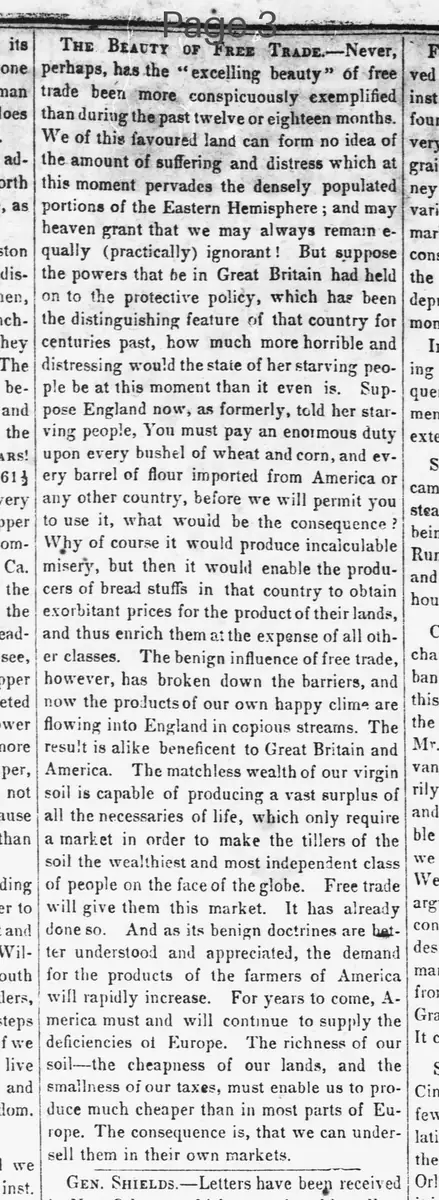
Never, perhaps, has the 'excelling beauty' of free trade been more conspicuously exemplified than during the past twelve or eighteen months. We of this favoured land can form no idea of the amount of suffering and distress which at this moment pervades the densely populated portions of the Eastern Hemisphere; and may heaven grant that we may always remain equally (practically) ignorant! But suppose the powers that be in Great Britain had held on to the protective policy, which has been the distinguishing feature of that country for centuries past, how much more horrible and distressing would the state of her starving people be at this moment than it even is.
Suppose England now, as formerly, told her starving people, You must pay an enormous duty upon every bushel of wheat and corn, and every barrel of flour imported from America or any other country, before we will permit you to use it, what would be the consequence? Why of course it would produce incalculable misery, but then it would enable the producers of bread stuffs in that country to obtain exorbitant prices for the product of their lands, and thus enrich them at the expense of all other classes.
The benign influence of free trade, however, has broken down the barriers, and now the products of our own happy clime are flowing into England in copious streams. The result is alike beneficent to Great Britain and America. The matchless wealth of our virgin soil is capable of producing a vast surplus of all the necessaries of life, which only require a market in order to make the tillers of the soil the wealthiest and most independent class of people on the face of the globe. Free trade will give them this market. It has already done so. And as its benign doctrines are better understood and appreciated, the demand for the products of the farmers of America will rapidly increase.
For years to come, America must and will continue to supply the deficiencies of Europe. The richness of our soil—the cheapness of our lands, and the smallness of our taxes, must enable us to produce much cheaper than in most parts of Europe. The consequence is, that we can undersell them in their own markets.
Never, perhaps, has the 'excelling beauty' of free trade been more conspicuously exemplified than during the past twelve or eighteen months. We of this favoured land can form no idea of the amount of suffering and distress which at this moment pervades the densely populated portions of the Eastern Hemisphere; and may heaven grant that we may always remain equally (practically) ignorant! But suppose the powers that be in Great Britain had held on to the protective policy, which has been the distinguishing feature of that country for centuries past, how much more horrible and distressing would the state of her starving people be at this moment than it even is.
Suppose England now, as formerly, told her starving people, You must pay an enormous duty upon every bushel of wheat and corn, and every barrel of flour imported from America or any other country, before we will permit you to use it, what would be the consequence? Why of course it would produce incalculable misery, but then it would enable the producers of bread stuffs in that country to obtain exorbitant prices for the product of their lands, and thus enrich them at the expense of all other classes.
The benign influence of free trade, however, has broken down the barriers, and now the products of our own happy clime are flowing into England in copious streams. The result is alike beneficent to Great Britain and America. The matchless wealth of our virgin soil is capable of producing a vast surplus of all the necessaries of life, which only require a market in order to make the tillers of the soil the wealthiest and most independent class of people on the face of the globe. Free trade will give them this market. It has already done so. And as its benign doctrines are better understood and appreciated, the demand for the products of the farmers of America will rapidly increase.
For years to come, America must and will continue to supply the deficiencies of Europe. The richness of our soil—the cheapness of our lands, and the smallness of our taxes, must enable us to produce much cheaper than in most parts of Europe. The consequence is, that we can undersell them in their own markets.
What sub-type of article is it?
Trade Or Commerce
Economic Policy
What keywords are associated?
Free Trade
Protective Policy
British Starvation
American Surplus
Wheat Imports
Corn Duties
European Markets
What entities or persons were involved?
Great Britain
England
America
Europe
Editorial Details
Primary Topic
Benefits Of Free Trade For Britain And America
Stance / Tone
Strongly Pro Free Trade
Key Figures
Great Britain
England
America
Europe
Key Arguments
Free Trade Exemplifies Beauty By Allowing American Imports To Relieve British Suffering
Protective Policies Would Cause Incalculable Misery By Imposing Duties On Imported Wheat And Flour
Free Trade Breaks Barriers, Enabling Copious Flow Of American Products To England
America's Virgin Soil Produces Surplus Necessaries, Making Farmers Wealthy With A Market
America Will Supply Europe's Deficiencies Due To Rich Soil, Cheap Lands, And Low Taxes
Free Trade Allows America To Undersell Europe In Their Own Markets