Thank you for visiting SNEWPapers!
Sign up free
Editorial
August 14, 1918
Harrisburg Telegraph
Harrisburg, Dauphin County, Pennsylvania
What is this article about?
Admiring obituary-like tribute to Henry Watterson upon his retirement from the Louisville Courier-Journal, detailing his journalistic career from 1858, Confederate service, Democratic involvement, loyalty post-Civil War, opposition to protectionism and post-1913 autocracy, and lamenting the decline of true Democratic principles.
Clipping
OCR Quality
95%
Excellent
Full Text
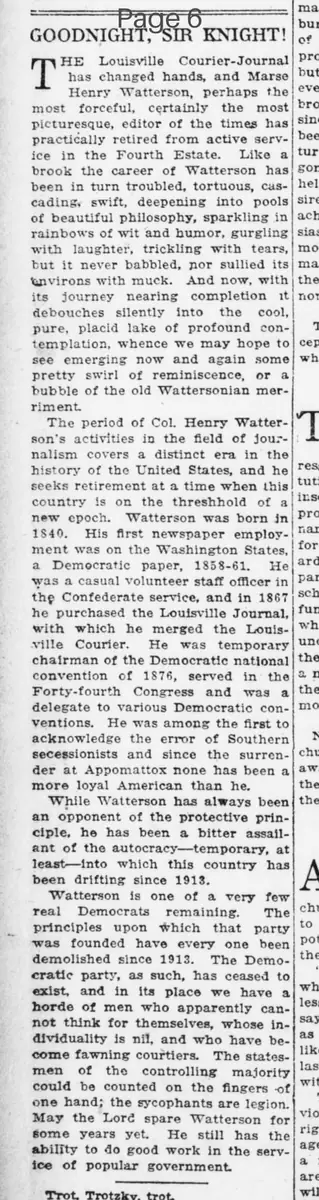
GOODNIGHT, SIR KNIGHT!
The
Louisville Courier-Journal
has changed hands, and Marse
Henry Watterson, perhaps the
most forceful, certainly the most
picturesque, editor of the times has
practically retired from active service
in the Fourth Estate. Like a
brook the career of Watterson has
been in turn troubled, tortuous, cascading, swift, deepening into pools
of beautiful philosophy, sparkling in
rainbows of wit and humor, gurgling
with laughter, trickling with tears,
but it never babbled, nor sullied its
environs with muck. And now, with
its journey nearing completion it
debouches silently into the cool,
pure, placid lake of profound contemplation, whence we may hope to
see emerging now and again some
pretty swirl of reminiscence, or a
bubble of the old Wattersonian merriment.
The period of Col. Henry Watterson's activities in the field of journalism covers a distinct era in the
history of the United States, and he
seeks retirement at a time when this
country is on the threshold of a
new epoch. Watterson was born in
1840. His first newspaper employment was on the Washington States,
a Democratic paper, 1858-61. He
was a casual volunteer staff officer in
the Confederate service, and in 1867
he purchased the Louisville Journal
with which he merged the Louisville Courier.
He
was temporary
chairman of the Democratic national
convention of 1876, served in the
Forty-fourth Congress and was a
delegate to various Democratic conventions. He was among the first to
acknowledge the error of Southern
secessionists and since the surrender at Appomattox none has been a
more loyal American than he.
While Watterson has always been
an opponent of the protective principle, he has been a bitter assailant of the autocracy-temporary, at
least-into which this country
has
been drifting since 1913.
Watterson is one of a very
few
real Democrats remaining.
The
principles upon which that party
was founded have every one been
demolished since 1913. The Democratic party, as such, has ceased to
exist, and in its place we have a
horde of men who apparently cannot think for themselves, whose individuality is nil, and who have become fawning courtiers. The statesmen of the controlling majority
could be counted on the fingers of
one hand; the sycophants are legion.
May the Lord spare Watterson for
some years yet. He still has the
ability to do good work in the service of popular government.
The
Louisville Courier-Journal
has changed hands, and Marse
Henry Watterson, perhaps the
most forceful, certainly the most
picturesque, editor of the times has
practically retired from active service
in the Fourth Estate. Like a
brook the career of Watterson has
been in turn troubled, tortuous, cascading, swift, deepening into pools
of beautiful philosophy, sparkling in
rainbows of wit and humor, gurgling
with laughter, trickling with tears,
but it never babbled, nor sullied its
environs with muck. And now, with
its journey nearing completion it
debouches silently into the cool,
pure, placid lake of profound contemplation, whence we may hope to
see emerging now and again some
pretty swirl of reminiscence, or a
bubble of the old Wattersonian merriment.
The period of Col. Henry Watterson's activities in the field of journalism covers a distinct era in the
history of the United States, and he
seeks retirement at a time when this
country is on the threshold of a
new epoch. Watterson was born in
1840. His first newspaper employment was on the Washington States,
a Democratic paper, 1858-61. He
was a casual volunteer staff officer in
the Confederate service, and in 1867
he purchased the Louisville Journal
with which he merged the Louisville Courier.
He
was temporary
chairman of the Democratic national
convention of 1876, served in the
Forty-fourth Congress and was a
delegate to various Democratic conventions. He was among the first to
acknowledge the error of Southern
secessionists and since the surrender at Appomattox none has been a
more loyal American than he.
While Watterson has always been
an opponent of the protective principle, he has been a bitter assailant of the autocracy-temporary, at
least-into which this country
has
been drifting since 1913.
Watterson is one of a very
few
real Democrats remaining.
The
principles upon which that party
was founded have every one been
demolished since 1913. The Democratic party, as such, has ceased to
exist, and in its place we have a
horde of men who apparently cannot think for themselves, whose individuality is nil, and who have become fawning courtiers. The statesmen of the controlling majority
could be counted on the fingers of
one hand; the sycophants are legion.
May the Lord spare Watterson for
some years yet. He still has the
ability to do good work in the service of popular government.
What sub-type of article is it?
Partisan Politics
What keywords are associated?
Henry Watterson
Louisville Courier Journal
Democratic Party
Journalism Retirement
Political Autocracy
Protective Principle
What entities or persons were involved?
Henry Watterson
Louisville Courier Journal
Democratic Party
Editorial Details
Primary Topic
Retirement Of Henry Watterson And Critique Of The Democratic Party
Stance / Tone
Admiring Tribute With Political Criticism
Key Figures
Henry Watterson
Louisville Courier Journal
Democratic Party
Key Arguments
Watterson's Career In Journalism Spans A Distinct Era In Us History
He Was Born In 1840 And Started In Newspapers In 1858
Served In Confederate Army And Later Merged Louisville Journal And Courier
Opposed Protective Tariffs And Post 1913 Political Autocracy
One Of The Few Remaining Real Democrats As The Party Has Lost Its Principles
Modern Democrats Lack Individuality And Are Sycophants