Thank you for visiting SNEWPapers!
Sign up free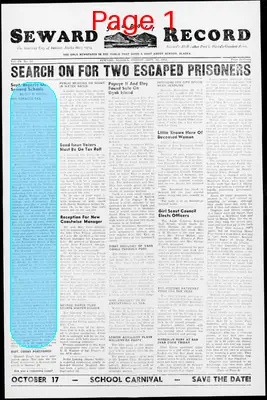
Story
September 26, 1952
Seward Seaport Record
Seward, Alaska
What is this article about?
Article details how Alaska's 1949 tobacco tax funds school construction and repair, with a distribution formula protecting small and large districts. Seward schools received significant allotments, accumulating funds for a new building to reduce bond needs.
Clipping

OCR Quality
98%
Excellent
Full Text
Supt. Reports On
Seward Schools
By Carl R. Carlson
THE TOBACCO TAX
Every time you buy a pack of cigarettes, cigars or tobacco, you are contributing to the building of Alaska's schools. In fact, the smokers of Alaska have already in the last three years contributed handsomely to the school coffers.
In 1949, the Territorial Legislature, in seeking new sources of revenue, learned that Alaska was one of the few political areas that did not tax tobacco. So that Legislature placed a fairly stiff tax on tobacco products (increased in 1951) providing that funds derived from this source should be used "for the exclusive purpose of rehabilitation, construction and repair of Alaska's school facilities."
Since no provision was made for distribution of this fund, Dr. Ryan, Commissioner of Education at that time, called a Superintendents' Conference at Juneau to work out a formula for transferring these funds to the various schools of the Territory.
This plan of distribution was a rather complex one, aimed at protecting both the small schools (like Eagle, Pelican and Yakutat), and the large schools (Anchorage and Fairbanks). This formula provides a small basic allowance of $3,000 per year per district. The remainder of the fund is divided into two parts.
One part is distributed on the basis of the average daily attendance of pupils of each district. The other part is distributed according to the number of professional employees (teachers, principals and superintendents). Distributions were to be made twice a year. This plan was accepted by the Territorial Board of Education and has been the basis for the distribution of the fund.
The Seward schools have been allotted a considerable sum from this source. In the initial distribution in 1950, Seward received $15,585.40. In 1951 the amount was $16,347.42. Distribution for the last half of 1951 was $13,600. Another distribution is now due for the half year ended June 30, 1952.
In Seward, this fund has been used sparingly. Most of the projects of remodeling the present school building have been paid for from the regular school budget. Most of the tobacco tax payments have been accumulated to apply to new school construction.
Since Seward must build a new school building soon, the Seward School Board feels that the fund should be permitted to grow, so the Board will have a sizeable amount available to apply to the initial payment of the new building. In this way the city will not have to float as large a bond issue to pay for the new school.
Yes, the use of tobacco is of importance to school finance.
But do not go out and overdo the tobacco habit just to help the schools. It is an expensive and dirty habit: I know--I smoke.
Seward Schools
By Carl R. Carlson
THE TOBACCO TAX
Every time you buy a pack of cigarettes, cigars or tobacco, you are contributing to the building of Alaska's schools. In fact, the smokers of Alaska have already in the last three years contributed handsomely to the school coffers.
In 1949, the Territorial Legislature, in seeking new sources of revenue, learned that Alaska was one of the few political areas that did not tax tobacco. So that Legislature placed a fairly stiff tax on tobacco products (increased in 1951) providing that funds derived from this source should be used "for the exclusive purpose of rehabilitation, construction and repair of Alaska's school facilities."
Since no provision was made for distribution of this fund, Dr. Ryan, Commissioner of Education at that time, called a Superintendents' Conference at Juneau to work out a formula for transferring these funds to the various schools of the Territory.
This plan of distribution was a rather complex one, aimed at protecting both the small schools (like Eagle, Pelican and Yakutat), and the large schools (Anchorage and Fairbanks). This formula provides a small basic allowance of $3,000 per year per district. The remainder of the fund is divided into two parts.
One part is distributed on the basis of the average daily attendance of pupils of each district. The other part is distributed according to the number of professional employees (teachers, principals and superintendents). Distributions were to be made twice a year. This plan was accepted by the Territorial Board of Education and has been the basis for the distribution of the fund.
The Seward schools have been allotted a considerable sum from this source. In the initial distribution in 1950, Seward received $15,585.40. In 1951 the amount was $16,347.42. Distribution for the last half of 1951 was $13,600. Another distribution is now due for the half year ended June 30, 1952.
In Seward, this fund has been used sparingly. Most of the projects of remodeling the present school building have been paid for from the regular school budget. Most of the tobacco tax payments have been accumulated to apply to new school construction.
Since Seward must build a new school building soon, the Seward School Board feels that the fund should be permitted to grow, so the Board will have a sizeable amount available to apply to the initial payment of the new building. In this way the city will not have to float as large a bond issue to pay for the new school.
Yes, the use of tobacco is of importance to school finance.
But do not go out and overdo the tobacco habit just to help the schools. It is an expensive and dirty habit: I know--I smoke.
What sub-type of article is it?
Historical Event
What themes does it cover?
Triumph
Justice
What keywords are associated?
Tobacco Tax
School Funding
Alaska Education
Seward Schools
Distribution Formula
What entities or persons were involved?
Dr. Ryan
Carl R. Carlson
Where did it happen?
Alaska, Seward, Juneau
Story Details
Key Persons
Dr. Ryan
Carl R. Carlson
Location
Alaska, Seward, Juneau
Event Date
1949 1952
Story Details
Alaska's 1949 tobacco tax funds school facilities; Dr. Ryan organizes distribution formula balancing small and large districts. Seward accumulates allotments ($15,585 in 1950, $16,347 in 1951, etc.) for new school construction to minimize bonds.