Thank you for visiting SNEWPapers!
Sign up free
The Lamar Register
Lamar, Prowers County, Colorado
What is this article about?
A family from Garden City, including pioneer editor Hamer Norris, visits Lamar and Granada. Norris shares stories of 1880s boom times: the first funeral in Granada turning into a dance, and his imaginative promotion of Sheridan Lake that backfired with a disappointed veteran. Granada saw frequent murders early on.
Clipping
OCR Quality
Full Text
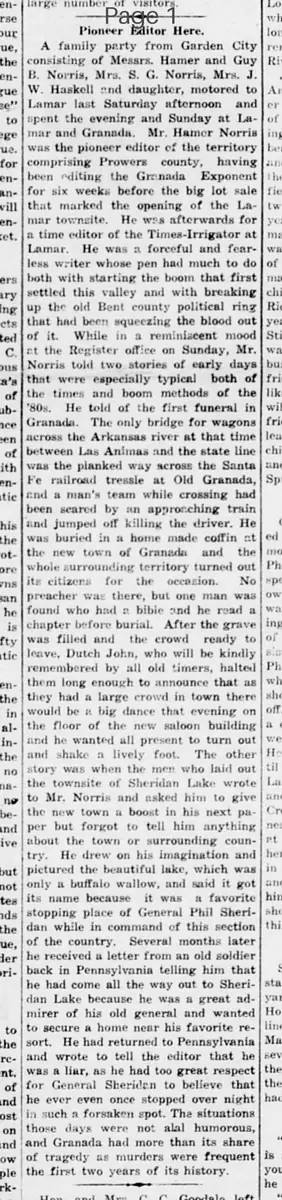
A family party from Garden City consisting of Messrs. Hamer and Guy B. Norris, Mrs. S. G. Norris, Mrs. J. W. Haskell and daughter, motored to Lamar last Saturday afternoon and spent the evening and Sunday at Lamar and Granada. Mr. Hamer Norris was the pioneer editor of the territory comprising Prowers county, having been editing the Granada Exponent for six weeks before the big lot sale that marked the opening of the Lamar townsite. He was afterwards for a time editor of the Times-Irrigator at Lamar. He was a forceful and fearless writer whose pen had much to do both with starting the boom that first settled this valley and with breaking up the old Bent county political ring that had been squeezing the blood out of it. While in a reminiscent mood at the Register office on Sunday, Mr. Norris told two stories of early days that were especially typical both of the times and boom methods of the '80s. He told of the first funeral in Granada. The only bridge for wagons across the Arkansas river at that time between Las Animas and the state line was the planked way across the Santa Fe railroad trestle at Old Granada, and a man's team while crossing had been scared by an approaching train and jumped off killing the driver. He was buried in a home made coffin at the new town of Granada and the whole surrounding territory turned out its citizens for the occasion.
No preacher was there, but one man was found who had a bible and he read a chapter before burial. After the grave was filled and the crowd ready to leave, Dutch John, who will be kindly remembered by all old timers, halted them long enough to announce that as they had a large crowd in town there would be a big dance that evening on the floor of the new saloon building and he wanted all present to turn out and shake a lively foot. The other story was when the men who laid out the townsite of Sheridan Lake wrote to Mr. Norris and asked him to give the new town a boost in his next paper but forgot to tell him anything about the town or surrounding country. He drew on his imagination and pictured the beautiful lake, which was only a buffalo wallow, and said it got its name because it was a favorite stopping place of General Phil Sheridan while in command of this section of the country. Several months later he received a letter from an old soldier back in Pennsylvania telling him that he had come all the way out to Sheridan Lake because he was a great admirer of his old general and wanted to secure a home near his favorite resort. He had returned to Pennsylvania and wrote to tell the editor that he was a liar, as he had too great respect for General Sheridan to believe that he ever even once stopped over night in such a forsaken spot. The situations those days were not all humorous, and Granada had more than its share of tragedy as murders were frequent the first two years of its history.
What sub-type of article is it?
What themes does it cover?
What keywords are associated?
What entities or persons were involved?
Where did it happen?
Story Details
Key Persons
Location
Garden City, Lamar, Granada, Prowers County, Arkansas River, Sheridan Lake
Event Date
1880s
Story Details
Pioneer editor Hamer Norris visits Lamar and Granada with family, reminiscing about his role in starting the valley boom and breaking political corruption. He recounts the first Granada funeral after a bridge accident, improvised with Bible reading and followed by a dance announced by Dutch John; and his fictional boost of Sheridan Lake as General Sheridan's favorite spot, leading to a veteran's disappointed letter calling him a liar. Early Granada saw frequent murders.