Thank you for visiting SNEWPapers!
Sign up free
Gazette Of The United States, & Philadelphia Daily Advertiser
Philadelphia, Philadelphia County, Pennsylvania
What is this article about?
Opinion pieces decry French corruption and urge purging pro-French members from US Congress. Satirical letter to Talleyrand exposes XYZ identities. Extracts from US envoys' dispatches detail French Directory's demands for speech explanations, reparations, and loans during 1797 Paris negotiations, stalling talks.
Merged-components note: These components are sequential in reading order (52 and 53) and the text in the second is a direct continuation of the dispatch extracts from the first, forming a single coherent foreign news article on French negotiations.
Clipping
OCR Quality
Full Text
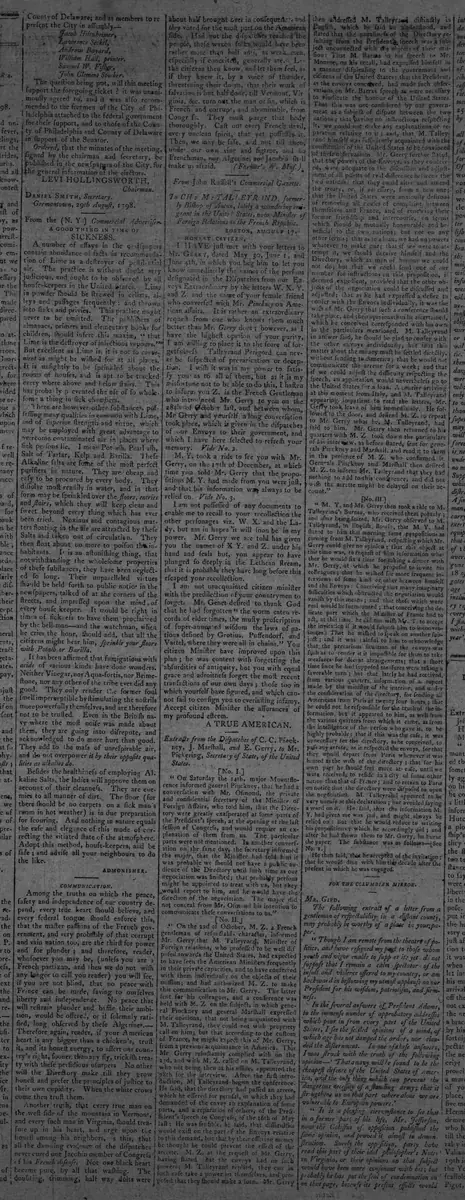
Another truth, that every true man on the west side of the mountain in Vermont, and every rich man in Virginia, should treasure up in his heart, and urge upon the honest among his neighbors, is this, that all the damning evidence of the dispatches never cured one Jacobin member of Congress of his French disease. Not one black heart became pure, by all that washing. The doubting, trimming, half way dolts were about half brought over in consequence, and they voted for the most part on the American side. Had not the dispatches reached the people, these waxen folks would have been rather more than half anti, as weak men, especially if conceited, generally are. Let the citizens then know, and let them feel, as if they knew it, by a voice of thunder, threatening their doom, that their work of salvation is but half done, till Vermont, Virginia, &c. turn out the man or men, which is French. and corrupt, and abominable, from Congress. They must purge that body thoroughly. Cast out every French devil, every unclean spirit, that yet possesses it. Then, we may be safe, and not till then, under our own vine and figtree, and no Frenchman, nor Algerine, nor Jacobin shall make us afraid.
(Farmer's Weekly Museum).
From John Russell's Commercial Gazette.
JOACHIM TALLEYRAND PERIGORD, formerly Bishop of Autun, lately a wandering emigrant in the United States, now Minister of Foreign Relations to the French Republic.
BOSTON, AUGUST 17.
HONEST CITIZEN,
I HAVE just met with your letters to Mr. Gerry, dated May 30, June 1, and June 4th, in which you beg him to let you know immediately the names of the persons designated in the Dispatches from our Envoys Extraordinary by the letters W. X. Y. and Z. and the name of your female friend who conversed with Mr. Pinckney on American affairs. It is rather an extraordinary request from one who knows them much better than Mr. Gerry does; however, as I have the highest opinion of your purity, I am willing to place it to the score of forgetfulness. Talleyrand Perigord can never be suspected of prevarication or deception. I wish it was in my power to satisfy you as to all of them, but as it is my misfortune not to be able to do this, I hasten to inform you Z. is the French Gentleman who introduced Mr. Gerry to you on the 28th of October last, and between whom, Mr Gerry and yourself, a long conversation took place, which is given in the dispatches of our Envoys to their government, and which I have here selected to refresh your memory. -Vide No. 2.
M. Y. took a ride to see you with Mr. Gerry, on the 17th of December, at which time you told Mr. Gerry that the propositions M. Y. had made from you were just, and that his information was always to be relied on. Vide No. 3.
I am not possessed of any documents to enable me to recall to your recollection the other personages viz. W. X. and the Lady, but am in hopes it will soon be in my power. Mr. Gerry we are told has given you the names of X Y. and Z, under his hand and seal but, you appear to have plunged so deeply in the Lethean stream, that it is probable they have long before this escaped your recollection.
I am not unacquainted citizen minister with the predilection of your countrymen to forget. Mr. Genet desired to thank God that he had forgotten "the worm eaten records of elder times, the musty proscription of super-annuated wisdom the laws of nations defined by Grotius, Puffendorf, and Vattel, where they were all in chains." You citizen Minister have improved upon this plan ; he was content with forgetting the absurdities of antiquity, but you with equal grace and adroitness forget the most recent transactions of our own days; those too in which yourself have figured, and which cannot fail to consign you to everlasting infamy.
Accept citizen Minister the assurances of my profound esteem.
A TRUE AMERICAN.
Extracts from the Dispatches of C. C. Pinckney, J. Marshall, and E. Gerry, to Mr. Pickering, Secretary of State, of the United States.
No. I.
"On Saturday the 14th, major Mountflorence informed general Pinckney, that he had a conversation with Mr. Bond, the private and confidential secretary of the Minister of Foreign Affairs, who told him, that the Directory were greatly exasperated at some parts of the President's speech, at the opening of the last session of Congress, and would require an explanation of them from us. The particular parts were not mentioned. In another conversation on the same day, the secretary informed the major, that the Minister had told him it was probable we should not have a public audience of the Directory until such time as our negociation was finished; that probably persons might be appointed to treat with us, but they would report to him, and he would have the direction of the negociation. The major did not conceal from Mr. Bond his intention to communicate these conversations to us."
No. II.
"On the 22d of October, M. Z. a French gentleman of respectable character, informed Mr. Gerry that M. Talleyrand, Minister of Foreign relations, who professed to be well disposed towards the United States, had expected to have seen the American Ministers frequently in their private capacities, and to have conferred with them individually on the objects of their mission; and had authorized M. Z. to make this communication to Mr. Gerry. The latter sent for his colleagues, and a conference was held with M. Z. on the subject, in which general Pinckney and general Marshall expressed their opinions, that not being acquainted with M. Talleyrand, they could not with propriety call on him; but that according to the custom of France, he might expect this of Mr. Gerry, from a previous acquaintance in America. This Mr. Gerry reluctantly complied with on the 23d, and with M. Z. called on M. Talleyrand, who not being then at his office, appointed the 25th for the interview. After the first introduction, M. Talleyrand began the conference. He said, that the directory had passed an arrete, which he offered for perusal, in which they had demanded of the envoy an explanation of some parts, and a reparation of others, of the President's speech to Congress, of the 16th of May last: He was sensible, he said, that difficulties would exist on the part of the Envoys relative to this demand, but that by their offering money he thought he could prevent the effect of the arrete. M. Z. at the request of Mr. Gerry, having stated that the envoys had no such powers; M. Talleyrand replied, they can in such case take a power by themselves, and proposed that they should make a loan. Mr. Gerry then addressed M. Talleyrand distinctly in English, which he said he understood, and stated that the uneasiness of the Directory resulting from the President’s speech was a subject unconnected with the objects of their mission: That M. Barras in his speech to Mr. Monroe, on his recall, had expressed himself in a manner displeasing to the government and citizens of the United States; that the President, as the envoys conceived, had made such observations on Mr. Barras speech as were necessary to vindicate the honour of the United States. That this was not considered by our government as a subject of dispute between the two nations; that having no instructions respecting it, we could not make any explanations or reparation relating to it; and, that M. Talleyrand himself was sufficiently acquainted with the constitution of the United States to be convinced of these observations. Mr. Gerry further stated, that the powers of the Envoys, as they conceived, were adequate to the discussion and adjustment of all points of real difference between the two nations; that they could alter and amend the treaty, or, if necessary, form a new one; that the United States were anxiously desirous of removing all causes of complaint between themselves and France, and of renewing their former friendship and intercourse, on terms which should be mutually honourable and beneficial to the two nations; but not on any other terms; that as to a loan, we had no powers whatever to make one; that if we were to attempt it, we should deceive himself and the Directory, which as men of honour we could not do; but that we could send one of our number for instructions on this proposition, if deemed expedient, provided that the other objects of the negociation could be discussed and adjusted; that as he had expressed a desire to confer with the Envoys individually, it was the wish of Mr. Gerry that such a conference should take place, and their opinions thus be ascertained, which he conceived corresponded with his own, in the particulars mentioned. M. Talleyrand in answer said, he should be glad to confer with the other envoys individually, but that this matter about the money must be settled directly, without sending to America; that he would not communicate the arrete for a week; and that if we could adjust the difficulty respecting the speech, an application would nevertheless go to the United States for a loan. A courier arriving at this moment from Italy, and M. Talleyrand appearing impatient to read the letters, Mr. Gerry took leave of him immediately. He followed to the door, and desired M. Z. to repeat to Mr. Gerry what he, M. Talleyrand, had said to him. Mr. Gerry then returned to his quarters with M. Z. took down the particulars of his interview, as before stated, sent for generals Pinckney and Marshall, and read it to them in the presence of M. Z. who confirmed it. Generals Pinckney and Marshall then desired M. Z. to inform Mr. Talleyrand that they had nothing to add to this conference, and did not wish the arrete might be delayed on their account."
No. III.
"M. Y. and Mr. Gerry then took a ride to M. Talleyrand's Bureau, who received them politely; and after being seated, Mr. Gerry observed to M. Talleyrand, in English, only, that M. Y. had stated to him that morning some propositions as coming from M. Talleyrand, respecting which Mr. Gerry could give no opinion ; that this object at this time was, to request of him information whether he would fix a time for taking a dinner with Mr. Gerry, at which he proposed to invite his colleagues ; that he wished for more frequent interviews of some kind or other between himself and the Envoys: Conceiving that many imaginary difficulties which obstructed the negotiation would vanish by this means; and that those which were real would be surmounted ; that conceiving the delicate part which the Minister of France had to act, at this time, he did not wish Mr. T. to accept the invitation if it would subject him to inconveniences: That he wished to speak on another subject ; and it was painful to him to acknowledge that the precarious situation of the envoys was such as to render it impossible for them to take measures for decent arrangements; that a short time since he had supposed measures were taking a favorable turn ; but that lately he had received, from various quarters, information of a report made by the minister of the interior, and under the consideration of the directory, for sending all Americans from Paris in twenty four hours ; that he could not be responsible for the truth of the information, but it appeared to him, as well from the various quarters from which it came, as from the intelligence of the person who gave it, to be highly probable; that if this was the case, it was unnecessary for the directory, as he conceived, to pass any arrete, as it respects the envoys, or that they would depart from Paris whenever it was hinted as the wish of the directory ; that for his own part he should feel more at ease, until we were received to reside in a city of some other nation than that of France; and to return to Paris on notice that the directory were disposed to open the negotiation. M. Talleyrand appeared to be very uneasy at this declaration; but avoided saying a word on it. He said, that the information M. Y. had given me was just, and might always be relied on : But that he would reduce to writing his propositions ; which he accordingly did ; and after he had shewn them to Mr. Gerry, he burnt the paper. The substance was as follows-See No. I.
He then said, that he accepted of the invitation; that he would dine with him the decade after the present in which he was engaged."
What sub-type of article is it?
What keywords are associated?
What entities or persons were involved?
Where did it happen?
Foreign News Details
Primary Location
Paris
Event Date
October 1797 To December 1797
Key Persons
Outcome
negotiations stalled due to french demands for explanations of president's speech, reparations, and a loan; envoys refused without instructions; rumors of american expulsion from paris; talleyrand accepts dinner invitation.
Event Details
US envoys in Paris faced French Directory's exasperation over President's speech; Talleyrand, via intermediaries M. Z. and M. Y., demanded explanations, reparations, and a loan to proceed with negotiations. Envoys asserted no powers for loan or speech issues, emphasized honorable terms only. Satirical letter reveals XYZ identities; commentary urges anti-French stance in US politics.