Thank you for visiting SNEWPapers!
Sign up free
Story
December 29, 1904
The Butler Weekly Times
Butler, Bates County, Missouri
What is this article about?
The Chicago Tribune advises that successful American business and professional men, who often die working due to ingrained habits, should prepare for retirement by maintaining intellectual interests to enjoy reading, travel, gardening, and philanthropy without boredom.
Clipping
OCR Quality
95%
Excellent
Full Text
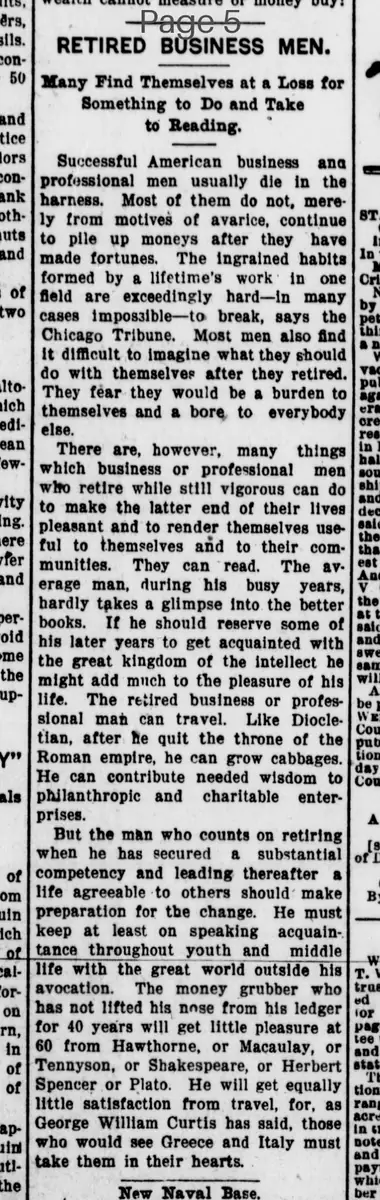
RETIRED BUSINESS MEN.
Many Find Themselves at a Loss for Something to Do and Take to Reading.
Successful American business and professional men usually die in the harness. Most of them do not, merely from motives of avarice, continue to pile up moneys after they have made fortunes. The ingrained habits formed by a lifetime's work in one field are exceedingly hard—in many cases impossible—to break, says the Chicago Tribune. Most men also find it difficult to imagine what they should do with themselves after they retired. They fear they would be a burden to themselves and a bore to everybody else.
There are, however, many things which business or professional men who retire while still vigorous can do to make the latter end of their lives pleasant and to render themselves useful to themselves and to their communities. They can read. The average man, during his busy years, hardly takes a glimpse into the better books. If he should reserve some of his later years to get acquainted with the great kingdom of the intellect he might add much to the pleasure of his life. The retired business or professional man can travel. Like Diocletian, after he quit the throne of the Roman empire, he can grow cabbages. He can contribute needed wisdom to philanthropic and charitable enterprises.
But the man who counts on retiring when he has secured a substantial competency and leading thereafter a life agreeable to others should make preparation for the change. He must keep at least on speaking acquaintance throughout youth and middle life with the great world outside his avocation. The money grubber who has not lifted his nose from his ledger for 40 years will get little pleasure at 60 from Hawthorne, or Macaulay, or Tennyson, or Shakespeare, or Herbert Spencer or Plato. He will get equally little satisfaction from travel, for, as George William Curtis has said, those who would see Greece and Italy must take them in their hearts.
Many Find Themselves at a Loss for Something to Do and Take to Reading.
Successful American business and professional men usually die in the harness. Most of them do not, merely from motives of avarice, continue to pile up moneys after they have made fortunes. The ingrained habits formed by a lifetime's work in one field are exceedingly hard—in many cases impossible—to break, says the Chicago Tribune. Most men also find it difficult to imagine what they should do with themselves after they retired. They fear they would be a burden to themselves and a bore to everybody else.
There are, however, many things which business or professional men who retire while still vigorous can do to make the latter end of their lives pleasant and to render themselves useful to themselves and to their communities. They can read. The average man, during his busy years, hardly takes a glimpse into the better books. If he should reserve some of his later years to get acquainted with the great kingdom of the intellect he might add much to the pleasure of his life. The retired business or professional man can travel. Like Diocletian, after he quit the throne of the Roman empire, he can grow cabbages. He can contribute needed wisdom to philanthropic and charitable enterprises.
But the man who counts on retiring when he has secured a substantial competency and leading thereafter a life agreeable to others should make preparation for the change. He must keep at least on speaking acquaintance throughout youth and middle life with the great world outside his avocation. The money grubber who has not lifted his nose from his ledger for 40 years will get little pleasure at 60 from Hawthorne, or Macaulay, or Tennyson, or Shakespeare, or Herbert Spencer or Plato. He will get equally little satisfaction from travel, for, as George William Curtis has said, those who would see Greece and Italy must take them in their hearts.
What sub-type of article is it?
Retirement Advice
Lifestyle Essay
What themes does it cover?
Moral Virtue
What keywords are associated?
Retirement
Businessmen
Reading
Travel
Intellectual Preparation
What entities or persons were involved?
Diocletian
George William Curtis
Story Details
Key Persons
Diocletian
George William Curtis
Story Details
Successful businessmen struggle with retirement due to work habits; advised to read, travel, garden, and engage in philanthropy, preparing by cultivating intellectual interests early to avoid dissatisfaction.