Thank you for visiting SNEWPapers!
Sign up free
The National Intelligencer And Washington Advertiser
Washington, District Of Columbia
What is this article about?
Transcript of Rep. John Randolph's speech in the U.S. House on April 7, 1808, opposing a bill to raise 6,000 additional troops, arguing it expands the standing army ineffectively, wastes resources, and undermines militia defense, while critiquing past policies and foreign relations.
Merged-components note: This is a single continuous congressional debate story split across multiple pages and components due to page boundaries; merging based on sequential reading order and textual continuation.
Clippings
1 of 3
OCR Quality
Full Text
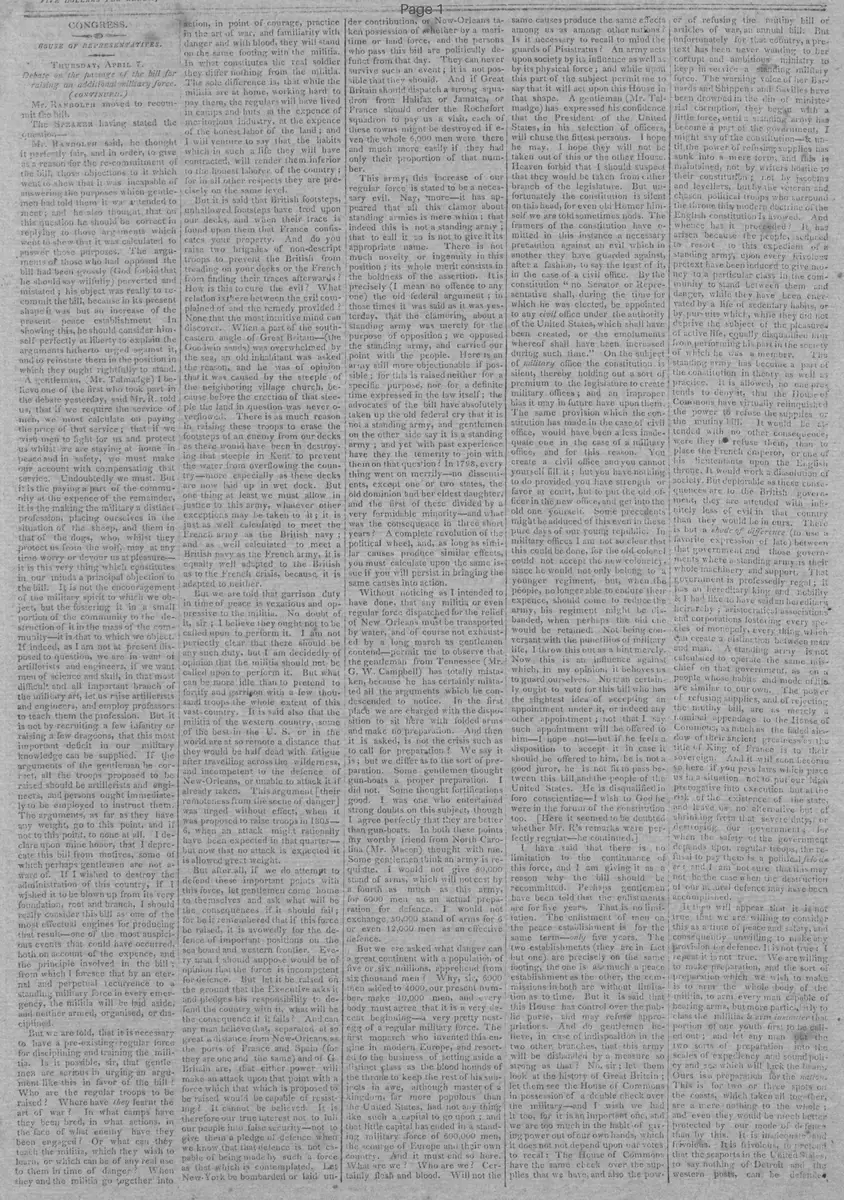
HOUSE OF REPRESENTATIVES.
THURSDAY, APRIL 7.
Debate on the passage of the bill for raising an additional military force (Continued.)
Mr. Randolph moved to recommit the bill.
The Speaker having stated the question—
Mr. Randolph said, he thought it perfectly fair, and in order, to give as a reason for the re-commitment of the bill, those objections to it which went to shew that it was incapable of answering the purposes which gentlemen had told them it was intended to meet; and he also thought that on this question he should be correct in replying to those arguments which went to shew that it was calculated to answer those purposes. The arguments of those who had opposed the bill had been grossly (God forbid that he should say wilfully) perverted and mistated; his object was really to recommit the bill, because in its present shape it was but an increase of the present peace establishment. In showing this, he should consider himself perfectly at liberty to explain the arguments hitherto urged against it, and to reinstate them in the position in which they ought rightfully to stand.
A gentleman, (Mr. Talmadge) I believe one of the first who took part in the debate yesterday, said Mr. R. told us, that if we require the service of men, we must calculate on paying the price of that service; that if we wish men to fight for us and protect us whilst we are staying at home in peace and in safety, we must make our account with compensating that service. Undoubtedly we must. But it is the paying a part of the community at the expence of the remainder, it is the making the military a distinct profession, placing ourselves in the situation of the sheep, and them in that of the dogs, who, whilst they protect us from the wolf, may at any time worry or devour us at pleasure— it is this very thing which constitutes in our minds a principal objection to the bill. It is not the encouragement of the military spirit to which we object, but the fostering it in a small portion of the community to the destruction of it in the mass of the community—it is that to which we object.
If indeed, as I am not at present disposed to question, we are in want of artillerists and engineers, if we want men of science and skill, in that most difficult and all important branch of the military art, let us raise artillerists and engineers, and employ professors to teach them the profession. But it is not by recruiting a few infantry or raising a few dragoons, that this most important deficit in our military knowledge can be supplied. If the arguments of the gentleman be correct, all the troops proposed to be raised should be artillerists and engineers, and persons ought immediately to be employed to instruct them. The arguments, as far as they have any weight, go to this point, and if not to this point, to none at all. I declare upon mine honor, that I deprecate this bill from motives, some of which perhaps gentlemen are not aware of. If I wished to destroy the administration of this country, if I wished it to be blown up from its very foundation, root and branch, I should really consider this bill as one of the most effectual engines for producing that result—one of the most auspicious events that could have occurred, both on account of the expence, and the principle involved in the bill; from which I foresee that by an eternal and perpetual recurrence to a standing military force in every emergency, the militia will be laid aside, and neither armed, organised, or disciplined.
But we are told, that it is necessary to have a pre-existing regular force for disciplining and training the militia. Is it possible, sir, that gentlemen are serious in urging an argument like this in favor of the bill? Who are the regular troops to be raised? Where have they learnt the art of war? In what camps have they been bred, in what actions, in the face of what enemy have they been engaged? Or what can they teach the militia, which they wish to learn, or which can be of any real use to them in time of danger? When they and the militia go together into action, in point of courage, practice in the art of war, and familiarity with danger and with blood, they will stand on the same footing with the militia. In what constitutes the real soldier they differ nothing from the militia. The sole difference is, that while the militia are at home, working hard to pay them, the regulars will have lived in camps and huts at the expence of meritorious industry, at the expence of the honest labor of the land; and I will venture to say that the habits which in such a life they will have contracted, will render them inferior to the honest laborer of the country; for in all other respects they are precisely on the same level.
But it is said that British footsteps, unhallowed footsteps have trod upon our decks, and when their trace is found upon them that France confiscates your property. And do you raise two brigades of non-descript troops to prevent the British from treading on your decks or the French from finding their traces afterwards? How is this to cure the evil? What relation is there between the evil complained of and the remedy provided? None that the most intuitive mind can discover. When a part of the southeastern angle of Great Britain (the Goodwin sands) was overwhelmed by the sea, an old inhabitant was asked the reason, and he was of opinion that it was caused by the steeple of the neighboring village church, because before the erection of that steeple the land in question was never overflowed. There is as much reason in raising these troops to erase the footsteps of an enemy from our decks as there would have been in destroying that steeple in Kent to prevent the water from overflowing the country—more especially as these decks are now laid up in wet dock. But one thing at least we must allow in justice to this army, whatever other exceptions may be taken to it; it is just as well calculated to meet the French army as the British navy; and as well calculated to meet a British navy as the French army, it is equally well adapted to the British as to the French crisis, because, it is adapted to neither.
But we are told that garrison duty in time of peace is vexatious and oppressive to the militia. No doubt of it, sir; I believe they ought not to be called upon to perform it. I am not perfectly clear that there should be any such duty, but I am decidedly of opinion that the militia should not be called upon to perform it. But what can be more idle than to pretend to fortify and garrison with a few thousand troops the whole extent of this vast country. It is said also that the militia of the western country, some of the best in the U. S. or in the world are at so remote a distance that they would be half dead with fatigue after travelling across the wilderness, and incompetent to the defence of New-Orleans, or unable to attack it if already taken. This argument [their remoteness from the scene of danger] was urged without effect, when it was proposed to raise troops in 1805–6, when an attack might rationally have been expected in that quarter—but now that no attack is expected it is allowed great weight.
But after all, if we do attempt to defend these important points with this force, let gentlemen come home to themselves and ask what will be the consequences if it should fail; for be it remembered that if this force be raised, it is avowedly for the defence of important positions on the sea board and western frontier. Every man I should suppose would be of opinion that the force is incompetent for defence. But let it be raised on the ground that the Executive asks it and pledges his responsibility to defend the country with it, what will be the consequence if it fails? And can any man believe that, separated at so great a distance from New-Orleans as the ports of France and Spain (for they are one and the same) and of Great Britain are, that either power will make an attack upon that point with a force which that which is proposed to be raised would be capable of resisting? It cannot be believed. It is therefore our true interest not to lull our people into false security—not to give them a pledge of defence when we know that that defence is not capable of being made by such a force as that which is contemplated. Let New York be bombarded or laid under contribution, or New-Orleans taken possession of whether by a maritime or land force, and the persons who pass this bill are politically dead from that day. They can never survive such an event; it is not possible that they should. And if Great Britain should dispatch a strong squadron from Halifax or Jamaica, or France should order the Rochefort squadron to pay us a visit, each of these towns might be destroyed if even the whole 6,000 men were there and much more easily if they had only their proportion of that number.
This army, this increase of our regular force is stated to be a necessary evil. Nay, more—it has appeared that all this clamor about standing armies is mere whim; that indeed this is not a standing army; that to call it so is not to give it its appropriate name. There is not much novelty or ingenuity in this position; its whole merit consists in the boldness of the assertion. It is precisely (I mean no offence to any one) the old federal argument; in those times it was said as it was yesterday, that the clamour about a standing army was merely for the purpose of opposition; we opposed the standing army, and carried our point with the people. Here is an army still more objectionable if possible: for this is raised neither for a specific purpose, nor for a definite time expressed in the law itself; the advocates of the bill have absolutely taken up the old federal cry that it is not a standing army, and gentlemen on the other side say it is a standing army; and yet with past experience have they the temerity to join with them on that question? In 1798, every thing went on merrily—no dissentients, except one or two states, the old dominion and her eldest daughter, and the first of these divided by a very formidable minority—and what was the consequence in three short years? A complete revolution of the political wheel, and, as long as similar causes produce similar effects, you must calculate upon the same issue if you will persist in bringing the same causes into action.
Without noticing as I intended to have done, that any militia or even regular force dispatched for the relief of New Orleans must be transported by water, and of course not exhausted by a long march as gentlemen contend—permit me to observe that the gentleman from Tennessee (Mr. G. W. Campbell) has totally mistaken, because he has certainly mistated all the arguments which he condescended to notice. In the first place we are charged with the disposition to sit here with folded arms and make no preparation. And then it is asked, is not the crisis such as to call for preparation? We say it is; but we differ as to the sort of preparation. Some gentlemen thought gun-boats a proper preparation. I did not. Some thought fortifications good. I was one who entertained strong doubts on this subject, though I agree perfectly that they are better than gun-boats. In both these points my worthy friend from North Carolina (Mr. Macon) thought with me. Some gentlemen think an army is requisite. I would not give 50,000 stand of arms, which will not cost by a fourth as much as this army, for 6000 men as an actual preparation for defence. I would not exchange 50,000 stand of arms for 6 or even 12,000 men as an effective defence.
But we are asked what danger can a great continent with a population of five or six millions, apprehend from six thousand men? Why, sir, 6000 men added to 4000, our present number, make 10,000 men, and every body must agree that it is a very decent beginning—a very pretty nest-egg of a regular military force. The first monarch who invented this engine in modern Europe, and resorted to the business of setting aside a distinct class as the blood hounds of the throne to keep the rest of his subjects in awe, although master of a kingdom, far more populous than the United States, had not any thing like such a capital to go upon; and that little capital has ended in a standing military force of 600,000 men, the scourge of Europe and their own country. And it must end so here.
What are we? Who are we? Certainly flesh and blood. Will not the same causes produce the same effects among us as among other nations? Is it necessary to recall to mind the guards of Pisistratus? An army acts upon society by its influence as well as by its physical force; and while upon this part of the subject permit me to say that it will act upon this House in that shape. A gentleman (Mr. Talmadge) has expressed his confidence that the President of the United States, in his selection of officers, will chuse the fittest persons. I hope he may. I hope they will not be taken out of this or the other House. Heaven forbid that I should suspect that they would be taken from either branch of the legislature. But unfortunately the constitution is silent on this head, for even old Homer himself we are told sometimes nods. The framers of the constitution have omitted in this instance a necessary precaution against an evil which in another they have guarded against, after a fashion, to say the least of it, in the case of a civil office. By the constitution "no Senator or Representative shall, during the time for which he was elected, be appointed to any civil office under the authority of the United States, which shall have been created, or the emoluments whereof shall have been increased during such time." On the subject of military office the constitution is silent, thereby holding out a sort of premium to the legislature to create military offices; and an improper bias it may in future have upon them.
The same provision which the constitution has made in the case of civil office, would have been a less inadequate one in the case of a military office, and for this reason. You create a civil office and you cannot yourself fill it; but you have nothing to do provided you have strength or favor at court, but to put the old officer in the new office, and get into the old one yourself. Some precedents might be adduced of this even in these pure days of our young republic. In military offices I am not so clear that this could be done, for the old colonel could not accept the new colonelcy, since he would not only belong to a younger regiment, but, when the people, no longer able to endure the expence, should come to reduce the army, his regiment might be disbanded, when perhaps the old one would be retained. Not being conversant with the punctilios of military life, I throw this out as a hint merely.
Now this is an influence against which, in my opinion, it behoves us to guard ourselves. No man certainly ought to vote for this bill who has the slightest idea of accepting an appointment under it, or indeed any other appointment; not that I say such appointment will be offered to him—I hope not—but if he feels a disposition to accept it in case it should be offered to him, he is not a good juror, he is not fit to pass between this bill and the people of the United States. He is disqualified in foro conscientiae—I wish to God he were in the forum of the constitution too. Here it seemed to be doubted whether Mr. R's remarks were perfectly regular—he continued.
I have said that there is no limitation to the continuance of this force, and I am giving it as a reason why the bill should be recommitted. Perhaps gentlemen have been told that the enlistments are for five years. That is no limitation. The enlistment of men on the peace establishment is for the same term—only five years. The two establishments (they are in fact but one) are precisely on the same footing, the one is as much a peace establishment as the other, the commissions in both are without limitation as to time. But it is said that this House has control over the public purse, and may refuse appropriations. And do gentlemen believe, in case of indisposition in the two other branches, that this army will be disbanded by a measure so strong as that? No, sir; let them look at the history of Great Britain; let them see the House of Commons in possession of a double check over the military—and I wish we had it too, or it is an important one, and we are too much in the habit of giving power out of our own hands, which it does not depend upon our votes to recall: The House of Commons have the same check over the supplies that we have, and also the power of refusing the mutiny bill or articles of war, an annual bill. But unfortunately for that country, a pretext has been never wanting to her corrupt and ambitious ministry to keep in service a standing military force. The warning voice of her Barnards and Shippens and Savilles have been drowned in the din of ministerial corruption, they began with a little force, until a standing army has become a part of the government, I might say of the constitution—& until the power of refusing supplies has sunk into a mere form, and (this is maintained, not by writers hostile to their constitution; not by jacobins and levellers, but by the veteran and chosen political troops who surround the throne) this modern doctrine of the English constitution is avowed. And whence has it proceeded? It has arisen because the people, seduced to resort to this expedient of a standing army, upon every frivolous pretext have been induced to give money to a particular class in the community to stand between them and danger, while they have been enervated by a life of sedentary habits, or by pursuits which, while they aid not deprive the subject of the pleasure of active life, equally disqualified him from performing his part in the society of which he was a member. This standing army has become a part of the constitution in theory as well as practice. It is allowed, no one pretends to deny it, that the House of Commons have virtually relinquished the power to refuse the supplies or the mutiny bill. It would be attended with no other consequence, were they to refuse them, than to place the French emperor, or one of his lieutenants upon the English throne. It would work a dissolution of society. But deplorable as these consequences are to the British government, they are attended with infinitely less of evil in that country than they would be in ours. There is but a shade of difference (to use a favorite expression of late) between that government and those governments where a standing army is their whole machinery and support. That government is professedly regal; it has an hereditary king and nobility & I had like to have said an hereditary hierarchy; aristocratical associations and corporations fostering every species of monopoly, every thing which can create a distinction between man and man. A standing army is not calculated to operate the same mischief on that government, as on a people whose habits and mode of life are similar to our own. The power of refusing supplies, and of rejecting the mutiny bill, are as merely a nominal appendage to the House of Commons, as much as the faded shadow of their ancient greatness as the title of King of France is to their sovereign. And it will soon become so here if you pass laws which place us in a situation not to put our high prerogative into execution but at the risk of the existence of the state, and leave us no alternative but of shrinking from that severe duty, or destroying our government; for when the safety of the government depends upon regular troops, the refusal to pay them is a political felo de se: and I am not sure that it may not be the case when the destruction of our natural defence may have been accomplished.
It then will appear that it is not true that we are willing to consider this as a time of peace and safety, and consequently unwilling to make any provision for defence. It is not true: I repeat it is not true. We are willing to make preparation, and the sort of preparation which we wish to make is to arm the whole body of the militia, to arm every man capable of bearing arms, but more particularly to class the militia, & arm in the first instance that portion of our youth first to be called out; and let any man but the two sorts of preparation into the scales of expediency and sound policy and see which will kick the beam. Ours is a preparation for the nation. This is for two or three spots on the coasts, which taken all together, are a mere nothing to the whole; and even they would be much better protected by our mode of defence than by this. It is inadequate and frivolous. It is frivolous, to pretend that the seaports in the United States, to say nothing of Detroit and the western posts, can be defended
by 10,000 men distributed amongst them. An enemy disposed to set seriously about attacking you, would never appear off Charleston, New-York, Norfolk or Wilmington, with such a force as you have provided to oppose him; they could hardly get one of their generals to assume the command of such a petty expedition. Either the Emperor of France or his Britannic majesty would consider himself degraded by sending out such a paltry equipment. But it is said that this sort of reasoning, would apply as well to 60,000 men as to 6,000. Without being quite sure of that let us ask whether the other sort of reasoning; that this is but a part, would not apply equally to 6,000 men as to 6,000? Would it not equally apply to an additional corporal's guard as to two brigades? Assuredly it would.
By those gentlemen who have recurred to the scenes of '98, we are told that at that day France was struggling for her existence against a formidable combination of kings, and that it was not our interest to prepare for defence against her. Really when gentlemen holding prominent situations on this floor are so totally mistaken as to an affair of yesterday, I can feel no kind of surprize that they should mistake arguments to which perhaps they did not pay as much attention as they ought to have paid to the political history of the past century. France in 1798 struggling against despots! France, who in '98 had subjugated Holland, all Belgium, Italy, all that part of Germany on this side of the Rhine, and had Spain under her thumb—when Bonaparte had finished Europe, and gone to Africa—soon to return to be made first consul! Have gentlemen forgotten? Do they mistake '98 for '92 or '93? The power of France was such in 1798 that Europe would have greedily snapped at a peace which would have left France in possession of millions of additional subjects, and thousands of additional square miles of territory—that would have left her in fact the arbitress of the continent. There was not an enemy within her territories in '97 or '98. Old France was yet trodden by the footsteps of an enemy except in the capacity of prisoners of war, or perhaps by some of her own subjects in rebellion. She was then and has been since in arms in the territories of subjugated states; she was not struggling for her existence, and none of those circumstances which gentlemen have conjured up did exist. On the contrary as far as insult and violation of neutral rights went, and as far as the five-headed king of France went in his insults to us as well as all the rest of the world, we had ample cause of war. But whether or not we had cause—for I speak in the language of writers on the laws of nations not of expediency, when I say that we had ample cause for war)—we had war, and in '98 refused to take those measures in actual war, flagrante bello, which gentlemen are willing to take in 1808, at the same time that they admit that we are not in actual war. When I say we refused, I was not then in public life—I came in the next year, and I recollect with pleasure that I was one of those who assisted in disbanding that army, at once the ridicule and abhorrence of a united people. I am now about to touch a subject, upon which I enter in self defence and self defence only. I touch it with reluctance, not because I shrink, or am at all disposed to shrink from the discussion which it may excite, or I would not require a better theme or a stronger position than that which I occupy on this ground—but I touch it with reluctance, because it may tend to call up feelings not friendly to the object which I have in view; in fact it may prejudice my cause—the cause which as an advocate of the people and of myself as one of them, I am trying to pour before you. But when the alternative is either of prejudicing (or risking the prejudice of) my cause, or of risking the prejudice of my reputation, I trust I shall never hesitate. I am sorry that these old occurrences have been hunted up—not because they do not very strongly make in favor of my present case in point of argument, but that they make very much against it in point of feeling; and may tend to excite unpleasant sensations which it was my heartfelt wish to have allayed. My colleague who sits before me (Mr. Clopton) began a plea of consistency, a comparison of conduct in 1798 and now. Without questioning the validity of the plea, without a desire to do it, I naturally threw back my memory upon past times. The proposition to raise troops in 1805 naturally obtruded itself on my mind; I saw that it might lay a foundation for a plausible charge of inconsistency against me, and I exercised the right of exculpating myself from any such charge. With that view and that only was it that I took up the question. But a gentleman who spoke yesterday, (Mr. Campbell) brought it before the House in a posture so twisted, so deformed, & distorted, that I considered it not merely my right, but my bounden duty to present it to the House in my view of it, willing to believe that the view which the gentleman took may have arisen from the prejudiced medium through which he and perhaps each of us has beheld the transaction—I say that it may arise from that cause, because I cannot believe any gentleman disposed to misstate acts on this floor.
In 1805 it is said that the territories of the U. S. were not violated by Spanish officers or troops; it is asserted that the Spaniards only came to the edge of the line, and employed means for getting our citizens over to their side of it. If the observation be restricted to the territory of the old U. S. I am willing to admit it (for aught I know to the contrary, and as the gentleman says so) that the Spaniards did not cross our lines—that they did employ Americans base enough to accept their bribes to bring our people into the territory over which they exercised jurisdiction. This makes the offence much greater. To seduce your citizens, to bribe your own citizens to take persons from within your limits, and carry them within those of a foreign power, is a greater insult than to come with armed troops and take them openly. And I am astonished that a gentleman who so very properly asserted the value of the privilege of the flag, which had been underrated, could not also see that the flag of the republic should cover the territory of the republic? Shall gentlemen urge that the flag of the merchantman should cover the crew with infinite advantage to the ship, and be blind enough not to see that the flag of the country ought to cover the crew on the great deck of the nation? How is this to be reconciled? The President of the United States told us in his message that our territory was invaded; and be it remembered that it was the territory of the good old U. States—God bless them! But granting that it were not invaded, I was and am astonished that gentlemen who can detect a lurking sophistry in a very able and argumentative speech—a very learned speech—and I hope it is not going too far to say that it contained a single lurking sophistry, for who could not detect it in the assertion that freedom from impressment is not an advantage to the seaman—the advantage is obvious; I do not speak of the right for it would take me a year to get through it; the advantages resulting from the principle that the character of the ship shall protect its crew, are the same as that the soil should protect the inhabitants; it gives security to the citizen, and that is the advantage. As long as the subjects of Bonaparte or the King of Great Britain are free, they are under the protection of our laws; and were we to permit them to come here and take off whomsoever they chuse to call their subjects, would not the same abuse take place as in impressment? And would the spirit of the people brook the indignity to see the minions of Fouche, or of a Bow street office come and take off our citizens? They would not, sir; and I wish to God we had the same power of protecting them on the deck as we have on the soil. The advantage consists in this: that although the British seamen may come into market and compete with the American for wages, if the flag protect the British seamen, a fortiori it protects your own citizens from being mistaken for them; and such a claim (for freedom of the flag) I do not speak of the law of nations—no more abrogates the distinction between the citizen and the foreigner, no more cheapens the inestimable privilege of American citizenship, than the assertion that the same man in our country is under the protection of our law. Suppose the officers of a foreign nation were to come here and seize their subjects by force? By the same argument that you would repel them, that the soil protects all, you do away all distinction between the citizen and the foreigner—and what advantage, it is triumphantly asked, is this to the American citizen? It is this advantage: that in establishing that principle you give security to the citizen: And the same argument will hold good on the sea in my own apprehension as on the land. At the same time I am very far from being one of those who wish to do away all distinction; I am willing to admit that our laws are radically defective on this subject: I wish they were amended; I do not wish to see a plea for filling our country with the refuse of Europe. Having done away the black slave trade, I wish to do away the white.
I have been hurried by this interesting topic from my point. It is said that in the years 1805-6, there existed no dispute between us and Spain as to limits. If I mistake not, except as to the western frontier—that we had no reason to believe that France countenanced Spain in any claim to limits, except on the eastern frontier. Mr. Campbell said that what he had said was in substance that at that time there was no reason to believe that France countenanced any claim of Spain to those lands west of the Mississippi which we claimed under the treaty with France. Then said Mr. R. the gentleman and myself are completely at issue. On Friday the 6th of December, 1805, a letter and communication from the President of the U. S. were received and referred to a select committee. That message constituted a part of the secret journal & was ordered to be printed. The clerk omitted it. A motion was made to amend the secret journal by inserting it. It was overruled. That communication I am proud to say, warranted a very different opinion. I remember it well; I have not forgotten the language of Mr. Talleyrand; it will ring in my ears with that of Mr. Champagny, & with the thunder of the guns of the Leopard as long as I live. It contained a most peremptory decision against us as to the eastern limits; on the subject of the western limits it was totally silent—from whence the gentleman from Tennessee may have drawn the inference, as others have before him, that as she was against us as to the eastern limits, of the land which she had sold us, and silent on the subject of the western, in the western she was in our favor. That inference may have been drawn. But in my opinion the fact itself, exclusive of strong circumstances by which it was accompanied, exclusive of the dispatches of our ministers at the court of Madrid which threw strong light on the subject, would have justified the opposite inference: indeed rendered it almost impossible not to draw that inference. No other can be drawn—Mr. R. was here called to order by Mr. Fisk who said that the subject was of a confidential nature—I have done, sir. I certainly did not stir the subject, and were I governed by that necessary thing called policy, I should not have noticed it: but really it is impossible for a man who has much respect to principle, to adhere invariably to policy. I will now proceed to state reasons not contained in that message or the dispatches which accompanied it, why that inference should be drawn; and in this respect I find myself treading on ground yet more delicate, but I tread it with a firm step at least. I shall touch upon it because I am told that a sort of informal denial of a fact & an important act too, stated by me at that session of Congress, has gone forth. I have never seen or heard it denied, and my eyes and ears have been open to it; but it has never come, nor do I believe that authority was ever given for making the denial; but as the responsibility has been assumed in an unauthorised manner by some unknown person, I will now re-state the fact; and I believe it will not be openly and explicitly denied. The party who alone can give a denial, has, too much regard to truth, to his own character and feelings, and to that peace of mind which the teller of a deliberate falsehood can never feel in this world or the next, to deny it. I will now state the fact, and ask a denial. not upon private responsibility, but upon authority. You will recollect, sir, that I was chairman of the committee to whom that message was referred. I called at the office of the department of state, which I had occasion to do to obtain a passport for a young relation and his servant whom I was sending to Europe, where only an education could be given him; it was not unnatural from the terms which then existed between the gentleman at the head of that department and myself—for till that moment they were perfectly amicable, and even intimate, as much so at least as could well exist between persons so unequal in point of age and standing in society.) that I should ask him about our foreign affairs, and what was to be done. The reply was to this effect: that foreign nations treated us as suited their own convenience without any regard to honor or justice. On the subject of our then pending differences with Spain, I was told—it has not been nor can it ever be denied; I will support it in any and every way—that France will not permit Spain to come to any accommodation of our territorial differences that did not involve a stipulation for the payment of money on our part, because, the money was to go to France; that whatever money we might stipulate to pay to Spain, she would get it; that she wanted money, and that we must give it or risk a French and Spanish war. We did give it—I have no doubt (as some of us believed) with a very crafty policy. We shut our eyes to the designs of France, and said it is not our affair: if we get from Spain what we want, it is not our business to know into whose pocket our money is to go. and moreover we are not officially apprised that France does prevent Spain from coming to an accommodation with us, or bound to know it; although we had that sort sort of knowledge which is full as much to be relied on as official information. I state this fact without a wish to excite any unpleasant sensation in any human breast: I state it from a motive of justice to myself: it proves that I was not wrong in drawing from the silence of France with respect to the western boundary an inference that she was not in our favor in that quarter, but that one boundary was enough for her to settle at a time, when upon every settlement she was to be well paid. This was my inference, and it was a just one. Why do I re-state the fact here? Because I did immediately on my return from Baltimore, state in the House the same fact, which was not then denied, and a denial of which I never heard whispered until within a few weeks past. Another fact I stated at the same time, not as coming within my own knowledge, which was denied; it was, that the pulse of the Secretary of the Treasury had been felt on the subject of advancing the money on account of the Floridas before the bill to appropriate it had passed thro' all the forms of a law. I then said that if the Secretary denied it I would disbelieve it, though it would require an exertion of all my faith. This produced the letter of the Secretary on the subject. This was a fact which I stated not as coming within my own knowledge: for if after the Secretary of the Treasury had told me these things, he had denied them, it would not have caused me to disbelieve them, it would only have proved him not to be a man of truth. I stated this at the time & said that if it were denied by the Secretary of the Treasury, I would disbelieve that of which I was not an ear witness. But it was greedily caught at, the cases were attempted to be jumbled together—although in themselves entirely separate and distinct. It was insinuated that a gentleman who was misinformed [which by the way did not at all appear from the Secretary's letter] as to a fact related to him, might be mistaken as to a fact of which he was an ear witness, and yet not a man in the House authorised to deny it. This wretched attempt at a denial by implication when the party might at once have been appealed to was conclusive proof that none could be directly made. From that day and date, my ideas of policy and politicians too underwent a sudden revolution. I saw persons in whom I had placed considerable confidence reconciling themselves as politicians to that which as men I firmly believed they would disdain to practise. A new light broke in upon my understanding; it did affect my ideas not only of politics but of politicians. I stated the circumstance immediately in the House; it was the immediate cause of what has been over and over again stiled a schism in this House,: but which has been attempted to be placed to a very different account—I shall make no further allusions; but if any other man does I am prepared with evidence within these walls to rebut it. This schism has been attempted to be traced to causes which even your own records, and the testimony of some of the first men in the country, one of them now in this House, will prove to have been posterior by weeks and months to the circumstance just mentioned, which occurred in December, and to the divisions which grew out of it. I dare any man to support the assertion—I dare him in the spirit of conscious rectitude and truth—for I have listened erectis auribus in the hope that some responsible person would venture to repeat the anonymous slanders which fill the columns of the public prints; I can prove the negative. I am sorry to give any offence. Though I do not wish the bill to pass, I am taking measures perhaps to ensure its passage; but I am compelled in self-defence—for be it remembered that those who are called the minority are so dependentis, the attacked party now; whatever they have been heretofore they now act on the defensive, and in self defence I have made these observations, and brought into view old times, which it were to be wished had not been brought up. I have been as unfortunate in making myself understood by the gentleman from Tennessee (Mr. Campbell) as he has been unfortunate in understanding the modern history of Europe and drawing inferences from the message to which he first made allusion. It is asked what has become of the war spirit of those gentlemen, who were at the commencement of the session for marching to Canada and reducing Quebec? The gentleman might not mean to include me in this apostrophe, but I consider it as addressed to me among others. I call the attention of the House to our situation now and then, and to the circumstances under the existence of which I spoke. The Chesapeake was attacked. What was it that I said? That I would demand reparation, and if it were not made I would take it. Did any gentleman speak of making any sort of war before reparation were demanded? No; it would have been inconsistent with the dignity of manhood and of this nation so to have done. We spoke of war if reparation were denied—and I do trust in God that Quebec would have been in ashes if Great-Britain had avowed the attack. But the President had issued a proclamation. I believe that in the then state of the public mind, this proclamation (for it was condemned by some of his greatest admirers as too lukewarm a measure) was absolutely necessary to prevent the country from rising man by man, and inflicting some mad act of vengeance on the persons and property of the enemy's subjects, and as such I think it was a wise measure, because it has led to happier results, which but for it would not have been attained. But I for one, then and since, although the proclamation under those circumstances was approved, could not help regretting that the President found himself obliged to issue that proclamation; for really instead of serving as a vindication of the national honor, it appeared to me to compromit it—to compromit it, because it merely existed in your gazettes, in your statutes at large, where such proclamations are or ought to be recorded—and yet it could not be executed. It was like an order to a ruffian or intruder—for hard words answer no purpose—to quit your house without the ability to turn him out. It was then compromitting the nation, inasmuch as we had not physical force to execute it, and it served as a pretext at least to the making of difficulty in repairing the insult done to the honour of the nation. That proclamation, especially when taken into connection with the peremptory injunction not to separate the affair of the Chesapeake from other points in negociation, operated in a degree as a pretext (not a just one certainly) to refuse to repair the injury done to our national honor. In so far I regret the proclamation; I think of it as gentlemen say they do of this standing army, that it was a necessary evil which could not have been avoided. Something must have been done, and nothing less calculated to precipitate us into a war could have been devised. But are gentlemen prepared to say that our situation is what it was on the 26th of October? On that day when the words so much carped at were uttered we were still in doubt whether G. Britain would or would not justify the attack on the Chesapeake; and we had greater reason to believe that she would than that she would not. The scale inclined that way, because we could hardly bring ourselves to believe that any officer would undertake such an act without authority. It was scarcely to be credited that an officer would have performed such an act without responsible authority—I do not mean winks and nods, but written orders. Since that time G. Britain has disavowed the act and has said that she is willing to make reparation. Does this make no change in our relative positions? It does. I do not say that it ought to satisfy our demand. Far from it; but it works a change. Even if does not, we have wrought a change with our own hands; and another European power has also assisted in working a change in our relative situation. In the first place we have conceded the point that the subjects might be discussed separately, and properly too, because it was rather unlucky to have blended them; we have done more, we have agreed to meet our adversary half-way, to withdraw the proclamation at the same instant that she should make concession. It is evident that the conduct of G. Britain in disavowing this act of her commander and in expressing her willingness to make reparation, has been such as to induce our government to ease off on its side and to change the relative position of the two countries. There can be no doubt of this; for surely if our position had been such as it was when we met here, our government would never have thought of it. There must have been something to produce this change in their conduct—and what was it? A formal renunciation of the act, and an avowal of readiness to make compensation. But exclusive of these considerations, there was one more powerful—the subsisting relations between us and France. It is not possible that any man who loves his country can consent to make war upon France at the instance of Great Britain, who has the same interest to embroil us with France, than France has to embroil us with G. Britain. it is impossible for any man who loves his country to consent to make war upon G. Britain at the mandate of France; and this their equal pressure upon us (and not upon each other) will in my opinion, keep us in the steady orbit, however critical, of neutrality and peace. The situation in which we now stand and in which we stood at the commencement of the session are different. Gentlemen have not stated our language fully and therefore not fairly. It was the language of more than one, that if the act was not disavowed we had nothing to do but to proceed immediately to Canada or Nova-Scotia: and then we should not have found Quebec fortified so strongly or such a force in Canada as at present. But the gentleman says that this force grows out of the state of affairs in Europe, and has drawn our attention to the state of things in case of peace in Europe, when that pressure of the two great powers upon each other of which he speaks shall be relaxed, and when he says our situation will be much worse than it is now. Are gentlemen aware of the extent of this argument? If our situation will be worse in peace than it is in war, if these 6,000 men grow out of the crisis of the European war, a still greater number will be required when Europe is at peace; and our army must increase in proportion to the decrease of the dangers which threaten us.
Sentiments that this is a standing force large as clear as day. We want 6000 men during the war; when there is peace we shall want a still greater number. Of course we must make addition upon addition, and this force is a permanent peace establishment. Your establishment when Europe is in war is increased: and when in peace it must be still further increased.
But the gentleman has not confined his mistakes to those already noticed; he has fallen into another error. He supposes that the embargo is now acknowledged, by those formerly opposed to it, to be a master piece of human ingenuity. It is not my business to recall its operation to the recollection of gentlemen, if the state of their pockets does not remind them of it; it is not my interest to call their attention to the embargo, for the same reason that it was not my interest to recall transactions of 1805-6; but when I must choose between evils and pass for one who would fall at the footstool of your chair and make confession of his political sins, I cannot hesitate, I never was one of your recantators; nor ever will, for I hope to maintain no opinions which truth and honor would compel me to acknowledge to be incorrect. If they do, however, I trust I shall have magnanimity to acknowledge it, however painful-- Mr. G. W. Campbell explained that he never had supposed that the gentleman had recanted; and certainly there were some gentlemen who had expressed a belief in the policy of the embargo who had not originally voted for it; to those he had allusion.] The gentleman explains his observation not to have been general, said Mr. R. I accept the explanation with pleasure. The gentleman's observations then apply to my friends if not to myself; and as I hope those gentlemen will assist me in taking a little of the burthen off my shoulders, I wish to assist them in taking some of it off theirs. Well, this embargo, which was to have been both the shield and the sword, has turned out but a sorry defence, and must be bolstered and buttressed up by 6,000 bayonets. It would not be too much to say that the embargo grew out of the measures of 1805-6; which tended to embroil us with Europe, and we have been struggling deeper and deeper in difficulty ever since. It was then believed by many (God forbid that I should say all) considerate and reflecting men that what was called conciliation to Spain while in hostile array, with whom a negociation had been broken off in a disgraceful manner, her minister insulting you and our minister asked for the two millions— it was said that this conciliation would infallibly lead, as one day follows another, to war. The non-importation law might be called the edge of the wedge, the embargo the center, and the standing army the butt— and it is all about to be driven to the hilt. What did we quarrel about in 1805-6? About the carriage of our own bulky produce to Europe or elsewhere & bringing home the returns? No; it was about what was called the carrying trade-- the colonial trade. This was the point on which we quarrelled-- the circuitous trade, not the direct trade which carries our own produce, and brings its value back in theirs-- but the circuitous trade. There never was one of us who maintained that this carrying trade was not a lawful & lucrative employment; it was a lawful trade, & one which we ought to maintain if we could. But we insisted that the only sort of trade which the people of the U. S. would go to war for, was the direct commerce; and it is even questionable whether we ought to go to war for that-- not that the circuitous trade is not valuable and productive; but it is one which is not worth the going to war for, at least by a people circumstanced as we are. Nothing is more certain than that the nation would never support a war for such an object as the carrying trade. I mention this because I believe my sentiments upon this subject have been widely mistaken by those whose good opinion it is the interest of every man who values his character to cherish. We quarrelled about impressed American seamen, and commenced a system which produced consequences, the remedy for which is an Embargo-- and we give up all our seamen, for they are not to be embargoed--- they will slip out. Great Britain has now not only all her own seamen but a great many of ours. She can have no difficulty in manning her fleet-- and I am not surprised to learn that in England the embargo is a most popular measure-- that they are glad to see the patriotism with which we bear it, and hope it will not fail us; we differ about some seamen, and we give them all up. We differ about a particular branch of trade, and we give up all trade. We surrender to G. Britain all the commerce of the world and what more can she ask. Can any man believe that if this embargo is continued it will not produce a most important reduction of seamen's wages? Whilst she carries cheaper than she ever did she has at the same time the monopoly of the supply, for as to the Continent's doing without tea, coffee and sugar, they will have them-- they have
them, and that is a proof that they find means of getting them. The British West Indies so long verging to ruin are at last relieved. Year after year they have petitioned Parliament complaining that they are undersold by the French colonies whose produce is carried in neutral bottoms (chiefly American) free of war risks and charges. We have done more for them than their own government could do. We have given them the monopoly of the supply of Europe-- and to the mother country the monopoly of the carrying trade also.
I therefore am not one of those who approve the embargo; and so far permit me to differ with my friend from South Carolina (Mr. D. R. Williams) in considering the embargo a half way measure. Not so. It is up to the hilt: commerce and agriculture are lingering and must die under its operation. [Mr. D. R. Williams said he did not say that he considered the embargo a half way measure. Far from it.] I understood, said Mr R. that it was among the number of those which my friend considered as half way measures. A half way measure indeed! It gives up to Great Britain all the seamen and all the commerce; their feet are not now upon your decks, for your vessels are all riding safely moored along your slips and wharves: and this measure absolutely gives agriculture a blow which she cannot recover till the embargo is removed. What has become of your fisheries? Some gentleman has introduced a proposition for buying their fish to relieve their fishermen. Indeed I would much sooner assent to buying their fish than to raising these troops, except indeed we are raising the troops to eat the fish. I beg pardon of the House-- I could not restrain a smile at the idea. After paying out this money to the soldiers, I think if any more money is to be expended upon them, we had better put them upon lent diet, and then buy these good people's fish and feed your soldiers with them. This would be an admirable contrivance, but for this: that in time of national distress, money should not be taken from the pockets of the industrious labourer to feed dissolute idleness. I recollect a celebrated author, and at the commencement of the Revolution a very good whig, who spoke of a project to keep down all murmurs by posts and pensions. A very bad recipe, which inflames the disease which it is intended to cure-- for unfortunately these posts and pensions, like military offices, do not come out of the pockets of the sovereign, but are wrung from the toil and sweat of the great body of our citizens, & must therefore, whatever effect they may produce on those gratuitously provided for, excite that discontent which for the moment they attempt to allay. I have one more reason with which I shall close my observations in favor of committing this bill. Not only that the bill in principle and detail is wrong-- the principle is not however new, since it is an addition to the military peace establishment-- but for another reason; that when this bill is recommitted, the House will be able to act on a subject of much greater importance-- I mean the organizing and arming the militia; and when that subject shall have been taken up, gentlemen will not have to urge the appropriation necessary for this force as a pre-existing reason to curtail the appropriation necessary for arming the militia. It is indeed said that if the expense be necessary, we ought to meet it. It is idle to talk of expense, if the object of it were necessary; I agree with them there. But there are in politics, whatever there are in logic, degrees of necessity. I do not believe the force is necessary; but granting it to be so, gentlemen themselves contend that it is not so indispensably necessary as arming the militia; and on their own principles they ought to take up that subject, and postpone the present bill.
(DEBATE TO BE CONTINUED.)
What sub-type of article is it?
What themes does it cover?
What keywords are associated?
What entities or persons were involved?
Where did it happen?
Story Details
Key Persons
Location
House Of Representatives
Event Date
Thursday, April 7
Story Details
Mr. Randolph moves to recommit a bill for raising additional military force, arguing it expands the standing army ineffectively, prefers arming the militia, critiques foreign policy influences, and warns of political consequences and constitutional risks.