Thank you for visiting SNEWPapers!
Sign up free
Alexandria Daily Gazette, Commercial & Political
Alexandria, Virginia
What is this article about?
On March 31, 1811, a large meeting of Boston citizens at Faneuil Hall adopted unanimous resolutions criticizing U.S. government policies on commerce, particularly the 1810 act favoring France over Britain, urging a change in state administration to oppose it. Speakers included Perkins, Lowell, Otis, Pollard, and Quincy.
Merged-components note: These components continue the report on the Boston town meeting and resolutions regarding US foreign policy and commerce; the third component was relabeled from 'story' to 'domestic_news' for consistency as it covers local/national political discourse.
Clippings
1 of 2
OCR Quality
Full Text
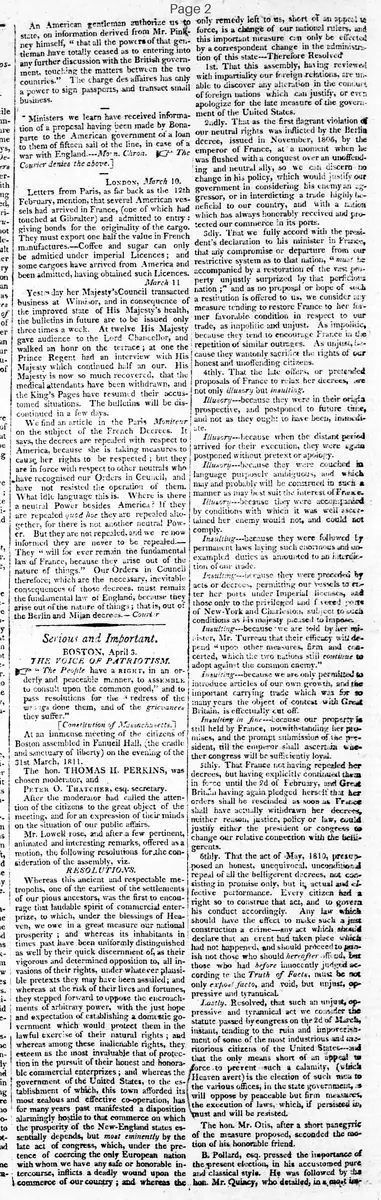
BOSTON, April 3.
THE VOICE OF PATRIOTISM.
"The People have a Right, in an orderly and peaceable manner, to ASSEMBLE to consult upon the common good," and to pass resolutions for the "redress of the wrongs done them, and of the grievances they suffer."
Constitution of Massachusetts.
At an immense meeting of the citizens of Boston assembled in Faneuil Hall, (the cradle and sanctuary of liberty) on the evening of the 31st March, 1811.
The hon. THOMAS H. PERKINS, was chosen moderator, and PETER O. THATCHER, Esq. secretary.
After the moderator had called the attention of the citizens to the great object of the meeting, and for an expression of their minds on the situation of our public affairs.
Mr. Lowell rose, and after a few pertinent, animated and interesting remarks, offered as a motion, the following resolutions for the consideration of the assembly, viz.
RESOLUTIONS.
Whereas this ancient and respectable metropolis, one of the earliest of the settlements of our pious ancestors, was the first to encourage that laudable spirit of commercial enterprise, to which, under the blessings of Heaven, we owe in a great measure our national prosperity; and whereas its inhabitants in times past have been uniformly distinguished as well by their quick discernment of, as their vigorous and determined opposition to, all invasions of their rights, under whatever plausible pretexts they may have been assailed; and whereas at the risk of their lives and fortunes, they stepped forward to oppose the encroachments of arbitrary power, with the just hope and expectation of establishing a domestic government which would protect them in the lawful exercise of their natural rights; and whereas among these inalienable rights, they esteem as the most invaluable that of protection in the pursuit of their honest and honorable commercial enterprizes; and whereas the government of the United States, to the establishment of which, this town afforded its most zealous and effective co-operation, has for many years past manifested a disposition alarmingly hostile to that commerce on which the prosperity of the New-England states essentially depends, but most eminently by the late act of congress, which, under the pretence of coercing the only European nation with whom we have any safe or honorable intercourse, inflicts a deadly wound upon the commerce of our country; and whereas the
only remedy left to us, short of an appeal to force, is a change of our national rulers, and this important measure can only be effected by a correspondent change in the administration of this state---Therefore Resolved
1st. That this assembly, having reviewed with impartiality our foreign relations, are unable to discover any alteration in the conduct of foreign nations which can justify, or even apologize for the late measure of the government of the United States.
2dly. That as the first flagrant violation of our neutral rights was inflicted by the Berlin decree, issued in November, 1806, by the emperor of France, at a moment when he was flushed with a conquest over an unoffending and neutral ally, so we can discern no change in his policy, which would justify our government in considering his enemy an aggressor, or in interdicting a trade highly beneficial to our country, and with a nation which has always honorably received and protected our commerce in its ports.
3dly. That we fully accord with the president's declaration to his minister in France, that any compromise or departure from our restrictive system as to that nation," must be accompanied by a restoration of the vast property unjustly surprised by that perfidious nation;" and as no proposal or hope of such a restitution is offered to us, we consider any measure tending to restore France to her former favorable condition in respect to our trade, as impolitic and unjust. As impolitic, because they tend to encourage France in the repetition of similar outrages. As unjust, because they wantonly sacrifice the rights of our honest and unoffending citizens.
4thly. That the late offers, or pretended proposals of France to relax her decrees, are not only illusory but insulting.
Illusory---because they were in their origin prospective, and postponed to future time, and not as they ought to have been, immediate.
Illusory---because when the distant period arrived for their execution, they were again postponed without pretext or apology.
Illusory---because they were couched in language purposely ambiguous, and which may and probably will be construed in such a manner as may best suit the interest of France.
Illusory---because they were accompanied by conditions with which it was well ascertained her enemy would not, and could not comply.
Insulting---because they were followed by permanent laws laying such enormous and unprecedented duties as amounted to an interdiction of our trade.
Insulting---because they were preceded by acts or decrees, permitting our vessels to enter her ports under Imperial licenses, and those only to the privileged and favored ports of New-York and Charleston, subject to such conditions as his majesty pleased to impose.
Insulting---because we are told by her minister, Mr. Turreau that their efficacy will depend "upon other measures, firm and concerted, which the two nations still continue to adopt against the common enemy."
Insulting---because we are only permitted to introduce articles of our own growth, and the important carrying trade which was for so many years the object of contest with Great Britain, is effectually cut off
Insulting in fine---because our property is still held by France, notwithstanding her promises, and the prompt submission of the president, till the emperor shall ascertain whether congress will be sufficiently loyal.
5thly. That France not having repealed her decrees, but having explicitly continued them in force until the 2d of February, and Great Britain having again pledged herself that her orders shall be rescinded as soon as France shall have actually withdrawn her decrees, neither reason, justice, policy or law, could justify either the president or congress to change our relative connection with the belligerents.
6thly. That the act of May, 1810, presupposed an honest, unequivocal, unconditional repeal of all the belligerent decrees, not consisting in promise only, but in actual and effectual performance. Every citizen had a right so to construe that act, and to govern his conduct accordingly. Any law which should have the effect to make such a just construction a crime--any act which should declare that an event had taken place which had not happened, and should proceed to punish not those who should hereafter offend, but those who had before innocently judged according to the Truth of Facts, must be not only ex post facto, and void, but unjust, oppressive and tyrannical
Lastly. Resolved, that such an unjust, oppressive and tyrannical act we consider the statute passed by congress on the 2d of March, instant, tending to the ruin and impoverishment of some of the most industrious and meritorious citizens of the United States---and that the only means short of an appeal to force, to prevent such a calamity, (which Heaven avert) is the election of such men to the various offices, in the state government, as will oppose by peaceable but firm measures, the execution of laws, which, if persisted in, must and will be resisted.
The hon. Mr. Otis, after a short panegyric of the measure proposed, seconded the motion of his honorable friend.
B. Pollard, esq. pressed the importance of the present election, in his accustomed pure and classical style. He was followed by the hon. Mr. Quincy, who detailed, in a most interesting
In a progressive and eloquent manner, the views and motives of the individuals who rule the destinies of our nation. It was grateful to Mr. Quincy's constituents to see him in the Hall of Representatives. He was listened to with the most uninterested attention, while he told the serious truths, which his public employment, and his experience had brought within his knowledge. The hon. Mr. Otis followed Mr. Quincy, and with his usual eloquence, brought home to our feelings the disastrous state of our public affairs. He proved that the plans of the present administration are in perfect conformity with those of Napoleon; and that the continental system which Napoleon has established through Europe, is now in operation on our own merchants at home.
The inferences from these discussions are, that the men who now rule, are corrupt and impotent; that they are humbly submissive and obedient to France; that they are inveterately hostile to Great Britain: that they entertain a fixed contempt and detestation of commerce; that they would sooner plunge this country into war with England and alliance with France, and consequently subject it to French dominion, than let the federal republicans again come into power, and expose the weak and wicked measures of the Jeffersonian policy.
The resolutions having been again read by the secretary, the motion was put on their acceptance and were adopted unanimously.
What sub-type of article is it?
What keywords are associated?
What entities or persons were involved?
Where did it happen?
Domestic News Details
Primary Location
Boston
Event Date
Evening Of The 31st March, 1811
Key Persons
Outcome
resolutions adopted unanimously, calling for election of state officials to oppose federal laws on commerce.
Event Details
Immense meeting of Boston citizens at Faneuil Hall where resolutions were passed criticizing U.S. government policies on foreign relations and commerce, particularly the act of March 2, 1811, seen as favoring France and harming New England trade; speakers addressed the assembly on the need for change in state administration.