Thank you for visiting SNEWPapers!
Sign up free
Story
November 28, 1888
The Indianapolis Journal
Indianapolis, Marion County, Indiana
What is this article about?
A Washington letter explains the personal costs for President-elect Harrison's family in the White House, including horses, carriages, servants, and household operations not covered by government, unlike Cabinet perks, while the residence is fully furnished.
Clipping
OCR Quality
95%
Excellent
Full Text
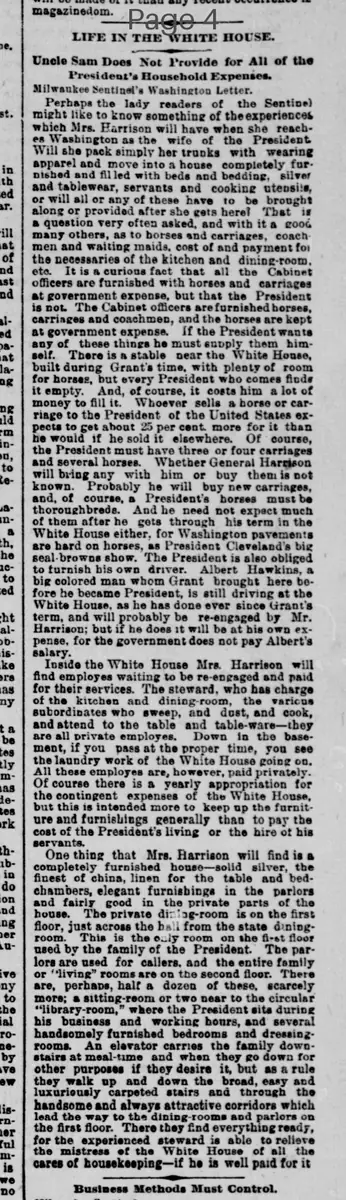
LIFE IN THE WHITE HOUSE.
Uncle Sam Does Not Provide for All of the President's Household Expenses.
Milwaukee Sentinel's Washington Letter.
Perhaps the lady readers of the Sentinel might like to know something of the experiences which Mrs. Harrison will have when she reaches Washington as the wife of the President. Will she pack simply her trunks with wearing apparel and move into a house completely furnished and filled with beds and bedding, silver and tableware, servants and cooking utensils, or will all or any of these have to be brought along or provided after she gets here? That is a question very often asked, and with it a good many others, as to horses and carriages, coachmen and waiting maids, cost of and payment for the necessaries of the kitchen and dining-room, etc. It is a curious fact that all the Cabinet officers are furnished with horses and carriages at government expense, but that the President is not. The Cabinet officers are furnished horses, carriages and coachmen, and the horses are kept at government expense. If the President wants any of these things he must supply them himself. There is a stable near the White House, built during Grant's time, with plenty of room for horses, but every President who comes finds it empty. And, of course, it costs him a lot of money to fill it. Whoever sells a horse or carriage to the President of the United States expects to get about 25 per cent. more for it than he would if he sold it elsewhere. Of course, the President must have three or four carriages and several horses. Whether General Harrison will bring any with him or buy them is not known. Probably he will buy new carriages, and, of course, a President's horses must be thoroughbreds. And he need not expect much of them after he gets through his term in the White House either, for Washington pavements are hard on horses, as President Cleveland's big seal-browns show. The President is also obliged to furnish his own driver. Albert Hawkins, a big colored man whom Grant brought here before he became President, is still driving at the White House, as he has done ever since Grant's term, and will probably be re-engaged by Mr. Harrison; but if he does it will be at his own expense, for the government does not pay Albert's salary.
Inside the White House Mrs. Harrison will find employes waiting to be re-engaged and paid for their services. The steward, who has charge of the kitchen and dining-room, the various subordinates who sweep, and dust, and cook, and attend to the table and table-ware—they are all private employes. Down in the basement, if you pass at the proper time, you see the laundry work of the White House going on. All these employes are, however, paid privately. Of course there is a yearly appropriation for the contingent expenses of the White House, but this is intended more to keep up the furniture and furnishings generally than to pay the cost of the President's living or the hire of his servants.
One thing that Mrs. Harrison will find is a completely furnished house—solid silver, the finest of china, linen for the table and bed chambers, elegant furnishings in the parlors and fairly good in the private parts of the house. The private dining-room is on the first floor, just across the hall from the state dining room. This is the only room on the first floor used by the family of the President. The parlors are used for callers, and the entire family or "living" rooms are on the second floor. There are, perhaps, half a dozen of these, scarcely more: a sitting-room or two near to the circular library-room, where the President sits during his business and working hours, and several handsomely furnished bedrooms and dressing-rooms. An elevator carries the family downstairs at meal-time and when they go down for other purposes if they desire it, but as a rule they walk up and down the broad, easy and luxuriously carpeted stairs and through the handsome and always attractive corridors which lead the way to the dining-rooms and parlors on the first floor. There they find everything ready, for the experienced steward is able to relieve the mistress of the White House of all the cares of housekeeping—if he is well paid for it.
Uncle Sam Does Not Provide for All of the President's Household Expenses.
Milwaukee Sentinel's Washington Letter.
Perhaps the lady readers of the Sentinel might like to know something of the experiences which Mrs. Harrison will have when she reaches Washington as the wife of the President. Will she pack simply her trunks with wearing apparel and move into a house completely furnished and filled with beds and bedding, silver and tableware, servants and cooking utensils, or will all or any of these have to be brought along or provided after she gets here? That is a question very often asked, and with it a good many others, as to horses and carriages, coachmen and waiting maids, cost of and payment for the necessaries of the kitchen and dining-room, etc. It is a curious fact that all the Cabinet officers are furnished with horses and carriages at government expense, but that the President is not. The Cabinet officers are furnished horses, carriages and coachmen, and the horses are kept at government expense. If the President wants any of these things he must supply them himself. There is a stable near the White House, built during Grant's time, with plenty of room for horses, but every President who comes finds it empty. And, of course, it costs him a lot of money to fill it. Whoever sells a horse or carriage to the President of the United States expects to get about 25 per cent. more for it than he would if he sold it elsewhere. Of course, the President must have three or four carriages and several horses. Whether General Harrison will bring any with him or buy them is not known. Probably he will buy new carriages, and, of course, a President's horses must be thoroughbreds. And he need not expect much of them after he gets through his term in the White House either, for Washington pavements are hard on horses, as President Cleveland's big seal-browns show. The President is also obliged to furnish his own driver. Albert Hawkins, a big colored man whom Grant brought here before he became President, is still driving at the White House, as he has done ever since Grant's term, and will probably be re-engaged by Mr. Harrison; but if he does it will be at his own expense, for the government does not pay Albert's salary.
Inside the White House Mrs. Harrison will find employes waiting to be re-engaged and paid for their services. The steward, who has charge of the kitchen and dining-room, the various subordinates who sweep, and dust, and cook, and attend to the table and table-ware—they are all private employes. Down in the basement, if you pass at the proper time, you see the laundry work of the White House going on. All these employes are, however, paid privately. Of course there is a yearly appropriation for the contingent expenses of the White House, but this is intended more to keep up the furniture and furnishings generally than to pay the cost of the President's living or the hire of his servants.
One thing that Mrs. Harrison will find is a completely furnished house—solid silver, the finest of china, linen for the table and bed chambers, elegant furnishings in the parlors and fairly good in the private parts of the house. The private dining-room is on the first floor, just across the hall from the state dining room. This is the only room on the first floor used by the family of the President. The parlors are used for callers, and the entire family or "living" rooms are on the second floor. There are, perhaps, half a dozen of these, scarcely more: a sitting-room or two near to the circular library-room, where the President sits during his business and working hours, and several handsomely furnished bedrooms and dressing-rooms. An elevator carries the family downstairs at meal-time and when they go down for other purposes if they desire it, but as a rule they walk up and down the broad, easy and luxuriously carpeted stairs and through the handsome and always attractive corridors which lead the way to the dining-rooms and parlors on the first floor. There they find everything ready, for the experienced steward is able to relieve the mistress of the White House of all the cares of housekeeping—if he is well paid for it.
What sub-type of article is it?
Curiosity
Historical Event
What themes does it cover?
Social Manners
What keywords are associated?
White House Expenses
Presidential Household
First Lady Duties
Government Provisions
Servants And Stables
What entities or persons were involved?
Mrs. Harrison
General Harrison
Albert Hawkins
Grant
Cleveland
Where did it happen?
White House, Washington
Story Details
Key Persons
Mrs. Harrison
General Harrison
Albert Hawkins
Grant
Cleveland
Location
White House, Washington
Story Details
Description of personal expenses and furnishings for the incoming President Harrison's household, including horses, carriages, servants, and kitchen needs, which are not provided by the government unlike for Cabinet officers; the White House is fully furnished but staff and maintenance are private costs.