Thank you for visiting SNEWPapers!
Sign up free
Editorial
September 2, 1846
Mississippi Democrat
Carrollton, Carroll County, Mississippi
What is this article about?
This editorial advocates for free trade between the United States and England, arguing that abolishing protective duties and corn laws would benefit both nations' economies by facilitating the exchange of American agricultural produce for British manufactures, using Texas annexation as an analogy and critiquing monopolies.
Clipping
OCR Quality
98%
Excellent
Full Text
From the Democratic Review
PRACTICAL ANNEXATION OF ENGLAND.
EXTRACT.
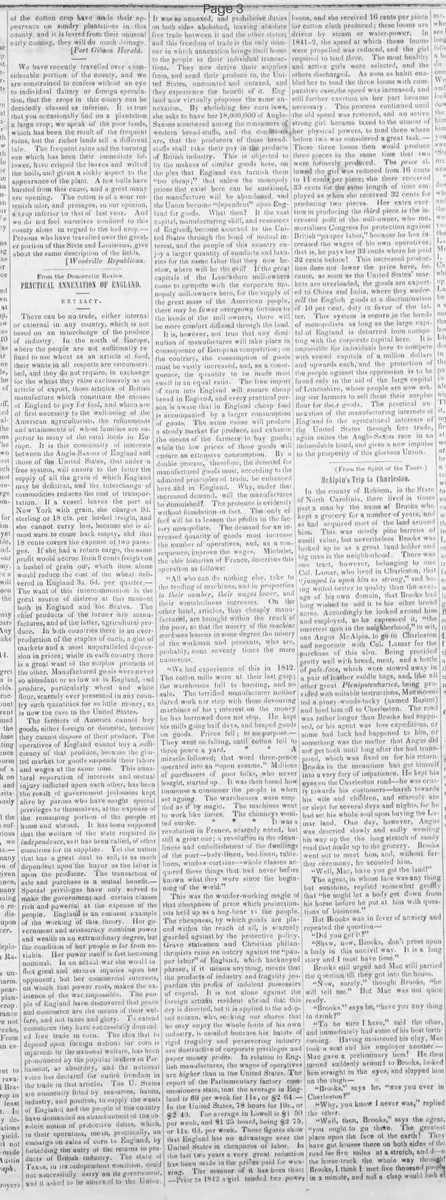
There can be no trade, either internal or external in any country, which is not based on an interchange of the produce of industry. In the north of Europe, where the people are not sufficiently refined to use wheat as an article of food, their wants in all respects are circumscribed, and they do not require, in exchange for the wheat they raise exclusively as an article of export, those articles of British manufacture which constitute the means of England to pay for food, and which are of first necessity to the well-being of the American agriculturists, the refinements and attainments of whose families are superior to many of the rural lords in Europe.
It is this community of interests between the Anglo Saxons of England and those of the United States, that under a free system, will ensure to the latter the supply of all the grain of which England may be deficient, and the interchange of commodities reduces the cost of transportation. If a vessel leaves the port of New York with grain, she charges 9d. sterling or 18 cts. per bushel freight, and she cannot carry less, because she is almost sure to come back empty, and that 18 cents covers the expense of two passages. If she had a return cargo, the same profit would accrue from 4 1/2 cents freight on a bushel of grain out, which item alone would reduce the cost of the wheat delivered in England 3s. 6d. per quarter.—
The want of this intercommunion is the great source of distress at this moment both in England and the States. The chief products of the former are manufactures, and of the latter, agricultural produce. In both countries there is an over-production of the staples of each, a glut of markets and a most unparalleled depression in prices; while in each country there is a great want of the surplus products of the other. Manufactured goods were never so abundant or so low as in England, and produce, particularly wheat and white flour, scarcely ever presented in any country such quantities for so little money, as is now the case in the United States.
The farmers of America cannot buy goods, either foreign or domestic, because they cannot dispose of their produce. The operatives of England cannot buy a sufficiency of that produce, because the glutted market for goods suspends their labors and wages at the same time. This unnatural separation of interests and mutual injury inflicted upon each other, has been the result of government jealousies kept alive by parties who have sought special privileges to themselves, at the expense of the remaining portion of the people at home and abroad. It has been supposed that the welfare of the state required its independence, as it has been called, of other countries for its supplies. Yet the nation that has a great deal to sell, is as much dependent upon the buyer as the latter is upon the producer. The transaction of sale and purchase is a mutual benefit.— Special privileges have only served to make the government and certain classes rich and powerful at the expense of the people. England is an eminent example of the working of this theory. Her government and aristocracy combine power and wealth in an extraordinary degree, but the condition of her people is far from enviable. Her power itself is fast becoming nominal. In an actual war she would inflict great and serious injuries upon her opponent; but her commercial interests, on which that power rests, makes the existence of the war impossible. The people of England have discovered that peace and commerce are the means of their welfare, and not taxes and glory. To extend commerce they have successfully demanded free trade in corn.
The idea that to depend upon foreign nations for corn is injurious to the national welfare, has been pronounced by the popular leaders in Parliament, as absurdity, and the national voice has declared for entire freedom in the trade in that article. The U. States are eminently fitted by resources, habits, industry, and position, to supply the wants of England; and the people of this country have demanded an abandonment of the obsolete notion of protective duties, which, in their operation, mean, practically, an embargo on sales of corn to England, by forbidding the entry of the returns in products of British industry. The state of Texas, in its independent condition, could not successfully carry on its government, and it asked to be annexed to the Union.
It was so annexed, and prohibitive duties on both sides abolished, leaving absolute free trade between it and the other states; and this freedom of trade is the only manner in which annexation brings itself home to the people in their individual transactions. They now derive their supplies from, and send their produce to, the United States, uncounted and untaxed, and they experience the benefit of it. England now virtually proposes the same annexation. By abolishing her corn laws, she asks to have her 18,000,000 of Anglo-Saxons numbered among the consumers of western bread-stuffs, and the conditions are, that the producers of those bread-stuffs shall take their pay in the products of British industry. This is objected to by the makers of similar goods here, on the plea that England can furnish them "too cheap;" that unless the monopoly prices that exist here can be sustained, the manufacture will be abandoned, and the Union become "dependent" upon England for goods. What then? If the vast capital, manufacturing skill, and resources of England, become annexed to the United States through the bond of mutual interest, and the people of this country enjoy a larger quantity of comforts and luxuries for the same labor that they now bestow, where will be the evil? If the great capitals of the Lancashire mill-owners come to compete with the corporate monopoly mill-owners here, for the supply of the great mass of the American people, there may be fewer overgrown fortunes in the hands of the mill owners, there will be more comfort diffused through the land.
It is, however, not true that any diminution of manufactures will take place in consequence of European competition; on the contrary, the consumption of goods must be vastly increased, and, as a consequence, the quantity to be made must swell in an equal ratio. The free import of corn into England will ensure cheap bread in England, and every practical person is aware that in England cheap food is accompanied by a larger consumption of goods. The same cause will produce a steady market for produce, and exchange the means of the farmers to buy goods; while the low prices of those goods will ensure an extensive consumption. By a double process, therefore, the demand for manufactured goods must, according to the admitted principles of trade, be enhanced here and in England. Why, under that increased demand, will the manufactures be diminished? The pretence is evidently without foundation in fact. The only effect will be to lessen the profits in the factory monopolists. The demand for an increased quantity of goods must increase the number of operatives, and, as a consequence, improve the wages. Michelet, the able historian of France, describes this operation as follows:
"All who can do nothing else, take to the tending of machines, and in proportion to their number, their wages lower, and their wretchedness increases. On the other hand, articles, thus cheaply manufactured, are brought within the reach of the poor, so that the misery of the machine workman lessens in some degree the misery of the workman and peasants, who are, probably, some seventy times the more numerous.
"We had experience of this in 1842. The cotton mills were at their last gasp; the warehouses full to bursting, and no sale. The terrified manufacturer neither dared work nor stop with these devouring machines of his; interest on the money he has borrowed does not stop. He kept his mills going half days, and heaped goods on goods. Prices fell; to no purpose.— They went on falling, until cotton fell to three pence a yard.
A miracle followed; that word three-pence operated into an "open sesame." Millions of purchasers of poor folks, who never bought, started up. It was then found how immense a consumer the people is when set agoing. The warehouses were emptied as if by magic.
The machines went to work like furies. The chimneys vomited smoke.
It was a revolution in France, scarcely noted, but still a great one; a revolution in the cleanliness and embellishment of the dwellings of the poor—body-linen, bed-linen, table-linen, window-curtains—whole classes acquired these things that had never before known what they were since the beginning of the world."
This was the wonder-working magic of that cheapness of price which protectionists held up as a bug-bear to the people. The cheapness, by which goods are placed within the reach of all, is scarcely guarded against by the protective policy. Grave statesmen and Christian philanthropists raise an outcry against the "pauper labor" of England, which hackneyed phrase, if it means anything, means that the products of industry and frugality jeopardize the profits of indolent possessors of capital. It is not alone against the foreign artisan resident abroad that this cry is directed, but it is applied to the adopted citizen, who, seeking our shores that he may enjoy the whole fruits of his own industry, is assailed because his habits of rigid frugality and persevering industry are destructive of corporate privileges and paper money profits. In relation to English manufactures, the wages of operatives are higher than in the United States. The report of the Parliamentary factory commissioners state, that the average in England is 69 hours per week for 11s, or $2 64.— In the United States, 78 hours for 10s., or $2 40. The average in Lowell is $1 50 per week, and $1 25 board, being $2 75, or 11s. 6d. per week. These figures show that England has no advantage over the United States in cheapness of labor. In the last two years a very great reduction has been made in the prices paid for weaving. The manner of it has been thus: —Prior to 1842 a girl tended two power looms, and she received 16 cents per piece for cotton cloth produced; these looms are driven by steam or water power.
In 1841-2, the speed at which these looms were propelled was reduced, and the girl required to tend three. The most healthy and active girls were selected, and the others discharged. As soon as habit enabled her to tend the three looms with comparative ease, the speed was increased, and still further exertion on her part became necessary. This process continued until the old speed was restored, and an active strong girl became taxed to the utmost of her physical powers, to tend three where before two was considered a great task.— These three looms then would produce three pieces in the same time that two were formerly produced. The price allowed the girl was reduced from 16 cents to 11 cents per piece; she there received 33 cents for the same length of time employed as when she received 32 cents for producing two pieces. Her extra exertion in producing the third piece is the increased profit of the mill-owner, who memorializes Congress for protection against British "pauper labor," because he has increased the wages of his own operatives; that is, he pays her 33 cents where he paid 32 cents before! This increased production does not lower the price here, because, as soon as the United States' markets are overloaded, the goods are exported to China and India, where they undersell the English goods at a discrimination of 10 per cent, duty in favor of the latter. This system is secure in the hands of monopolists as long as the large capital of England is debarred from competing with the corporate capital here. It is impossible for individuals here to compete with vested capitals of a million dollars and upwards each, and the protection of the people against this oppression is to be found only in the aid of the large capital of Lancashire, whose people are now asking our farmers to sell them their surplus flour for their goods. The practical annexation of the manufacturing interests of England to the agricultural interests of the United States through free trade, again unites the Anglo-Saxon race in an indissoluble bond, and gives a new impulse to the prosperity of this glorious Union.
PRACTICAL ANNEXATION OF ENGLAND.
EXTRACT.
There can be no trade, either internal or external in any country, which is not based on an interchange of the produce of industry. In the north of Europe, where the people are not sufficiently refined to use wheat as an article of food, their wants in all respects are circumscribed, and they do not require, in exchange for the wheat they raise exclusively as an article of export, those articles of British manufacture which constitute the means of England to pay for food, and which are of first necessity to the well-being of the American agriculturists, the refinements and attainments of whose families are superior to many of the rural lords in Europe.
It is this community of interests between the Anglo Saxons of England and those of the United States, that under a free system, will ensure to the latter the supply of all the grain of which England may be deficient, and the interchange of commodities reduces the cost of transportation. If a vessel leaves the port of New York with grain, she charges 9d. sterling or 18 cts. per bushel freight, and she cannot carry less, because she is almost sure to come back empty, and that 18 cents covers the expense of two passages. If she had a return cargo, the same profit would accrue from 4 1/2 cents freight on a bushel of grain out, which item alone would reduce the cost of the wheat delivered in England 3s. 6d. per quarter.—
The want of this intercommunion is the great source of distress at this moment both in England and the States. The chief products of the former are manufactures, and of the latter, agricultural produce. In both countries there is an over-production of the staples of each, a glut of markets and a most unparalleled depression in prices; while in each country there is a great want of the surplus products of the other. Manufactured goods were never so abundant or so low as in England, and produce, particularly wheat and white flour, scarcely ever presented in any country such quantities for so little money, as is now the case in the United States.
The farmers of America cannot buy goods, either foreign or domestic, because they cannot dispose of their produce. The operatives of England cannot buy a sufficiency of that produce, because the glutted market for goods suspends their labors and wages at the same time. This unnatural separation of interests and mutual injury inflicted upon each other, has been the result of government jealousies kept alive by parties who have sought special privileges to themselves, at the expense of the remaining portion of the people at home and abroad. It has been supposed that the welfare of the state required its independence, as it has been called, of other countries for its supplies. Yet the nation that has a great deal to sell, is as much dependent upon the buyer as the latter is upon the producer. The transaction of sale and purchase is a mutual benefit.— Special privileges have only served to make the government and certain classes rich and powerful at the expense of the people. England is an eminent example of the working of this theory. Her government and aristocracy combine power and wealth in an extraordinary degree, but the condition of her people is far from enviable. Her power itself is fast becoming nominal. In an actual war she would inflict great and serious injuries upon her opponent; but her commercial interests, on which that power rests, makes the existence of the war impossible. The people of England have discovered that peace and commerce are the means of their welfare, and not taxes and glory. To extend commerce they have successfully demanded free trade in corn.
The idea that to depend upon foreign nations for corn is injurious to the national welfare, has been pronounced by the popular leaders in Parliament, as absurdity, and the national voice has declared for entire freedom in the trade in that article. The U. States are eminently fitted by resources, habits, industry, and position, to supply the wants of England; and the people of this country have demanded an abandonment of the obsolete notion of protective duties, which, in their operation, mean, practically, an embargo on sales of corn to England, by forbidding the entry of the returns in products of British industry. The state of Texas, in its independent condition, could not successfully carry on its government, and it asked to be annexed to the Union.
It was so annexed, and prohibitive duties on both sides abolished, leaving absolute free trade between it and the other states; and this freedom of trade is the only manner in which annexation brings itself home to the people in their individual transactions. They now derive their supplies from, and send their produce to, the United States, uncounted and untaxed, and they experience the benefit of it. England now virtually proposes the same annexation. By abolishing her corn laws, she asks to have her 18,000,000 of Anglo-Saxons numbered among the consumers of western bread-stuffs, and the conditions are, that the producers of those bread-stuffs shall take their pay in the products of British industry. This is objected to by the makers of similar goods here, on the plea that England can furnish them "too cheap;" that unless the monopoly prices that exist here can be sustained, the manufacture will be abandoned, and the Union become "dependent" upon England for goods. What then? If the vast capital, manufacturing skill, and resources of England, become annexed to the United States through the bond of mutual interest, and the people of this country enjoy a larger quantity of comforts and luxuries for the same labor that they now bestow, where will be the evil? If the great capitals of the Lancashire mill-owners come to compete with the corporate monopoly mill-owners here, for the supply of the great mass of the American people, there may be fewer overgrown fortunes in the hands of the mill owners, there will be more comfort diffused through the land.
It is, however, not true that any diminution of manufactures will take place in consequence of European competition; on the contrary, the consumption of goods must be vastly increased, and, as a consequence, the quantity to be made must swell in an equal ratio. The free import of corn into England will ensure cheap bread in England, and every practical person is aware that in England cheap food is accompanied by a larger consumption of goods. The same cause will produce a steady market for produce, and exchange the means of the farmers to buy goods; while the low prices of those goods will ensure an extensive consumption. By a double process, therefore, the demand for manufactured goods must, according to the admitted principles of trade, be enhanced here and in England. Why, under that increased demand, will the manufactures be diminished? The pretence is evidently without foundation in fact. The only effect will be to lessen the profits in the factory monopolists. The demand for an increased quantity of goods must increase the number of operatives, and, as a consequence, improve the wages. Michelet, the able historian of France, describes this operation as follows:
"All who can do nothing else, take to the tending of machines, and in proportion to their number, their wages lower, and their wretchedness increases. On the other hand, articles, thus cheaply manufactured, are brought within the reach of the poor, so that the misery of the machine workman lessens in some degree the misery of the workman and peasants, who are, probably, some seventy times the more numerous.
"We had experience of this in 1842. The cotton mills were at their last gasp; the warehouses full to bursting, and no sale. The terrified manufacturer neither dared work nor stop with these devouring machines of his; interest on the money he has borrowed does not stop. He kept his mills going half days, and heaped goods on goods. Prices fell; to no purpose.— They went on falling, until cotton fell to three pence a yard.
A miracle followed; that word three-pence operated into an "open sesame." Millions of purchasers of poor folks, who never bought, started up. It was then found how immense a consumer the people is when set agoing. The warehouses were emptied as if by magic.
The machines went to work like furies. The chimneys vomited smoke.
It was a revolution in France, scarcely noted, but still a great one; a revolution in the cleanliness and embellishment of the dwellings of the poor—body-linen, bed-linen, table-linen, window-curtains—whole classes acquired these things that had never before known what they were since the beginning of the world."
This was the wonder-working magic of that cheapness of price which protectionists held up as a bug-bear to the people. The cheapness, by which goods are placed within the reach of all, is scarcely guarded against by the protective policy. Grave statesmen and Christian philanthropists raise an outcry against the "pauper labor" of England, which hackneyed phrase, if it means anything, means that the products of industry and frugality jeopardize the profits of indolent possessors of capital. It is not alone against the foreign artisan resident abroad that this cry is directed, but it is applied to the adopted citizen, who, seeking our shores that he may enjoy the whole fruits of his own industry, is assailed because his habits of rigid frugality and persevering industry are destructive of corporate privileges and paper money profits. In relation to English manufactures, the wages of operatives are higher than in the United States. The report of the Parliamentary factory commissioners state, that the average in England is 69 hours per week for 11s, or $2 64.— In the United States, 78 hours for 10s., or $2 40. The average in Lowell is $1 50 per week, and $1 25 board, being $2 75, or 11s. 6d. per week. These figures show that England has no advantage over the United States in cheapness of labor. In the last two years a very great reduction has been made in the prices paid for weaving. The manner of it has been thus: —Prior to 1842 a girl tended two power looms, and she received 16 cents per piece for cotton cloth produced; these looms are driven by steam or water power.
In 1841-2, the speed at which these looms were propelled was reduced, and the girl required to tend three. The most healthy and active girls were selected, and the others discharged. As soon as habit enabled her to tend the three looms with comparative ease, the speed was increased, and still further exertion on her part became necessary. This process continued until the old speed was restored, and an active strong girl became taxed to the utmost of her physical powers, to tend three where before two was considered a great task.— These three looms then would produce three pieces in the same time that two were formerly produced. The price allowed the girl was reduced from 16 cents to 11 cents per piece; she there received 33 cents for the same length of time employed as when she received 32 cents for producing two pieces. Her extra exertion in producing the third piece is the increased profit of the mill-owner, who memorializes Congress for protection against British "pauper labor," because he has increased the wages of his own operatives; that is, he pays her 33 cents where he paid 32 cents before! This increased production does not lower the price here, because, as soon as the United States' markets are overloaded, the goods are exported to China and India, where they undersell the English goods at a discrimination of 10 per cent, duty in favor of the latter. This system is secure in the hands of monopolists as long as the large capital of England is debarred from competing with the corporate capital here. It is impossible for individuals here to compete with vested capitals of a million dollars and upwards each, and the protection of the people against this oppression is to be found only in the aid of the large capital of Lancashire, whose people are now asking our farmers to sell them their surplus flour for their goods. The practical annexation of the manufacturing interests of England to the agricultural interests of the United States through free trade, again unites the Anglo-Saxon race in an indissoluble bond, and gives a new impulse to the prosperity of this glorious Union.
What sub-type of article is it?
Economic Policy
Trade Or Commerce
Agriculture
What keywords are associated?
Free Trade
Corn Laws
Protective Duties
Anglo Saxon Commerce
Economic Annexation
Pauper Labor
Monopolies
What entities or persons were involved?
England
United States
Anglo Saxons
Parliament
Texas
Lancashire Mill Owners
Michelet
Editorial Details
Primary Topic
Advocacy For Free Trade And Practical Annexation Of England To Us Via Commerce
Stance / Tone
Strongly Pro Free Trade And Anti Protectionism
Key Figures
England
United States
Anglo Saxons
Parliament
Texas
Lancashire Mill Owners
Michelet
Key Arguments
Trade Requires Interchange Of Industry Products Between Us Agriculture And English Manufactures
Lack Of Free Trade Causes Economic Distress In Both Countries Due To Overproduction And Market Gluts
Protective Duties And Corn Laws Hinder Mutual Benefits And Enrich Monopolies At Public Expense
England's Abolition Of Corn Laws Invites Free Trade With Us, Analogous To Texas Annexation
Free Trade Will Increase Consumption, Not Diminish Us Manufactures, By Lowering Prices And Boosting Demand
Cheap Goods Benefit The Poor And Expand Markets, As Illustrated By French Cotton Example In 1842
English Labor Is Not Cheaper Than Us; Protectionism Exploits Workers To Sustain Monopolist Profits