Thank you for visiting SNEWPapers!
Sign up free
Richmond Enquirer
Richmond, Richmond County, Virginia
What is this article about?
Desultory observations opposing slavery restrictions in Missouri, arguing it unconstitutionally divides the Union geographically, underestimates southern strength, and risks national discord. References figures like Rufus King and historical examples. Signed Virginius.
Merged-components note: Merged components 41 and 42 as they form a single continuous opinion piece submitted to the editor on the Missouri Question, signed 'VIRGINIUS'. Relabeled from 'editorial' to 'letter_to_editor' as it is a reader-submitted letter with observations addressed to the editor.
Clippings
1 of 2
OCR Quality
Full Text
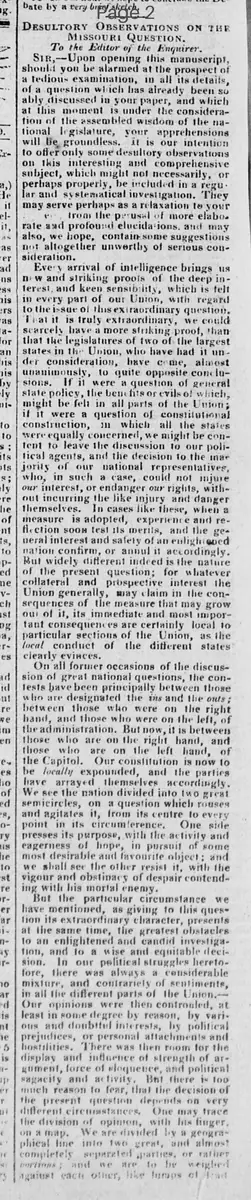
To the Editor of the Enquirer.
SIR,—Upon opening this manuscript, should you be alarmed at the prospect of a tedious examination, in all its details, of a question which has already been so ably discussed in your paper, and which at this moment is under the consideration of the assembled wisdom of the national legislature, your apprehensions will be groundless. it is our intention to offer only some desultory observations on this interesting and comprehensive subject, which might not necessarily, or perhaps properly, be included in a regular and systematic investigation. They may serve perhaps as a relaxation to your readers from the perusal of more elaborate and profound elucidations. and may also, we hope, contain some suggestions not altogether unworthy of serious consideration.
Every arrival of intelligence brings us new and striking proofs of the deep interest, and keen sensibility. which is felt in every part of our Union, with regard to the issue of this extraordinary question. That it is truly extraordinary, we could scarcely have a more striking proof, than that the legislatures of two of the largest states in the Union, who have had it under consideration, have come, almost unanimously, to quite opposite conclusions. If it were a question of general state policy, the benefits or evils of which, might be felt in all parts of the Union; if it were a question of constitutional construction, in which all the states were equally concerned, we might be content to leave the discussion to our political agents. and the decision to the majority of our national representatives. who, in such a case, could not injure our interest, or endanger our rights, without incurring the like injury and danger themselves. In cases like these, when a measure is adopted, experience and reflection soon test its merits, and the general interest and safety of an enlightened nation confirm, or annul it accordingly.
But widely different indeed is the nature of the present question; for whatever collateral and prospective interest the Union generally, may claim in the consequences of the measure that may grow out of it, its immediate and most important consequences are certainly local to particular sections of the Union, as the local conduct of the different states clearly evinces.
On all former occasions of the discussion of great national questions, the contests have been principally between those who are designated the ins and the outs; between those who were on the right hand, and those who were on the left, of the administration. But now, it is between those who are on the right hand. and those who are on the left hand, of the Capitol. Our constitution is now to be locally expounded, and the parties have arrayed themselves accordingly.
We see the nation divided into two great semicircles, on a question which rouses and agitates it, from its centre to every point in its circumference. One side presses its purpose, with the activity and eagerness of hope, in pursuit of some most desirable and favourite object: and we shall see the other resist it, with the vigour and obstinacy of despair contending with his mortal enemy.
But the particular circumstance we have mentioned, as giving to this question its extraordinary character, presents at the same time, the greatest obstacles to an enlightened and candid investigation, and to a wise and equitable decision. In our political struggles heretofore, there was always a considerable mixture, and contrariety of sentiments, in all the different parts of the Union.— Our opinions were then controlled, at least in some degree by reason, by various and doubtful interests, by political prejudices, or personal attachments and hostilities. There was then room for the display and influence of strength of argument, force of eloquence, and political sagacity and activity. But there is too much reason to fear, that the decision of the present question depends on very different circumstances. One may trace the division of opinion, with his finger. on a map. We are divided by a geographical line into two great, and almost completely separated parties. or rather portions: and we are to be weighed against each other, like lumps of lead
placed in opposite scales; and that which contains the heaviest mass of mortality, will make the other kick the beam.
The peculiar nature of this question is such, that we not only feel an indignant reluctance in approaching it, but the pain, of a wound inflicted by the hand of unkindness and injustice, which has driven us to the public discussion of it. It is an ancient settlement, and faith and honour stood pledged not to disturb it. Why, then, has it been disturbed? This, indeed, is of all inquiries, the one which first, and most naturally presents itself to the mind, upon being turned to the contemplation of this subject. For what purpose has this proposition, to prohibit slavery in Missouri, and in all new states to be hereafter admitted into the Union, even introduced? For whose benefit? This is a question to which, if propounded by reason, justice, or humanity, it will puzzle the authors and advocates of this scheme, to give a satisfactory answer.
As it is not our intention to trouble ourselves, or our readers, with any systematic order, or divisions, in the remarks we shall make on this subject, we will take occasion here, to notice an idea which has been suggested from different quarters, and lately by a gentleman on the floor of congress, for whose private virtues, and public patriotism, we entertain a very sincere respect. This gentleman is reported as declaring his intention "to record his vote against suffering the dark cloud of calamity, which now overshadows his country, to roll on beyond the peaceful shores of the Mississippi." Mr. King too, in his late communication, deplores the prospect of "slavery, instead of freedom, being extended over the boundless region beyond the Mississippi." What is it, in reality, that these gentlemen deprecate? What are the objects of their deep concern? Have they transferred their tender humanity from animate, to inanimate, objects? Is it the forests, the prairies, the soil, from St. Louis to the Pacific, for which they feel this enthusiastic affection? Or is it contended that the permission of slavery beyond the Mississippi, must necessarily produce a great and deplorable increase of the actual number of slaves that would otherwise exist in the United States? Is this consequence to arise from a more rapid natural increase, produced by the improvement of their means of subsistence and comfort? Will philanthropy have the courage to use this argument? Or is it supposed that by increasing the demand for them, it will offer such inducements to foreign importation, by the practice of smuggling, as to make important additions to their numbers from that source? The nations of Europe, under whose flag this traffic is carried on, are gradually relinquishing it. It is already severely, and it necessarily may be still more severely, prohibited, by the laws of the United States: and with the aid of the professed wishes of all parts of the Union for its suppression, and the evident interest of the old southern states that it should be suppressed, (and the zeal of colonization and emancipation societies may be added, if necessary,) our laws may be executed with such rigour, that no increase, from this source, can be justly apprehended, sufficient to induce the adoption of a measure considered, by a great and respectable part of the Union, as hostile to their rights, interest, and tranquillity, and, as inconsistent with the constitution of the United States.
It would seem, from the arguments and declamation used on this subject, as if it were not from the "migration," as it is termed, of these people across the Mississippi, from the present states, nor from their foreign importation, nor from the ordinary source of natural increase, that this deplorable addition to human slavery is apprehended. It would seem as if it were feared that, should Missouri be admitted into the Union with the right to hold slaves, the citizens, in order to populate the boundless regions of the west with them, will cause them to spring up, in countless numbers, by casting stones and sticks over their shoulders. Would it not be well to consider, whether it be not more to be apprehended, that an unconstitutional, or what is believed to be an unconstitutional, interference with this subject, may produce effects similar to those ascribed, in classic allegory, to the sowing of the dragon's teeth? Have these gentlemen no feeling for, or no respect for the feelings of, the present slave-holding states? Or is it their wish, in endeavouring to prevent "this dark cloud" from rolling on to the west, that it should increase and condense around our heads, till it literally becomes "a darkness that may be felt?" But perhaps they may be sanguine, or absurd, enough to say, that this will not be the effect of their measure;-that, in their wisdom, they will find means to prevent such a consequence. Do they, in their enthusiasm, expect to be endued with the power of performing miracles? Do they expect to be able, at the head of these people, without the bloody visitation to their master's houses, of a Passover and a Spoiling, to conduct them to the shore of the Atlantic, and cause its wild waves to retire to the right hand and to the left, that they may go over, on dry land, and take peaceable possession of the West India Islands? We have seen something like this, (if we understand it rightly,) suggested by Mr. King, who, when speaking of our vicinity to the European colonies in these islands, says, "colonies whose future destiny can hardly be regarded as problematical." Enthusiasm is not incompatible with cunning. When separated from it, it is sometimes useful, always powerful, in execution; but too often weak, and always dangerous, in counsel. And is it upon visions like these, that irrevocable measures of policy and legislation are to be adopted, affecting the constitutional rights of the states of this union, and the exclusive prosperity and repose of a large portion of it? But perhaps we may have widely misapprehended Mr. King's meaning; for we confess, that the future destiny of these colonies, and his mysterious allusion to our vicinity to them, are to us, equally problematical and incomprehensible.
But we are gravely told by Mr. King, that with respect to our prosperity, as far as that depends on the present constitution, we have contrived to appropriate to ourselves, more than our due proportion, by the "concessions" which the northern states were obliged to make to us, in order "to secure the adoption of the constitution;" and we are reminded by him, and by others equally well informed, that with respect to our internal, or domestic repose and safety, "we are already, and must continue to be, dependent on the unshackled strength, and fraternal kindness of our more fortunate northern brethren, whose ability to afford us the necessary protection, will be increased by the adoption of the proposed restriction."
And has it really, come to this at last! After having reposed in safety, in our present situation, just two hundred years, how has it happened, all at once, that we are become dependent for our daily and nightly peace and security, on these who are hundreds of miles distant from us ;-and, if we were to judge from the language which is sometimes used towards us, particularly on this topic, we might be induced to fear, that it is not in locality that they feel farthest removed from us? Has this alarming crisis in our situation been produced, by the influence of bible and colonization societies, and the supplementary revelation, from which it has been recently discovered, that the practice of domestic slavery is inconsistent with the belief and practice of the christian religion? Far, very far, be it from us, to intend ridicule towards any of these institutions : but we have a right, and are bound by the laws of God and nature, to defend ourselves, and all that is most dear to us, from falling victims to the endless abuse of these institutions.
But, it seems, we are no longer to be regarded as a sound and vigorous arm of this Union, capable of contributing to its defence and support, in the hour of danger, from foreign or domestic violence. No-We must be surrounded, for our own protection, "with a barrier of freemen" to defend us from the brave South Americans, (who have no slaves among them, we presume :) who are destined, one day, to meet and encounter, in the glorious contest for empire.-not southern and western slaveholders. They will have enough to do, nay-more than they can do, to take care of themselves, at home ....Contempt!-O, no-No contempt. Keep your proud southern heart quiet. This is the language of our brethren :and they never have spoken, and never will speak of us with contempt, with regard to this, or any other subject. They know too, that there is no feeling more dangerous to those who indulge it, whether they be individuals or communities, than the feeling of contempt. And we need no stronger proofs of the truth of this position, than are abundantly furnished by our own experience. Our revolutionary war would certainly not have happened, at the time it did, and perhaps not even to this day, had it not been for the contempt which the mother country felt for the colonies. And our last war would as certainly not have happened, but for the contempt which the British government felt for our Union, arising from the belief, that in the event of a war with them, the strongest part of this Union would render no assistance against them; a belief, the correctness of which, the event itself has not decided; but a contempt which, in both instances, has been most memorably chastised.
Mr. Editor, we are aware, that some respectable persons may think, that we approach and handle this part of our subject too incautiously, too roughly. But it is our misfortune, our necessity, to think otherwise; and we believe it to be our duty, to all concerned, to express what we think. Nothing is more notorious than that, for years past, an opinion has prevailed, in some parts of our Union, for it has been frequently, publicly, and sometimes officially announced, that the southern, and southwestern states, possess and exercise undue influence in the direction of our public affairs, and particularly in the distribution of public burdens, while they are greatly deficient in the physical power, to defend this influence, and to sustain a relative proportion of these burdens. And in one respect, this opinion has been suffered to pass uncontradicted, till it seems to be believed, that we are incapable of defending and securing even our own domestic safely and tranquillity. We confidently believe, that there is a radical error in this opinion throughout ; and it is important, and is every day, becoming more and more so, that this opinion should be corrected. And it will be well indeed, should it be corrected by such means as reason, and the past experience of others, abundantly supply, and be postponed for ever from the dreadful test of our own experience.
That the moral and physical powers of the free inhabitants of the states in which slavery exists, would suffer in a comparison with those of the citizens of other states, will not be asserted by any one who has a proper respect for his own character, and who knows any thing of the most important transactions of this country, and of the persons and states who have borne a conspicuous part in them. Our just title to equality, in these respects, has been amply sustained and established, in council and in the field, and is recorded indelibly on the most splendid page of American history, and in the annals of the civilized world. But it is believed and asserted, that our physical power, as a community, must be estimated by a large subtraction, on account of the existence of a supposed internal infirmity connected with the condition of a particular part of our population. If we examine the records of history, for the past experience of other nations, it will be much easier to find materials for the complete overthrow, than for the support of this theory : and the examples that could be found, might be applied with increased force, to our case, in which there are peculiar and striking circumstances distinguishing it from former cases, greatly in favor of the free population of our states. Among most ancient nations where slavery existed, and particularly among the Greeks, and Romans, the slaves not only resembled their masters, in personal appearance, but frequently equalled, and surpassed them, in acquirements and knowledge on the most important subjects. They were secretaries, librarians, and traders, to their masters, frequently the first tutors of their children, and generally performed for the community the office which the printing press now executes for us; and to supply the arena of the theatres, considerable numbers of them were constantly trained to the most skilful use of arms. Their numbers too, in many instances, were much greater, in proportion to the free population, than with us. And yet, under so many circumstances calculated to render them dangerous, the Greeks and Romans found no great difficulty in keeping this population in subjection, even while the chief strength of their free citizens was employed, at a distance from home, in subjugating the rest of the world.
But it will be said, the governments and population of Greece and Rome were altogether military. And who shall hinder our governments and population from becoming equally military, if imperious lawless necessity require it? And what can be more likely to produce this necessity than the very measure which is now blindly and vehemently urged upon us? Let those who are endeavouring to procure the adoption of this measure, as the indirect means of regaining the power which is acknowledged to have been fairly "conceded" to us, but which, we contend, was no concession at all, look well to its consequences. It is one of the peculiar circumstances belonging to a state where many slaves exist, that the whole of the free population, fit to bear arms, may be converted into soldiers, without comparatively injuring the resources of the community. And where all the free men of a state constitute one great standing army there can be but little danger to the public liberty, from those at home, and still less from abroad. It was one of the objects, and, it is hoped, will be one of the happy effects, of our union, to prevent the necessity of a policy so burthensome and painful to those who practice it, and so dangerous to those who are the objects of it. But should a brave and magnanimous people, (or a proud and aspiring one, if these characteristics are preferred,) be reproached with their comparative weakness, till they be persuaded of its existence, and more especially, should measures be adopted to make them feel it, they may be driven to seek a remedy in such means as may be more than sufficient to secure their own domestic tranquillity, or even to raise them to the contested equality. The freemen of the slave-holding states, instead of being employed in the peaceful pursuits of agriculture, manufactures, and mechanics, must be devoted to the service of camps and garrisons; and, their youth, instead of being brought up in grammar schools and universities, must go from the nursery to the Gymnasium, or the Campus Martius, and from thence to the tented field.
But, Sir, at this busy season, we have already occupied too much of your time and paper. Should our leisure, and yours, serve hereafter, perhaps we may continue in a few numbers more, our "desultory remarks" on the Missouri Question.
VIRGINIUS.
What sub-type of article is it?
What themes does it cover?
What keywords are associated?
What entities or persons were involved?
Letter to Editor Details
Author
Virginius
Recipient
The Editor Of The Enquirer
Main Argument
the letter opposes prohibiting slavery in missouri and future states, arguing it is unconstitutional, divides the nation along geographical lines, threatens southern interests and security, and stems from misguided humanitarian concerns that ignore historical precedents and southern capabilities.
Notable Details