Thank you for visiting SNEWPapers!
Sign up free
New Hampshire Statesman And State Journal
Concord, Merrimack County, New Hampshire
What is this article about?
Daniel Webster's famous Senate speech replying to John C. Calhoun, arguing against South Carolina's nullification of federal tariff laws, defending the Union's perpetuity, federal supremacy, and the Constitution's provisions for interpreting laws and protecting manufactures.
Merged-components note: These two components form a continuous narrative of Mr. Webster's speech in reply to Mr. Calhoun, spanning pages 1 and 2. The content is a full political narrative, best labeled as 'story' overall.
Clippings
1 of 2
OCR Quality
Full Text
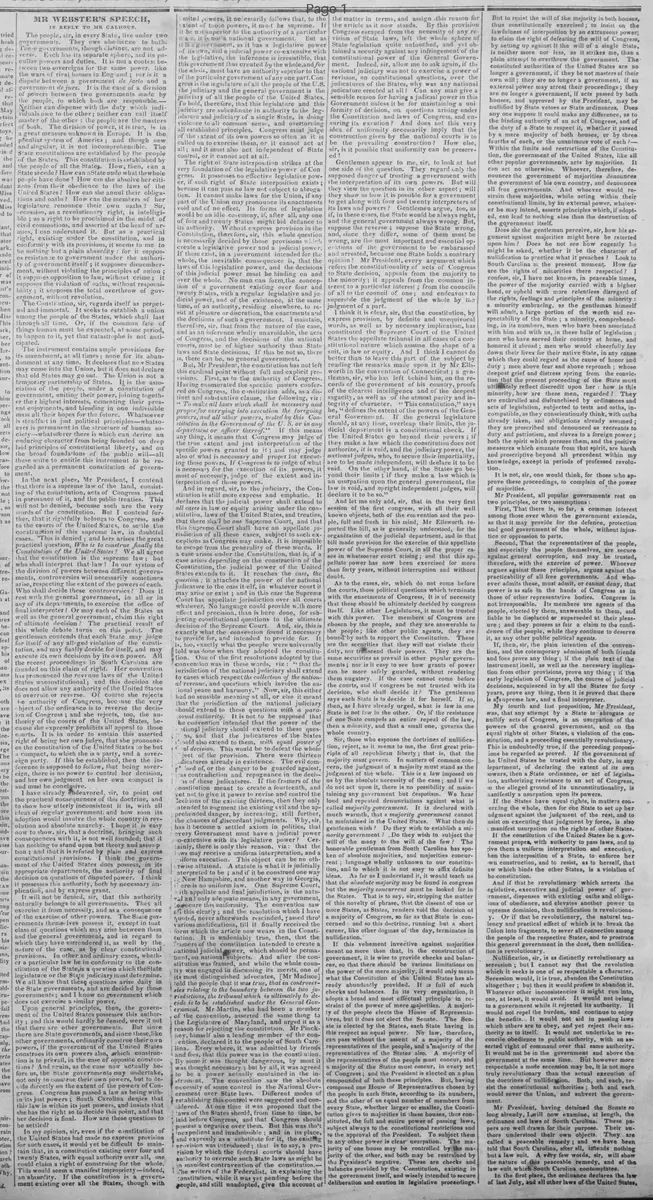
The people, sir, in every State, live under two governments. They owe obedience to both. These governments, though distinct, are not adverse. Each has its separate sphere, and its peculiar powers and duties. It is not a contest between two sovereigns for the same power, like the wars of rival houses in England; nor is it a dispute between a government de facto and a government de jure. It is the case of a division of powers between two governments made by the people, to which both are responsible.- Neither can dispense with the duty which individuals owe to the other; neither can call itself master of the other: the people are the masters of both. The division of power, it is true, is in a great measure unknown in Europe. It is the peculiar system of America; and though new and singular, it is not incomprehensible. The State constitutions are established by the people of the States. This constitution is established by the people of all the States. How, then, can a State secede? How can a State undo what the whole people have done? How can she absolve her citizens from their obedience to the laws of the United States? How can she annul their obligations and oaths? How can the members of her legislature renounce their own oaths? Sir, secession, as a revolutionary right, is intelligible; as a right to be proclaimed in the midst of civil commotions, and asserted at the head of armies, I can understand it. But as a practical right, existing under the constitution, and in conformity with its provisions, it seems to me to be nothing but a plain absurdity: for it supposes resistance to government under the authority of government itself; it supposes dismemberment, without violating the principles of union; it supposes opposition to law, without crime; it supposes the violation of oaths, without responsibility; it supposes the total overthrow of government, without revolution.
The Constitution, sir, regards itself as perpetual and immortal. It seeks to establish a union among the people of the States, which shall last through all time, Or, if the common fate of things human must be expected, at some period, to happen to it, yet that catastrophe is not anticipated. The instrument contains ample provisions for its amendment, at all times; none for its abandonment at any time. It declares that new States may come into the Union, but it does not declare that old States may go out. The Union is not a temporary partnership of States. It is the association of the people, under a constitution of government, uniting their power, joining together the highest interests, cementing their present enjoyments, and blending in one indivisible mass all their hopes for the future. Whatsoever is steadfast in just political principles--whatsoever is permanent in the structure of human society—whatsoever there is which can derive an enduring character from being founded on deep laid principles of constitutional liberty, and on the broad foundations of the public will-all these unite to entitle this instrument to be regarded as a permanent constitution of government.
In the next place, Mr President, I contend that there is a supreme law of the land, consisting of the constitution, acts of Congress passed in pursuance of it, and the public treaties. This will not be denied, because such are the very words of the constitution. But I contend further, that it rightfully belongs to Congress, and to the courts of the United States, to settle the construction of this supreme law, in doubtful cases. This is denied; and here arises the great practical question, Who is to construe finally the Constitution of the United States? We all agree that the constitution is the supreme law; but who shall interpret that law? In our system of the division of powers between different governments, controversies will necessarily sometimes arise, respecting the extent of the powers of each. Who shall decide these controversies? Does it rest with the general government, in all or in any of its departments, to exercise the office of final interpreter? Or may each of the States as well as the general government, claim this right of ultimate decision? The practical result of this whole debate turns on this point. The gentleman contends that each State may judge for itself of any alleged violation of the constitution, and may finally decide for itself, and may execute its own decisions by its own power. All the recent proceedings in South Carolina are founded on this claim of right. Her convention has pronounced the revenue laws of the United States unconstitutional: and this decision she does not allow any authority of the United States to overrule or reverse. Of course she rejects the authority of Congress, because the very object of the ordinance is to reverse the decision of Congress; and she rejects, too, the authority of the courts of the United States, because she expressly prohibits all appeal to those courts. It is in order to sustain this asserted right of being her own judge, that she pronounces the constitution of the United States to be but a compact, to which she is a party, and a sovereign party. If this be established, then the inference is supposed to follow, that being sovereign, there is no power to control her decision, and her own judgment on her own compact is and must be conclusive.
I have already endeavored, sir, to point out the practical consequences of this doctrine, and to show how utterly inconsistent it is, with all ideas of regular government, and how soon its adoption would involve the whole country in revolution and absolute anarchy. I hope it is easy now to show, sir, that a doctrine, bringing such consequences with it, is not well founded; that it has nothing to stand upon but theory and assumption; and that it is refuted by plain and express constitutional provisions. I think the government of the United States does possess, in its appropriate departments, the authority of final decision on questions of disputed power. I think it possesses this authority, both by necessary implication, and by express grant.
It will not be denied, sir, that this authority naturally belongs to all governments. They all exercise it from necessity, and as a consequence of the exercise of other powers. The State governments themselves possess it, except in that class of questions which may arise between them and the general government, and in regard to which they have surrendered it, as well by the nature of the case, as by clear constitutional provisions. In other and ordinary cases, whether a particular law be in conformity to the constitution of the State, is a question which the State legislature or the State judiciary must determine. We all know that these questions arise daily in the State governments, and are decided by those governments; and I know no government which does not exercise a similar power.
Upon general principles, then, the government of the United States possesses this authority: and this would hardly be denied, were it not that there are other governments. But since there are State governments, and since these, like other governments, ordinarily construe their own powers, if the government of the United States construes its own powers also, which construction is to prevail, in the case of opposite constructions? And again, as the case now actually before us, the State governments may undertake, not only to construe their own powers, but to decide directly on the extent of the powers of Congress. Congress has passed a law as being within its just powers; South Carolina denies that this law is within its just powers, and insists that she has the right so to decide this point, and that her decision is final. How are these questions to be settled?
In my opinion, sir, even if the constitution of the United States had made no express provision for such cases, it would yet be difficult to maintain that, in a constitution existing over four and twenty States, with equal authority over all, one could claim a right of construing for the whole. This would seem a manifest impropriety-indeed, an absurdity. If the constitution is a government existing over all the States, though with limited powers, it necessarily follows that, to the extent of those powers, it must be supreme. If it be not superior to the authority of a particular State, it is not a national government. But as it is a government, as it has a legislative power of its own, and a judicial power co-extensive with the legislative, the inference is irresistible, that this government thus created by the whole, and for the whole, must have an authority superior to that of the particular government of any one part. Congress is the legislature of all the people of the U.S. the judiciary and the general government is the judiciary of all the people of the United States. To hold, therefore, that this legislature and this judiciary are subordinate in authority to the legislature and judiciary of a single State, is doing violence to all common sense, and overturning all established principles. Congress must judge of the extent of its own powers so often as it is called on to exercise them, or it cannot act at all; and it must also act independent of State control, or it cannot act at all.
The right of State interposition strikes at the very foundation of the legislative power of Congress. It possesses no effective legislative power, if such right of State interposition exists; because it can pass no law not subject to abrogation. It cannot make laws for the Union, if any part of the Union may pronounce its enactments void and of no effect. Its forms of legislation would be an idle ceremony, if, after all, any one of four and twenty States might bid defiance to its authority. Without express provision in the Constitution, therefore, sir, this whole question is necessarily decided by those provisions which create a legislative power and a judicial power. If these exist, in a government intended for the whole, the inevitable consequence is, that the laws of this legislative power, and the decisions of this judicial power must be binding on and over the whole. No man can form the conception of a government existing over four and twenty States, with a regular legislative and judicial power, and of the existence, at the same time, of an authority, residing elsewhere, to resist at pleasure or discretion, the enactments and the decisions of such a government. I maintain, therefore, sir, that from the nature of the case, and as an inference wholly unavoidable, the acts of Congress, and the decisions of the national courts, must be of higher authority than State laws and State decisions. If this be not so, there is, there can be, no general government.
But, Mr President, the constitution has not left this cardinal point without full and explicit provisions. First, as to the authority of Congress. Having enumerated the specific powers conferred on Congress, the constitution adds, as a distinct and substantive clause, the following, viz: "To make all laws which shall be necessary and proper for carrying into execution the foregoing powers, and all other powers, vested by this Constitution in the Government of the U. S. or in any department or officer thereof." If this means any thing, it means that Congress may judge of the true extent and just interpretation of the specific powers granted to it; and may judge also of what is necessary and proper for executing those powers. If Congress is to judge of what is necessary for the execution of its powers, it must of necessity, judge of the extent and interpretation of those powers.
And in regard, sir, to the judiciary, the Constitution is still more express and emphatic. It declares that the judicial power shall extend to all cases in law or equity arising under the constitution, laws of the United States, and treaties, that there shall be one Supreme Court, and that this Supreme Court shall have an appellate jurisdiction of all these cases, subject to such exceptions as Congress may make. It is impossible to escape from the generality of these words. If a case arises under the Constitution, that is, if a case arises depending on the construction of the Constitution, the judicial power of the United States extends to it. It reaches the case, the question; it attaches the power of the national judicature to the case itself, in whatever court it may arise or exist; and in this case the Supreme Court has appellate jurisdiction over all courts whatever. No language could provide with more effect and precision, than is here done, for subjecting constitutional questions to the ultimate decision of the Supreme Court. And, sir, this is exactly what the convention found it necessary to provide for, and intended to provide for. It is, too, exactly what the people were universally told was done when they adopted the constitution. One of the first resolutions adopted by the convention was in these words, viz: "that the jurisdiction of the national judiciary shall extend to cases which respect the collection of the national revenue, and questions which involve the national peace and harmony." Now, sir, this either had no sensible meaning at all, or else it meant that the jurisdiction of the national judiciary should extend to these questions with a paramount authority. It is not to be supposed that the convention intended that the power of the national judiciary should extend to these questions, and that the judicatures of the States should also extend to them, with equal power of final decision. This would be to defeat the whole object of the provision. There were thirteen judicatures already in existence. The evil complained of, or the danger to be guarded against, was contradiction and repugnance in the decisions of these judicatures. If the framers of the constitution meant to create a fourteenth, and yet not to give it power to revise and control the decisions of the existing thirteen, then they only intended to augment the existing evil and the apprehended danger, by increasing, still further, the chances of discordant judgments. Why, sir, has it become a settled axiom in politics, that every Government must have a judicial power co-extensive with its legislative power? Certainly, there is only this reason, viz: that the laws may receive a uniform interpretation, and a uniform execution. This object can be no otherwise attained. A statute is what it is judicially interpreted to be; and if it be construed one way in New Hampshire, and another way in Georgia, there is no uniform law. One Supreme Court, with appellate and final jurisdiction, is the natural and only adequate means, in any government, to secure thus uniformity. The convention saw all this clearly; and the resolution which I have quoted, never afterwards rescinded, passed through various modifications, till it finally received the form which the article now wears in the Constitution. It is undeniably true, then, that the framers of the constitution intended to create a national judicial power, which should be paramount, on national subjects. And after the constitution was framed, and while the whole country was engaged in discussing its merits, one of its most distinguished advocates, [Mr Madison] told the people that it was true, that in controversies relating to the boundary between the two jurisdictions, the tribunal which is ultimately to decide is to be established under the General Government. Mr Martin, who had been a member of the convention, asserted the same thing to the Legislature of Maryland, and urged it as a reason for rejecting the constitution. Mr Pinckney, himself also a leading member of the convention, declared it to the people of South Carolina. Every where, it was admitted by friends and foes, that this power was in the constitution. By some it was thought dangerous, by most it was thought necessary; but by all, it was agreed to be a power actually contained in the instrument. The convention saw the absolute necessity of some control in the National Government over State laws. Different modes of establishing this control were suggested and considered. At one time it was proposed that the laws of the States should, from time to time, be laid before Congress, and that Congress should possess a negative over them. But this was thought inexpedient and inadmissible; and in its place, and expressly as a substitute for it, the existing provision was introduced: that is to say, a provision by which the federal courts should have authority to overrule such State laws as might be in manifest contravention of the constitution.— The writers of the Federalist, in explaining the constitution, while it was yet pending before the people, and still unadopted, give this account of the matter in terms, and assign this reason for the article as it now stands. By this provision Congress escaped from the necessity of any revision of State laws, left the whole sphere of State legislation quite untouched, and yet obtained a security against any infringement of the constitutional power of the General Government. Indeed, sir, allow me to ask again, if the national judiciary was not to exercise a power of revision, on constitutional questions, over the judicatures of the States, why was any national judicature erected at all? Can any man give a sensible reason for having a judicial power in this Government unless it be for maintaining a uniformity of decision, on questions arising under the Constitution and laws of Congress, and ensuring its execution? And does not this very idea of uniformity necessarily imply that the construction given by the national courts is to be the prevailing construction? How else, sir, is it possible that uniformity can be preserved?
Gentlemen appear to me, sir, to look at but one side of the question. They regard only the supposed danger of trusting a government with the interpretation of its own powers. But will they view the question in its other aspect; will they show us how it is possible for a government to get along with four and twenty interpreters of its laws and powers? Gentlemen argue, too, as if, in these cases, the State would be always right, and the general government always wrong. But, suppose the reverse; suppose the State wrong, and, since they differ, some of them must be wrong, are the most important and essential operations of the government to be embarrassed and arrested, because one State holds a contrary opinion? Mr President, every argument which refers the constitutionality of acts of Congress to State decision, appeals from the majority to the minority; it appeals from the common interest to a particular interest; from the councils of all to the council of one; and endeavors to supersede the judgment of the whole by the judgment of a part.
I think it is clear, sir, that the constitution, by express provision, by definite and unequivocal words, as well as by necessary implication, has constituted the Supreme Court of the United States the appellate tribunal in all cases of a constitutional nature which assume the shape of a suit, in law or equity. And I think I cannot do better than to leave this part of the subject by reading the remarks made upon it by Mr Ellsworth in the convention of Connecticut; a gentleman, sir, who has left behind him, on the records of the government of his country, proofs of the clearest intelligence and of the deepest sagacity, as well as of the utmost purity and integrity of character. "This constitution," says he, "defines the extent of the powers of the General Government. If the general legislature should, at any time, overleap their limits, the judicial department is a constitutional check. If the United States go beyond their powers; if they make a law which the constitution does not authorize, it is void, and the judiciary power, the national judges, who, to secure their impartiality, are to be made independent, will declare it to be void. On the other hand, if the States go beyond their limits; if they make a law which is an usurpation upon the general government, the law is void, and upright independent judges, will declare it to be so."
And let me only add, sir, that in the very first session of the first congress, with all their well known objects, both of the convention and the people, full and fresh in his mind, Mr Ellsworth reported the bill, as is generally understood, for the organization of the judicial department, and in that bill made provision for the exercise of this appellate power of the Supreme Court, in all the proper cases in whatsoever court arising; and that this appellate power has now been exercised for more than forty years, without interruption and without doubt.
As to the cases, sir, which do not come before the courts, those political questions which terminate with the enactments of Congress, it is of necessity that these should be ultimately decided by congress itself. Like other Legislatures, it must be trusted with this power. The members of Congress are chosen by the people, and they are answerable to the people; like other public agents, they are bound by oath to support the Constitution. These are the securities that they will not violate their duty, nor transcend their powers. They are the same securities as prevail in other popular governments; nor is it easy to see how grants of power can be more safely guarded, without rendering them nugatory. If the case cannot come before the courts, and if congress be not trusted with its decision, who shall decide it? The gentleman says each State is to decide it for herself. If so, then, as I have already urged, what is law in one State is not law in the other. Or, if the resistance of one State compels an entire repeal of the law, then a minority, and that a small one, governs the whole country.
Sir, those who espouse the doctrines of nullification, reject, as it seems to me, the first great principle of all republican liberty; that is, that the majority must govern. In matters of common concern, the judgment of a majority must stand as the judgment of the whole. This is a law imposed on us by the absolute necessity of the case: and if we do not act upon it, there is no possibility of maintaining any government but despotism. We hear loud and repeated denunciations against what is called majority government. It is declared with much warmth, that a majority government cannot be maintained in the United States. What then do gentlemen wish? Do they wish to establish a minority government? Do they wish to subject the will of the many to the will of the few? The honorable gentleman from South Carolina has spoken of absolute majorities, and majorities concurrent; language wholly unknown to our constitution, and to which it is not easy to affix definite ideas. As far as I understand it, it would teach us that the absolute majority may be found in congress but the majority concurrent must be looked for in the States. That is to say, sir, stripping the matter of this novelty of phrase, that the dissent of one or more States, as States, renders void the decision of a majority of Congress, so far as that State is concerned: and so this doctrine, running but a short career, like other dogmas of the day, terminates in nullification.
If this vehement invective against majorities meant no more than that, in the construction of government, it is wise to provide checks and balances, so that there should be various limitations on the power of the mere majority, it would only mean what the Constitution of the United States has already abundantly provided. It is full of such checks and balances. In its very organization, it adopts a broad and most effectual principle in restraint of the power of mere majorities. A majority of the people elects the House of Representatives, but it does not elect the Senate. The Senate is elected by the States, each State having in this respect an equal power. No law, therefore, can pass without the assent of a majority of the representatives of the people, and a majority of the representatives of the States also. A majority of the representatives of the people must concur, and a majority of the States must concur, in every act of Congress; and the President is elected on a plan compounded of both these principles. But, having composed one House of Representatives chosen by the people in each State, according to its numbers, and the other of an equal number of members from every State, whether larger or smaller, the Constitution gives to majorities in these houses, thus constituted, the full and entire power of passing laws, subject always to the constitutional restrictions and to the approval of the President. To subject them to any other power is clear usurpation. The majority of one house may be controlled by the majority of the other, and both may be restrained by the President's negative. These are checks and balances provided by the Constitution, existing in the government itself, and wisely intended to secure deliberation and caution in legislative proceedings.
But to resist the will of the majority in both houses, thus constitutionally exercised; to insist on the lawfulness of interposition by an extraneous power; to claim the right of defeating the will of Congress, by setting up against it the will of a single State, is neither more nor less, as it strikes me, than a plain attempt to overthrow the government. The constituted authorities of the United States are no longer a government, if they be not masters of their own will; they are no longer a government, if an external power may arrest their proceedings; they are no longer a government, if acts passed by both houses, and approved by the President, may be nullified by State vetoes or State ordinances. Does any one suppose it could make any difference, as to the binding authority of an act of Congress, and of the duty of a State to respect it, whether it passed by a mere majority of both houses, or by three fourths of each, or the unanimous vote of each? Within the limits and restrictions of the Constitution, the government of the United States, like all other popular governments, acts by majorities. It can act no otherwise. Whoever, therefore, denounces the government of majorities denounces the government of his own country, and denounces all free governments. And whoever would restrain these majorities, while acting within their constitutional limits, by an external power, whatever he may intend, asserts principles which, if adopted, can lead to nothing else than the destruction of the government itself.
Does not the gentleman perceive, sir, how his argument against majorities might here be retorted upon him? Does he not see how cogently he might be asked, whether it be the character of nullification to practice what it preaches? Look to South Carolina at the present moment. How far are the rights of minorities there respected? I confess, sir, I have not known, in peaceable times, the power of the majority carried with a higher hand, or upheld with more relentless disregard of the rights, feelings and principles of the minority: a minority embracing, as the gentleman himself will admit, a large portion of the worth and respectability of the State; a minority, comprehending, in its numbers, men who have been associated with him and with us, in these halls of legislation; men who have served their country at home, and honored it abroad; men who would cheerfully lay down their lives for their native State, in any cause which they could regard as the cause of honor and duty; men above fear and above reproach; whose deepest grief and distress spring from the conviction that the present proceeding of the State must ultimately reflect discredit upon her: how is this minority, how are these men, regarded? They are enthralled and disfranchised by ordinances and acts of legislation, subjected to tests and oaths, incompatible, as they conscientiously think, with oaths already taken, and obligations already assumed; they are proscribed and denounced as recreants to duty and patriotism, and slaves to a foreign power; both the spirit which pursues them, and the positive measures which emanate from that spirit, are harsh and proscriptive beyond all precedent within my knowledge, except in periods of professed revolution.
It is not, sir, one would think, for those who approve these proceedings, to complain of the power of majorities.
Mr President, all popular governments rest on two principles, or two assumptions:
First, That there is, so far, a common interest among those over whom the government extends, as that it may provide for the defence, protection and good government of the whole, without injustice or oppression to parts.
Second, That the representatives of the people, and especially the people themselves, are secure against general corruption, and may be trusted, therefore, with the exercise of power. Whoever argues against these principles, argues against the practicability of all free governments. And whoever admits these, must admit, or cannot deny, that power is as safe in the hands of Congress as in those of other representative bodies. Congress is not irresponsible. Its members are agents of the people, elected by them, answerable to them, and liable to be displaced or superseded at their pleasure; and they possess as fair a claim to the confidence of the people, while they continue to deserve it, as any other public political agents.
If, then, sir, the plain intention of the convention, and the cotemporary admission of both friends and foes prove any thing; if the plain text of the instrument itself, as well as the necessary implication from other provisions, prove any thing; if the early legislation of Congress, the course of judicial decisions, acquiesced in by all the States for forty years, prove any thing, then it is proved that there is a supreme law, and a final interpreter.
My fourth and last proposition, Mr President, was, that any attempt by a State to abrogate or nullify acts of Congress, is a usurpation of the powers of the general government, and on the equal rights of other States, a violation of the constitution, and a proceeding essentially revolutionary. This is undoubtedly true, if the preceding propositions be regarded as proved. If the government of the United States be trusted with the duty, in any department, of declaring the extent of its own powers, then a State ordinance, or act of legislation, authorizing resistance to an act of Congress, in the alleged ground of its unconstitutionality, is manifestly a usurpation upon its powers.
If the States have equal rights, in matters concerning the whole, then for one State to set up her judgment against the judgment of the rest, and to insist on executing that judgment by force, is also manifest usurpation on the rights of other States.
If the constitution of the United States be a government proper, with authority to pass laws, and to give them a uniform interpretation and execution, then the interposition of a State, to enforce her own construction, and to resist, as to herself, that law which binds the other States, is a violation of the constitution.
And if that be revolutionary which arrests the legislative, executive and judicial power of government, dispenses with existing oaths and obligations of obedience, and elevates another power to supreme dominion, then nullification is revolutionary. Or if that be revolutionary, the natural tendency and practical effect of which is to break the Union into fragments, to sever all connection among the people of the respective States, and to prostrate this general government in the dust, then nullification is revolutionary.
Nullification, sir, is as distinctly revolutionary as secession; but I cannot say that the revolution which it seeks is one of so respectable a character. Secession would, it is true, abandon the Constitution altogether; but then it would profess to abandon it. Whatever other inconsistencies it might run into, one, at least, it would avoid. It would not belong to a government while it rejected its authority. It would not repel the burden, and continue to enjoy the benefits. It would not aid in passing laws which others are to obey, and yet reject their authority as to itself. It would not undertake to reconcile obedience to public authority, with an asserted right of command over that same authority. It would not be in the government and above the government at the same time. But however more respectable a mode secession may be, it is not more truly revolutionary than the actual execution of the doctrines of nullification. Both, and each, resist the constitutional authorities: both and each would sever the Union, and subvert the government.
Mr President, having detained the Senate so long already, I will now examine, at length, the ordinance and laws of South Carolina. These papers are well drawn for their purpose. Their authors understood their own objects. They are called a peaceable remedy; and we have been told that South Carolina, after all, intends nothing but a law suit. A very few words, sir, will show the nature of this peaceable remedy, and of the law suit which South Carolina contemplates.
In the first place, the ordinance declares the law of last July, and all other laws of the United States,
laying duties, to be absolutely null and void, and makes it unlawful for the constituted authorities of the United States to enforce the payment of such duties. It is, therefore, sir, an indictable offence, at this moment, in South Carolina, for any person to be concerned in collecting revenue, under the laws of the United States. It being declared unlawful to collect these duties by what is considered a fundamental law of the State, an indictment lies of course against any one concerned in such collection, and he is, on general principles, liable to be punished by fine and imprisonment. The terms, it is true, are that it is unlawful "to enforce the payment of duties ;" but every custom-house officer enforces payment while he detains the goods, in order to obtain such payment. The ordinance, therefore, reaches every body concerned in the collection of the duties.
This is the first step in the prosecution of the peaceable remedy. The second is more decisive. By the act commonly called the replevin law, any person whose goods are seized or detained by the collector for the payment of duties, may serve out a writ of replevin, and by virtue of that writ the goods are to be restored to him. A writ of replevin is a writ which the sheriff is bound to execute, and for the execution of which he is bound to employ force if necessary. He may call out the posse, and must do so, if resistance be made. This posse may be armed or unarmed. It may come forth with military array, and under the lead of military men. Whatever number of troops may be assembled in Charleston, they may be summoned, with the governor, or commander-in-chief, at their head, to come in aid of the sheriff. It is evident then, sir, that the whole military power of the State is to be employed whenever necessary, in dispossessing the custom house officers, and in seizing and holding the goods without paying the duties. This is the second step in the peaceable remedy.
Sir, whatever pretenses may be set up to the contrary, this is the direct application of force, and of military force. It is unlawful, in itself, to replevy goods in the custody of the collectors: but this unlawful act is to be done, and it is to be done by power. Here is a plain interposition, by physical force, to resist the laws of the Union. The legal mode of collecting duties is to detain goods till such duties are paid or secured. But force comes and overpowers the collector and his assistants, and takes away the goods, leaving the duties unpaid. There cannot be a clearer case of forcible resistance to law. And it is provided that the goods thus seized shall be held against any attempt to retake them, by the same force which seized them.
Having thus dispossessed the officers of the government of the goods, without payment of duties, and seized and secured them by the strong arm of the State, only one thing more remained to be done, and that is, to cut off all possibility of legal redress; and that too is accomplished, or thought to be accomplished. The ordinance decrees, that all judicial proceedings founded on the revenue laws, (including, of course, proceedings in the courts of the United States) shall be null and void. This nullifies the judicial power of the United States. Then comes the test oath act. This requires all State judges and jurors in the State courts to swear that they will execute the ordinance, and all acts of the legislature, passed in pursuance thereof. The ordinance declares, that no appeal shall be allowed from the decision of the State courts to the Supreme Court of the United States; and the replevin act makes it an indictable offence for any clerk to furnish a copy of the record for the purpose of such appeal.
The two principal provisions on which South Carolina relies, to resist the laws of the United States, and nullify the authority of this government, are, therefore, these:
1. A forcible seizure of goods before the duties are paid or secured, by the power of the State, civil and military.
2. The taking away, by the most effectual means in her power, of all legal redress in the courts of the United States; the confining all judicial proceedings to her own State tribunals, and the compelling of judges and jurors of these her own courts, to take an oath before hand, that they will decide all cases according to the ordinance, and the acts passed under it; that is, that they will decide the cause one way. They do not swear to try it on its own merits; they only swear to decide it as nullification requires.
The character, sir, of these provisions, defies comment. Their object is as plain as their means are extraordinary. They propose direct resistance, by the whole power of the State, to laws of Congress, to cut off, by methods deemed adequate, any redress by legal and judicial authority. They arrest legislation, defy the executive, and banish the judicial power of this government. They authorize and command acts to be done, and done by force, both of numbers and of arms, which if done, and done by force, are clearly acts of rebellion and treason.
Such, sir, are the laws of South Carolina; such, sir, is the peaceable remedy of nullification. Has not nullification reached, sir, even thus early, that point of direct and forcible resistance to law, to which I intimated, three years ago, it plainly tended?
And now, Mr President, what is the reason for passing laws like these? What are the oppressions experienced under the Union, calling for measures which thus threaten to sever and destroy it? What invasions of public liberty, what ruin to private happiness, what long list of rights violated, or wrongs unredressed, is to justify to the country, to posterity and to the world, this assault upon the free constitution of the United States, this great and glorious work of our fathers? At this very moment, sir, the whole land smiles in peace and rejoices in plenty. A general and a high prosperity pervades the country; and, judging by the common standard, by increase of population and wealth, or judging by the opinions of that portion of her people not embarked in those dangerous and desperate measures, this prosperity overspreads South Carolina herself.
Thus happy at home, our country, at the same time, holds high the character of her institutions, her power, her rapid growth, and her future destiny, in the eyes of all foreign States. One danger, only, creates hesitation; one doubt only exists to darken the otherwise unclouded brightness of that aspect, which she exhibits to the view and to the admiration of the world. Need I say that that doubt respects the permanency of our Union; and need I say, that that doubt is now caused, more than by any thing else, by these very proceedings of South Carolina? Sir, all Europe is at this moment beholding us, and looking for the issue of this controversy; those who hate free institutions with malignant hope; those who love them, with deep anxiety and shivering fear.
The cause, then, sir, the cause! Let the world know the cause which has thus induced one State of the Union to bid defiance to the power of the whole, and openly to talk of secession.
Sir, the world will scarcely believe that this whole controversy, and all the desperate measures which its support requires, have no other foundation than a difference of opinion upon a provision of the constitution, between a majority of the people of South Carolina, on one side, and a vast majority of the whole people of the United States on the other. It will not credit the fact, it will not admit the possibility that in an enlightened age, in a free, popular republic, under a government where the people govern, as they must always govern, under such systems, by majorities; at a time of unprecedented happiness, without practical oppression, without evils, such as may not only be pretended, but felt and experienced; evils, not slight or temporary, but deep, permanent and intolerable; a single State should rush into conflict with all the rest, attempt to put down the power of the Union by her own laws, and to support those laws by her military power, and thus break up and destroy the world's last hope. And well the world may be incredulous. We who hear and see it, can ourselves hardly yet believe it. Even after all that had preceded it, this ordinance struck the country with amazement.
It was incredible and inconceivable that South Carolina should thus plunge headlong into resistance to the laws, on a matter of opinion, and on a question too on which the preponderance of opinion was so overwhelmingly against her. The ordinance declares that Congress has exceeded its just power by laying duties on imports, intended for the protection of manufactures. This is the opinion of South Carolina, and on the strength of that opinion she nullifies the laws. Yet has the rest of the country no right to its opinions also? Is one State to sit sole arbitress? She maintains that those laws are plain, deliberate and palpable violations of the constitution; that she has a sovereign right to decide this matter; and that having so decided, she is authorized to resist their execution by her own sovereign power; and she declares that she will resist it, though such resistance should shatter the Union into atoms.
Mr President, I do not intend to discuss the propriety of these laws at large; but I will ask, how are they shown to be thus plainly and palpably unconstitutional? Have they no countenance at all in the constitution itself? Are they quite new in the history of the government? Are they a sudden and violent usurpation on the rights of the States? Sir, what will the civilized world say, what will posterity say, when they learn that similar laws have existed from the very foundation of the government; that for thirty years the power was never questioned; and that no State in the Union has more freely and unequivocally admitted it than South Carolina herself:
To lay and collect duties and imposts, is an express power, granted by the Constitution to Congress. It is, also, an exclusive power; for the Constitution as expressly prohibits all the States from exercising it themselves. This express and exclusive power is unlimited in the terms of the grant, but is attended with two specific restrictions -first, that all duties and imposts shall be equal in all the States; second, that no duties shall be laid on exports. The power, then, being granted, and being attended with these two restrictions and no more, who is to impose a third restriction on the general words of the grant? If the power to lay duties as known among all other nations, and as known in all our history, and as it was perfectly understood when the Constitution was adopted, includes a right of discriminating, while exercising the power, and of laying some duties heavier and some lighter, for the sake of encouraging our own domestic products, what authority is there for giving to the words used in the Constitution a new, narrow and unusual meaning? All the limitations which the Constitution intended it has expressed, and what it has left unrestricted is as much a part of its will as the restraints which it has imposed.
But these laws, it is said, are unconstitutional on account of the motive. How, sir, can a law be examined on any such ground? How is the motive to be ascertained? One house, or one member, may have one motive: the other house, or another member, another. One motive may operate to-day, and another to-morrow. Upon any such mode of reasoning as this, one law might be unconstitutional now, and another law, in exactly the same words, perfectly constitutional next year. Besides, articles may not be taxed, for the purpose of protecting home products, but other articles may be left free, for the same purpose, and with the same motive. A law, therefore, would become unconstitutional from what it omitted as well as what it contained. Mr President, it is a settled principle, acknowledged in all legislative halls, recognized before all tribunals, sanctioned by the general sense and understanding of mankind, that there can be no inquiry into the motives of those who pass laws, for the purpose of determining on their validity. If the law be within the fair meaning of the words in the grant of the power, its authority must be admitted until it is repealed. This rule, everywhere acknowledged, everywhere admitted, is so universal, and so completely without exception, as that even an allegation of fraud, in the majority of a legislature, is not allowed as a ground to set aside a law.
But, sir, is it true, that the motive for these laws is such as is stated? I think not. The great object of all these laws is, unquestionably, Revenue. If there were no occasion for revenue, the laws would not have been passed: and it is notorious that almost the entire revenue of the country is derived from them. And as yet we have collected none too much revenue. The treasury has not been more exhausted for many years than at the present moment. All that South Carolina can say is that in passing the laws which she now undertakes to nullify, particular articles were taxed from a regard to the protection of domestic articles, higher than they would have been had no such regard been entertained. And she insists that, according to the Constitution no such discrimination can be allowed; that duties should be laid for revenue, and revenue only; and that it is unlawful to have reference, in any case, to protection. In other words, she denies the power of DISCRIMINATION. She does not, and cannot, complain of excessive taxation; on the contrary, she professes to be willing to pay any amount of revenue merely as revenue; and up to the present moment there is no surplus revenue. Her grievance, then, that plain and palpable violation of the Constitution, which she insists has taken place, is simply the exercise of the power of DISCRIMINATION. Now, sir, is the exercise of this power of discrimination plainly and palpably unconstitutional? I have already said the power to lay duties is given by the Constitution in broad and general terms. There is also conferred on Congress the whole power of regulating commerce in another distinct provision. Is it clear and palpable, sir, can any man say it is a case beyond doubt, that under these two powers Congress may not justly discriminate in laying duties, for the purpose of countervailing the policy of foreign nations, or of favoring our own home productions?
Sir, what ought to conclude this question, forever as it would seem to me, is, that the regulation of commerce, and the imposition of duties are in all commercial nations, powers avowedly and constantly exercised for this very end. That undeniable truth ought to settle the question; because the constitution ought to be considered, when it uses well known language, as using it in its well known sense. But it is equally undeniable that it has been from the very first fully believed that this power of discrimination, was conferred on Congress; and the constitution was itself recommended, urged upon the people, and enthusiastically insisted on, in some of the States, for that very reason. Not that at that time, the country was extensively engaged in manufactures, especially of those kinds now existing. But the trades and crafts of the seaport towns, the business of the artisans, and manual laborers, these employments, the work of which supplies so great a portion of the daily wants of all classes, all these looked to the new constitution as a source of relief from the severe distress which followed the war. It would sir, be unpardonable, at so late an hour, to go into details on this point; but the truth is as I have stated. The papers of the day, the resolutions of public meetings, the debates in the conventions, all that we open our eyes upon, in the history of the times, prove it.
The honorable gentleman, sir, from South Carolina, has referred to two incidents connected with the proceedings of the convention at Philadelphia, which he thinks are evidence to show that the power of protecting manufactures, by laying duties, and by commercial regulations, was not intended to be given by Congress. The first is, as he says, that a power to protect manufactures was expressly proposed but not granted. I think, sir, the gentleman is quite mistaken in relation to this part of the proceedings of the convention. The whole history of the occurrence to which he alludes is simply this: Toward the conclusion of the convention, after the provisions of the constitution had been mainly agreed upon, after the power to lay duties and the power to regulate commerce had both been granted, a long list of propositions was made, and referred to the committee, containing various miscellaneous powers, some or all of which it was thought might be properly vested in Congress. Among these, was a power to establish a university; to grant charters of incorporations; to regulate stage coaches on the post roads: and also the power to which the gentleman refers, and which is expressed in these words: "To establish public institutions, rewards and immunities, for the promotion of agriculture, commerce, trades, & manufactures." The committee made no report on this or various other propositions in the same list. But the only inference from this omission is, that neither the committee nor the convention thought it proper to authorize Congress "to establish public institutions, rewards and immunities" for the promotion of manufactures and other interests. The convention supposed it had done enough, at any rate it had done all it had intended, when it had given to Congress, in general terms, the power to lay imposts, and the power to regulate trade. It is not to be argued, from its omission to give more, that it meant to take back what it had already given. It had given the impost power; it had given the regulation of trade; and it did not deem it necessary to give it the further and distinct power of establishing public institutions.
The other fact, sir, on which the gentleman relies, is the declaration of Mr Martin, to the legislature of Maryland. The gentleman supposes Mr Martin to have urged against the constitution that it did not contain the power of protection. But, if the gentleman will look again at what Mr Martin said, he will find, I think, that what Mr Martin complained of was, that the constitution, by its prohibition on the States, had taken away from the States the power of protecting their own manufactures by duties on imports. This is undoubtedly true; but I find no expression of Mr Martin intimating that the constitution had not conferred on Congress the same power which it had thus taken from the States.
But, sir, let us go to the first Congress; let us look in upon this and the other house, at the first session of their organization. We see in both houses men distinguished among the framers, friends and advocates of the constitution. We see in both, those who had drawn, discussed, and matured the instrument, in the convention, explained and defended it before the people, and were now elected members of Congress to put the new government into motion, and to carry the powers of the constitution into beneficial execution. At the head of the government was Washington himself, who had been President of the convention, and in his cabinet were others most thoroughly acquainted with the history of the constitution, and distinguished for the part taken in its discussion. If these persons were not acquainted with the meaning of the constitution; if they did not understand the work of their own hand, who can understand it, or who shall now interpret it to us?
Sir, the volume which records the proceedings and debates of the first session of the house of representatives lies before me. I open it, and I find that having provided for the administration of the necessary oaths, the very first measure proposed for consideration is, the laying of imposts; and in the very first committee of the whole into which the house of representatives ever resolved itself, on this its earliest subject, and in this its very first debate, the duty of so laying the imposts as to encourage manufactures was advanced, and enlarged upon by almost every speaker; and doubted or denied by none. The first gentleman who suggests this as the clear duty of Congress, and as an object necessary to be attended to, is Mr Fitzsimons, of Pennsylvania; the second Mr White, of Virginia; the third Mr Tucker, of South Carolina.
But the great leader, sir, on this occasion, was Mr Madison. Was he likely to know the intentions of the convention and the people? Was he likely to understand the constitution? At the second sitting of the committee, Mr Madison explained his own opinions of the duty of Congress fully and explicitly. I must not detain you, sir, with more than a few short extracts from these opinions, but they are such as are clear, intelligible and decisive.
"The States," says he, "that are most advanced in population, and ripe for manufactures, ought to have their particular interest attended to, in some degree." While these States retained the power of making regulations of trade, they had the power to cherish such institutions. By adopting the present constitution, they have thrown the exercise of this power into other hands; they must have done this with an expectation that those interests would not be neglected here."
In another report of the same speech, Mr Madison is represented as using still stronger language; as saying that the constitution, having taken this power away from the States, and conferred it on Congress, it would be a fraud on the States and on the people, were Congress to refuse to exercise it.
Mr Madison argues, sir, on this early and interesting occasion, very justly and liberally in favor of the general principles of unrestricted commerce. But he argues also, with equal force and clearness, for certain important exceptions to these general principles.
The first, sir, respects those manufactures which had been brought forward under encouragement by the State Governments. "It would be cruel," says Mr Madison, "to neglect them, and to divert their industry into other channels, for it is not possible for the hand of man to shift from one employment to another without being injured by the change." Again: "There may be some manufactures which, being once formed, can advance towards perfection without any adventitious aid: while others for want of the fostering hand of Government will be unable to go on at all. Legislative provision, therefore, will be necessary to collect the proper objects for this purpose; and this will form another exception to my general principle." And again:
"The next exception that occurs is one on which great stress is laid by some well informed men, and this with great plausibility; that each nation should have, within itself, the means of defence, independent of foreign supplies; that, in whatever relates to the operations of war, no State ought to depend upon a precarious supply from any part of the world. There may be some truth in this remark, and therefore it is proper for legislative attention."
In the same debate, sir, Mr Burke, from South Carolina, supported a duty on hemp, for the express purpose of encouraging its growth on the strong lands of South Carolina. "Cotton," he said was also in contemplation among them, and if good seed could be procured, he hoped might succeed." Afterwards, sir, the cotton seed was obtained, its culture was protected, and it did succeed. Mr Smith, a very distinguished member from that State, observed: "It has been said, and justly, that the State which adopted this constitution expected its administration would be conducted with a favorable hand. The manufacturing States wished the encouragement of manufactures: the maritime States the encouragement of ship building; and the agricultural States the encouragement of agriculture."
Sir, I will detain the Senate by reading no more extracts from these debates. I have already shown a majority of the members of South Carolina, in this very first session, acknowledging this power of protection, voting for its exercise, and proposing its extension to their own products. Similar propositions came from Virginia; and indeed, sir, in the whole debate, at whatever page you open the volume, you find the power admitted, and you find it applied to the protection of particular articles, or not applied, according to the discretion of Congress. No man denied the power-no man doubted it; the only questions were, in regard to the several articles proposed to be taxed, whether they were fit subjects for protection, and what the amount of that protection ought to be. Will gentlemen, sir, now answer the argument drawn from those proceedings of the first Congress? Will they undertake to deny that that Congress did act on the avowed principle of protection? Or, if they admit it, will they tell us how those who framed the Constitution fell thus early into this great mistake about its meaning? Will they tell us how it should happen that they had so soon forgotten their own sentiments and their own purposes? I confess I have seen no answer to this argument, nor any respectable attempt to answer it. And, sir, how did this debate terminate? What law was passed? There it stands, sir, among the statutes, the second law in the book. It has a preamble, and that preamble expressly recites, that the duties which it imposes are laid "for the support of government, for the discharge of the debts of the United States, and the encouragement and protection of manufactures." Until, sir, this early legislation, this co-equal with the Constitution itself, thus full and explicit, can be explained away, no man can doubt of the meaning of that instrument.
Mr President, this power of discrimination, thus admitted, avowed and practised upon, in the first revenue act, has never been denied or doubted until within a few years past. It was not at all doubted, in 1816, when it became necessary to adjust the revenue to a state of peace. On the contrary, the power was then exercised, not without opposition as to its expediency; but as far as I remember, or have understood, without the slightest opposition founded on any supposed want of constitutional authority. Certainly, South Carolina did not doubt it. The Tariff of 1816 was introduced, carried through and established under the lead of South Carolina. Even the minimum policy is of South Carolina origin. The honorable gentleman himself supported, and ably supported, the tariff of 1816. He has informed us, sir, that his speech on that occasion was sudden and off-hand, he being called upon by the request of a friend. I am sure the gentleman so remembers it, and that it was so: but there is nevertheless, much method, arrangement and clear exposition in that extempore speech. It is very able; very much to the point, very decisive. And in another speech, delivered two months earlier, on the proposition to repeal the internal taxes, the honorable gentleman had touched the same subject, and had declared, "that a certain encouragement ought to be extended at least to our woollen and cotton manufactures."
I do not quote these speeches, sir, for the purpose of showing that the honorable gentleman has changed his opinion; my object is other, and higher. I do it for the sake of saying, that that cannot be so plainly and palpably unconstitutional, as to warrant resistance to law, nullification, and revolution, which the honorable gentleman and his friends have heretofore agreed to, and acted upon, without doubt and without hesitation. Sir, it is no answer to say, that the tariff of 1816 was a revenue bill. So are they all revenue bills. The point is, and the truth is, that the tariff of 1816, like the rest, did discriminate, it did distinguish one article from another; it did lay duties for protection. Look to the case of coarse cottons; under the minimum calculation, the duty on these was sixty to eighty per cent. Something besides revenue certainly was intended in this; and, in fact, the law cut up our whole commerce with India in that article. It is, sir, only within a few years that Carolina has denied the constitutionality of these protective laws. The gentleman himself has narrated to us the true history of her proceedings on this point. He says that, after the passing of the law of 1828, despairing then of being able to abolish the system of protection, political men went forth among the people, and set up the doctrine that the system was unconstitutional. "And the People," says the honorable gentleman, "received the doctrine." This, I believe is true, sir. The people did then receive the doctrine; they had never entertained it before. Down to that period, the constitutionality of these laws had been no more doubted in South Carolina, than elsewhere. And I suspect it is true, sir, and I deem it a great misfortune, that, to the present moment, a great portion of the people of the State have never yet seen more than one side of the argument. I believe that thousands of honest men are involved in scenes now passing, led away by one sided views of the question, and following their leaders by the impulses of an unlimited confidence. Depend upon it, sir, if we can avoid the shock of arms, a day for reconsideration and reflection will come; truth and reason will act with their accustomed force, and the public opinion of South Carolina will be restored to its usual constitutional and patriotic tone.
But, sir, I hold South Carolina to her ancient, her cool, her uninfluenced, her deliberate opinions. I hold her to her own admissions, nay, to her own claims and pretensions, in 1789, in the first congress, and to her acknowledgments and avowed sentiments through a long series of succeeding years. I hold her to the principles on which she led congress to act in 1816; or if she has changed her own opinions, I claim some respect for those who still retain the same opinions. I say she is precluded from asserting that doctrines which she has herself so long and so ably sustained, are plain, palpable, and dangerous violations of the constitution.
Mr. President, if the friends of nullification should be able to propagate their opinions, and give them practical effect, they would, in my judgment, prove themselves the most skilful "architects of ruin," the most effectual extinguishers of high raised expectation, the greatest blasters of human hopes, which any age has produced. They would stand up to proclaim, in tones which would pierce the ears of half the human race, that the last great experiment of representative government had failed. They would send forth sounds, at the hearing of which the doctrine of the divine right of kings would feel, even in its grave, a returning sensation of vitality and resuscitation. Millions of eyes, of those who now feed their inherent love of liberty on the success of the American example, would turn away from beholding our dismemberment, and find no place on earth whereon to rest their gratified sight. Amidst the incantations, and orgies of nullification, secession, disunion, and revolution, would be celebrated the funeral rites of constitutional and republican liberty.
But, sir, if the government do its duty; if it act with firmness and with moderation, these opinions cannot prevail. Be assured, sir, be assured, that, among the political sentiments of this people, the love of union is still uppermost. They will stand fast by the constitution, and by those who defend it. I rely on no temporary expedients-on no political combination-but I rely in the true American feeling, the genuine patriotism of the people, and the imperative decision of the public voice. Disorder and confusion, indeed, may arise; scenes of commotion and contest are threatened, and perhaps may come. With my whole heart, I pray for the continuance of the domestic peace and quiet of the country. I desire most ardently the restoration of affection and harmony to all its parts. I desire that every citizen of the whole country may look to this government with no other sentiments but those of grateful respect and attachment. But I cannot yield, even to kind feelings, the cause of the constitution, the true glory of the country, and the great trust which we hold in our hands for succeeding ages. If the constitution cannot be maintained without meeting these scenes of commotion and contest, however unwelcome, they must come. We cannot, we must not, we dare not omit to do that which, in our judgment, the safety of the Union requires.— Not regardless of consequences, we must yet meet consequences; seeing the hazards which surround the discharge of public duty, it must yet be discharged. For myself, sir, I shun no responsibility justly devolving on me, here or elsewhere, in attempting to maintain the cause. I am tied to it by indissoluble bands of affection and duty, and I shall cheerfully partake in its fortunes and its fate. I am ready to perform my own appropriate part whenever and wherever the occasion may call on me, and to take my chance among those upon whom blows may fall first and fall thickest. I shall exert every faculty I possess in aiding to prevent the constitution from being nullified, destroyed, or impaired; and even should I see it fall, I will still, with a voice, feeble perhaps, but earnest as ever issued from human lips, and with fidelity and zeal, which nothing shall extinguish, call on the PEOPLE to come to its rescue.
What sub-type of article is it?
What themes does it cover?
What keywords are associated?
What entities or persons were involved?
Where did it happen?
Story Details
Key Persons
Location
United States Senate
Story Details
Webster argues against secession and nullification, defending the Union's perpetuity, federal supremacy in interpreting the Constitution, the role of Congress and Supreme Court, majority rule, and the constitutionality of protective tariffs, citing historical precedents and South Carolina's past support.