Thank you for visiting SNEWPapers!
Sign up free
Edgefield Advertiser
Edgefield, Edgefield County, South Carolina
What is this article about?
A letter to the editor urges South Carolinians to actively support the Democratic Party in the November 1868 elections, despite Republican dominance from Reconstruction, to test party strength, secure funding, and eventually restore white governance, reduce taxation, and revive economic prosperity. It critiques Radical policies, references Mississippi's success, and quotes Horatio Seymour on sectionalized currency.
Clipping
OCR Quality
Full Text
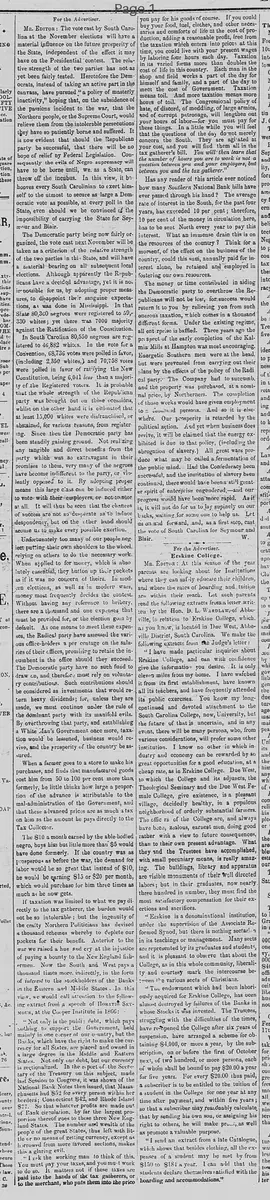
Mr. Editor: The vote cast by South Carolina at the November elections will have a material influence on the future prosperity of the State, independent of the effect it may have on the Presidential contest. The relative strength of the two parties has not as yet been fairly tested. Heretofore the Democrats, instead of taking an active part in the canvass, have pursued "a policy of masterly inactivity," hoping that, on the subsidence of the passions incident to the war, that the Northern people, or the Supreme Court, would relieve them from the intolerable persecutions they have so patiently borne and suffered. It is now evident that should the Republican party be successful, that there will be no hope of relief by Federal Legislation. Consequently the evils of Negro supremacy will have to be borne until, we. as a State, can throw off the incubus. In this view, it behooves every South Carolinian to exert himself to the utmost to secure as large a Democratic vote as possible, at every poll in the State, even should we be convinced of the impossibility of carrying the State for Seymour and Blair.
The Democratic party being now fairly organized, the vote cast next November will be taken as a criterion of the relative strength of the two parties in this State, and will have a material bearing on all subsequent local elections. Although apparently the Republicans have a decided advantage, yet it is not impossible for us, by adopting proper measures, to disappoint their sanguine expectations, as was done in Mississippi. In that State 80,300 negroes were registered to 59,330 whites; yet there was 7000 majority against the Ratification of the Constitution.
In South Carolina 80,550 negroes are registered to 46,882 whites. In the vote for a Convention, 68,736 votes were polled in favor, (including 2,350 whites,) and 70,758 votes were polled in favor of ratifying the New Constitution. Being 6,041 less than a majority of the Registered voters. It is probable that the whole strength of the Republican party was brought out on those occasions, whilst on the other hand it is estimated that at least 15,000 whites were disfranchised, or abstained, for various reasons, from registering. Since then the Democratic party has been steadily gaining ground. Not realizing any tangible and direct benefits from the party which was so extravagant in their promises to them, very many of the negroes have become indifferent to the party, or violently opposed to it. By adopting proper means this large class can be induced either to vote with their employers, or not to vote at all. It will thus be seen that the chances of success are not so desperate as to induce despondency, but on the other hand should arouse us to make every possible exertion.
Unfortunately too many of our people neglect putting their own shoulders to the wheel, relying on others to do the necessary work. When applied to for money, which is absolutely essential, they button up their pockets as if it was no concern of theirs. In modern elections, as well as in modern wars, money most frequently decides the contest. Without having any reference to bribery, there are a thousand and one expenses that must be provided for, or the election goes by default. As one means to meet these expenses, the Radical party have assessed the various office-holders a percentage on the salaries of their offices, promising to retain the incumbent in the office should they succeed.
The Democratic party have no such fund to draw on, and therefore must rely on voluntary contributions, Such contributions should be considered as investments that would return heavy dividends; for, unless they are made, we must continue under the rule of the dominant party with its manifold evils. By overthrowing that party, and establishing a White Man's Government once more, taxation would be lessened, business would revive, and the prosperity of the country be assured.
When a farmer goes to a store to make his purchases, and finds that manufactured goods cost him from 50 to 100 per cent more than formerly, he little thinks how large a proportion of the advance is attributable to the mal-administration of the Government, and that these advanced prices are as much a tax on him as the amount he pays directly to the Tax Collector.
The $10 a month earned by the able-bodied negro, buys him but little more than $5 would have done formerly. If the country was as prosperous as before the war, the demand for labor would be so great that instead of $10. he would be earning $15 or $20 per month, which would purchase for him three times as much as he now gets.
If taxation was limited to what we pay directly to the tax gatherer, the burden would not be so intolerable; but the ingenuity of the crafty Northern Politicians has devised a thousand schemes whereby to deplete our pockets for their benefit. Anterior to the war we raised a hue and cry at the injustice of paying a bounty to the New England fishermen. Now the South and West pays a thousand times more, indirectly, in the form of interest to the stockholders of the Banks in the Eastern and Middle States. In this view. we would call attention to the following extract from a speech of Horatio Seymour, at the Cooper Institute in 1868:
"Not only is the public debt, which pays nothing to support the Government, held mainly in one corner of our country, but the Banks, which have the right to make the currency for all States, are placed and owned in a large degree in the Middle and Eastern States. Not only our debt, but our currency is sectionalized. In the report of the Secretary of the Treasury on this subject, made last Session to Congress, it was shown of the National Bank Notes then issued, that Massachusetts had $52 for every person within her borders; Connecticut $42, and Rhode Island $77. So that whatever profits are made out of Bank circulation, by far the largest proportion thereof goes to these three New England States. The number and wealth of the people of the great States, thus left with little or no means of getting currency, except as borrowed from more favored sections, makes this a glaring evil.
I ask the working man to think of this. You must pay your taxes, and you must work to do so. It matters not if these taxes are paid into the hands of the tax gatherers, or to the merchant, who puts them into the price you pay for his goods of course. If you could buy your food, fuel, clothes, and other necessaries and comforts of life at the cost of production, adding a reasonable profit, free from the taxation which enters into prices at this time, you could live with your present wages by laboring four hours each day. Taxation in its varied forms more than doubles the cost of life in this country. Each man in the shop and field works a part of the day for himself and family, and a part of the day to meet the cost of Government. Taxation means toil. And more taxation means more hours of toil. The Congressional policy of hate, of discord, of meddling, of large armies, and of corrupt patronage, will lengthen out your hours of labor for you must pay for these things. In a little while you will feel that the questions of the day do not merely concern the South. They are agitated at your cost, and you will find them all in the tax gatherer's bill. You will then learn that the number of hours you are to work is not a question between you and your employers, but between you and the tax gatherer."
Has any reader of this article ever noticed how many Southern National Bank bills have ever passed through his hand? The average rate of interest in the South, for the past four years, has exceeded 10 per cent; therefore, 10 per cent of the money in circulation here, has to be sent North every year to pay this interest. What an immense drain this is on the resources of the country? Think for a moment, of the effect on the business of the country, could this sum, annually paid for interest alone, be retained and employed in fostering our own resources.
The money or time contributed in aiding the Democratic party to overthrow the Republicans will not be lost, for success would return it to you by relieving you from such onerous taxation, which comes in a thousand different forms. Under the existing regime, all enterprise is baffled. Three years ago the prospect of the early completion of the Kalmia Mills at Hampton was most encouraging. Energetic Southern men were at the head. but were prevented from carrying out their plans by the effects of the policy of the Radical party. The Company had to succumb, and the property was purchased, at a nominal price, by Northerners. The completion of those works would have given employment to a thousand persons. And so it is elsewhere. Our prosperity is retarded by the political action. And yet when business does revive, it will be claimed that the energy exhibited is due to that policy, (including the abrogation of slavery.) All great wars produce what may be called a fermentation of the public mind. Had the Confederacy been successful, and the institution of slavery been continued, there would have been a still greater spirit of enterprise engendered,—and our progress would have been more rapid. As it is, it will not do for us to lay supinely on our backs, waiting for some one to help us. Let us on and forward, and, as a first step, cast the vote of South Carolina for Seymour and Blair.
W.
What sub-type of article is it?
What themes does it cover?
What keywords are associated?
What entities or persons were involved?
Letter to Editor Details
Author
W.
Recipient
Mr. Editor
Main Argument
south carolinians must actively support and fund the democratic party in the november 1868 elections to demonstrate strength against republicans, challenge negro supremacy, and ultimately restore white governance, thereby reducing taxation and reviving prosperity.
Notable Details