Thank you for visiting SNEWPapers!
Sign up free
Editorial
April 22, 1940
Mcallen Daily Press
Mcallen, Hidalgo County, Texas
What is this article about?
This editorial from the McAllen Daily Press critiques Stuart Chase's articles in Harper's Magazine on capital shortages and Wall Street, accusing them of defeatism, unsupported assertions, and bias toward socialism. The author defends free enterprise, criticizes New Deal policies, and highlights flaws in Chase's economic reasoning.
Clipping
OCR Quality
98%
Excellent
Full Text
McALLEN DAILY PRESS, McALLEN, TEXAS
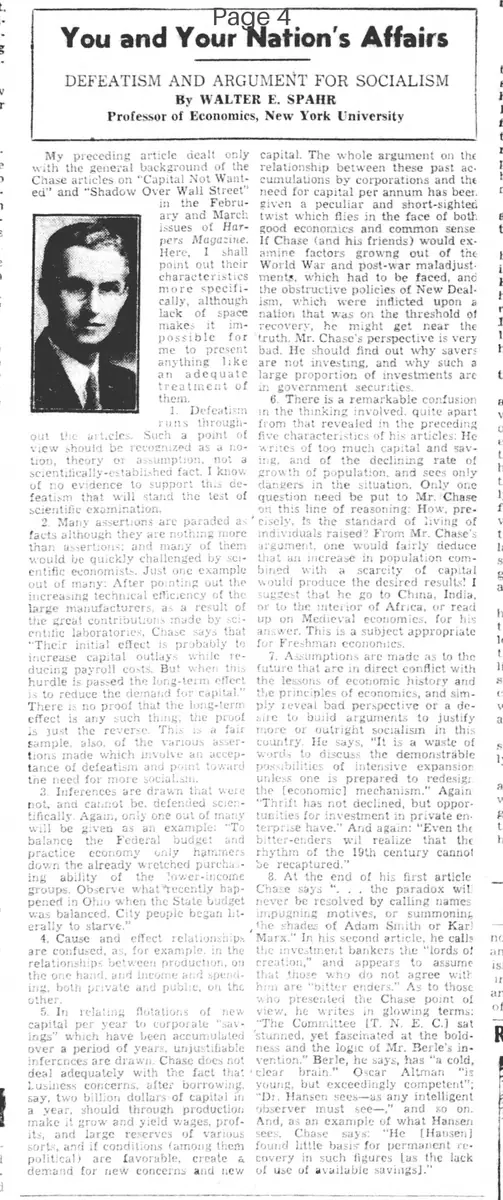
You and Your Nation's Affairs
My preceding article dealt only with the general background of the Chase articles on "Capital Not Wanted" and "Shadow Over Wall Street" in the February and March issues of Harper's Magazine.
Here, I shall point out their characteristics more specifically, although lack of space makes it impossible for me to present anything like an adequate treatment of them.
1. Defeatism runs throughout the articles. Such a point of view should be recognized as a notion, theory or assumption, not a scientifically-established fact. I know of no evidence to support this defeatism that will stand the test of scientific examination.
2. Many assertions are paraded as facts although they are nothing more than assertions; and many of them would be quickly challenged by scientific economists. Just one example out of many. After pointing out the increasing technical efficiency of the large manufacturers, as a result of the great contributions made by scientific laboratories, Chase says that their initial effect is probably to increase capital outlays while reducing payroll costs. But when this hurdle is passed the long-term effect is to reduce the demand for capital. There is no proof that the long-term effect is any such thing, the proof is just the reverse. This is a fair sample, also, of the various assertions made which involve an acceptance of defeatism and point toward the need for more socialism.
3. Inferences are drawn that were not, and cannot be, defended scientifically. Again, only one out of many will be given as an example: "To balance the Federal budget and practice economy only hammers down the already wretched purchasing ability of the lower-income groups. Observe what recently happened in Ohio when the State budget was balanced. City people began literally to starve."
4. Cause and effect relationships are confused, as, for example in the relationships between production, on the one hand, and income and spending, both private and public, on the other.
5. In relating flotations of new capital per year to corporate "savings" which have been accumulated over a period of years, unjustifiable inferences are drawn. Chase does not deal adequately with the fact that business concerns, after borrowing, say, two billion dollars of capital in a year, should through production make it grow and yield wages, profits, and large reserves of various sorts, and if conditions (among them political) are favorable, create a demand for new concerns and new capital. The whole argument on the relationship between these past accumulations by corporations and the need for capital per annum has been given a peculiar and short-sighted twist which flies in the face of both good economics and common sense.
If Chase (and his friends) would examine factors growing out of the World War and post-war maladjustments, which had to be faced, and the obstructive policies of New Dealism, which were inflicted upon a nation that was on the threshold of recovery, he might get near the truth. Mr. Chase's perspective is very bad. He should find out why savers are not investing, and why such a large proportion of investments are in government securities.
6. There is a remarkable confusion in the thinking involved, quite apart from that revealed in the preceding five characteristics of his articles. He writes of too much capital and saving, and of the declining rate of growth of population, and sees only dangers in the situation. Only one question need be put to Mr. Chase on this line of reasoning: How, precisely, is the standard of living of individuals raised? From Mr. Chase's argument, one would fairly deduce that an increase in population combined with a scarcity of capital would produce the desired results. I suggest that he go to China, India, or to the interior of Africa, or read up on Medieval economies, for his answer. This is a subject appropriate for Freshman economics.
7. Assumptions are made as to the future that are in direct conflict with the lessons of economic history and the principles of economics, and simply reveal bad perspective or a desire to build arguments to justify more or outright socialism in this country. He says, "It is a waste of words to discuss the demonstrable possibilities of intensive expansion unless one is prepared to redesign the [economic] mechanism." Again, "Thrift has not declined, but opportunities for investment in private enterprise have." And again: "Even the bitter-enders will realize that the rhythm of the 19th century cannot be recaptured."
8. At the end of his first article Chase says ". . . the paradox will never be resolved by calling names, impugning motives, or summoning the shades of Adam Smith or Karl Marx." In his second article, he calls the investment bankers the "lords of creation," and appears to assume that those who do not agree with him are "bitter enders." As to those who presented the Chase point of view, he writes in glowing terms: "The Committee [T. N. E. C.] sat stunned, yet fascinated at the boldness and the logic of Mr. Berle's invention." Berle, he says, has "a cold, clear brain." Oscar Altman "is young, but exceedingly competent"; "D. Hansen sees—as any intelligent observer must see—," and so on.
And, as an example of what Hansen sees, Chase says, "He [Hansen] found little basis for permanent recovery in such figures as the lack of use of available savings."
You and Your Nation's Affairs
My preceding article dealt only with the general background of the Chase articles on "Capital Not Wanted" and "Shadow Over Wall Street" in the February and March issues of Harper's Magazine.
Here, I shall point out their characteristics more specifically, although lack of space makes it impossible for me to present anything like an adequate treatment of them.
1. Defeatism runs throughout the articles. Such a point of view should be recognized as a notion, theory or assumption, not a scientifically-established fact. I know of no evidence to support this defeatism that will stand the test of scientific examination.
2. Many assertions are paraded as facts although they are nothing more than assertions; and many of them would be quickly challenged by scientific economists. Just one example out of many. After pointing out the increasing technical efficiency of the large manufacturers, as a result of the great contributions made by scientific laboratories, Chase says that their initial effect is probably to increase capital outlays while reducing payroll costs. But when this hurdle is passed the long-term effect is to reduce the demand for capital. There is no proof that the long-term effect is any such thing, the proof is just the reverse. This is a fair sample, also, of the various assertions made which involve an acceptance of defeatism and point toward the need for more socialism.
3. Inferences are drawn that were not, and cannot be, defended scientifically. Again, only one out of many will be given as an example: "To balance the Federal budget and practice economy only hammers down the already wretched purchasing ability of the lower-income groups. Observe what recently happened in Ohio when the State budget was balanced. City people began literally to starve."
4. Cause and effect relationships are confused, as, for example in the relationships between production, on the one hand, and income and spending, both private and public, on the other.
5. In relating flotations of new capital per year to corporate "savings" which have been accumulated over a period of years, unjustifiable inferences are drawn. Chase does not deal adequately with the fact that business concerns, after borrowing, say, two billion dollars of capital in a year, should through production make it grow and yield wages, profits, and large reserves of various sorts, and if conditions (among them political) are favorable, create a demand for new concerns and new capital. The whole argument on the relationship between these past accumulations by corporations and the need for capital per annum has been given a peculiar and short-sighted twist which flies in the face of both good economics and common sense.
If Chase (and his friends) would examine factors growing out of the World War and post-war maladjustments, which had to be faced, and the obstructive policies of New Dealism, which were inflicted upon a nation that was on the threshold of recovery, he might get near the truth. Mr. Chase's perspective is very bad. He should find out why savers are not investing, and why such a large proportion of investments are in government securities.
6. There is a remarkable confusion in the thinking involved, quite apart from that revealed in the preceding five characteristics of his articles. He writes of too much capital and saving, and of the declining rate of growth of population, and sees only dangers in the situation. Only one question need be put to Mr. Chase on this line of reasoning: How, precisely, is the standard of living of individuals raised? From Mr. Chase's argument, one would fairly deduce that an increase in population combined with a scarcity of capital would produce the desired results. I suggest that he go to China, India, or to the interior of Africa, or read up on Medieval economies, for his answer. This is a subject appropriate for Freshman economics.
7. Assumptions are made as to the future that are in direct conflict with the lessons of economic history and the principles of economics, and simply reveal bad perspective or a desire to build arguments to justify more or outright socialism in this country. He says, "It is a waste of words to discuss the demonstrable possibilities of intensive expansion unless one is prepared to redesign the [economic] mechanism." Again, "Thrift has not declined, but opportunities for investment in private enterprise have." And again: "Even the bitter-enders will realize that the rhythm of the 19th century cannot be recaptured."
8. At the end of his first article Chase says ". . . the paradox will never be resolved by calling names, impugning motives, or summoning the shades of Adam Smith or Karl Marx." In his second article, he calls the investment bankers the "lords of creation," and appears to assume that those who do not agree with him are "bitter enders." As to those who presented the Chase point of view, he writes in glowing terms: "The Committee [T. N. E. C.] sat stunned, yet fascinated at the boldness and the logic of Mr. Berle's invention." Berle, he says, has "a cold, clear brain." Oscar Altman "is young, but exceedingly competent"; "D. Hansen sees—as any intelligent observer must see—," and so on.
And, as an example of what Hansen sees, Chase says, "He [Hansen] found little basis for permanent recovery in such figures as the lack of use of available savings."
What sub-type of article is it?
Economic Policy
Partisan Politics
What keywords are associated?
Economic Defeatism
Capital Investment
Socialism Critique
New Deal Obstruction
Free Enterprise Defense
Investment Bankers
Population Growth
Living Standards
What entities or persons were involved?
Stuart Chase
Harper's Magazine
New Deal
T. N. E. C.
Berle
Oscar Altman
D. Hansen
Adam Smith
Karl Marx
Editorial Details
Primary Topic
Critique Of Stuart Chase's Economic Articles Promoting Defeatism And Socialism
Stance / Tone
Strongly Critical Of Chase's Views, Supportive Of Free Market Economics And Opposed To New Deal Policies
Key Figures
Stuart Chase
Harper's Magazine
New Deal
T. N. E. C.
Berle
Oscar Altman
D. Hansen
Adam Smith
Karl Marx
Key Arguments
Defeatism In Chase's Articles Lacks Scientific Evidence.
Assertions Presented As Facts Are Unsupported And Promote Socialism.
Inferences Like Budget Balancing Causing Starvation Are Indefensible.
Confusion Of Cause And Effect In Production, Income, And Spending.
Unjustifiable Inferences About Corporate Savings And Capital Needs.
Failure To Consider World War And New Deal Impacts On Investment.
Confusion On Capital, Savings, Population Growth, And Living Standards.
Assumptions Conflict With Economic History, Justifying Socialism.
Hypocrisy In Chase's Rhetoric And Praise For Like Minded Figures.